
If your wrist is under 6 inches, the “best fitness tracker for women” is usually not the one with the prettiest case color or the longest feature list. It is the one whose band can actually close without leaving a tail, whose sensor stays flat against your skin, and whose case does not sit halfway over your wrist bone.
That is not a niche annoyance. Average female wrist circumference is commonly cited around 5.7 to 6.2 inches, while average male wrist circumference is around 6.5 to 7.2 inches, a gap of roughly an inch before anyone even starts talking about taste, sleeve clearance, or sleep comfort.[1] A tracker designed around a broader default can be technically excellent and still fail on a 5.5-inch wrist for very boring reasons: the strap holes start too late, the lugs overhang, the band flares away from the arm, or the optical sensor loses contact when the device slides.
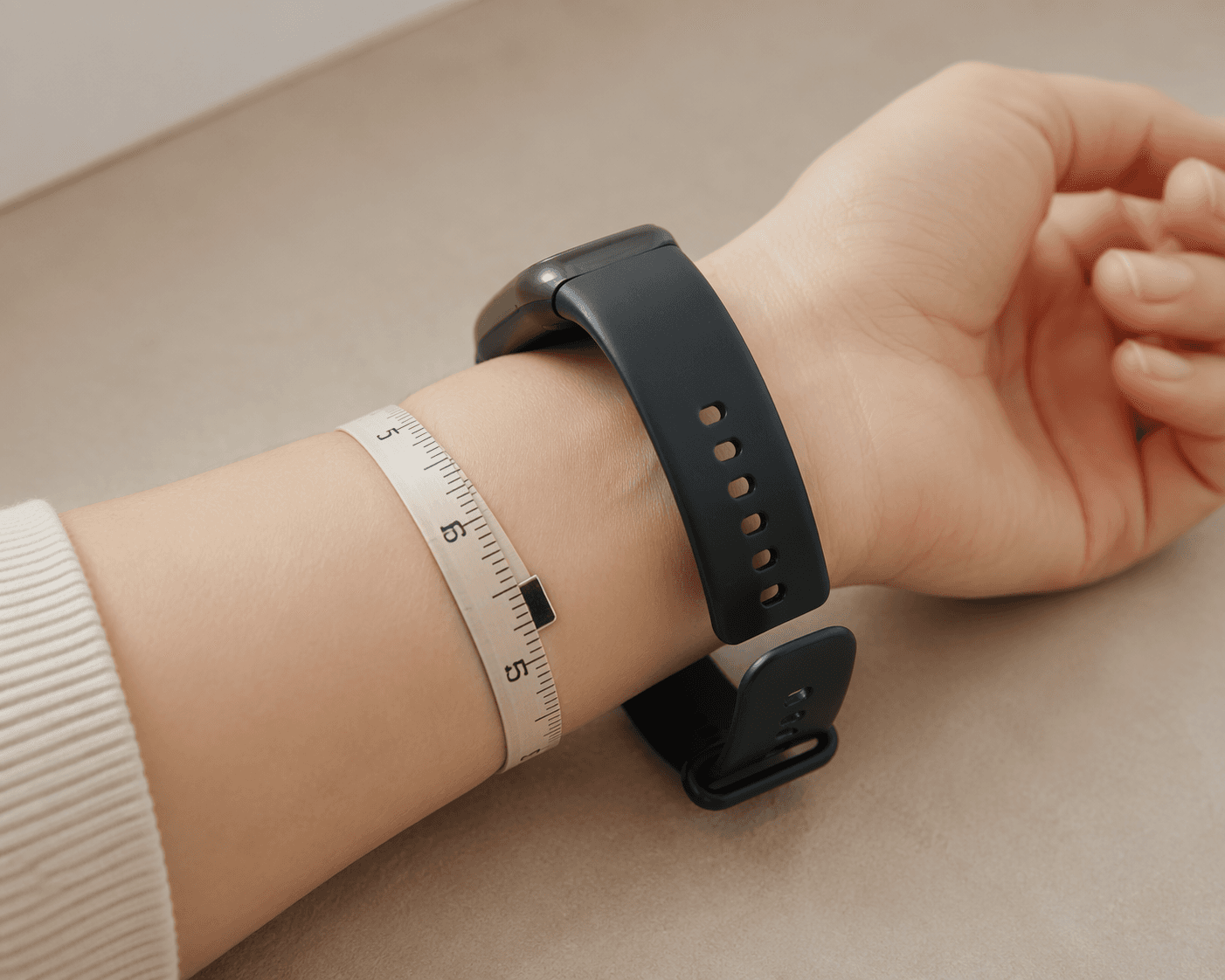
The short version: the Garmin Lily 2 is the safest small-wrist pick because its band starts at 4.3 inches. The Fitbit Inspire 3 is the lightest budget alternative, but its band starts at 5.5 inches. Apple Watch SE 3 and Series 11 can work on small wrists if you choose the smaller case and the right S/M or third-party band. Oura Ring avoids wrist fit entirely, but it moves the compromises to your fingers, your lifting routine, and a monthly subscription.
Last reviewed: June 26, 2026. Prices, app names, model availability, and subscription terms can change quickly in this category, so treat fit measurements as the starting point and confirm current manufacturer sizing before ordering.
Start by eliminating what cannot physically fit
A tracker that starts at 5.5 inches may be fine on a 5.9-inch wrist and maddening on a 5.4-inch one. The difference is not dramatic in a product photo, but it is obvious when you sleep in it, do push-ups, or try to tighten the band one more notch and run out of holes.
The band circumference numbers below rely heavily on La Petite Poire’s small-wrist measurements because it is one of the few sources that publishes the minimum ranges shoppers actually need. That is useful, but it is still a limited set of sources. Cross-check against current manufacturer charts where possible, especially if you are between sizes or buying a newer band style.
| Device | Smallest listed/observed fit | Weight / size notes | GPS | Best fit for |
|---|---|---|---|---|
| Garmin Lily 2 | 4.3–6.9 in band; 14mm strap | 1.1 oz; small round jewelry-style case | Connected GPS only; no built-in GPS | Smallest wrists that need the most reliable band fit |
| Fitbit Inspire 3 | 5.5–7.1 in band; 0.5 in band width | 0.32 oz / 9g tracker weight | No built-in GPS | Budget buyers who want the lightest band-style tracker |
| Apple Watch SE 3 / Series 11, smaller case | S/M band fits about 5.1–6.3 in | 41mm or 42mm case options, depending on model | Built-in GPS on watch models | iPhone users who want smartwatch features and will solve the band fit |
| Oura Ring 4 / early Oura Ring 5 coverage | Sized by finger, not wrist | No wrist case or strap | No watch-style GPS screen | People who want out of wrist wear entirely |
For a deeper breakdown of case dimensions on specific models, see our full fit audit. This guide stays focused on the buying decision: which compromises are acceptable once the device actually fits.
Garmin Lily 2: the best fit for wrists under 6 inches, with real trade-offs
The Garmin Lily 2 is the rare tracker that seems to begin with a small wrist instead of reluctantly scaling down from a larger watch. Its band range is listed at 4.3 to 6.9 inches, with a 14mm strap and a 1.1-ounce weight.[1] That 4.3-inch starting point matters more than another wellness widget in the app. It means someone with a 5.4- or 5.6-inch wrist is not automatically living at the last hole.
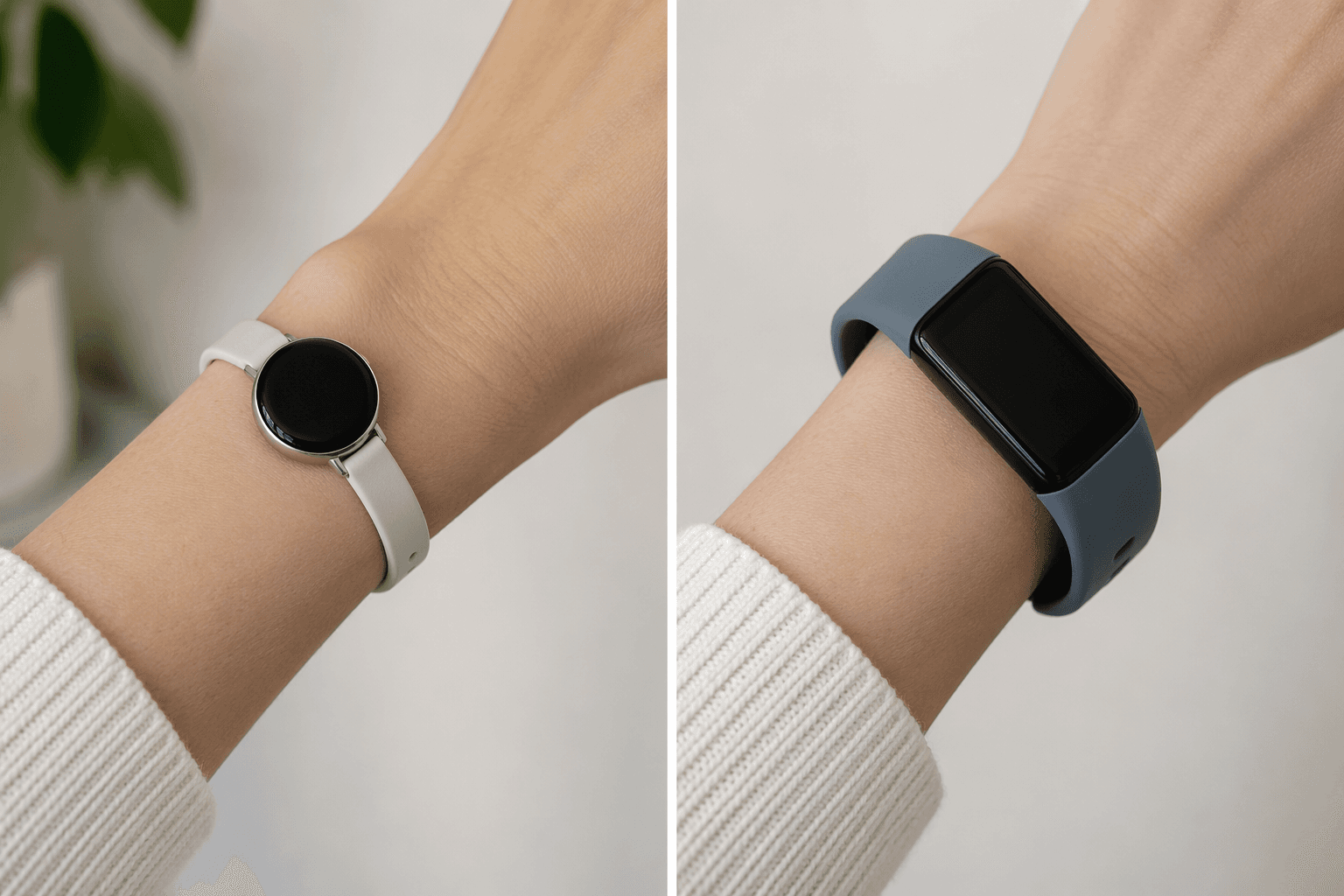
The Lily 2 also avoids a problem many “small” trackers still have: a narrow wrist paired with a visually loud rectangle. Its round face and slim strap read more like a small watch or bracelet than a miniaturized training computer. Women’s Health testers also noted the Lily 2’s style-forward design in 2026 coverage, which fits the device’s actual strength: it is one of the few trackers that can look restrained without needing to pretend it is not a tracker.[3]
The catch is that the Lily 2 is not a runner’s watch in disguise. It does not have built-in GPS, so outdoor distance tracking depends on connected GPS through your phone. Its display is grayscale rather than the brighter color screen you get on many smartwatches and some bands.[1] If you run with your phone anyway and mostly care about steps, sleep, heart rate, cycle tracking, light workouts, and a device you can forget you are wearing, that is a reasonable exchange. If you want glanceable pace outdoors without carrying a phone, it is not.
This is where fit-first shopping becomes irritating but clarifying. The Lily 2 earns the top small-wrist recommendation because it solves the mechanical problem better than the others. It does not win because it has every feature. It wins because on wrists under 6 inches, many “better” devices stop being better once they twist, slide, or need the band cinched into a crease.
Fitbit Inspire 3: the lightest budget pick, if 5.5 inches is small enough
The Fitbit Inspire 3 is the practical budget answer for many small wrists, not the tiniest one. Its band range is measured at 5.5 to 7.1 inches, with a 0.5-inch band width.[1] Wirecutter lists the Inspire 3 at 0.32 ounces, or 9 grams, which is why it feels so different from a watch-style tracker on a small arm.[2]
That weight number explains more than a product photo can. A heavy case can make a too-loose band rotate; a very light capsule has less mass fighting the strap. If your wrist is around 5.7 to 5.9 inches and you do not mind a narrow rectangular screen, the Inspire 3 may stay put well enough for everyday wear, sleep, and gym sessions.
The Inspire 3 is more basic than the Lily 2 in appearance and more limited than a smartwatch in interaction. It also lacks built-in GPS.[1] Good Housekeeping’s 2026 testing coverage emphasized hands-on factors such as band comfort, display readability, and women’s-health feature depth across its tracker testing, which is the right lens for this category: a tracker can be accurate enough and still be unpleasant if the screen is too cramped or the band fit is marginal.[4]
For budget shoppers comparing Fitbit models, the Inspire 3 is the one to start with because the small-wrist math is better than on many larger bands. If you are choosing between Fitbit options, our Fitbit Air vs Inspire 3 vs Charge 6 comparison goes deeper on what you gain and lose inside the Fitbit line. For the bigger budget question, see what you actually lose with a $50 fitness tracker.
Apple Watch SE 3 and Series 11: feature-rich only if you solve the band
The Apple Watch is the wrong place to begin if your first question is “what fits the smallest wrist?” It becomes more interesting after you have accepted the work of choosing the right case and band. For the 2026 SE 3 and Series 11 generation, the smaller 41mm or 42mm case options are the ones to consider, and S/M bands are listed around 5.1 to 6.3 inches.[1]
That 5.1-inch minimum sounds promising, but a watch case is not just a band. The rectangle has to sit flat on the top of your wrist. On a narrow wrist, even a technically compatible band can leave the case looking wide or feeling top-heavy, especially during sleep. This is the model family where trying it on in person is worth more than another hour of scrolling.
If it fits, the Apple Watch gives you the smartwatch layer the Lily 2 and Inspire 3 do not: richer apps, better notifications, built-in GPS, and a more capable display. The trade-off is daily charging behavior rather than band simplicity; the reported 2026 range for these models is roughly 24 to 43 hours depending on model and use. It also keeps you inside the Apple ecosystem.
This is the right pick for an iPhone user who wants a small smartwatch and is willing to be fussy about straps. It is not the cleanest answer for someone who just wants a tracker to stop sliding up her forearm.
Oura Ring 4 and 5: the escape hatch from wrist fit
Oura changes the question completely. No wrist case, no strap holes, no band tail, no sensor pod pulling a silicone loop sideways. If every wrist tracker you try feels wrong, a ring can be the cleanest form-factor exit. Our ring vs smartwatch vs fitness band guide covers that fork in more detail.
The compromise moves to your hand. Rings can scratch against dumbbells and barbells, and they can become uncomfortable during gripping exercises. Forbes Vetted’s trainer-tested coverage flags durability and accuracy caveats around Oura Ring 4 in strength-training contexts, which matters if lifting is a regular part of your week.[5] Women’s Health testers also discussed Oura’s comfort during sleep, a place where the ring format can feel less intrusive than a watch for some users.[3]
The other nontrivial cost is software. Oura requires a $5.99/month subscription for full access to features such as readiness scores and fuller cycle tracking. Because Oura Ring 5 was still in early testing during the cited 2026 coverage, most hands-on tester evidence should be read as Oura Ring 4 evidence unless a review specifically names the newer generation.
If subscription cost is part of the decision, compare the long-term price before treating a ring as a simple alternative. We break down those recurring charges in the hidden subscription costs guide.
What to do when the tracker you want does not fit
After-market bands are not a failure of shopping. For small wrists, they are often the difference between keeping a device and sending it back. The mistake is treating the band as an accessory after the real purchase, when it is part of the fit system.
- Check the minimum wrist circumference before color, finish, or feature comparisons. A band that starts above your wrist measurement is not “maybe fine”; it is a return label waiting to happen.
- Look for shorter third-party bands before giving up on a watch-style device. Apple Watch owners especially have a large after-market strap ecosystem, and the right short band can make the smaller case much more wearable.
- For compatible Fitbit models, look at Fitbit Ace kids’ bands. Some Ace kids’ bands can work with adult Fitbit models at lower cost, which is exactly the kind of unglamorous fix small-wrist shoppers end up needing.
- For leather bands, consider professional hole-punching instead of doing it with a kitchen tool. A clean extra hole can rescue a band; a torn one can make the device sit crooked.
- Keep the return window open until you have slept in the tracker and worn it during a normal workout. Standing in front of a mirror for two minutes will not reveal whether the case migrates toward your hand or presses into your wrist bone.
Consumer Reports’ smartwatch and fitness tracker buying guidance emphasizes matching the device type to fit, use, and testing priorities rather than buying from a feature list alone.[6] That advice is especially useful here because small wrists expose problems that spec sheets hide. A larger watch may pass every software test and still be wrong for your arm.
How to choose without overbuying
Measure your wrist with a soft tape where you actually wear a tracker, not halfway up your forearm. If you are using string, mark it and measure it flat against a ruler. Then compare your number with the minimum band circumference, not just the case size or the words “small/medium.”
If your wrist is below 5.5 inches, the Garmin Lily 2 is the clear place to start because the 4.3-inch band minimum gives it room that the Inspire 3 does not have. If your wrist is 5.5 to 6 inches and budget matters, the Inspire 3 deserves a look because its 0.32-ounce weight makes it unusually easy to tolerate. If you want apps, notifications, and built-in GPS, start with the smaller Apple Watch case and solve the band before judging the watch. If wrist wear is the whole problem, consider Oura only after accepting the ring’s lifting, scratching, and subscription trade-offs.
For a broader women’s tracker framework beyond small wrists, see the factors that actually matter and what women actually need in a fitness tracker watch. If you are tired of “for women” meaning a pink strap and nothing else, the Beyond Pink guide covers that problem directly.
For wrists under 6 inches, the safest recommendation is still the Garmin Lily 2. The Fitbit Inspire 3 is the lightest budget alternative. Apple Watch works only when the smaller case and band are chosen deliberately. Oura is best for people who want out of the wrist problem entirely and can live with ring-specific compromises.
References
- Fitness trackers for small wrists, La Petite Poire
- The 3 Best Fitness Trackers of 2026, Wirecutter
- The 10 Best Fitness Trackers of 2026, Tested by Fitness Editors, Women's Health
- 9 Best Fitness Trackers for Women of 2026, Tested by Experts, Good Housekeeping
- Best Fitness Trackers 2026 | Trainer Tested, Forbes Vetted
- How to Choose a Smartwatch or Fitness Tracker, Consumer Reports
Comments
Join the discussion with an anonymous comment.