
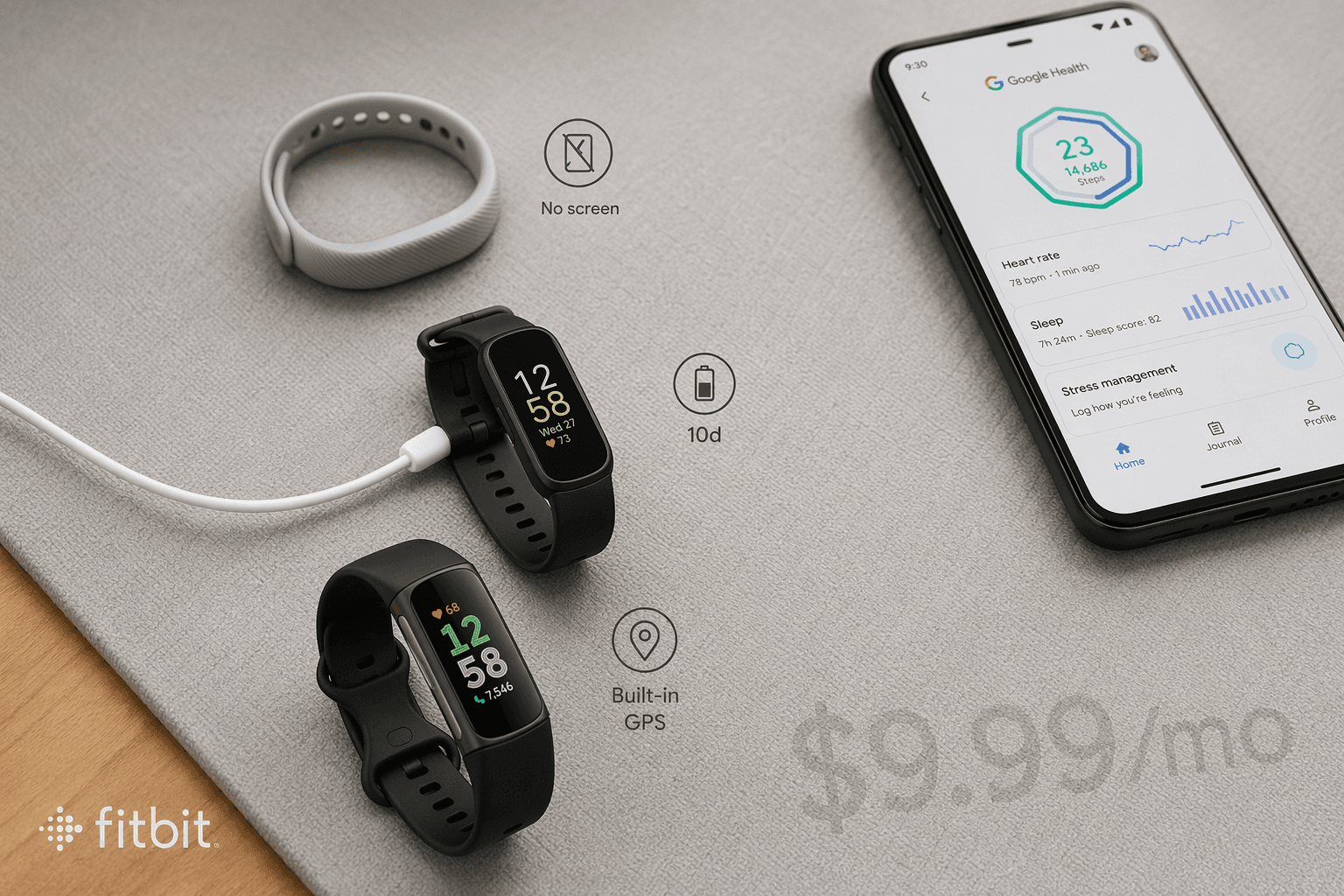
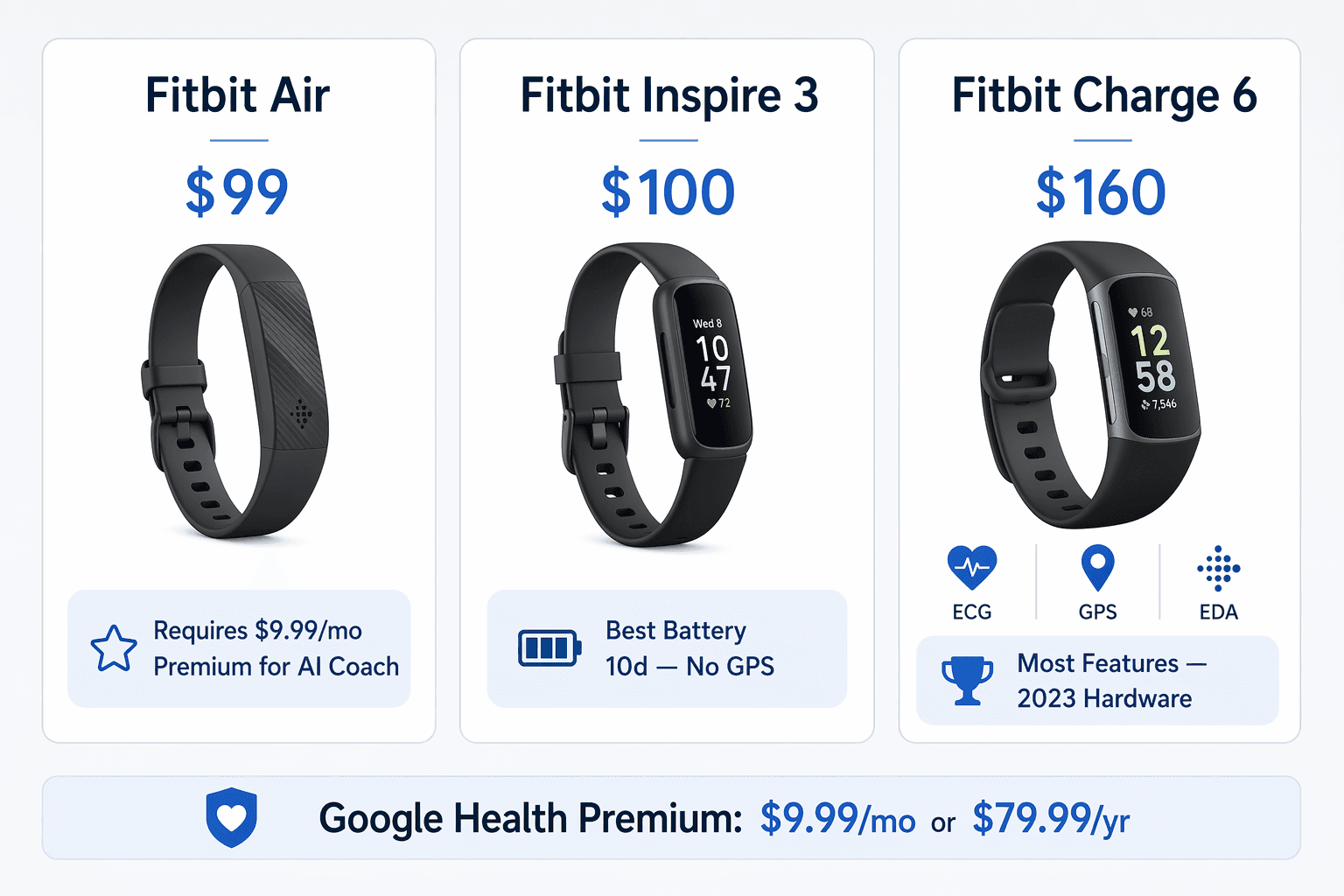
Pick up the three current Fitbit band models — Air, Inspire 3, Charge 6 — and the first thing you notice is the size difference. The Air is a skinny silicone band with no screen at all. The Inspire 3 has a small color display. The Charge 6 is noticeably thicker, with a side button and a sensor bump. Their prices range from $99 to $160. But the real gap between them isn't the hardware. It's whether you're willing to pay $9.99 every month for the rest of the time you own it.
The Only Question That Matters: What Do You Lose Without the Subscription?
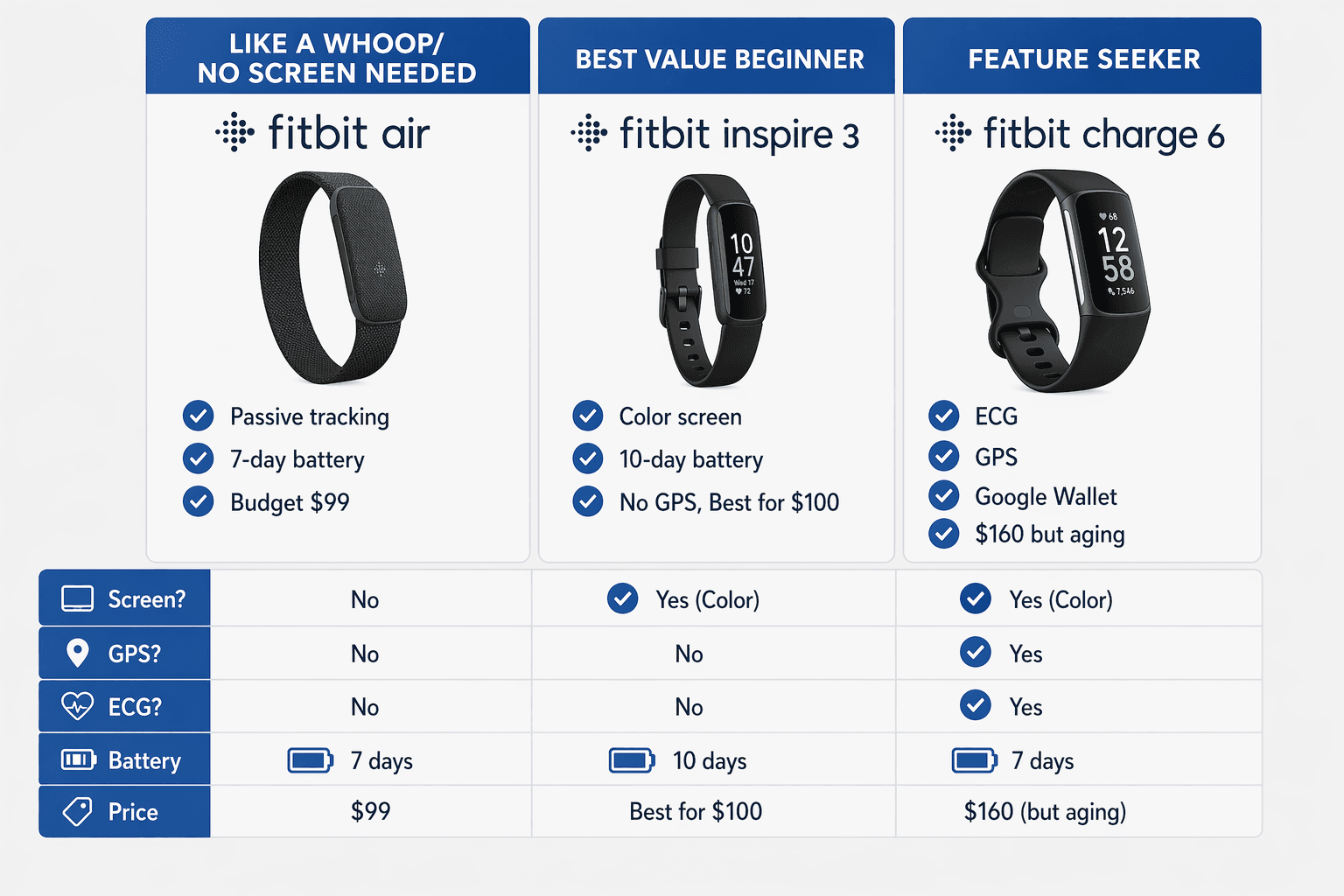
| Feature | Fitbit Air | Fitbit Inspire 3 | Fitbit Charge 6 |
|---|---|---|---|
| Price | $99.99 | $99.95 | $159.95 |
| Screen | None (screenless) | Color AMOLED | Color OLED + button |
| Built-in GPS | No | No (phone only) | Yes, but unreliable |
| ECG | No | No | Yes |
| Battery life | 7–8.5 days | 8–10 days | 7 days (8h GPS) |
| Subscription required for main differentiator | Yes ($9.99/mo) | No (optional) | Yes ($9.99/mo) |
| Total cost over 2 years (with Premium) | $339 | $340 (but can skip) | $400 |
The Fitbit Air: A $99 Tracker That Costs $339 Over Two Years
The Air is Fitbit's attempt to compete with screenless trackers like Whoop and Oura — but at a lower upfront price. Weighing 12 grams, no display, entirely reliant on the phone app. Its main selling point is the Health Coach, an AI feature that gives personalized guidance based on your data. That feature requires $9.99 per month Google Health Premium. Without it, you're left with a step counter that has no screen and no way to check anything without pulling out your phone.
PCMag reported 8.5 days of battery in their tests (S4); other sources say 7 days. The variance suggests it depends heavily on how often you sync with the phone — screenless trackers can drain faster when the app is opened frequently. Either way, the Air lasts less than the Inspire 3, and you don't even get a screen as a trade-off.
Do the math: $99 for the band plus $240 for two years of Premium equals $339. That is not a budget device. It's a $339 device that happens to come with a free band. If you're already paying for Google Health Premium (maybe you own a Pixel Watch), the Air makes sense as a cheap secondary band. Otherwise, look elsewhere.
For readers who want to explore other screenless options, I wrote a Screenless Fitness Tracker Buyer's Guide 2026 that covers the Air alongside the Whoop and Oura ring with a clearer cost comparison.
The Inspire 3: Why It's the Real Value Champion
At the same $100 price as the Air, the Inspire 3 gives you a color AMOLED screen, a band that Business Insider calls the most comfortable Fitbit they've tested (S7), and a 10-day battery that easily outlasts the other two. It also has automatic activity detection that consistently picks up walks and bike rides without manual start. And crucially: none of its core tracking features require a subscription. Sleep tracking, heart rate, step count, and SpO2 work fully with the free Google Health app.
The Inspire 3 does not have built-in GPS. That is the main trade-off. If you run without your phone, you won't get accurate distance or pace. But for casual walkers, gym-goers, and anyone who carries their phone anyway, that is not a problem. You can still use phone-connected GPS through the app.
Battery-life sources vary between 8 days (PCMag, S4) and 10 days (Fitbit official, S1, S7). Real-world use with always-on display off will land closer to the higher number. Either way, it beats the Air's 7–8 days and the Charge 6's 7 days.
This is the device I recommend for most Fitbit shoppers. It offers 90% of the Fitbit experience at the lowest upfront cost and no required monthly fee. If you're not sure whether you want a screen, whether you need GPS, or whether you'll actually use Premium — get the Inspire 3. You can always upgrade later.
The Charge 6: ECG and GPS, but the GPS Is a Known Problem
The Charge 6 is the oldest of the three — released in late 2023 — and the only one with ECG, EDA stress tracking, and built-in GPS. It also has Google Maps, Google Wallet, and YouTube Music controls. On paper it's the most capable Fitbit band. But two things hold it back: the GPS accuracy and the price.
Outdoor Gear Lab put the Charge 6's GPS through a controlled test: on a 2.8-mile route, the tracker was off by 0.86 miles. That is a 31% error. Wareable also reported the GPS frequently lost connection during workouts and took a long time to acquire a signal (S6). I don't buy that this is just a firmware issue — the hardware itself seems compromised. If you need reliable distance and route tracking, do not rely on the Charge 6's built-in GPS. Use the phone-connected GPS instead, which works fine.
The ECG is a genuine health tool. Wareable found it consistent with measurements from the Apple Watch Ultra 2 and a dedicated pulse oximeter (S6). Heart rate accuracy is good — within ±3 BPM of a Polar H10 chest strap (S9). But in practice, very few people use ECG on any wearable more than a few times. It's a nice checkmark, not a daily-use feature.
The Charge 6 costs $160, and over two years with Premium it hits $400. That is more than four times the price of the Inspire 3 without Premium. If ECG is essential — for example, because you have a known heart condition and your doctor recommended monitoring — then the Charge 6 is the only band in this lineup that offers it. But for everyone else, the value proposition is thin.
For readers on the fence about timing, check my Fitbit Charge 6 at $99 in 2026: Buy Now or Wait for the Charge 7? article. If the Charge 6 drops to $99 on sale — which has happened — it becomes a more reasonable buy for ECG users who can tolerate the GPS workaround.
What $9.99/Month Does to the Total Cost
| Model | Upfront cost | 2-year Premium cost | Total with Premium | Total without Premium |
|---|---|---|---|---|
| Fitbit Air | $99 | $240 | $339 | $99 (but core feature missing) |
| Fitbit Inspire 3 | $100 | $240 | $340 | $100 (all core features work) |
| Fitbit Charge 6 | $160 | $240 | $400 | $160 (extra features like ECG work without Premium) |
The table makes it clear: the Air without Premium is a limited device. The Inspire 3 without Premium is a fully functional tracker. The Charge 6 without Premium still gives you ECG, stress tracking, and most hardware features — you only lose advanced sleep insights and the Health Coach. If you are on a budget and don't want a monthly bill, the Inspire 3 is the only model that doesn't punish you for skipping Premium.
How to Decide
Here's how I see it:
If you refuse to pay $9.99/month for a subscription, do not buy the Fitbit Air. The Inspire 3 is your band. It has a screen, long battery, and full core features without requiring a monthly fee.
If you need ECG — I mean genuinely need it for medical reasons — you have to get the Charge 6. But plan to use phone-connected GPS for outdoor runs, because the built-in GPS is unreliable.
If you want a screenless distraction-free tracker and are already paying for Google Health Premium (maybe you use it with a Pixel Watch), the Air is a decent secondary or sleep-tracking band.
If you are a casual user who just wants steps, sleep, heart rate, and an occasional workout log, the Inspire 3 is the clear winner. You don't need Premium, and you get the best battery of the three.
If you are unsure which form factor suits you — band, smartwatch, ring, or screenless — read my broader guide on Top Rated Fitness Tracker: Band vs. Smartwatch vs. Ring vs. Screenless to see the full landscape.
The Verdict
The Fitbit Inspire 3 is the right buy for the majority of Fitbit shoppers. It gives you the screen you want, the battery life you need, and the core tracking features you came for — without forcing a $9.99 monthly payment just to get the value out of it. At $100, it is the best value in Fitbit's 2026 band lineup.
The Air is a niche product. It works for people who already pay for Premium and want a cheap second tracker. For everyone else, the hidden cost makes it a poor deal.
The Charge 6 is a capable device that is let down by its aging GPS hardware and its $160 price. If ECG matters, buy it — but find it on sale, and use phone GPS.
Still undecided? My Best Fitness Tracker 2026: A Decision Framework by User Profile compares Fitbit with Garmin, Apple, Whoop, and others if you are open to other brands.
Comments
Join the discussion with an anonymous comment.