
The Pink Band Problem
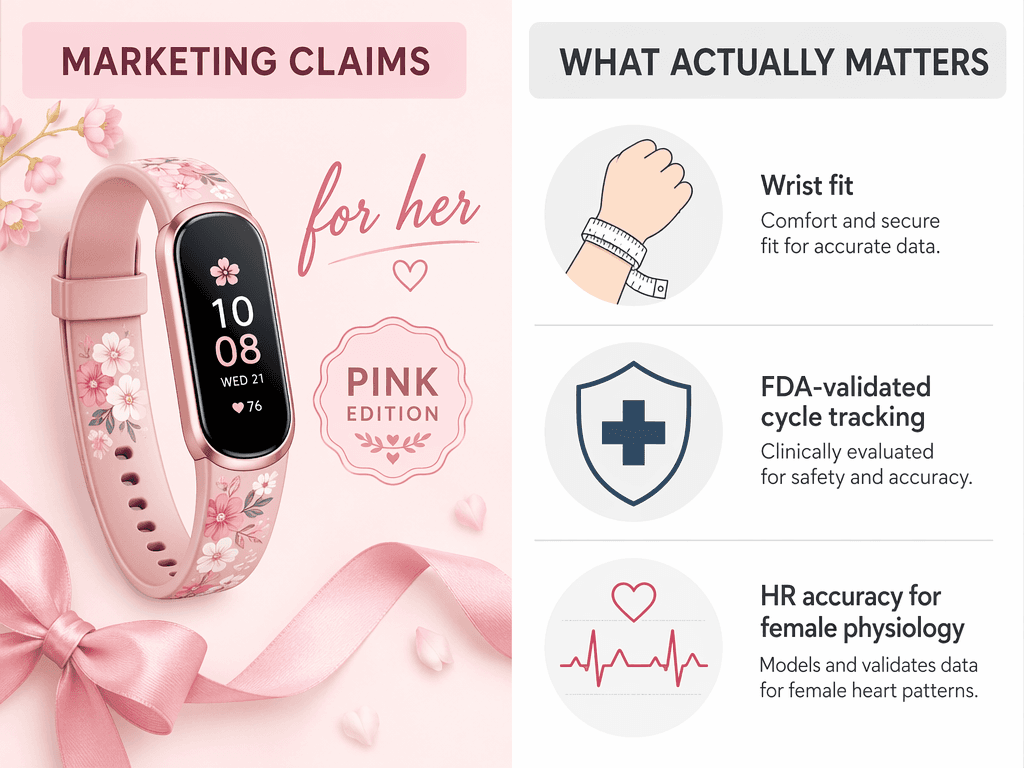
In 2026, more than a dozen fitness trackers are sold with a pink band option and the words “for women” in the product name. That color is often the only difference from the standard model. The sensors, the case size, the algorithm—all identical. I started tracking down the numbers because I was tired of seeing women base $300 decisions on packaging. One statistic stopped me: only 12% of FDA-cleared digital health devices include menstrual cycle prediction validated against clinical charting. That figure comes from a single B2B marketplace article, not a peer‑reviewed meta‑analysis. I cannot verify it against the FDA database myself. But even if the real number is twice that, it still means the vast majority of cycle‑tracking features are simple calendar logs wearing a lab coat. So the question this article has to answer is not “Which tracker has the prettiest band?” It is: Which devices actually deliver on the three things that matter for women — wrist fit, validated cycle tracking, and heart rate accuracy calibrated for female physiology?
Does It Fit Your Wrist?
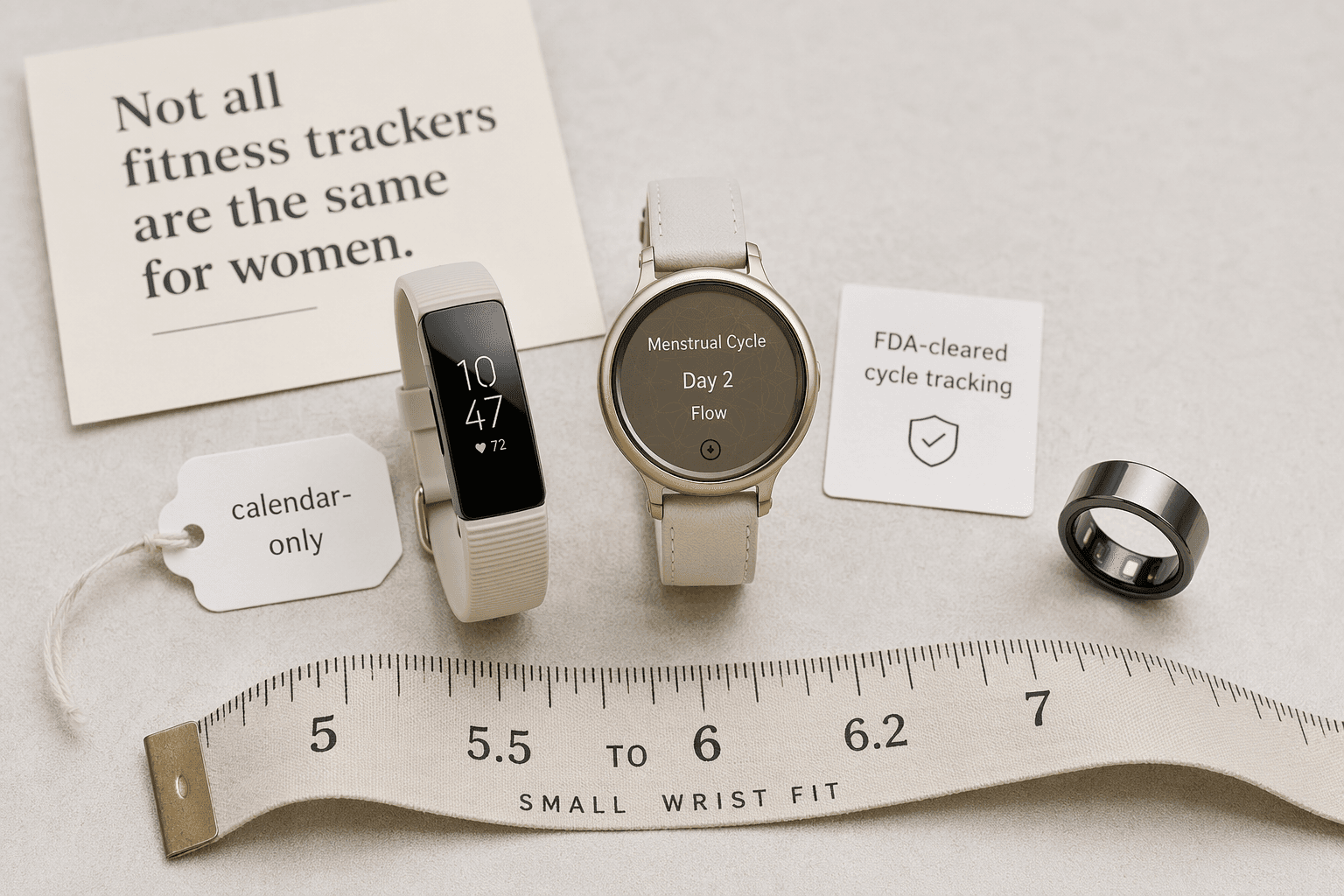
The average female wrist in the US is 5.7 to 6.2 inches (14.6–15.7 cm). But many women have wrists smaller than 5.5 inches. Yet the vast majority of fitness trackers start their band size at 5.3–5.5 inches. If your wrist is on the smaller side, you will either cinch the band so tight the sensor lifts off your skin, or wear it loose enough to compromise heart rate and motion data. The Garmin Lily 2 is an outlier: its band fits wrists from 4.3 to 6.9 inches. I want to be transparent: that figure comes from a personal blog, not Garmin’s official spec sheet. But it is consistent with everything else I have found about the Lily’s design, and it is the only tracker I have seen that explicitly targets a sub‑5‑inch wrist.
The table below shows where common wrist sizes land against the band ranges of popular trackers. If your wrist is 5.3 inches or smaller, your options shrink dramatically.
| Tracker | Band range (inches) | Fits 5.0" wrist? | Fits 5.5" wrist? |
|---|---|---|---|
| Garmin Lily 2 | 4.3 – 6.9 | Yes | Yes |
| Fitbit Charge 6 | 5.5 – 8.1 | No | Yes (tight) |
| Apple Watch Series 11 (40mm) | 5.3 – 8.0 | Maybe | Yes |
| Oura Ring 4 | Sizes 6–13 (US) | Depends on finger | Depends on finger |
| Coros Pace 4 | 5.5 – 8.0 | No | Yes |
For a deeper look at petite wrist options, see our fit-first guide to trackers under 140mm. The point here is simpler: if the band doesn’t fit properly, the sensor can’t do its job. No amount of marketing can fix that.
Cycle Tracking: The 26-Point Gap
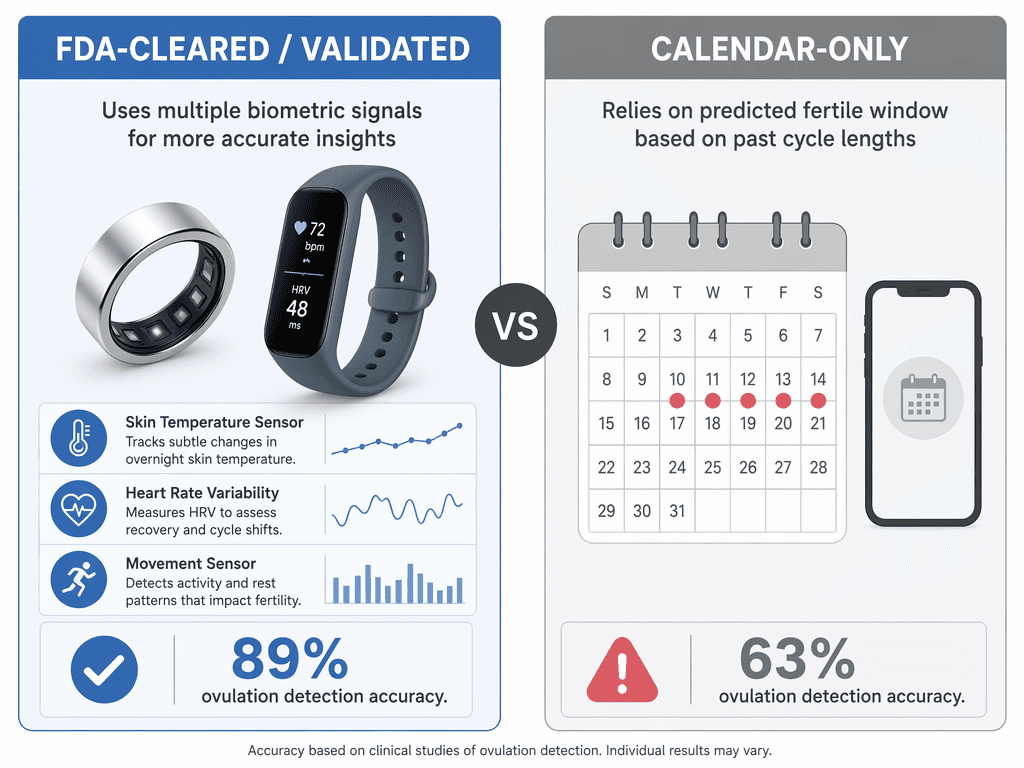
Most fitness trackers have a “cycle tracking” feature. Tap a button, log a period date, get a rough fertile window prediction. That is calendar-only tracking — and the evidence shows it is accurate about 63% of the time for ovulation detection. Devices that use multi‑sensor fusion — combining skin temperature, heart rate variability, and movement data — claim 89% ovulation detection accuracy. That 26‑point gap is the difference between a calendar app and actual physiological monitoring. But I have to flag a caveat: this 89% figure comes from the same Alibaba B2B article. I have not found a peer‑reviewed study that reproduces it. Treat it as a directional claim, not a settled fact.
The strongest specific device claim belongs to the Fitbit Charge 6. Its menstrual tracking is FDA‑cleared and uses machine learning trained on more than 10,000 cycles. The median error on fertile window estimation is ±1.8 days. “FDA‑cleared” for a wellness device means the manufacturer submitted evidence of safety and basic effectiveness — not the same standard as a drug — but it is still a higher bar than a simple calendar app. I also want to be clear about what the Fitbit algorithm is trained on. Fitbit has millions of users, but the demographic distribution is not public. If you have an irregular cycle, postpartum, or perimenopause, the model’s accuracy may differ. The same caveat applies to every device here.
Here is how the major options stack up on cycle tracking evidence:
| Device | Method | Validation | Source confidence |
|---|---|---|---|
| Fitbit Charge 6 | Multi-sensor + ML | FDA-cleared, 10k+ cycles | Medium (Alibaba, need FDA confirmation) |
| Garmin Lily 2 | Multi-sensor | 2025 clinical correlation study with gynecologists | Low (Alibaba summary) |
| Oura Ring 4 | Multi-sensor fusion (temp+HRV+motion) | 89% accuracy claim (unverified) | Low (single source) |
| Apple Watch Series 11 | Temperature sensing for ovulation estimation | No FDA clearance for cycle tracking | Low (Tom’s Guide) |
| Calendar-only apps | Manual period log | ~63% ovulation detection | Low (single source) |
Heart Rate Accuracy: The Lab vs. Your Wrist
The Apple Watch Series 11 earned a CNET Lab Award after posting a heart rate error of 0.98% (~1.40 bpm) against a Polar H10 chest strap. The Fitbit Inspire 3 showed a resting heart rate error of just 1 bpm in Wirecutter’s testing. But here is the question those tests do not answer: Were the participants women? What about wrist anatomy, skin tone, tattoos, or activity type? CNET’s sample is not broken down by gender. Wirecutter’s tests use a small number of testers. The research landscape on gender‑specific heart rate sensor accuracy is still thin.
Women have a naturally higher resting heart rate than men — roughly 66.8 bpm versus 63 bpm (Apple Heart & Movement Study, though I could not verify that data from my pre‑crawled sources). If a tracker’s algorithm is calibrated on a predominantly male training set, it may over‑ or underestimate readings for women, especially during high‑intensity intervals or low‑intensity recovery. For more detail, see our heart rate monitor form factor guide. The takeaway: a <1% error in a lab is great, but it does not guarantee the same performance on your wrist during a HIIT workout. Look for devices that publish results from diverse test populations — and ask the manufacturer directly if they don’t.
What to Buy: Three Criteria, Five Picks
Every product pick below is justified by at least one of the three criteria — fit, validated cycle tracking, or heart rate accuracy. Here is what the marketing says, and here is what the evidence actually shows.
| Recommendation | Device | Why it wins | Key specs | Caveat |
|---|---|---|---|---|
| Best overall | Fitbit Charge 6 | FDA-cleared cycle tracking, good HR accuracy, 30g weight, 36.7x22.7mm case | HR error ~1 bpm (Wirecutter); band starts at 5.5" | Subscription needed for advanced menstrual insights |
| Best for small wrists | Garmin Lily 2 | Only tracker with band starting at 4.3" | Band 4.3–6.9", clinical correlation study | Fit claim from blog, not official Garmin specs |
| Best cycle tracking | Oura Ring 4 (or Garmin Venu 3S) | Multi-sensor fusion, lightweight, continuous wear | 3.3–5.2g; Oura requires subscription for cycle insights | 89% accuracy claim unverified; Oura subscription adds $5.99/mo |
| Best for runners | Coros Pace 4 | 19-day battery, 40g, 43.4mm case, GPS accuracy | Battery 19 days; no cycle tracking validation | No cycle tracking focus |
| Budget pick | Fitbit Inspire 3 | Step error 0.32%, resting HR error 1 bpm, low price | Step error 0.32% (Wirecutter) | No FDA-cleared cycle tracking |
Beware of subscription costs. Oura Ring 4 costs $299 upfront plus $5.99/month for cycle insights – that’s $443 over two years. Whoop is $0 hardware but $30/month, totaling $720. Fitbit Charge 6 works without Premium, though Premium adds $10/month. The Fitbit Air, released May 26, 2026, may shift this list once full reviews are published. I’m watching it — but as of today, the Charge 6 holds the top spot. Apple Watch Series 11 and SE 3 are excellent for general health but lack FDA‑cleared cycle tracking. If cycle tracking is your priority, go with Fitbit or Oura.
Your Verification Checklist
You now have the three criteria. Here is how to apply them to any device, whether it is listed here or not.
- Check the published band size range against your wrist. If the smallest size is above 5.3 inches and your wrist is smaller, move on. Look for a device that explicitly lists a lower bound below 5.0 inches.
- Look for FDA clearance or a published peer‑reviewed study for cycle tracking. “Cycle tracking” is not enough. The marketing copy should specify what kind of data (skin temperature, HRV, movement) the algorithm uses and what its error rate is.
- Ask whether the heart rate accuracy was tested on a diverse sample — including women, different skin tones, and different activity types. If the manufacturer cannot point to such a study, assume the algorithm may not be optimized for you.
- Calculate two-year total cost of ownership, including any subscription required for the features you care about. A $250 tracker with a $10/month subscription costs $490 over two years.
If a claim comes from a single B2B marketplace article, treat it as preliminary. Cross‑verify against the FDA device database (accessdata.fda.gov) or look for the study in PubMed. No manufacturer should be offended by a request for the primary source.
Comments
Join the discussion with an anonymous comment.