
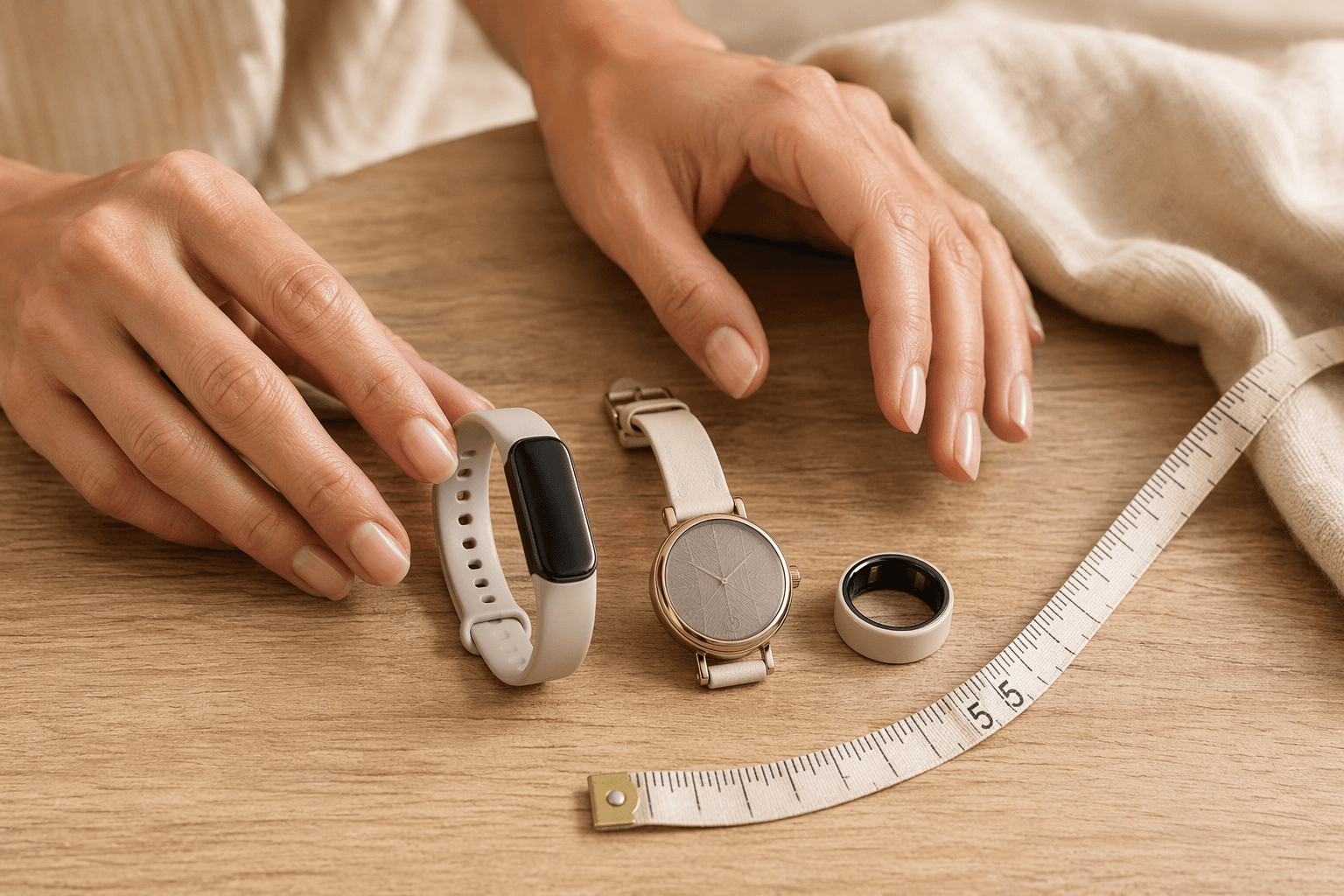
Your wrist is normal. The industry isn't.
If you've ever tried on a fitness tracker and found the band gaping, sliding up your forearm, or pinching at the smallest hole, you probably assumed the problem was you. It's not. The average female wrist measures 5.7–6.2 inches. The average male wrist measures 6.5–7.2 inches. Most trackers are built for the male average, and their "small" bands often start at 5.5 inches or higher — which means a significant portion of women are already excluded before they even look at the features.
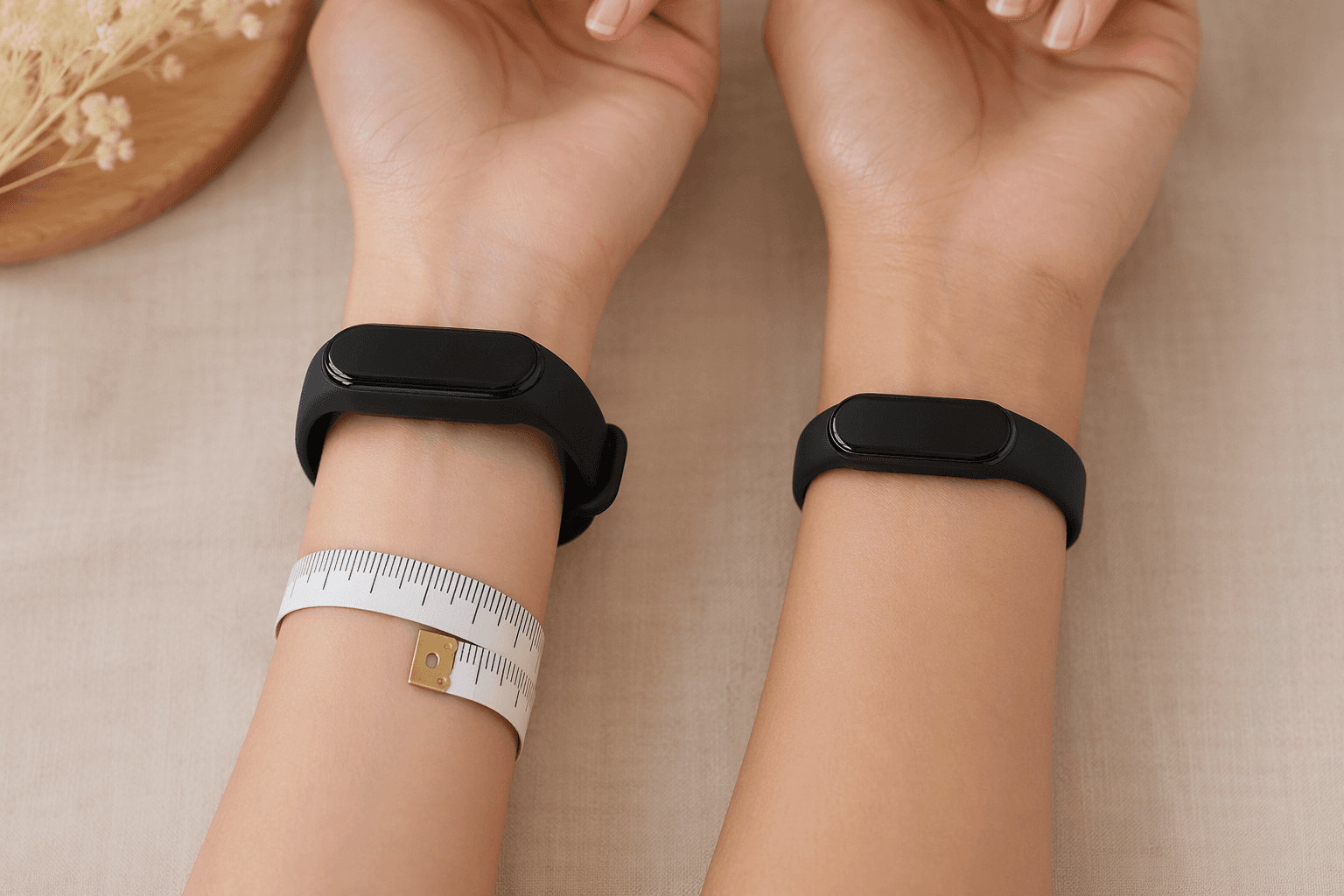
This isn't a matter of personal preference. It's a design bias that systematically ignores a large segment of the market. The consequence isn't just a loose band — it's that the tracker doesn't work properly. A poor fit means the optical heart rate sensor can't maintain consistent skin contact, sleep tracking becomes unreliable, and you're less likely to wear the device at all. A small study from PMC found that participants ranked comfort as the top priority for an ideal wearable — above battery life, durability, and features. When the band doesn't fit, the tracker becomes an expensive desk ornament. And that gap in the photo below? That's not a styling choice. It's the result of a band that was never designed for that wrist circumference.
What the specs actually say — and what they don't
I went through the official band-size ranges, case dimensions, and weight for every major fitness tracker currently on the market. I also cross-referenced real-world fit notes from Women's Health testers and the small-wrist community at La Petite Poire. Here's what I found.
| Model | Band min | Band max | Case width | Weight | Fit notes |
|---|---|---|---|---|---|
| Garmin Lily 2 | 4.3 in | 6.9 in | 35mm | 24g | Smallest case and band; only option for under 5 in; no GPS |
| Fitbit Luxe | 5.3 in | 7.1 in | 36.3mm | 26g | Small band from 5.3 in; snug on 5-in wrist; slight gap |
| Fitbit Charge 6 | 5.5 in | 7.9 in | 26.4mm | 30g | Slim case; thin band; good for average small wrists |
| Apple Watch Series 11 42mm | 5.1 in | 6.3 in | 42mm | 30.3g | Small band from 5.1 in; smallest hole is tight for 5-in wrist |
| Apple Watch 41mm | 5.1 in | 6.3 in | 41mm | ~30g | Same band range; no room to adjust for very small wrists |
| Samsung Galaxy Watch 8 | 5.5 in | 8.4 in | 44mm | ~33g | Medium band too big for 5'3" tester; bulges on small wrists |
| Coros Pace 4 | 5.5 in | 8.0 in | 43.4mm | 32g | Bulky on petite wrist; 43.4mm case is large |
| Google Pixel Watch 4 41mm | 5.1 in | 6.7 in | 41mm | ~31g | 41mm version available; 45mm too large for small wrists |
| Amazfit Active 2 | 5.5 in | 8.0 in | 44mm | 28g | 44mm case; bulky for sleep; not ideal for small wrists |
| Fitbit Ace (kids) | 4.6 in | 5.5 in | ~28mm | ~22g | Fits small wrists but childish design; limited features |
Only two options. One if your wrist is under 5 inches.
Look at the table above. The Fitbit Luxe starts at 5.3 inches. The Garmin Lily 2 starts at 4.3 inches. Every other mainstream model starts at 5.1 inches (Apple Watch) or higher. That means if your wrist is smaller than 5.5 inches — which is the case for many women with petite frames — you have exactly two options. If your wrist is under 5 inches, you have one.
The Fitbit Ace (kids' tracker) starts at 4.6 inches, but it's designed for children — the design is deliberately childish, the feature set is minimal, and it doesn't track advanced metrics like HRV or sleep stages in a useful way. It's not a serious option for an adult who wants a real fitness tracker.
A different band won't fix this
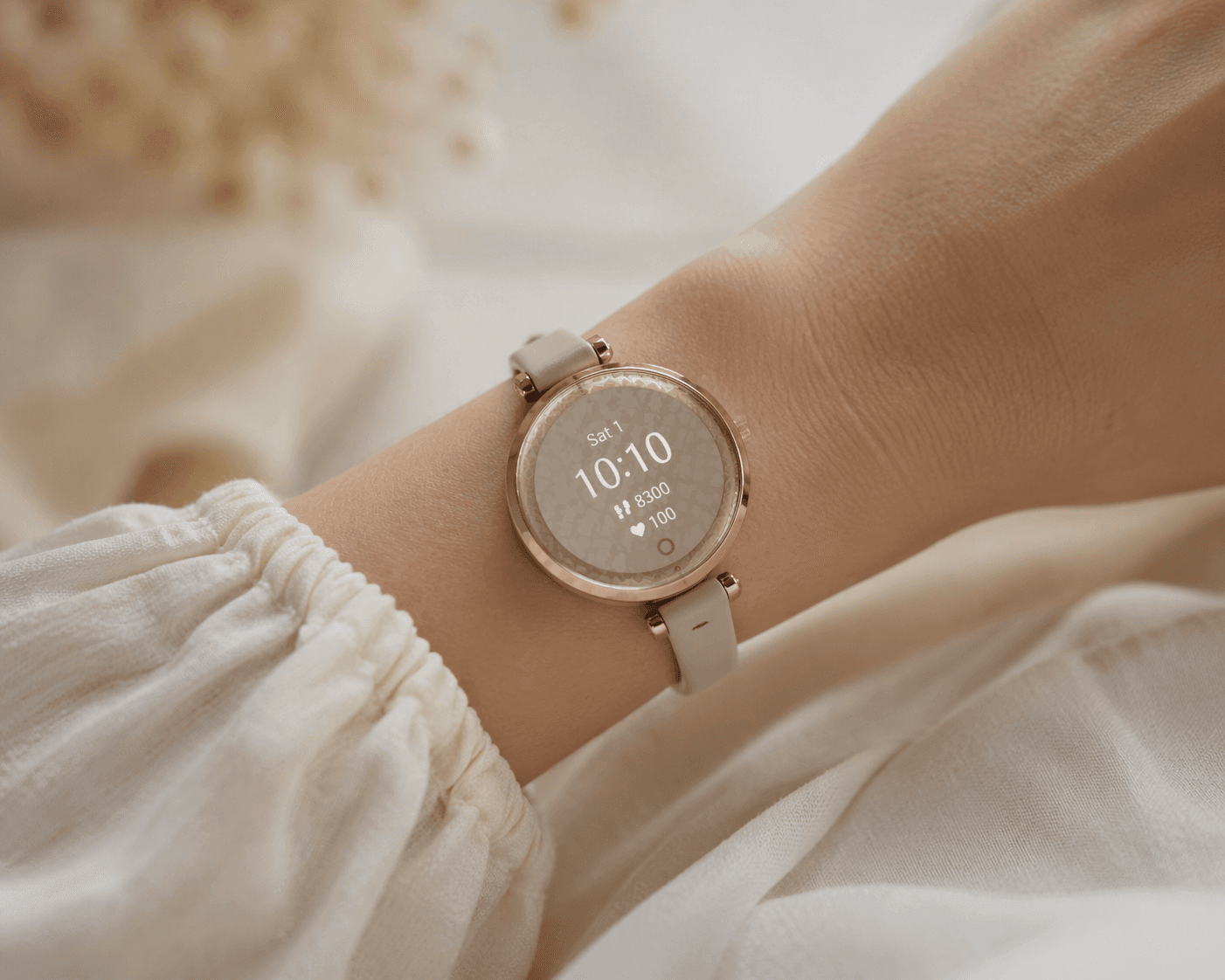
If you have a small wrist, you've probably heard this advice: buy a replacement band. I tried. The owner of La Petite Poire, who has a 5-inch wrist, documented that every after-market band she could find on Amazon for the Fitbit Luxe was too large. The only bands that fit sub-5.5-inch wrists are the discontinued Fitbit Ace-compatible bands — which aren't made for the Luxe anyway.
After-market bands are designed for the same average wrist sizes as the original bands. The third-party market has no incentive to cater to the smallest end of the distribution, because they serve a broad audience. The result is that a person with a 5-inch wrist cannot simply swap their way to a proper fit.
Some people resort to punching extra holes in the band, but that damages the material and often makes the fit even worse — the band can curl or twist at the new hole. Others use small adhesive tabs to take up slack, but those solutions are temporary and can affect sensor accuracy. (If you're curious about how tightness affects accuracy, see our guide to wearable tracker accuracy.)
The trade-offs you can't avoid
If you're in the sub-5.5-inch demographic, your choice is between two compromises.
- The Garmin Lily 2 is the only tracker that fits wrists under 5 inches. It has a jewelry-inspired design, decent sleep tracking, and a comfortable band that starts at 4.3 inches. But it lacks built-in GPS. That means if you go for a run without your phone, you won't get a distance or pace reading. It also has a smaller screen and fewer smartwatch features than a typical Garmin. If GPS-less running is a dealbreaker, the Lily 2 won't work — but no other tracker will fit your wrist either. That's the current market reality.
- The Fitbit Luxe starts at 5.3 inches, so it works for most wrists down to about 5¼ inches. It's a slim, attractive band with a small case. But its feature set is minimal — it lacks an altimeter, SpO2 sensor, and built-in GPS. It's more of an activity tracker than a sports watch. If you want advanced health metrics, you'll need to look at larger models that don't fit.
If your wrist is between 5.5 and 6.2 inches, you have more options — the Fitbit Charge 6, Apple Watch 41mm, and Google Pixel Watch 4 41mm all start around 5.1–5.5 inches and offer stronger feature sets. Our Best Fitness Trackers for Women in 2026 guide covers those models in more depth, including cycle tracking and style considerations.
It's not a technology problem. It's a willingness problem.
Manufacturers already make adjustable bands; they just choose not to extend the range low enough. The materials are cheap — an extra two inches of band material costs pennies. The case size reduction would require a small redesign, but not a fundamental one.
The PMC study's wear-time data hints at the consequence of ignoring this segment: participants wore the Oura Ring (20.4 hours/day) longer than the Apple Watch (16.9 hours/day), primarily because the ring was more comfortable and didn't have fit issues. When a device is uncomfortable, people take it off. When they take it off, they don't get the health data they bought it for. Poor fit directly reduces the device's usefulness.
Why hasn't the market responded? Possibly because the sub-5.5-inch wrist demographic is a minority, and manufacturers prioritize the majority. But consider: the female average wrist is 5.7–6.2 inches, and many women fall below 5.5 inches. That's not a tiny niche. It's a substantial portion of the female population — the same population that fitness tracker companies claim they want to reach with "women's" models. Yet the only model that fits a 5-inch wrist is the Garmin Lily 2, which was designed specifically as a jewelry piece, not as a serious fitness tool.
I don't believe this will change quickly. The industry moves slowly on form-factor updates. But if enough buyers vote with their wallets — and their wrists — manufacturers may eventually notice. In the meantime, if you have a small wrist, you now know your options. They are limited, but they exist. Choose carefully, and don't let anyone tell you the problem is your wrist.
Comments
Join the discussion with an anonymous comment.