
Why Hot Nights Wreck Home Workout Recovery (No-AC Fixes)
Hot nights quietly undo home-workout recovery by stealing the deep sleep your muscles need to rebuild. See what one hot night measurably costs your next workout in a small, no-AC apartment — and which cooling levers are actually worth trying.
- Citation source
- Scientific Reports (2023); Frontiers in Physiology (2025); Sleep Foundation
- Evidence level
- Restrained inference
- Recommended frequency
- End moderate evening exercise at least 90 minutes before bed
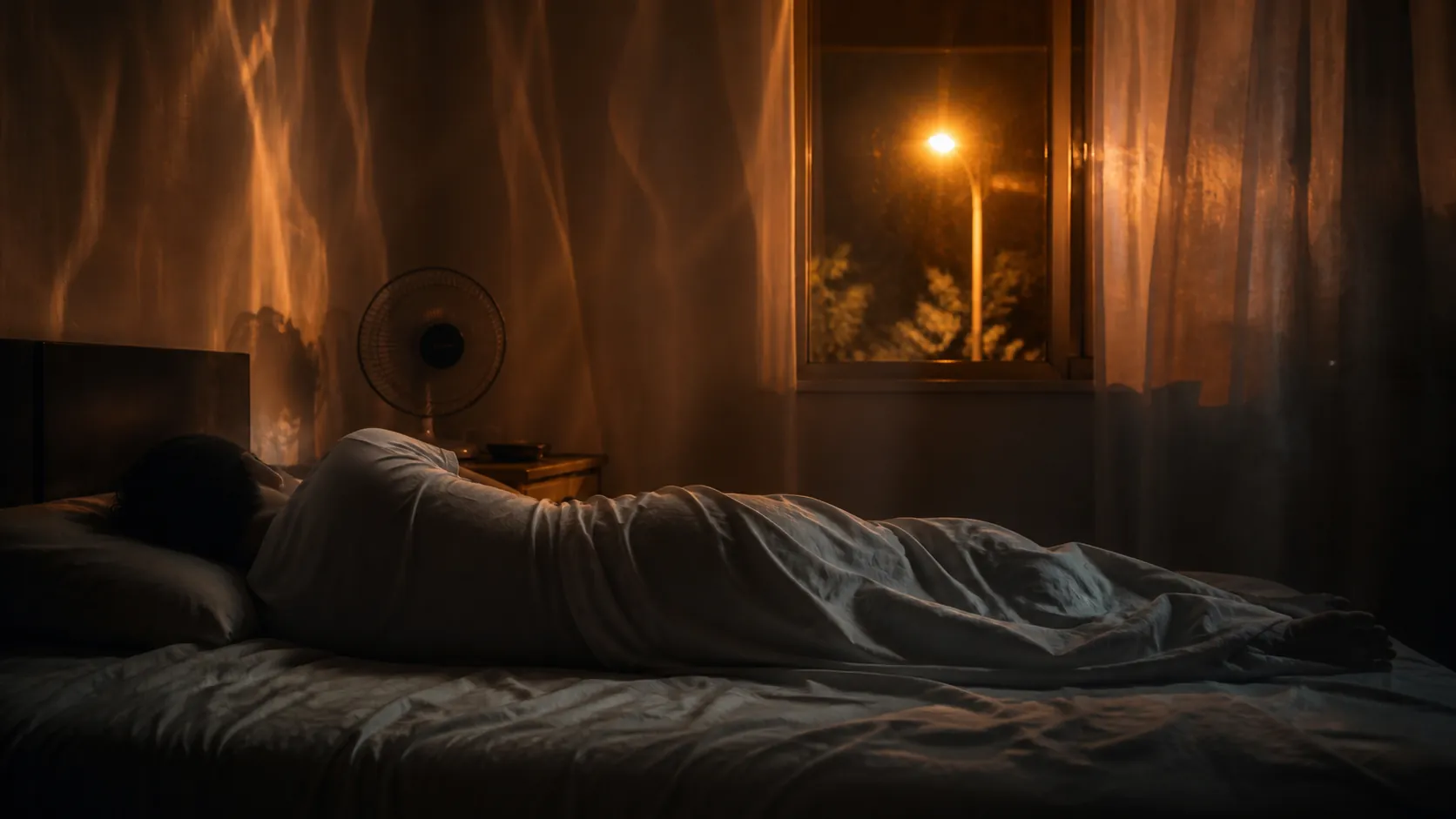
The real cost of a hot night shows up in tomorrow’s workout
Hot weather, sleep recovery, and home workouts are tied together by one boring but brutal chain: the room stays warm, sleep gets lighter and more broken, and the next session feels harder than it should. Not because one sweaty night erased your fitness. Because the sleep you were counting on for recovery did not do its normal job.
The clearest numbers come from real bedrooms, not perfect sleep-lab rooms. In a longitudinal study of 10,903 person-nights in older adults’ homes, sleep efficiency dropped by 5–10% as bedroom temperature rose from 25°C to 30°C, or 77°F to 86°F. The model also predicted about 60 minutes less total sleep as bedroom temperature rose from 22°C to 30°C, and the observed temperature range linked with best sleep was 68–77°F [1].
That study was in older adults, so it should not be stretched into a universal rule for every younger lifter, runner, or Pilates person training at home. Still, it catches something anyone in a small apartment recognizes: 86°F is not just “a little uncomfortable.” It can mean less time asleep, more time awake, and a lower-quality night before you ask your body to perform again.
The next-day training link is not guesswork either. A 2025 meta-analysis of 45 studies with 670 participants found that sleep deprivation significantly impaired aerobic endurance, skill control, speed, explosive power, and maximum force, while raising perceived exertion. The effects were stronger in afternoon tests, which is exactly when many after-work home exercisers are trying to train again [2].
That is the “why did my normal workout feel weirdly heavy?” moment. A hot night does not need to wreck every marker at once. It can shave off sleep efficiency, make the night feel choppy, and leave tomorrow’s body interpreting ordinary sets, intervals, or mobility work as more expensive.
Why heat is such a bad recovery roommate
Sleep is not just time spent horizontal. To settle into deeper sleep, the body needs to shed heat. A hot bedroom fights that process, especially when the air is humid enough that sweat sits on the skin instead of evaporating cleanly.
A review on thermal environment and sleep found that heat exposure during sleep increases wakefulness and decreases slow-wave sleep and REM sleep, with REM described as the most temperature-sensitive stage. Humid heat adds more thermal load, and the review notes evidence that sleep disruption did not adapt even after five consecutive hot days [3].
That matters for training because recovery is not only about sore muscles calming down. Overnight repair depends on sleep continuity and sleep architecture: enough uninterrupted time for the body to move through the stages that support restoration. If you want the deeper physiology, the companion guide on how heat disrupts sleep and workout recovery covers the core-temperature conflict in more detail. Here, the practical point is simpler: if the room blocks heat loss, recovery sleep gets harder to protect.
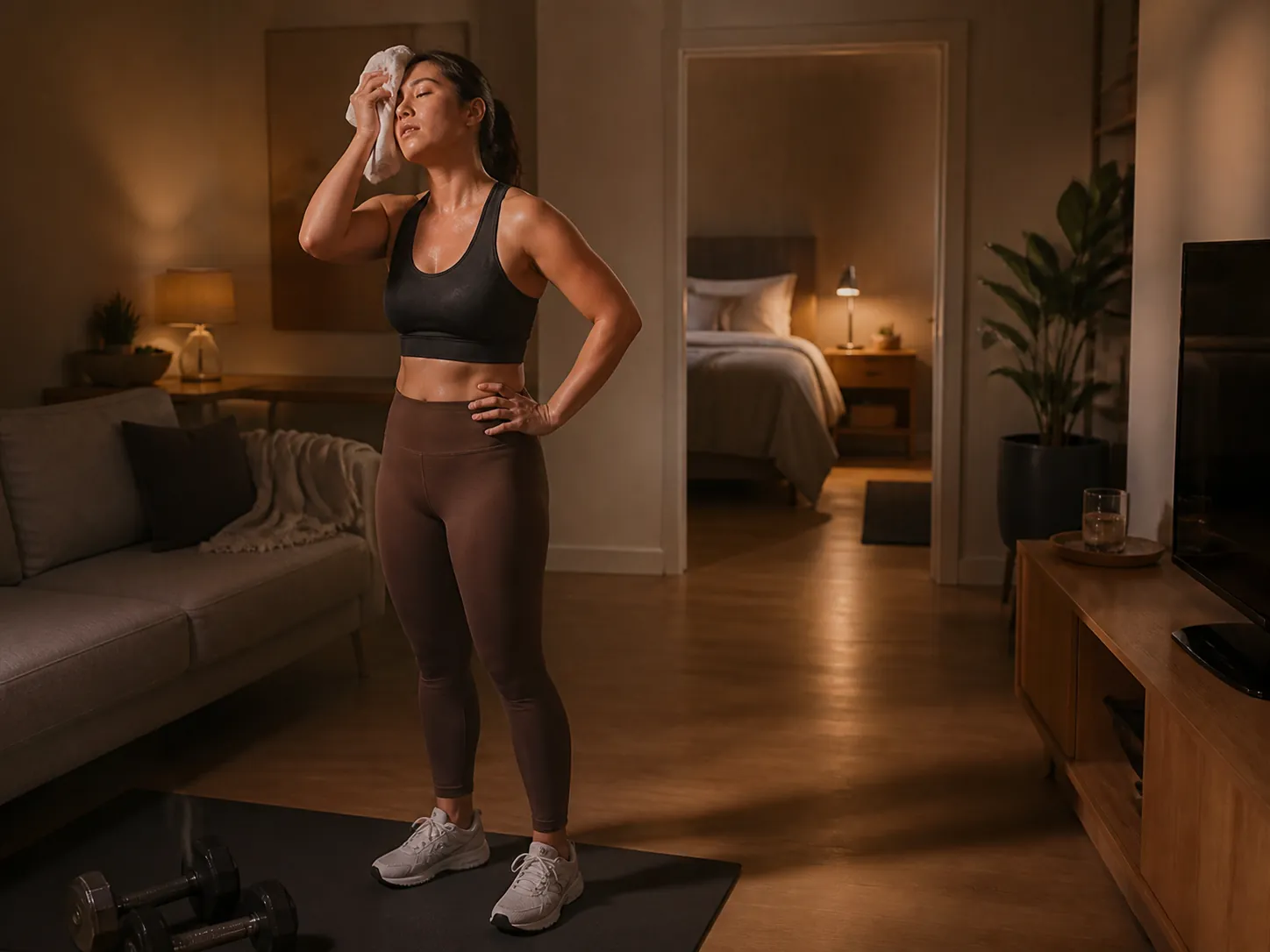
Evening home workouts can heat both the body and the room
After-work training is often the only realistic option. The problem in a small apartment is that a workout does not only raise your body temperature. Dumbbell circuits, jump rope intervals, hard indoor cycling, or a sweaty mat session can warm the exact room that has to become your bedroom-adjacent recovery space an hour later.
The body side has a time course. A review discussing evening exercise and sleep reports that core temperature after a 60-minute exercise session returned to baseline within 30–120 minutes depending on intensity [4]. Sleep Foundation guidance similarly treats moderate evening exercise as generally fine when it ends at least about 90 minutes before bed, while vigorous exercise within roughly one hour of bedtime is the higher-risk zone for sleep [5].
That does not mean evening workouts are bad. It means the last part of the session matters more in summer. A hard finisher at 9:45 p.m. in a room that already feels like a laundry closet is different from a moderate strength session that ends early enough for your skin, breathing, and room air to settle.
If your schedule is fixed, the useful move is not guilt. It is heat management: shorten the hottest finisher, move the cooldown near a window if outside air is cooler, shower with timing in mind, and avoid sending damp heat straight from workout mat to bed.
No-AC cooling levers that are actually worth sorting by timing
Cooling advice gets useless when it arrives as a pile of hacks. A fan, a shower, an open window, and a lighter blanket do different jobs at different times. The question is not “what sounds refreshing?” It is: what helps your body lose heat before sleep, and what helps the room stop holding heat around you?
| Situation | Best low-cost lever | Why it can help | What to watch |
|---|---|---|---|
| You finished an evening workout and bedtime is still 90+ minutes away | Use a real cooldown, then ventilate the workout area if outside air is cooler | Gives core temperature time to drift down; a 60-minute session may take 30–120 minutes to return to baseline depending on intensity [4] | Do not turn the cooldown into more conditioning; the goal is heat release, not extra work |
| You trained late and feel overheated close to bed | Take a cool shower close to bedtime if it helps you feel less heat-loaded | Some clinician guidance recommends a cool shower when sleeping without air conditioning [6] | Very cold water can feel shocking or stimulating for some people; aim for comfortable cooling, not a toughness test |
| You have about two hours before bed | Try a warm bath or warm shower earlier in the evening | A warm bath roughly two hours before bed is recommended as a heat-loss aid because it can encourage heat release afterward [7] | This is timing-dependent; doing it too close to bed in a hot room may simply make you feel hotter |
| The room is hotter than the hallway or outside air | Create cross-ventilation: open opposite windows or a window and door, then aim a fan to move air through | Moves trapped indoor heat out instead of only pushing stale air around | If outdoor air is hotter, smoky, unsafe, or extremely humid, ventilation may not help |
| The room is humid and sweat is not evaporating | Use fan airflow directly across skin; reduce bedding and sleep clothing | Air movement helps evaporation at skin level, which is one route for heat loss [3] | A fan can feel heroic and still not fix high humidity; judge by sleep, not by fan speed |
| Your mattress and sheets hold heat | Use lighter layers, separate damp workout clothes from bedding, and avoid lying down sweaty | Reduces the heat and moisture trapped against skin during the first sleep window | Damp sheets are a recovery problem, not a badge of discipline |
| You can cool only one zone | Prioritize the bed zone: fan angle, open door, lighter bedding, and a clear path for airflow | Your sleeping microclimate matters even when the whole apartment cannot be cooled | Do not waste the only fan cooling an empty workout corner after you move to bed |
| You want a target to test | Track bedroom temperature alongside sleep efficiency, wakefulness, and next-day workout feel | Real-home data found best observed sleep in a warmer range than some formal cool-room recommendations [1] | Your best workable range may not match a lab-style target, especially in a rental |
The warm-bath versus cool-shower advice is not as contradictory as it looks. Both are attempts to change heat loss. A warm bath earlier can draw blood flow toward the skin and set up heat release afterward; a cool shower close to bed can reduce the immediate feeling of being overheated. Timing changes the logic.
The room levers are less glamorous but often more important in a small apartment. If the bedroom shares air with the workout space, start moving heat out before you are exhausted. Open a door before the final cooldown. Put the fan where it moves air toward an exit, not just at your face. Keep sweaty clothes and towels out of the sleep area. These are not personality upgrades. They are setup changes, the same kind of environment design that makes home training easier in the first place. If that framing helps, the setup-focused guide on home workout motivation and willpower gets into the broader pattern.
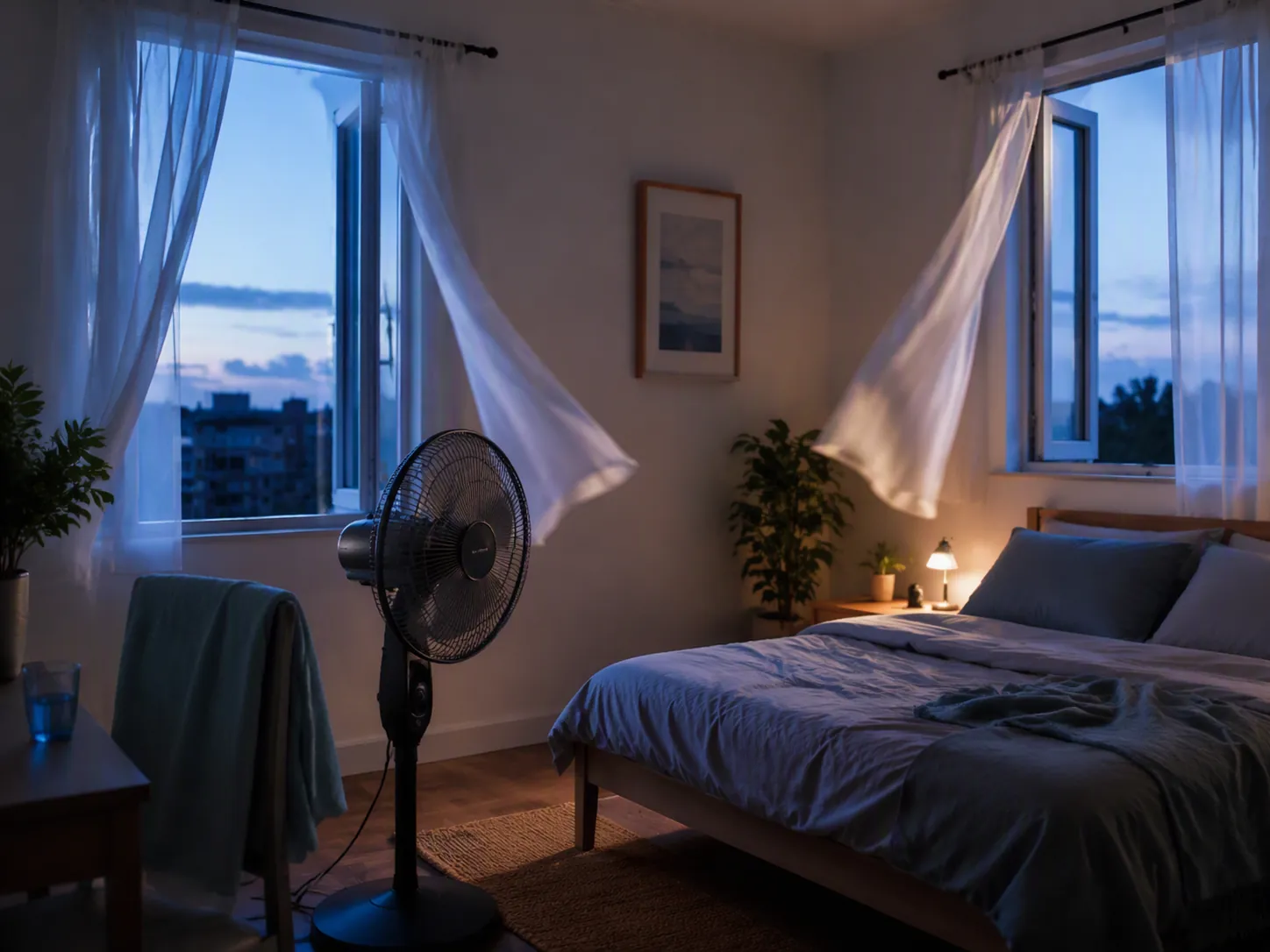
Temperature targets are clues, not commandments
A lot of sleep advice gives one crisp number range and then acts as if the problem is solved. That is tidy on a page and rough in a top-floor rental. Cleveland Clinic lists 60–67°F as an ideal bedroom temperature range for sleep and describes temperatures above 70°F as too hot for many people [8]. The real-home study above, though, observed best sleep between 68°F and 77°F in older adults’ homes [1].
Those ranges are not equal kinds of evidence. A formal cool-bedroom recommendation is a useful target if you can reach it. Real-home observed data tells you what happened in lived-in rooms with real constraints, in a specific population. Your own tracking tells you what changes your sleep and training when the thermostat, landlord, noise, humidity, or budget will not cooperate.
| Temperature guidance | How to use it in a no-AC apartment |
|---|---|
| 60–67°F formal cool-bedroom range | Treat as an idealized reference point if you have reliable cooling, not as a moral requirement [8] |
| 68–77°F observed best-sleep range in one real-home older-adult study | Treat as a practical comparison point, especially if you cannot cool below the low 70s [1] |
| Your own sleep efficiency, wakefulness, and next-day workout feel | Treat as the deciding layer: if a fan angle, shower timing, or bedding change improves these, keep it |
If you want to run a small self-test, track only a few things for a hot week: bedroom temperature when you get into bed, how often you wake, how rested you feel on waking, and how hard your normal workout feels the next day. Wearable users can compare bedroom temperature against sleep efficiency or recovery trends; the guide on using Oura Ring recovery data for smarter home workouts shows one way to do that without turning every night into a science project.
For a deeper target-setting approach, use the separate guide to the best room temperature for sleep recovery. This article’s job is narrower: protect recovery when the room is hot and perfect cooling is not available.
How to adjust the workout without surrendering the routine
The right summer adjustment is usually smaller than people think. You may not need to stop training after work. You may need to stop finishing every hot-night workout as if recovery conditions are normal.
- Move the hardest work earlier in the session so the final 10–15 minutes can bring temperature and breathing down.
- On the hottest nights, cut the metabolic finisher before cutting the whole workout.
- Use lower-heat strength work instead of high-rep circuits when the room is already stuffy.
- End vigorous sessions farther from bedtime when possible; the highest-risk window is hard exercise within roughly one hour of bed [5].
- Treat the shower, fan placement, and bedding change as part of the workout plan, not as optional extras after you are already cooked.
This is also where a broader recovery routine helps. Hydration, food, cooldowns, and sleep prep all matter more when the room is working against you. The guide to a complete post-workout recovery routine at home is a better place for the full overnight repair checklist.
When heat is not the whole explanation
A hot bedroom can make recovery look worse than it is. It can also hide other issues. If fatigue persists after the weather breaks, if easy workouts keep feeling unusually hard, or if you have symptoms that feel out of proportion to the heat, do not keep blaming the apartment forever.
Heat illness symptoms, faintness, chest pain, shortness of breath that is unusual for you, confusion, or persistent sleep disruption deserve medical attention. For a quieter but common recovery rule-out, the guide on iron deficiency and poor home workout recovery is worth reading if tiredness keeps hanging around after the room cools down.
For ordinary hot-weather recovery, the practical stance is this: protect the pre-sleep cooling window, lower the room or skin heat load with the cheapest lever that fits your space, and judge the result by sleep continuity and next-day workout feel. A fan cannot fix every apartment. A perfect 65°F room is not available to everyone. But better timing, airflow, bedding, and workout intensity can keep one hot night from turning into a whole week of flat training.
References
- Nighttime ambient temperature and sleep in community-dwelling older adults, Scientific Reports, 2023, https://pmc.ncbi.nlm.nih.gov/articles/PMC10529213/
- Effect of sleep deprivation on sports performance: a systematic review and meta-analysis, Frontiers in Physiology, 2025, https://www.frontiersin.org/journals/physiology/articles/10.3389/fphys.2025.1544286/full
- Effects of thermal environment on sleep and circadian rhythm, Journal of Physiological Anthropology, 2012, https://pmc.ncbi.nlm.nih.gov/articles/PMC3427038/
- Evening exercise and sleep in healthy participants: a systematic review and meta-analysis, 2023, https://pmc.ncbi.nlm.nih.gov/articles/PMC10636512/
- The Best Time of Day to Exercise for Sleep, Sleep Foundation, https://www.sleepfoundation.org/physical-activity/best-time-of-day-to-exercise-for-sleep
- Tips for sleeping without air conditioning, HealthPartners, https://www.healthpartners.com/blog/tips-for-sleeping-without-air-conditioning/
- Keep your cool and stay healthy with these hot weather sleep tips, American Heart Association, Aug. 19, 2025, https://www.heart.org/en/news/2025/08/19/keep-your-cool-and-stay-healthy-with-these-hot-weather-sleep-tips
- What’s the Ideal Room Temperature for Better Sleep?, Cleveland Clinic, https://health.clevelandclinic.org/what-is-the-ideal-sleeping-temperature-for-my-bedroom
This is general fitness education, not medical advice. For diagnosis or treatment of pain or injury, consult a qualified clinician.
Pick your next session
Browse all routines to find an appropriately-spaced next session.
Spot something off?
This content sits adjacent to health guidance — tell us if a citation or figure needs a correction.