
How hot weather sleep quietly cuts into workout recovery
Hot nights don't just feel uncomfortable — they blunt the core-body-temperature drop that deep sleep depends on, while the same heat raises the load of every workout. If you train at home through a hot stretch, this explainer shows how that double stressor cuts into recovery and which low-cost, behavioral fixes protect sleep best.
- Citation source
- CDC
- Evidence level
- general guideline
A hot home workout does not end when the dumbbells go back under the bed. In hot weather, the session usually costs more internally, and then the night is less prepared to pay that cost back. That is the real recovery problem on hot nights: heat can make the workout feel harder, then blunt the sleep physiology that helps you repair from it.
That matters most for the person training in a small apartment room, garage corner, or spare bedroom that stayed warm after sunset. “Keep the bedroom cool” is fine as a target. It is not a complete plan when the room never really dumps the day’s heat.

The part heat disrupts is not just comfort
Sleep has a temperature rhythm. Core body temperature begins falling roughly two hours before sleep onset, and the first bout of non-REM sleep is most likely to arrive near the steepest part of that decline.[1] That is why a hot night can feel so oddly unfair: you may be tired enough, your room may be dark enough, and your phone may be put away, but the body-temperature signal that helps launch stable sleep is working against a warm environment.
The body does not simply “turn down” its core temperature like a thermostat. It has to move heat outward. Sleep-related cooling depends partly on heat leaving the core through the skin, while humans also tend to maintain a skin microclimate around 31–35°C and often sleep best in room conditions around 19–21°C, depending on bedding and clothing.[1][2] A stuffy bedroom narrows the gap between your warm body and the surrounding air. Add a heavy comforter, a closed-up room, or sun-baked walls, and the path for heat loss gets worse.
This is the mechanism that turns a normal complaint into a recovery issue. The hot room is not only making sleep less pleasant. It can mistime the descent into deeper sleep by making it harder for the body to release heat when that release should be accelerating.

This also explains why cold air and cold skin are not the whole story. You can feel sticky and overheated on the surface, or you can blast one part of the body with a fan and still have a room that is poor at supporting whole-body heat loss. The recovery-relevant question is whether your pre-sleep environment helps the internal temperature drop happen on time.
Heat adds load before sleep ever starts
A summer workout in a hot room is not the same internal event as the same workout in mild conditions. Public-health guidance for athletes treats heat as a risk factor that requires adjustments to intensity, rest, hydration, and timing, and sport-science consensus work describes heat stress as a condition that increases physiological strain during training.[3][4] That does not mean every warm home session is dangerous. It does mean the same external plan can become a larger internal load.
For home training, the difference is practical. A circuit that is manageable in March can turn into a sweat-soaked grinder in August. Heart rate drifts up sooner. Rest periods stop feeling like recovery. Grip gets sloppy. The floor fan mostly moves hot air around. Then, instead of sleeping in a room that helps downshift the system, you lie in the heat generated by the day, the building, and the session itself.
If the heat is severe enough that the workout itself needs changing, use the workout-side guidance in how to cut indoor workouts in extreme heat. This article is about the next step: what happens when that hotter internal load meets worse sleep.
What recovery research actually supports
The cleanest muscle-recovery warning does not come from an ordinary muggy night. It comes from a sharper lab condition. In a randomized crossover study of 13 healthy young adults, one night of total sleep deprivation reduced postprandial muscle protein synthesis by about 18%, from 0.072 to 0.059 %·h−1. The same study reported cortisol area under the curve about 21% higher and testosterone area under the curve about 24% lower after sleep deprivation.[5]
Those numbers are useful, but they need to stay inside their fence. The study tested total sleep deprivation in a small sample. It does not mean one hot, broken night automatically cuts your recovery by 18%, or that a bad week in July has a neat percentage penalty. The better takeaway is simpler and more defensible: the biology that supports muscle repair is sleep-sensitive. When sleep is severely disrupted, the muscle-building environment can shift in the wrong direction.
Heat-training studies make the hot-weather side of the problem harder to dismiss. In one study, five consecutive days of heat training in 30 recreationally trained men reduced total time asleep and perceived sleep quality while increasing awake time and wake after sleep onset compared with baseline.[6] In another controlled comparison, workload-matched heat-acclimation training at 34.9°C reduced sleep efficiency by about 2.1% and lengthened wake after sleep onset compared with temperate training.[7]
Again, this is not a recovery-loss calculator. The studies involved controlled heat-training conditions, not every apartment bedroom or every dumbbell workout. But the pattern lines up with the mechanism: heat can raise the cost of training and can make the following sleep shorter, more fragmented, or less satisfying. For a home trainer who wakes flat after doing everything else right, that is enough evidence to treat hot-night sleep protection as part of programming.
The room target is useful, but it is not the whole answer
A bedroom around 65°F is a good practical target, and sleep-environment guidance often clusters around roughly 60–68°F for many adults.[8] If you can reach that without turning your home into a refrigerator, fine. It gives your body a better runway for the pre-sleep temperature drop.
Plenty of people cannot reach it during a heat wave. Renters may have one weak window unit. A garage gym may stay hot into the night. A small bedroom may get afternoon sun and hold it. That is where advice has to move from perfect setpoints to protecting the temperature drop by removing as many obstacles as possible.
For a deeper setpoint discussion, use the ideal sleep temperature after a home workout. If the practical problem is sleeping without air conditioning, the tactics in how to sleep without AC and recover faster from workouts are the natural next layer.
Protect the temperature drop before bedtime
The best fixes are not dramatic. They mostly make the room and the body less hostile to the normal pre-sleep cooling pattern.
| When | What to do | Why it helps |
|---|---|---|
| Before the workout | Move the hardest session earlier when possible, or trim intensity during the hottest part of the day. | You start bedtime with less accumulated heat strain. |
| Late afternoon | Block direct sun with curtains or shades before the room heats up. | It is easier to prevent heat gain than to purge it from walls, flooring, and bedding later. |
| Evening | Use lighter bedding and sleepwear; remove insulation before you feel trapped under it. | Less trapped heat makes skin-to-room heat loss easier. |
| After training | Rehydrate steadily, but avoid turning the last hour before bed into a catch-up chug. | You replace sweat losses without guaranteeing repeated bathroom trips. |
| One to two hours before bed | Take a warm shower for at least 10 minutes if it suits you. | Passive warming can trigger rebound cooling as heat leaves through the skin. |
Move the hard work out of the hottest slot
If your room becomes an oven by 6 p.m., a late hard session is asking sleep to clean up two messes: the training load and the heat load. Earlier is not always possible. Work, kids, noise rules, and shared space all matter. But when the choice exists, move heavy lower-body work, dense circuits, or long conditioning earlier in the day and leave lower-intensity mobility, easy zone work, or skill practice for the warmer evening.
When you cannot move the workout, reduce the internal load. Longer rests, fewer near-failure sets, and shorter finishers are not weakness in a hot room. They are the same kind of programming adjustment as reducing volume when sleep debt is high.
Stop the room from banking heat
Curtains and shades matter most before the room gets hot. Closing them after sunset may make the bedroom darker, but it does not undo hours of solar gain. If the workout room and bedroom are the same space, block afternoon sun, keep unnecessary electronics off, and avoid leaving thick bedding spread out in the warmest part of the room.
Fans can help sweat evaporate and move cooler air when cooler air exists. They are less impressive when they only stir hot, humid air. Use them as part of airflow, not as proof the room is recovery-ready.
Make bedding boring and light
The blanket that feels psychologically comforting at bedtime can become a heat trap at 2 a.m. A thin sheet, breathable sleepwear, and the option to uncover feet or lower legs can do more for a hot night than a complicated recovery ritual. The point is not to feel chilly. The point is to stop insulation from blocking heat release when the body is trying to cool.
Hydrate early enough that sleep still gets a chance
Hot training increases sweat loss, so ignoring fluids is not a recovery strategy. The mistake is waiting until bedtime to fix the whole day. Drink steadily after the session, include food and electrolytes when the workout and sweat loss justify it, and taper the last stretch before bed so you are not waking repeatedly to use the bathroom. For summer fueling and fluid context, see summer fatigue prevention foods.
The warm shower is the trick that sounds backward
A cold shower feels logical on a hot night. It may feel good, and if you are overheated it can be useful for comfort. But the better-supported sleep-timing move is a warm shower or bath one to two hours before bed.
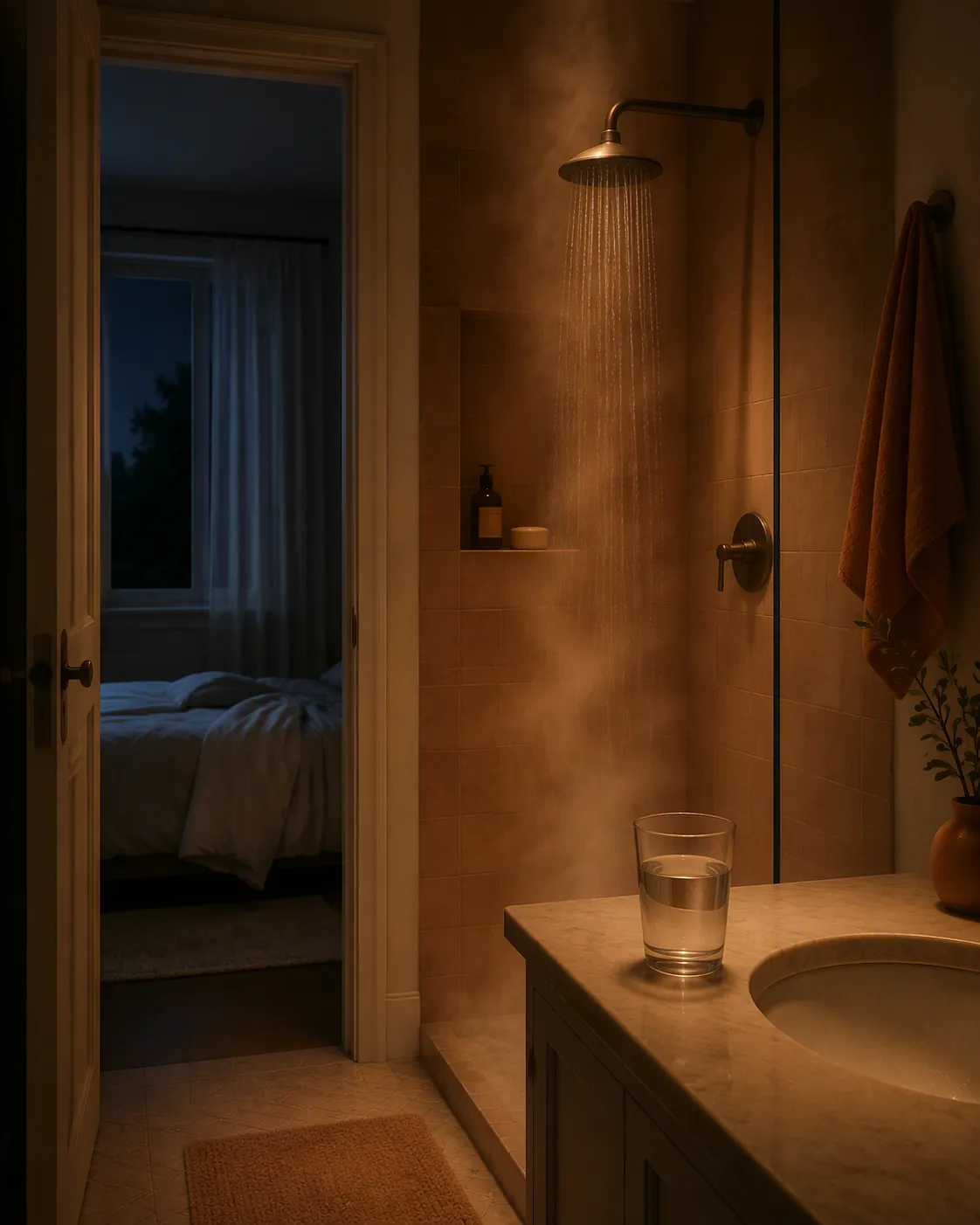
Passive warming sends blood toward the skin. After you get out, that peripheral heat can dissipate, supporting the same downward core-temperature movement that helps sleep arrive. A meta-analysis cited in sleep-and-thermoregulation work found that water-based passive warming for at least 10 minutes, one to two hours before bedtime, shortened sleep latency by about 36%.[2]
This does not require a spa routine. Warm, not scalding. Long enough to heat the skin, not so long that you raise the room humidity and feel worse. Then dry off, get into lighter sleepwear, and let the room setup do its job.
Do not turn this into a gadget problem first
Cooling mattresses, bed fans, wearables, and temperature trackers may help some people. They are not the spine of the decision. If the workout is too late, the room baked all afternoon, the bedding traps heat, and hydration is crammed into the final hour, a device is being asked to rescue a chain of avoidable problems.
Wearable temperature trends can be interesting, especially when they match what you already feel: higher overnight body temperature, worse sleep continuity, lower readiness. But the actionable part usually stays plain. Reduce the heat load before bed. Make the room less insulated. Adjust training when sleep is likely to be poor.
When hot-night fatigue is no longer a fitness problem
A fitness article can help you adjust training and sleep conditions. It should not talk you out of medical care. Persistent insomnia, repeated nights of severe sleep disruption, worrying fatigue, dizziness, confusion, fainting, chest pain, or signs of heat illness belong with a clinician or urgent medical guidance, not with another recovery hack.
The same line applies if you are older, pregnant, managing a medical condition, taking medications that affect heat tolerance or hydration, or caring for someone vulnerable in a hot home. Training plans are optional. Heat illness is not.
The compact training decision
If tonight will be hot, recovery planning starts before bed and maybe before the workout. Move or downshift the hardest session if the room will still be hot late. Block sun before it loads the space. Keep bedding light. Rehydrate steadily instead of panic-drinking at bedtime. Use a warm shower one to two hours before sleep when it fits.
For the broader recovery structure around sleep, food, soreness, and rest days, use the post-workout recovery routine at home. Hot-weather sleep loss is not a guaranteed missed-gains disaster. It is real enough to sit in the same category as load selection, rest days, and workout timing.
References
- The Temperature Dependence of Sleep — Frontiers in Neuroscience, 2019
- Sleep and thermoregulation — Current Opinion in Physiology, 2020
- Heat and Athletes — Centers for Disease Control and Prevention
- Consensus recommendations on training and competing in the heat — British Journal of Sports Medicine, 2015
- One night of sleep deprivation decreases muscle protein synthesis in healthy young adults — Physiological Reports, 2021
- The effect of consecutive days of exercise in the heat on sleep in trained men — Journal of Thermal Biology, 2018
- Sleep is impaired in response to workload-matched heat acclimation training — European Journal of Sport Science, 2023
- The Best Temperature for Sleep — Sleep Foundation
This is general fitness education, not medical advice. For diagnosis or treatment of pain or injury, consult a qualified clinician.
Pick your next session
Browse all routines to find an appropriately-spaced next session.
Spot something off?
This content sits adjacent to health guidance — tell us if a citation or figure needs a correction.