
Off-Trail Hiking Risks in Wyoming and How to Recover
This article explains the specific, documented risks of off-trail hiking in Wyoming—including SAR data, fall and ankle injury rates, and rescue response times—and provides a practical home-recovery plan for the most common Wyoming backcountry injuries like ankle sprains and knee strains.
- Citation source
- REI Expert Advice
- Evidence level
- general guideline
Off-trail hiking risks in Wyoming start with a simple change in consequence. A twisted ankle on a maintained path near a busy overlook is still painful. The same ankle rolled on talus above timberline in the Wind River Range, in afternoon weather, with no boot track back to the basin, becomes a transportation problem, a rescue problem, and then a recovery problem that may follow the hiker home for weeks.
Wyoming’s own rescue picture is large enough that it should settle the tone. Search and rescue teams in the state handled 329 missions in 2024, with hikers rescued more than any other activity group, according to Wyoming Public Media’s reporting on state SAR data.[1] The Wyoming Office of Homeland Security describes the broader scale as more than 300 search and rescue missions annually, concentrated heavily in mountain terrain and outdoor recreation settings.[2]
The parks do not dress this up. Grand Teton National Park says, “Solo hiking, off-trail hiking, and trail running are not recommended,” and its safety page adds the sentence that belongs in every ambitious route plan: “Rescue is not a certainty.”[3] Yellowstone’s warning is different but just as blunt: the park advises against off-trail hiking because the risk of bear attack is higher away from established routes.[4]
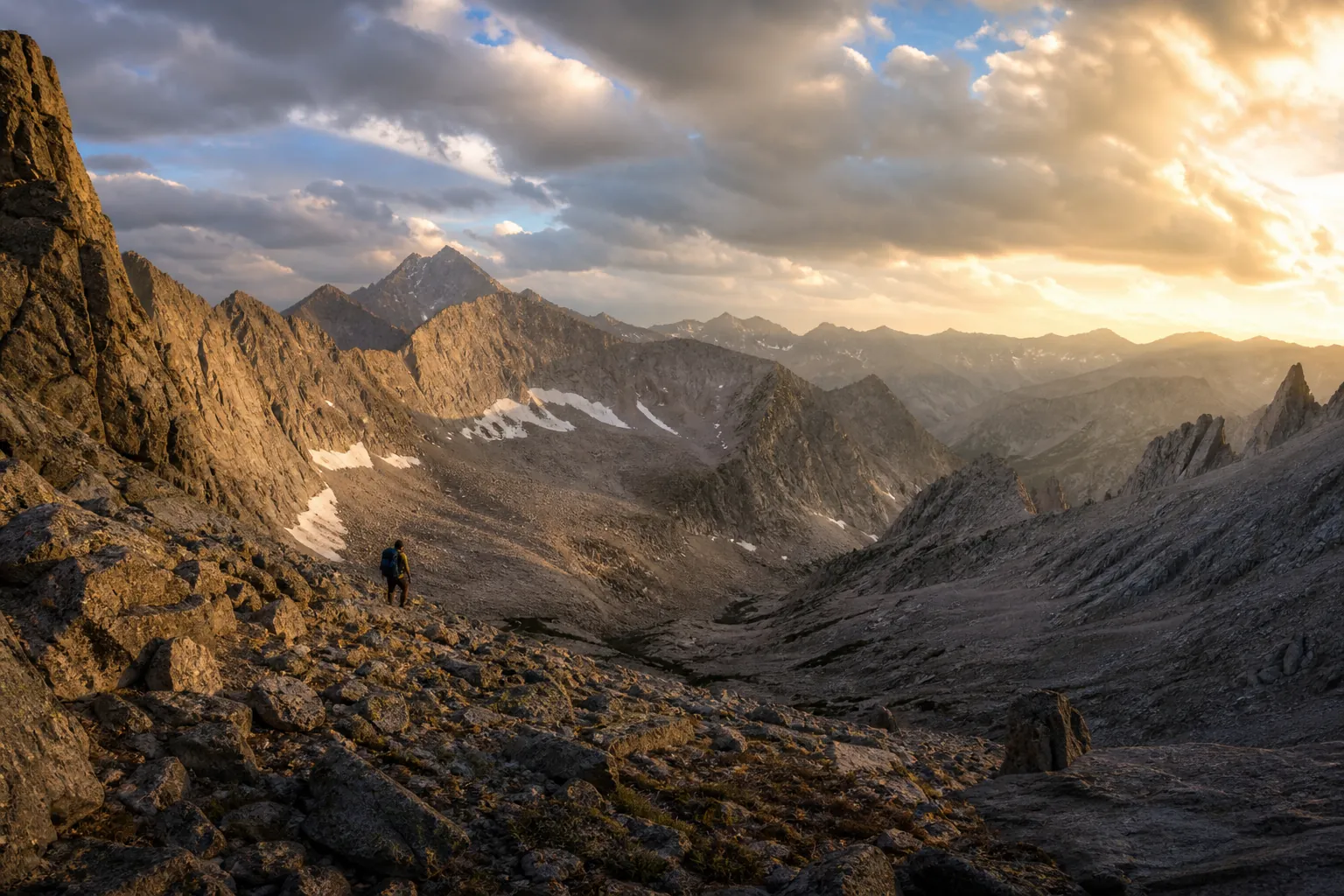
That does not make every off-trail hiker careless. Some of the best Wyoming travel happens where there is no tread: a pass read from a topo map, a basin reached by judgment instead of signage, a quiet line through granite and willow. But the terrain does not care whether the decision was thoughtful. In September 2024, a hiker in the Wind River Mountains suffered serious injuries after an estimated 80- to 100-foot fall, a single case that should not be inflated into a frequency claim but does show the kind of exposure Wyoming backcountry can contain.[5]
Why ordinary hiking injuries get bigger off trail
Most hiking injuries are not cinematic. They are slips, falls, rolled ankles, sore knees, and soft-tissue damage. A 2026 hiking-injury statistics compilation reports that falls and slips account for about half of hiking injuries, while ankle injuries account for 42%, head injuries 13.4%, and knee injuries about 10%.[6] Those figures are national and secondary, so they should not be treated as a Wyoming-specific injury registry. They are still useful as a baseline because they point to the body parts and mechanisms that matter before the terrain raises the stakes.
A peer-reviewed Appalachian Trail study gives another baseline, though from a very different hiking culture and route. In Boulware’s 2003 study of long-distance hikers, blisters were reported by 64%, diarrhea by 56%, skin irritation by 51%, and acute joint pain by 36%.[7] That study is valuable because it reminds hikers that ordinary medical problems are common in wilderness travel. It is less useful for predicting what happens when someone leaves a Wyoming trail and crosses loose rock, snowmelt streams, steep timber, and high basins with no direct exit.
The difference is not just remoteness. Off trail, every step has a smaller margin for error. Talus blocks shift. Scree turns a controlled descent into sliding. Deadfall changes stride length and foot placement. Stream crossings add wet rock and cold feet. Alpine weather can reduce visibility or turn an injury into an exposure problem. Elevation adds fatigue, and fatigue makes sloppy footwork more likely. In bear country, especially in Yellowstone, leaving established routes also changes wildlife risk in a way the park specifically calls out.[4]
This is why the same diagnosis can mean different things. “Ankle sprain” sounds modest on a clinic note. Off-route above timberline, it may mean a hiker can no longer descend loose rock, cannot safely hop across water, and cannot carry a pack without turning a mild injury into a severe one. The injury is common; the setting decides how punishing it becomes.
| Common injury pattern | Why Wyoming off-trail terrain raises the consequence |
|---|---|
| Ankle sprain or foot injury | Loose rock, angled slabs, stream crossings, and long exits make each step a reinjury test. |
| Knee strain or acute joint pain | Steep descents and uneven sidehilling increase load when the joint is already irritated. |
| Fall-related bruising, cuts, or soft-tissue trauma | Talus, deadfall, and granite can turn a simple slip into a body-wide impact. |
| Head impact | Remote terrain increases the seriousness of confusion, dizziness, or delayed evaluation. |
| Bear encounter risk | Yellowstone specifically warns that attack risk is higher when hiking off trail. |
The rescue is only one part of the injury
Rescue numbers can make the story feel finished: beacon triggered, team deployed, helicopter shown against a ridge. But for the injured hiker and the people carrying the load around them, rescue is only the handoff between one hard phase and the next.
Backpacker’s reporting on Garmin inReach SOS data said the device network saw more than 3,000 SOS incidents annually, with hikers and backpackers the top group triggering rescues and roughly one-third of incidents requiring helicopter extraction.[8] That is secondary reporting on Garmin data, not an independent census of all rescues. Still, it lines up with the practical reality in Wyoming: when someone is injured far from a road, the exit may depend on terrain, weather, aviation availability, communications, and the risk accepted by rescuers.
Day hikers deserve special attention because they often plan for a short outing rather than a long failure. National Geographic, discussing search and rescue cases across U.S. national parks from 2004 to 2014, reported that day hikers made up 42% of 46,609 SAR cases, about four times the rate of overnight backpackers, and that off-trail navigation errors were the leading reason hikers required rescue.[9] That does not prove Wyoming day hikers are uniquely careless. It does suggest that the shorter the intended trip, the easier it is to underpack for the version that goes wrong.
A locator, a first-aid kit, and a route left with someone at home all matter. But none of them cancels the sentence from Grand Teton: rescue is not a certainty.[3] The more honest planning question is not “Can someone come get me?” It is “What happens if I have to sit cold for hours, descend slowly with help, or spend the next month rebuilding a joint I thought I had only tweaked?”
What most hikers are unprepared for at home
The home part is where a lot of outdoor advice goes quiet. The hiker is back from Bridger-Teton country or the Bighorns. The boots are drying. The pack smells like sweat and spruce. Now there are stairs, work shifts, a small apartment, a dog that still needs walking, and a swollen ankle that does not care how fit the hiker was before the trip.
This is not medical diagnosis. A hiker with severe pain, deformity, numbness, inability to bear weight, worsening swelling, head-impact symptoms, fever, deep wounds, or any concern about fracture, concussion, infection, or blood clot needs medical care. The point here is narrower: for common soft-tissue outcomes after a backcountry injury, recovery needs a progression, not a random collection of stretches found at midnight.
For ankle sprains, REI’s injury guidance describes early care with rest, ice, compression, and elevation, and notes that mild sprains may improve over one to two weeks while severe sprains can take months and may require physical therapy.[10] That timeline matters because many hikers mentally file an ankle sprain under “annoying” rather than “season-altering.” The body may disagree.
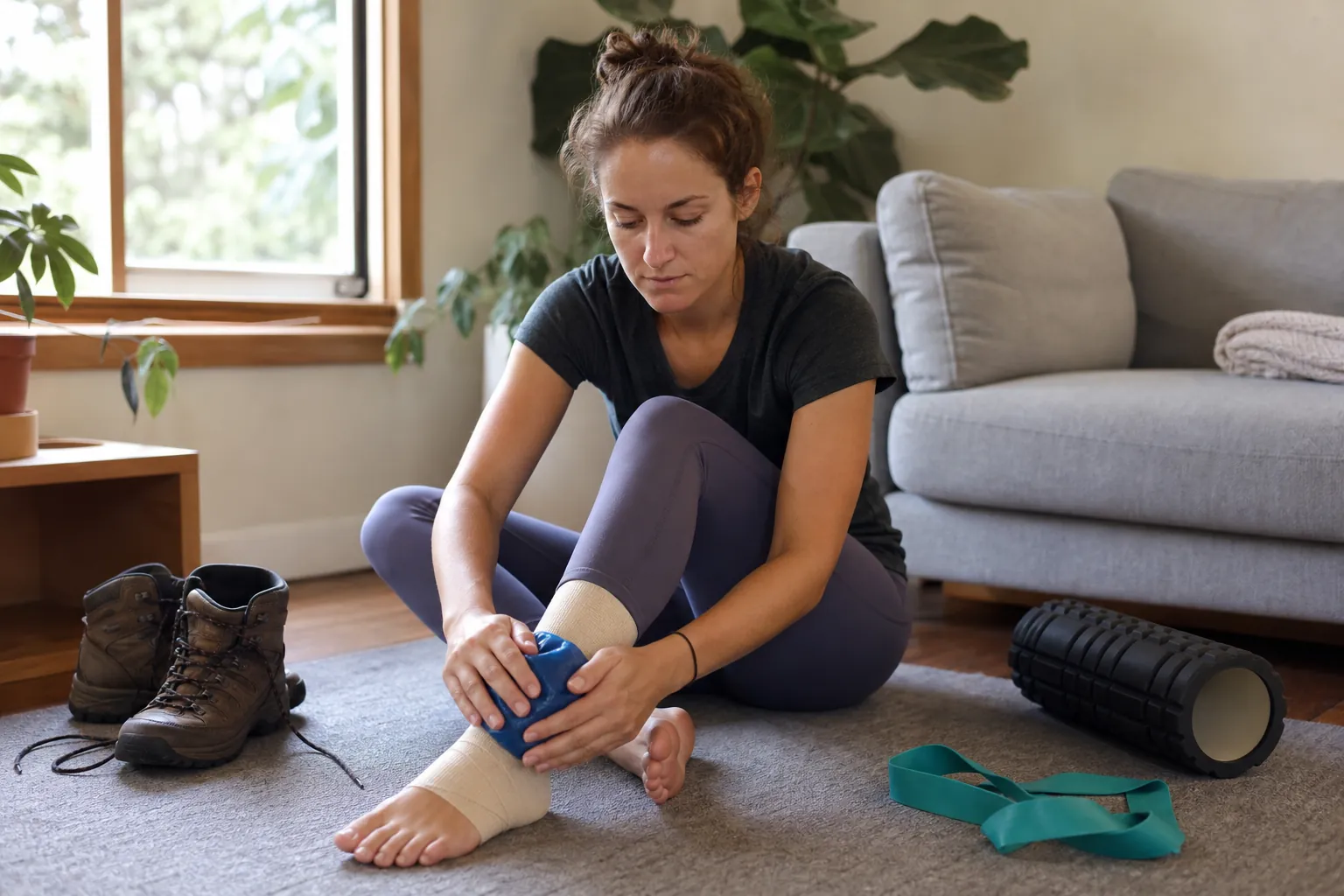
The first few days: calm the joint before testing it
The first phase is not the time to prove toughness. For a mild ankle sprain or knee strain that has already been medically cleared or does not show red flags, the early job is to reduce irritation: rest from aggravating movement, use ice and compression if appropriate, elevate when possible, and keep normal daily movement within a tolerable range. REI’s guidance places this kind of care at the front of ankle-sprain management.[10]
- Keep swelling visible: take note of whether the ankle or knee looks better, worse, or unchanged from morning to evening.
- Protect stairs: use a handrail, slow the descent, and avoid carrying heavy loads if the joint feels unstable.
- Do not turn pain into a fitness test: limping through errands is still loading.
- Call a clinician if weight bearing is sharply painful, symptoms worsen, or the injury does not behave like a mild strain or sprain.
A small home can still support this phase. A clear strip of floor, a chair, a towel, and a resistance band are often more useful than a crowded corner full of equipment. If space is the limiting factor, a simple small-space recovery exercise setup is enough to begin rebuilding movement without turning the living room into a gym.
Early loading: use pain as information, not a dare
Once the sharp phase settles, the mistake is usually doing either too much or nothing at all. Complete rest can leave the joint stiff and weak. Too much testing can keep it irritated. The middle ground is controlled loading: small, repeatable movements that are easy to stop when symptoms rise.
Treeline Review’s article with Blaze Physio describes isometric exercises as a way to reduce tendon pain for roughly 45 minutes after a session, and separately recommends a conservative return rule: increase hiking mileage by about 10% for each day off, rather than jumping straight back to the pre-injury load.[11] Those are not magic numbers for every injury, but they are useful guardrails because they force progression to be earned instead of assumed.
| Home recovery task | What it looks like in practice |
|---|---|
| Ankle range of motion | Gentle ankle circles, alphabet motions, or controlled flex-and-point work while seated. |
| Isometric loading | Press the foot or leg gently into an immovable object without moving through a painful range. |
| Balance reintroduction | Start near a wall or counter before trying unsupported single-leg work. |
| Walking progression | Add distance only if swelling, pain, and gait stay controlled afterward. |
| Return to uneven ground | Delay rocks, roots, sidehills, and descents until flat walking feels boringly reliable. |
Foot and ankle injuries deserve their own plan because they carry every step afterward. A phase-based foot injury recovery plan at home can help separate early protection from later strength work. The distinction matters. A person who starts calf raises, hops, or long walks before swelling and gait have normalized is not being disciplined; they are asking damaged tissue to solve a scheduling problem.
Knees and soft tissue: the descent often shows up later
Knee strains after off-trail travel often have a delayed quality. The hiker remembers the descent: sidehilling out of a basin, stepping down off granite blocks, braking on loose dirt, compensating for an ankle that already felt wrong. The next morning, stairs tell the truth.
For a non-emergency knee strain, the same broad logic applies: calm symptoms, preserve comfortable motion, then reload gradually. Deep lunges, jump training, weighted step-downs, and steep treadmill hikes belong later, not in the first burst of motivation. Lower-body stretching can help when it is used to restore comfortable movement rather than force range. A gentle lower-body recovery stretching routine can be adapted for hikers if painful positions are skipped and intensity stays modest.
Fall-related soft-tissue trauma is less tidy. A hip bruise, scraped shin, sore ribs, or shoulder jolt may not fit into a single named injury. That makes tracking more important, not less. Pain that spreads, swelling that increases, dizziness after a head impact, chest pain, shortness of breath, or a wound that looks infected should move the hiker out of home recovery and into medical evaluation.
A practical home plan after an off-trail Wyoming injury
The useful plan is not elaborate. It is honest about the first two weeks, because that is when many hikers either neglect the injury or poke at it until it becomes chronic.
| Phase | Main decision | Progress sign |
|---|---|---|
| Days 0-3 | Protect the injured area, reduce irritation, and seek care for red flags. | Pain and swelling are stable or improving, not escalating. |
| Days 4-14 | Restore comfortable range of motion and begin light, controlled loading if appropriate. | Walking becomes smoother and daily tasks cause less next-day soreness. |
| Weeks 2+ | Build strength, balance, and walking volume before returning to uneven terrain. | Flat walking, stairs, and basic strength work feel reliable. |
| Return to hiking | Increase mileage and terrain difficulty gradually instead of returning straight to the old route. | No meaningful symptom rebound after each increase. |
The home kit can stay plain: elastic wrap, ice pack, a firm chair, a resistance band, comfortable shoes, and a way to record symptoms. Recovery tools can be useful if they support the plan rather than replace it. A roller, compression tool, or massage device may help some people manage soreness, but the standard remains function: better walking, better stair control, less swelling, and steadier balance. If you are comparing home recovery tools, keep the question practical rather than gadget-driven: does this help you do the next appropriate step? A small-space recovery tool review can be useful only if it stays subordinate to that question.
The harder part is restraint. A hiker who can walk around the kitchen may still not be ready for a loaded descent. A knee that tolerates stretching may not tolerate sidehilling. An ankle that feels fine on carpet may still fail on loose rock. Wyoming punishes that gap because so much of the travel that drew the hiker there in the first place is uneven, remote, and slow to exit.
Plan past the evacuation
A complete off-trail plan for Wyoming includes the usual field decisions: route, weather, navigation, communication, bear awareness, turnaround time, and who knows the itinerary. But if the plan ends at “I can call for help,” it is still unfinished.
The missing questions are quieter. Who drives if the right ankle is wrapped and throbbing? How many stairs wait at home? Can work be modified for a week? Is there room to do range-of-motion work without stepping over gear? Is there a clinician to call if the injury does not improve? What is the first easy walk back, and what route is deliberately too hard for now?
Off-trail hiking in Wyoming is not automatically reckless. It can be careful, skilled, and deeply worth doing. But it changes the consequences of common injuries. A fall or ankle sprain is no longer just a trail mishap when it happens in talus, bear country, alpine weather, or a basin where help may arrive late or not at all. The more reliable standard is not fear and not bravado. It is whether the hiker has planned for the slow, unglamorous recovery after the mountain is already behind them.
References
- Wyoming SAR Teams Bailed Out Hikers the Most in 2024 — Wyoming Public Media, Jan. 3, 2025
- Wyoming Search and Rescue — Wyoming Office of Homeland Security
- Safety — Grand Teton National Park, National Park Service
- Hike Smart — National Park Service
- Hiker Suffers Serious Injuries in Wind River Mountains — SweetwaterNOW
- 59 Hiking Injury Statistics and Trends 2026 — KURU Footwear
- Medical Risks of Wilderness Hiking — PubMed, 2003
- New Data Reveal Why Hikers Called for Rescue in 2025 — Backpacker, Feb. 2026
- Why Some Lost Hikers Live and Others Die — National Geographic
- How to Prevent Common Hiking Injuries — REI Expert Advice
- Dealing with Pain on a Hike — Treeline Review / Blaze Physio
This is general fitness education, not medical advice. For diagnosis or treatment of pain or injury, consult a qualified clinician.
Pick your next session
Browse all routines to find an appropriately-spaced next session.
Spot something off?
This content sits adjacent to health guidance — tell us if a citation or figure needs a correction.