
Do Tylenol or Naproxen Sabotage Post-Workout Recovery?
If you take Tylenol or naproxen for post-workout soreness, you might worry about slowing muscle growth. This article breaks down the conflicting evidence to help you decide when it's safe to use and when it might backfire.
- Citation source
- Sports Medicine Review
- Evidence level
- restrained inference
The question usually shows up after the workout is already done. Your legs are trashed from split squats, your chest is tight from pressing, and tomorrow’s calendar does not care that you trained hard in a garage or spare room. A bottle of Tylenol or naproxen is sitting nearby, and the worry is not dramatic: if you take it, are you throwing away the muscle-growth signal you just earned?
The useful answer starts with a distinction that gets lost online: one or two doses for unusually bad soreness is a different recovery decision than taking high-dose NSAIDs after most workouts. For a typical under-60 home-gym lifter training for hypertrophy, routine high-dose NSAID use is the bigger concern. Occasional use is unlikely to matter much. Tylenol is not automatically “gain-neutral,” but it does avoid some NSAID-specific kidney concerns that matter when exercise, heat, sweat, and dehydration are in the picture.
Why lifters started worrying about Tylenol and NSAIDs
The worry did not come from gym folklore alone. In a 2002 study, researchers looked at muscle protein synthesis after a bout of eccentric resistance exercise and found that both ibuprofen and acetaminophen suppressed the normal post-exercise rise in muscle protein synthesis by roughly 30% to 50% compared with placebo.[1] That matters because muscle protein synthesis is one of the short-term signals lifters care about after training.
That finding also ruins a tidy shortcut. It is tempting to say NSAIDs are the muscle-growth problem and Tylenol is the safe workaround. The acute study does not support that clean split. Acetaminophen, the active ingredient in Tylenol, was not an NSAID, yet it still reduced the immediate post-exercise muscle protein synthesis response in that experiment.[1]
The stronger long-term concern comes from an eight-week training study in young adults ages 18 to 35. Participants taking high-dose ibuprofen at 1,200 mg per day had about half the muscle hypertrophy response compared with the low-dose aspirin group.[2] That is closer to the real fear: not just a lab signal after one session, but less growth after weeks of training.
Naproxen sits in the same practical conversation because it is an NSAID, but the evidence is not as direct. Much of the muscle-growth research uses ibuprofen, not naproxen. It is fair to be cautious about routine naproxen use because the class shares COX-inhibiting anti-inflammatory effects, but it is not fair to pretend every ibuprofen result proves the exact same outcome for naproxen at every dose and schedule.
The evidence does not point in one direction
If the story ended with the 2002 and 2018 studies, the rule would be simple: never take Tylenol or NSAIDs after lifting. But the research refuses to stay that neat.
In older adults, Trappe’s group reported the opposite pattern: people who took NSAIDs or acetaminophen during resistance training gained more muscle mass than placebo.[3] That does not mean younger hypertrophy-focused lifters should copy that approach. It means age changes the interpretation. A 25-year-old training four days per week for size is not automatically living in the same recovery biology as an older adult in a supervised resistance-training study.
A 2012 review by Brad Schoenfeld also took a more measured position, concluding there was little reason to believe occasional NSAID use negatively affects muscle growth.[4] That word occasional does a lot of work. It is the difference between using medication when soreness is exceptional and making pain relief part of the default post-workout stack.
The newer literature complicates the picture further. A 2025 Journal of Physiology study reported that NSAID ingestion augmented hypertrophy in trained men between days 28 and 84.[5] That is a problem for any scare-piece version of the story. It is a reminder that training status, timing, tissue environment, drug protocol, and measurement window can all shift the answer.
Even the mechanism remains unsettled. A follow-up analysis from the Lilja group could not identify clear differences in mTOR signaling, satellite cells, or ribosome biogenesis that explained the reduced hypertrophy seen with high-dose ibuprofen.[6] So the honest conclusion is narrower than “pain relievers kill gains.” The better question is whether your age, dose, frequency, and reason for taking the drug resemble the situations where adaptation looked worse.
The decision boundary for a home-gym lifter
For someone training alone, frequency is the cleanest place to start because it is the behavior you can actually see. You may not know your inflammatory signaling profile. You do know whether you are reaching for naproxen after every hard leg day.
| Pattern | How to think about it |
|---|---|
| One-off use after unusually bad soreness | Lower concern for hypertrophy, especially if the soreness is not injury-like and the dose follows the label |
| Use several times per week during a hypertrophy block | Higher concern, especially for under-60 lifters using NSAIDs to keep training through soreness |
| Taking naproxen or another NSAID before or after most workouts | Treat as a recovery-plan problem, not a clever recovery tool |
| Daily pain relief needed to train | This moves out of normal soreness management and belongs with a clinician |
That boundary is imperfect because the literature does not hand us a universal cutoff. Still, a practical home-gym rule is reasonable: rare use for exceptional soreness belongs in a lower-concern bucket; routine use, more than a couple of times per week, or use tied to nearly every hard session belongs in the riskier bucket.
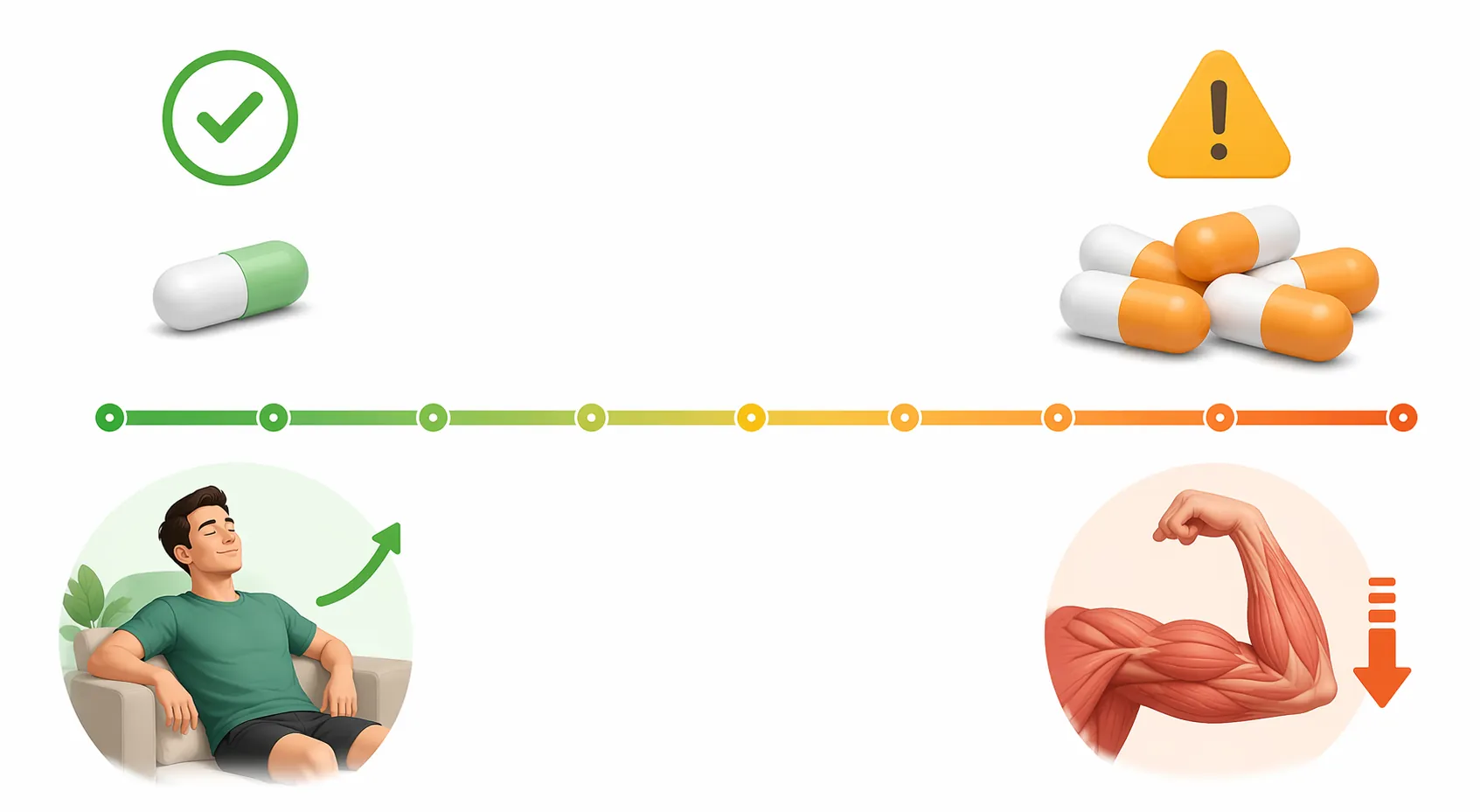
Dose matters because the negative young-adult study was not casual use
The Lilja study that should make younger lifters pay attention used 1,200 mg per day of ibuprofen for eight weeks.[2] That is not the same thing as taking an occasional labeled dose when soreness is unusually disruptive. The study is important because it shows chronic high-dose anti-inflammatory use can show up in long-term hypertrophy outcomes, not because it proves every isolated dose after a hard workout ruins the session.
Timing matters less than habit
People often ask whether taking Tylenol or naproxen immediately after training is worse than taking it later that night. The acute muscle protein synthesis study looked at the post-exercise period, so timing is not irrelevant.[1] But for real-life decision-making, the bigger issue is usually not the exact minute. It is whether the medication has become attached to training itself: lift, shower, take pills, repeat.
Reason for use matters because soreness and injury are different problems
Normal delayed-onset muscle soreness is uncomfortable, but it usually behaves like soreness: it comes after unfamiliar or harder work, spreads through the trained muscle, and fades. Sharp pain, joint pain, swelling, worsening pain, or pain that makes you change your movement is a different category. Medication can make that category easier to ignore, which is exactly why it can be a bad training partner.
If naproxen is what lets you keep loading a painful knee or shoulder several days a week, the gain-sabotage question is no longer the main question. The problem is that the drug is helping you override a signal your programming should probably respect.
Tylenol versus naproxen is not only a muscle-growth question
Tylenol and naproxen are often grouped together because both can reduce how sore you feel. They do not carry the same risk profile. Acetaminophen is not an NSAID. Naproxen is. That distinction matters most when the workout is long, hot, sweaty, or paired with poor hydration.
Houston Methodist advises against using NSAIDs as the first-line option for sore muscles after workouts and points to acetaminophen as a preferable occasional choice partly because NSAIDs can stress the kidneys, especially around exercise and dehydration.[7] Outside Online makes a similar practical recommendation, favoring acetaminophen over NSAIDs for exercise-induced aches when a pain reliever is needed.[8]
Harvard Health covered an ultramarathon study in which 44% of runners showed reduced kidney function, with worse results among those taking ibuprofen.[9] That was endurance racing, not a normal home hypertrophy workout, so it should not be dragged too far. But it does show why “NSAID plus exercise stress plus dehydration” is a separate safety issue from whether your biceps grow.
None of that makes acetaminophen harmless. It has its own dosing limits and liver-safety concerns, especially with alcohol or other acetaminophen-containing products. The point is narrower: if the situation is occasional soreness rather than injury, acetaminophen may be the more sensible first-line pain-relief choice for many lifters, while routine NSAID use deserves more hesitation.
What to do with soreness without turning pills into the plan
A recovery plan does not need to be anti-medication to be disciplined. It just needs to stop treating soreness relief as proof that recovery happened. A pain reliever can reduce the symptom while the workload, sleep debt, hydration problem, or programming mistake remains untouched.
- If soreness is ordinary, first adjust the next session: reduce load, range of motion, volume, or proximity to failure instead of masking the signal.
- If soreness is exceptional but not injury-like, an occasional labeled dose is unlikely to sabotage months of hypertrophy work.
- If soreness repeatedly requires naproxen or another NSAID to keep training, treat the pattern as a programming or recovery warning.
- If pain is sharp, joint-specific, worsening, swollen, or persistent, stop using a recovery article as the decision-maker and get medical help.
This is also where the boring recovery variables earn their keep. Protein intake, sleep quality, hydration, and sane progression are less convenient than a pill, but they are closer to the machinery you are trying to protect. If nutrition is the weak link, start with protein foods that support home workout muscle gain. If sleep is the recurring problem, recovery can be limited by issues as concrete as sleep apnea or hot-weather sleep disruption.
The sports-medicine recovery literature does not give strong support for using either NSAIDs or acetaminophen as a daily recovery aid.[10] That matches the common-sense home-gym rule: medication can be a tool for an unusual day, not the system that makes your training sustainable.
The practical rule
If you are under 60, training for hypertrophy, and asking about Tylenol or naproxen for post workout recovery, the cleanest rule is this: occasional use for unusually bad, non-injury soreness is unlikely to sabotage your gains; routine high-dose NSAID use after workouts is the pattern to avoid.
Tylenol is not automatically invisible to muscle adaptation, based on the acute protein-synthesis data.[1] Naproxen is not proven to blunt growth in every lifter just because ibuprofen did in one young-adult chronic study.[2] The most defensible decision is to match the evidence to the behavior: age, dose, frequency, timing, and why you need the drug.
For a more medication-specific choice, use the practical companion guide. For the gains question, the boundary is already clear enough: do not turn soreness relief into an automatic post-workout ritual, and do not use naproxen or any pain reliever to train through pain that keeps asking for attention.
References
- Effect of ibuprofen and acetaminophen on postexercise muscle protein synthesis, PubMed, 2002
- High doses of anti-inflammatory drugs compromise muscle strength and hypertrophic adaptations to resistance training in young adults, PubMed, 2018
- Influence of acetaminophen and ibuprofen on skeletal muscle adaptations to resistance exercise in older adults, PubMed, 2011
- The use of nonsteroidal anti-inflammatory drugs for exercise-induced muscle damage: implications for skeletal muscle development, PubMed, 2012
- Cyclooxygenase inhibition augments skeletal muscle hypertrophy in response to resistance exercise training in humans, The Journal of Physiology, 2025
- High doses of anti-inflammatory drugs compromise muscle strength and hypertrophic adaptations to resistance training in young adults: a randomized controlled trial, Journal of Applied Physiology, 2023
- Should You Take Pain Relievers for Sore Muscles After Workouts?, Houston Methodist, 2024
- Should You Take Pain Relievers for Exercise-Induced Aches?, Outside Online
- Is it safe to take ibuprofen for the aches and pains of exercise?, Harvard Health Publishing
- Evidence-Based Recovery Part 4: Medications and Supplements, Sports Med Review
This is general fitness education, not medical advice. For diagnosis or treatment of pain or injury, consult a qualified clinician.
Pick your next session
Browse all routines to find an appropriately-spaced next session.
Spot something off?
This content sits adjacent to health guidance — tell us if a citation or figure needs a correction.