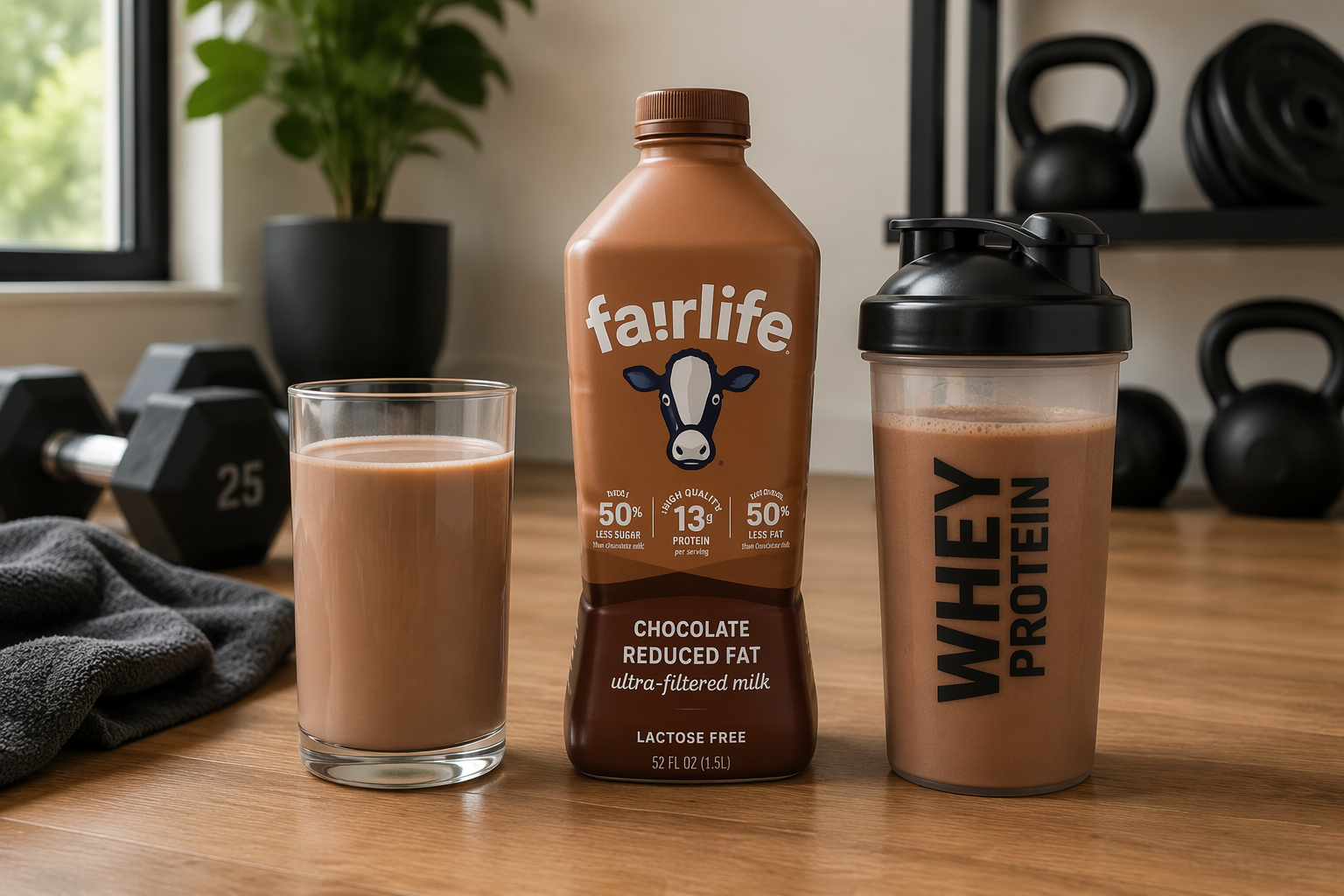
Fairlife milk for post workout recovery makes the most sense when the workout was real, but not massive: a 30- to 60-minute home session with dumbbells, a bike, a rower, circuits, or some mix of strength and conditioning. In that slot, Fairlife chocolate milk is more useful than regular chocolate milk if you want more protein and less sugar in the same familiar drink. It is less convincing if you need a large protein dose after heavy lifting, where a whey shake or a higher-protein Fairlife/Core Power-style drink is the cleaner fit.
The shelf-level comparison is not subtle once the labels are next to each other. Regular chocolate milk is cheap and carb-heavy. Fairlife chocolate milk is denser in protein and lighter on sugar. Whey wins the protein contest, but it is not really a complete recovery drink unless the rest of your meal or drink covers carbs, fluid, and electrolytes.
| Option | Protein | Carbs / sugar | Convenience | Hydration and minerals | Cost position |
|---|---|---|---|---|---|
| Regular chocolate milk | About 8g protein per cup in regular milk [1] | Typically carb-forward; traditional chocolate milk is often discussed around a 3:1 or 4:1 carb-to-protein recovery ratio [2] | Pour and drink | Milk-based fluid with naturally occurring minerals | Usually the budget pick |
| Fairlife chocolate ultra-filtered milk | 13g protein per 1-cup serving [3] | 13g carbs and 12g sugar per serving on Fairlife chocolate 2% nutrition labeling [3] | Pour and drink; lactose-free [3] | Milk-based fluid plus calcium, vitamin D, sodium, and potassium listed on the label [3] | Premium grocery option |
| Whey protein shake | Commonly 25–40g protein per shake, depending on serving size and product | Often low-carb unless mixed with milk, fruit, or another carb source | Requires mixing unless bought ready-to-drink | Usually weaker as a built-in fluid, carb, and electrolyte package unless you build it that way | Strong protein-per-serving value, but not as grab-and-go |
The Difference Starts With Ultra-Filtration
Fairlife is not just regular milk with a cleaner label slapped on the front. Its useful difference comes from ultra-filtration, which concentrates milk protein while reducing sugar. Fairlife describes its process as separating milk into components, then recombining them so the finished milk has more protein and less sugar than regular milk; the brand’s general protein explainer lists 13g protein per cup for Fairlife ultra-filtered milk versus 8g per cup for regular milk [1].
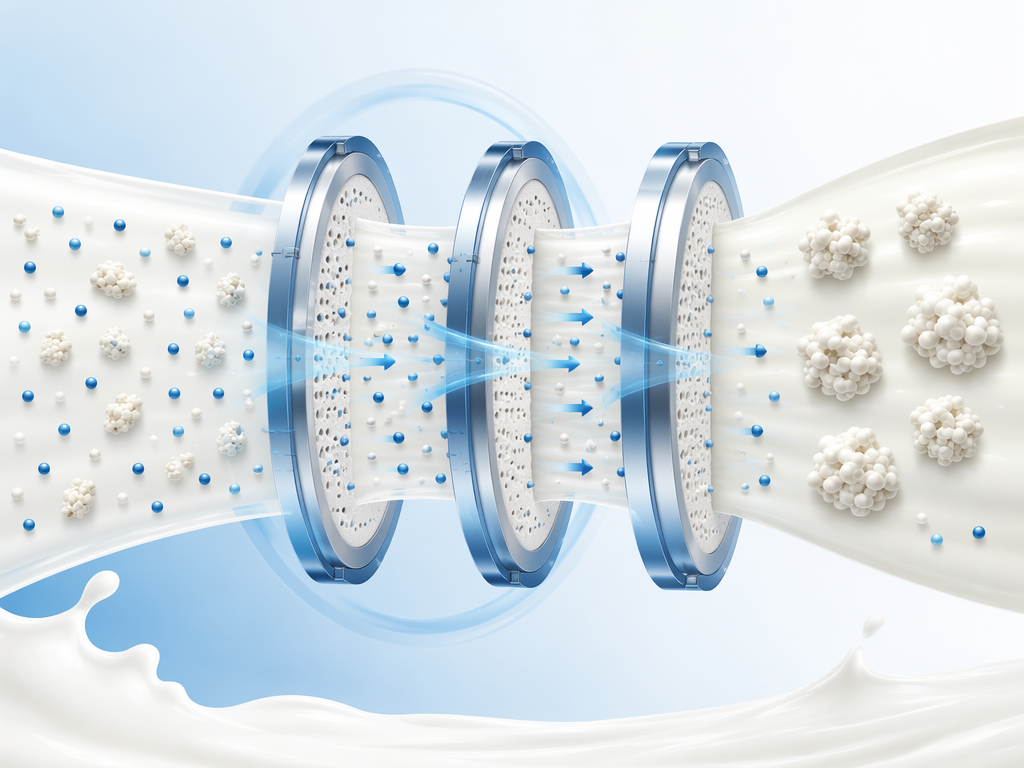
That is the whole reason Fairlife lands in a different recovery lane from regular chocolate milk. It is still milk. It still gives you fluid, carbs, calcium, vitamin D, sodium, and potassium in the chocolate 2% version’s nutrition panel [3]. But it shifts the balance toward protein without turning the drink into a pure protein supplement.
For a home workout, that shift matters. A moderate lifting or mixed cardio-strength session usually does not require treating recovery like a second sport. You may just need something you can drink before answering email, getting dinner started, or putting equipment away. Fairlife’s advantage is that it improves the protein side of chocolate milk without asking you to scoop powder, wash a shaker, or turn the snack into a project.
Regular Chocolate Milk Still Has a Job
Regular chocolate milk gets dismissed too quickly by people who only look at sugar. The higher carb load is part of why chocolate milk became a recovery staple in the first place. A traditional cup gives less protein than Fairlife, but its carb-heavy profile lines up better with workouts that drain glycogen: longer cycling sessions, hard intervals, running, or high-volume conditioning.
A 2019 systematic review and meta-analysis of 12 controlled trials found chocolate milk produced similar or superior recovery effects compared with placebo or sports drinks [4]. That supports chocolate milk as a category. It does not prove that Fairlife chocolate milk, specifically, has been shown in controlled trials to outperform regular chocolate milk after training.
There is also a budget reality. If someone is training several days per week and already tolerates regular milk, plain old chocolate milk remains the cheap, easy option. It loses on protein density and sugar control, but it does not lose on availability or price. For a household buying groceries carefully, that can be the deciding factor.
The Carb-to-Protein Ratio Changes the Use Case
Traditional chocolate milk is often framed around a 3:1 or 4:1 carb-to-protein ratio, a pattern aimed at replenishing glycogen while also supplying protein [2]. Fairlife chocolate milk sits much closer to a balanced ratio, with 13g protein and 13g carbs per serving on the chocolate 2% label [3]. That does not make one universally better. It makes them better for different workouts.
| Workout type | What recovery probably needs most | Best fit |
|---|---|---|
| 30-minute dumbbell session | A moderate protein dose, some fluid, easy calories | Fairlife chocolate milk |
| 45- to 60-minute mixed strength and bike workout | Protein plus some carbs and fluid | Fairlife chocolate milk, or regular chocolate milk if budget matters more |
| Long endurance or hard interval session | More carbohydrate for glycogen replacement | Regular chocolate milk, possibly with a meal |
| Heavy lifting session with high volume | More total protein than one cup of Fairlife provides | Whey shake or higher-protein ready-to-drink option |
| Quick recovery before a full meal soon after | Convenience, tolerability, enough nutrition to bridge the gap | Fairlife or regular chocolate milk |
This is where Fairlife’s middle-ground status is actually useful. Many home workouts are not long enough to demand a huge carb replacement drink, but they are also not so trivial that water alone feels like enough. Fairlife gives a little of everything, with a stronger protein showing than regular chocolate milk and fewer carbs than the classic recovery ratio.
The trade-off is obvious after harder sessions. If the workout was long enough that your legs feel emptied out, Fairlife’s lower-carb profile may be less helpful than regular chocolate milk or a carb-containing meal. If the workout was heavy enough that protein is the main recovery priority, 13g is probably not the finish line.
Where Whey Beats Both Milks
Whey is the obvious winner if the only scoreboard is protein per serving. A typical shake can land in the 25–40g range depending on the product and serving size, which makes Fairlife chocolate milk’s 13g look modest. For a heavy lifter finishing a long lower-body day or a high-volume strength block, that difference is not a detail. It can determine whether the drink is the recovery serving or just part of one.
The reason whey does not automatically win for everyone is that it usually arrives as an ingredient, not a complete post-workout drink. If mixed with water, it gives protein and fluid, but very little carbohydrate. Depending on the workout, that may be fine. It may also mean you need a banana, a meal, a sports drink, or milk in the shaker to cover what Fairlife or chocolate milk already includes by default.
Convenience matters more than people admit. A tub of whey can be economical and effective, but it still asks you to measure, mix, rinse, and remember. That is not hard. It is just enough friction that some people skip it, especially after evening workouts or short sessions squeezed between obligations. A ready-to-drink bottle or carton solves that problem at a higher price.
The Evidence Is Stronger for Chocolate Milk Than for Fairlife Specifically
Verywell Fit named Fairlife Chocolate 2% Ultra-Filtered Milk its best post-workout recovery drink overall in 2024, with dietitian review behind the ranking [5]. That is a useful third-party signal, especially because the pick is not coming from Fairlife’s own marketing.
Still, a product ranking is not the same as a controlled recovery trial. The controlled evidence base cited most often belongs to chocolate milk more broadly, not to Fairlife’s ultra-filtered chocolate milk as a branded intervention. The 2019 meta-analysis supports the idea that chocolate milk can compare well with placebo and sports drinks after exercise [4]. It does not tell us that Fairlife’s 13g-protein, lower-sugar formula produces better recovery outcomes than standard chocolate milk.
One review summarized a study in adolescent athletes where those given chocolate milk after training consumed 473ml with 44g carbohydrate and 16g protein, and saw average strength gains of 20.5kg over 7 weeks versus 4.8kg for a carbohydrate-only drink [6]. That is a useful reminder that the protein in chocolate milk is not decorative. But again, the lesson is about protein-containing chocolate milk in recovery, not a direct Fairlife-versus-whey-versus-regular-milk trial.
That leaves the practical conclusion in a narrower, more honest place: Fairlife has a label that lines up well with moderate recovery needs, and chocolate milk as a category has supportive research. The missing piece is Fairlife-specific outcome research.
Who Should Choose Fairlife Chocolate Milk
Fairlife chocolate milk is easiest to justify for someone training at home 3–5 days per week, usually for 30–60 minutes, who wants a recovery drink that is better built than regular chocolate milk but less fussy than a shake. That person may not need 40g of protein immediately after every session. They may need a reliable drink with enough protein to matter, some carbs, fluid, and minerals, with a taste that does not feel like a chore.
- Choose Fairlife if your workouts are moderate strength, cycling, rowing, circuits, or mixed sessions lasting about 30–60 minutes.
- Choose Fairlife if regular chocolate milk feels too sugary for the amount of protein it gives.
- Choose Fairlife if convenience is the difference between taking recovery seriously and skipping it.
- Choose Fairlife if lactose-free milk is easier for you to tolerate; Fairlife’s ultra-filtered milks are labeled lactose-free [3].
- Choose Fairlife if you want a grocery-store recovery option rather than a supplement routine.
The premium is the catch. Fairlife is not the cheapest way to get calories after a workout, and it is not the cheapest way to get protein. What it sells is the combination: more protein than regular chocolate milk, less sugar than regular chocolate milk, and fewer steps than whey.
Who Should Stick With Regular Chocolate Milk
Regular chocolate milk is still the budget pick. If the cost difference decides whether you can use a recovery drink consistently, regular chocolate milk wins. Consistency beats a premium carton that only appears in the fridge once in a while.
It also makes sense after longer or more glycogen-draining sessions, especially when the goal is to replace carbohydrate along with getting some protein. The higher sugar content is not automatically a flaw in that setting. It is fuel returning to the system.
The reason to move away from regular chocolate milk is not that it is useless. It is that the protein return per serving can look light for strength-focused training, and the sugar may feel high if the workout was only moderate. That is the opening Fairlife walks through.
Who Should Use Whey or Core Power Instead
If the session was heavy, long, or built around progressive strength work, Fairlife chocolate milk may be too small a protein serving on its own. This is where whey earns its place. It gives you a larger protein dose without requiring multiple cups of milk, and it is easier to scale up or down.
Fairlife’s own sports-positioned Core Power line sits closer to that need than regular Fairlife chocolate milk. Fairlife describes Core Power as a protein shake line and notes its “Official Protein Shake of FIFA World Cup” and U.S. Soccer designations [7]. That does not prove it is the best recovery drink for your workout, but it does show the product is positioned differently from a standard cup of ultra-filtered chocolate milk.
For heavy lifters, the cleaner choice is usually simple: use whey or a higher-protein ready-to-drink shake as the protein anchor, then add carbs and electrolytes if the workout calls for them. Fairlife chocolate milk can still be part of the day. It just should not be mistaken for a high-protein recovery shake.
The Price Question
Price is where the tidy nutrition argument gets messier. Regular chocolate milk usually wins the grocery-budget test. Fairlife asks you to pay more for a denser nutrition profile and lactose-free convenience. Whey often wins on protein per serving, but the real cost depends on whether you also need milk, fruit, a separate carb source, or a ready-to-drink format.
The fair comparison is not “Which one has the best label?” It is “Which one will I actually use after the workouts I actually do?” If Fairlife replaces a skipped recovery snack, it may be worth the premium. If it replaces cheap chocolate milk after long cardio sessions, the upgrade is less obvious. If it replaces whey after heavy lifting, it may underdeliver on protein unless another meal is coming soon.
Local pricing matters enough that it should be checked instead of assumed. Look at the cost per serving, not just the bottle price, and compare it with how often you train. A drink that makes sense twice a week may feel different when it becomes a 5-day habit.
Practical Verdict
Fairlife chocolate milk is worth considering for post-workout recovery when the workout is moderate, the recovery window is busy, and you want more protein with less sugar than regular chocolate milk. It is a strong fit for many home gym sessions because it covers several needs at once: protein, some carbs, fluid, and milk’s mineral package.
Regular chocolate milk is the better budget choice and can be especially useful after longer carb-draining work. Whey, or a higher-protein ready-to-drink option such as Core Power, is the better choice when the session demands a larger protein dose. Regular Fairlife chocolate milk does not need to be treated like a miracle recovery product to be useful. Its best case is simpler: it is a convenient middle option for realistic home training.
References
- How Much Protein Is in Milk? — fairlife
- Why You Should Drink Chocolate Milk Post Workout — Cooper Aerobics, July 27, 2018
- 2% Reduced Fat Ultra-Filtered Milk — fairlife
- Effectiveness of chocolate milk on recovery from exercise: a systematic review and meta-analysis of controlled clinical trials — PubMed
- The Best Post-Workout Recovery Drinks of 2024 — Verywell Fit, 2024
- Back to basics: Chocolate milk in recovery and performance — Science for Sport, 2018
- Core Power — fairlife




Comments
Join the discussion with an anonymous comment.