
The most useful moment for an Oura Ring fitness tracker is not during the workout. It is the quiet minute before the workout, when the app says your Readiness is low, your HRV is drifting down, your temperature is a little elevated, and your plan still says legs, intervals, or full-body strength.
That is where home training gets messy. No coach is watching the week accumulate. Adjustable dumbbells do not know that yesterday’s “light” ride turned into a threshold session. A mat and an exercise bike will let you keep proving discipline long after judgment has left the room.
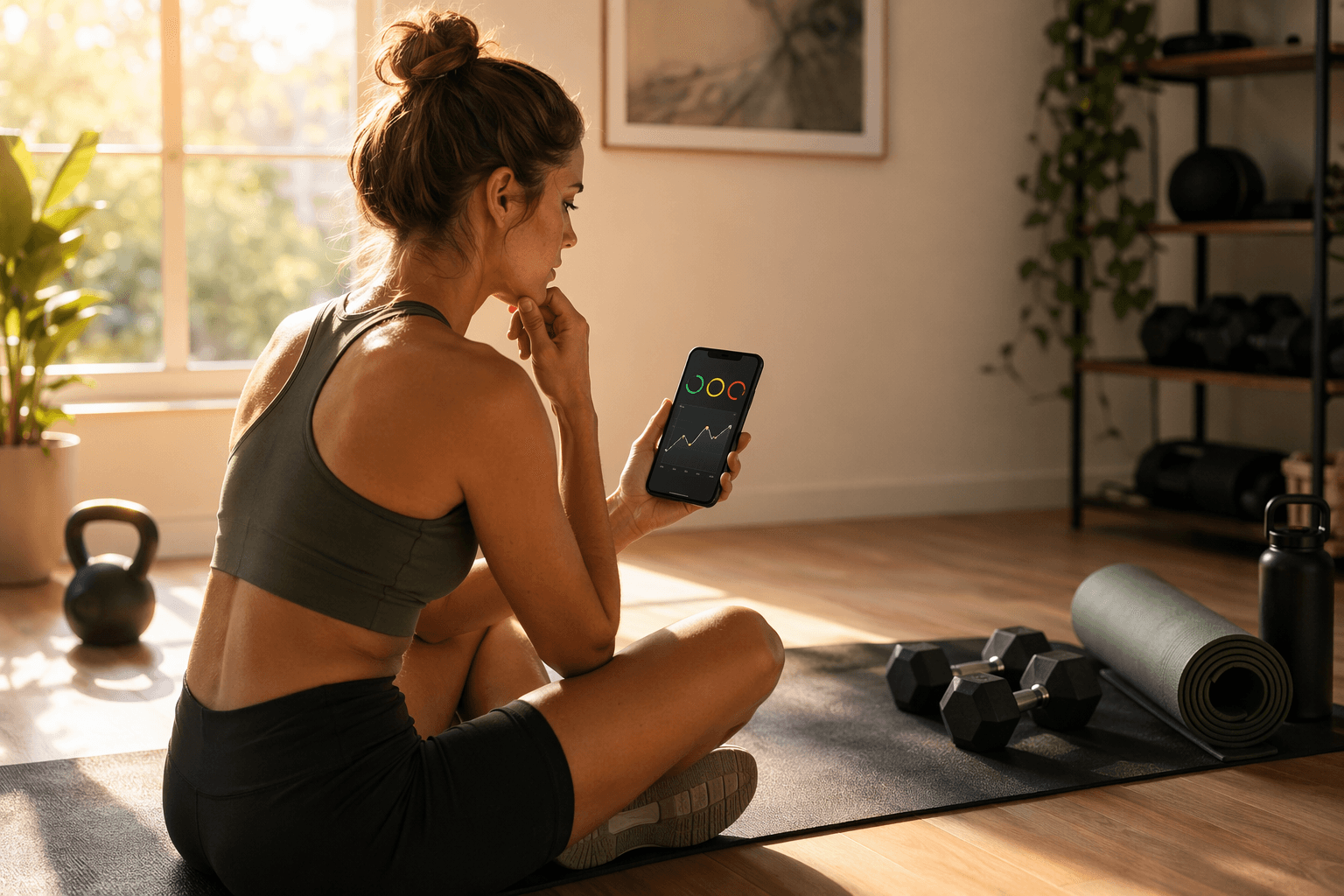
Oura is strongest here as a recovery governor, not as a complete workout tracker. It will not count your dumbbell reps with coaching-level context, measure whether your quads are ready after split squats, or replace a chest strap for hard interval work. Its value is simpler: it gives you an objective stoplight before you make another training decision based only on motivation, soreness, or guilt.
Start with the Readiness stoplight
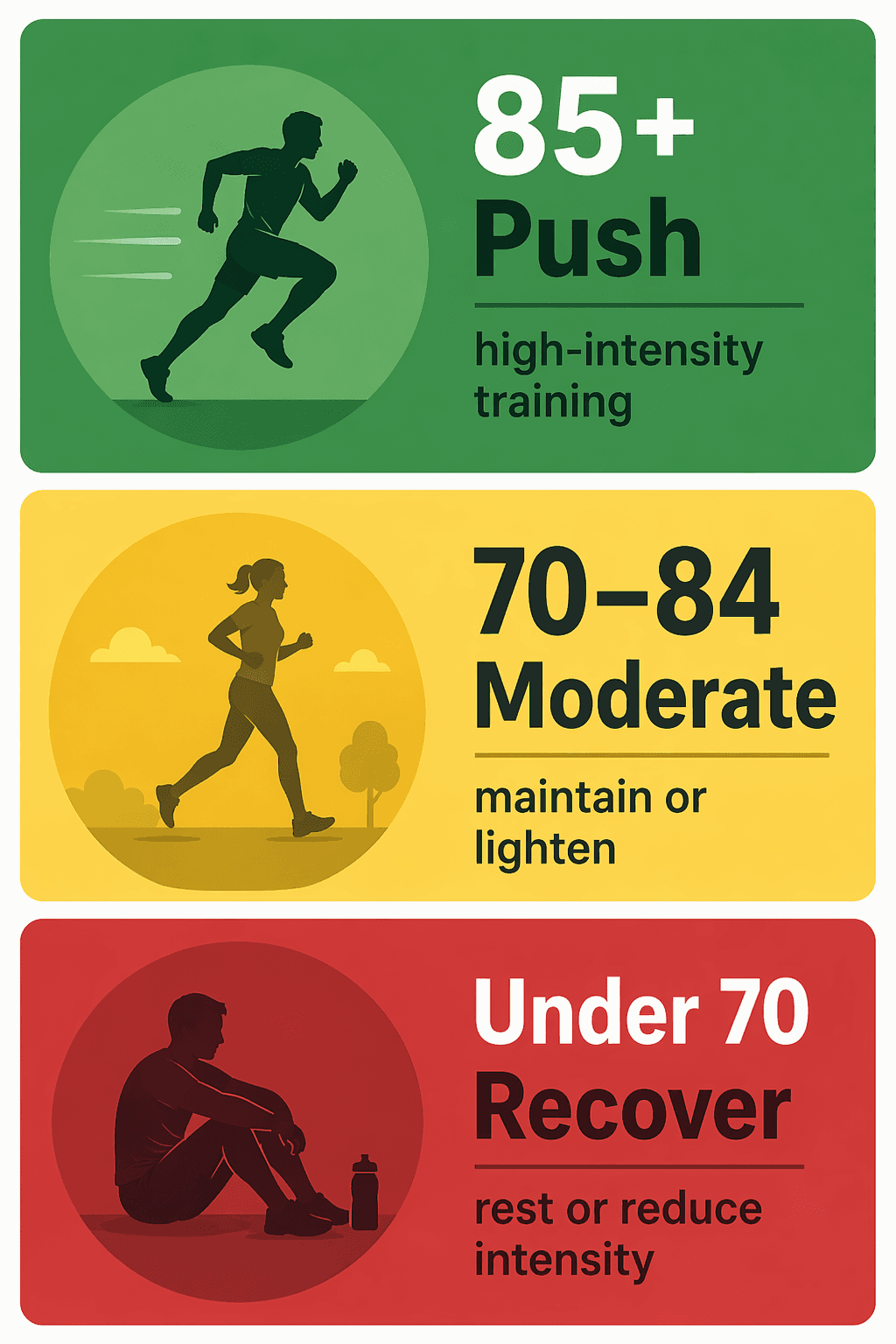
Oura’s official Readiness guidance is useful because it turns a messy morning dashboard into a first decision. A Readiness Score of 85 or higher means you are in the “optimal” range and generally ready for action. A score from 70 to 84 means you have recovered well enough for moderate training. A score below 70 is a warning to pay attention because you may not be fully recovered.[1]
| Oura Readiness | Training decision | What that can look like at home |
|---|---|---|
| 85+ | Push | Heavy strength work, planned progression, intervals, or a demanding full-body session if your body also feels ready |
| 70–84 | Maintain or moderate | Keep the workout, but avoid turning every set or interval into a test |
| Under 70 | Recover or reduce | Rest, mobility, easy Zone 2-style cardio, technique work, or a sharply reduced version of the plan |
Those thresholds should be treated as a starting rule, not a command system. If your Readiness is 86 but your knees feel beaten up from lunges, the number does not make heavy lower-body work intelligent. If your score is 68 after one short night but your HRV trend is stable and the planned session is easy mobility, the day may not need to become a full shutdown.
The practical rule is to let Readiness set the ceiling for the day. High Readiness permits intensity; it does not require it. Low Readiness asks you to justify intensity before you do it.
Use HRV as a trend, not a morning verdict
A single low HRV reading can be noise. A sliding pattern is more useful. Oura’s HRV Balance compares recent HRV with a longer-term average over several weeks, which makes it better suited for spotting accumulated stress than for judging one isolated morning.[1]
For home training, the useful question is not “What is my HRV today?” It is “Is my 7-day HRV direction supporting the work I keep adding?” A declining 7-day average, especially when paired with lower Readiness and higher resting heart rate, is an early reason to stop stacking hard days.
A reasonable operating heuristic is to reduce training load by about 30–50% for 3–5 days when your HRV trend is clearly falling and Readiness is repeatedly soft. That is not a clinically validated prescription. It is a practical starting adjustment: fewer sets, lower load, easier intervals, longer rests, or replacing a hard workout with active recovery.
For strength work, a 30–50% reduction might mean keeping the movement pattern but cutting total sets. A planned dumbbell squat day could become two easy technique sets and some mobility. A full-body progression from a dumbbell workout plan might hold the same exercises but remove the progression target for the day.
For cardio, the same reduction usually means changing intensity before changing everything else. The hard bike intervals become an easy aerobic ride. The progression session from a home cardio program becomes a maintenance day instead of a fitness test.
What to do with one bad morning
One bad morning should make you check the rest of the dashboard, not panic. Look at the 7-day HRV direction, resting heart rate, temperature, sleep, and how your body feels when you walk downstairs or warm up. If only one signal is off, use a longer warm-up and cap the workout. If several signals are off, reduce the plan before the first set.
This is where a ring beats memory. Most people remember yesterday’s workout. Fewer remember the accumulation of the last six days clearly enough to make a good decision.
Temperature changes the decision faster than soreness does
Soreness often tempts negotiation. Elevated body temperature should get less negotiation, especially when it appears with low Readiness, lower HRV, or Symptom Radar warnings.
Oura reports that its temperature detection is more than 99% accurate compared with research-grade sensors and can detect changes as small as 0.13°C; that accuracy figure is based on Oura’s internal data, not an independent peer-reviewed validation.[2][3] The practical threshold worth watching is a temperature elevation around 0.3–0.5°C above your baseline, which may reflect immune response, illness onset, or hormonal phase rather than training readiness alone.[2][3]
When temperature is elevated, the question changes from “Can I train lighter?” to “Am I about to spend the rest of the week recovering from a workout I did not need?” If the app prompts Rest Mode, take it seriously. Oura says Rest Mode disables Activity Score and activity goals, and reweights Readiness toward recovery signals such as resting heart rate, HRV balance, recovery index, body temperature, and previous night sleep.[4]
That matters because activity goals can be the wrong incentive at exactly the wrong time. If the body is showing strain, chasing a burn, streak, or step target is just another way to turn recovery into a performance task.
Fold Symptom Radar into the same morning check
Symptom Radar belongs beside Readiness and HRV, not in a separate novelty folder. It monitors changes in body temperature, respiratory rate, resting heart rate, and HRV, then labels the signal as no signs, minor signs, or major signs.[5][6][7]
Several reviewers have reported that Symptom Radar appeared to flag illness 1–2 days before they felt obvious symptoms.[5][6][7] Those are reviewer experiences, not proof that every user will get that warning. Still, the decision rule is easy: if Symptom Radar shows major signs, do not treat the day like a normal training day. If it shows minor signs and the rest of the dashboard is soft, reduce or rest.
The cost of being conservative here is usually one lighter day. The cost of being stubborn can be the training week.
A morning decision loop that actually changes the workout
The dashboard only helps if it changes the session. Before training, run the same short sequence:
- Check Readiness first. Use 85+, 70–84, and under 70 as the starting ceiling for intensity.
- Compare HRV with the 7-day trend. A one-day dip asks for caution; a declining trend asks for load reduction.
- Scan body temperature. A meaningful elevation moves the decision toward recovery, especially if other signals agree.
- Check Symptom Radar. Minor or major signs should lower the day’s ambition.
- Ask one subjective question: do the first five minutes of movement feel better, the same, or worse than expected?
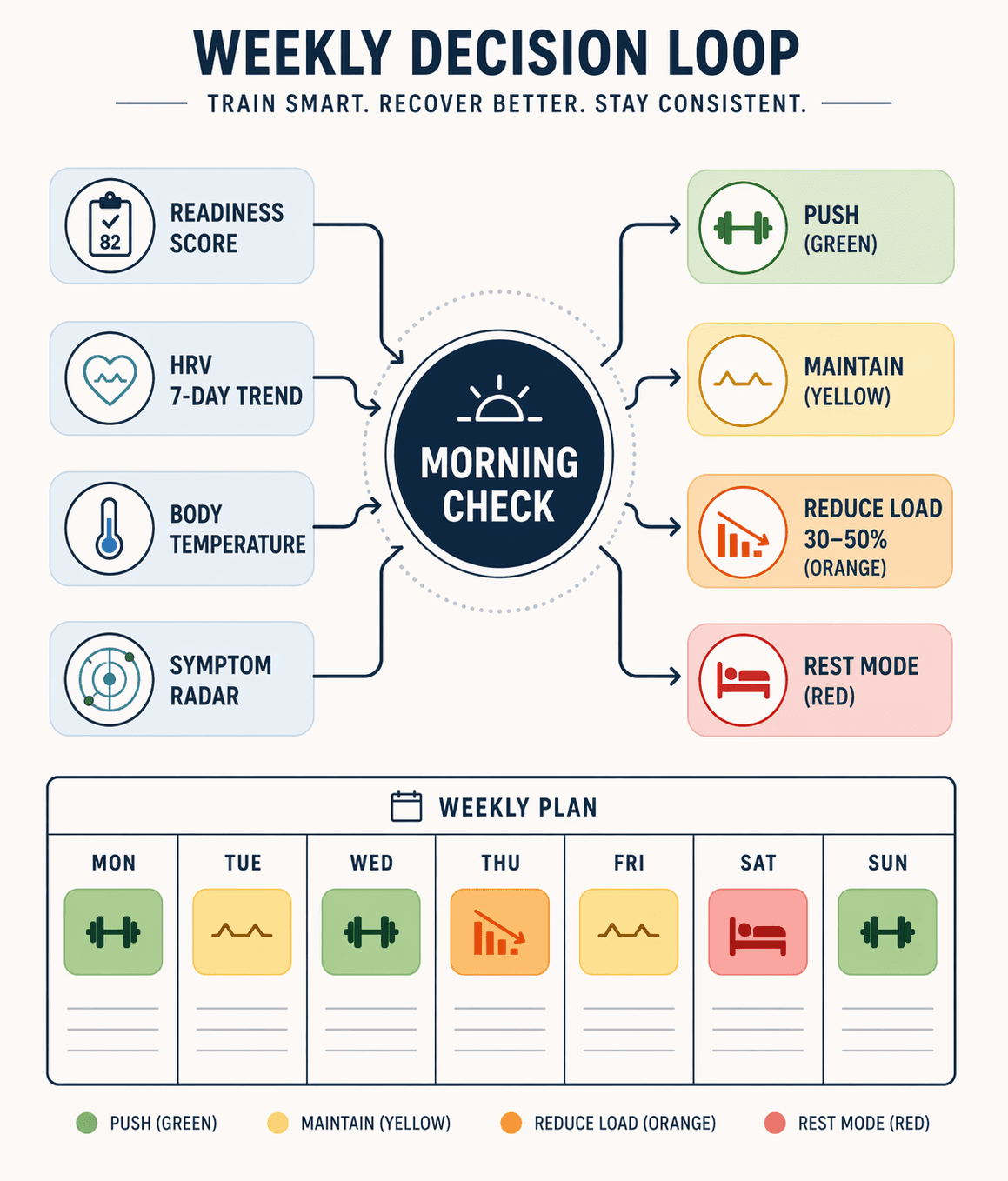
That last subjective check is not a loophole. It is a safeguard against pretending the ring knows everything. If Readiness is good but your warm-up feels unusually heavy, downshift. If Readiness is moderate and movement improves quickly, a controlled maintenance workout may be fine.
| Signal pattern | Decision | Example adjustment |
|---|---|---|
| Readiness 85+, HRV stable or rising, normal temperature, no Symptom Radar signs | Push | Do the planned hard strength or cardio session |
| Readiness 70–84, HRV stable, normal temperature | Maintain | Train as planned but avoid extra sets or intensity creep |
| Readiness 70–84, HRV falling for several days | Reduce | Cut load or volume 30–50% for several days and reassess |
| Readiness under 70, elevated temperature, or major Symptom Radar signs | Stop chasing training goals | Rest, enable or accept Rest Mode, and protect recovery |
Build the week from patterns, not heroic single days
Daily decisions prevent bad workouts. Weekly review prevents bad patterns. Once or twice a week, look back at Readiness, 7-day HRV direction, body temperature notes, Rest Mode prompts, Symptom Radar alerts, and how the workouts actually felt.
Oura’s Resilience Score can help here because it looks across a 14-day window and reflects nighttime recovery, daytime recovery, and daytime stress load. The Sleep Health Score is even longer range, using a 90-day window. Those scores are not daily workout commands, but they can show whether your current training rhythm is leaving enough room for recovery.
Here is an illustrative week, not a sourced case. It shows how a home athlete training four to six days per week might let Oura change the plan before fatigue becomes obvious.
| Day | Morning signals | Original plan | Adjusted decision |
|---|---|---|---|
| Monday | Readiness high, HRV stable, normal temperature | Lower-body strength | Push the planned session |
| Tuesday | Readiness moderate, HRV stable | Easy bike ride | Maintain, keep it easy |
| Wednesday | Readiness moderate, HRV begins dipping | Full-body dumbbells | Keep movement pattern, remove progression work |
| Thursday | Readiness under 70, HRV still down | Intervals | Replace with mobility or active recovery |
| Friday | Temperature elevated and Symptom Radar shows signs | Upper-body strength | Rest or accept Rest Mode |
| Saturday | Temperature normalizing, Readiness improving | Cardio | Easy aerobic work only |
| Sunday | Trend recovering | Optional workout | Review week and plan next hard day only if signals continue improving |
The important move in that example is not the exact schedule. It is the willingness to change Thursday before Friday forces the issue. Active recovery can still be training if it improves the next useful session; foam rolling, mobility, walking, or easy spinning all belong in that category when the data is pointing down. For more ideas, see this guide to foam rolling and active recovery for home gym training.
What Oura should not be asked to do
Oura’s recovery signals are useful, but the ring is not a full training system. It cannot measure muscle-specific recovery. It cannot tell whether your hamstrings are ready for Romanian deadlifts after a hard hinge day. It cannot directly measure central nervous system fatigue in a way that tells you which lift to change.
It is also not the strongest tool for serious workout measurement. If you care about interval heart rate, cycling intensity, running pace, lifting volume, or rep-by-rep progression, pair the ring with the right tool for that job. A chest strap, watch, band, or bike computer may make more sense during training. This is where a two-device fitness tracker setup can be more honest than expecting one ring to do everything.
The sleep data also deserves restraint. In an independent validation study of the first-generation Oura ring with 41 adolescents and young adults, Oura showed 96% sensitivity for detecting sleep compared with polysomnography, but only 48% specificity for detecting wake. It also underestimated deep sleep by about 20 minutes and overestimated REM sleep by about 17 minutes.[8]
That study used first-generation hardware and algorithms, so it should not be treated as a direct accuracy verdict on newer rings. Oura’s newer sleep-staging accuracy claims, including claims for more recent generations, remain internal claims as of June 2026 rather than independently published validation of the same kind. For a broader accuracy discussion, see this guide to fitness tracker ring accuracy.
The same validation study found that Oura correctly categorized 90.9% of sleepers under 6 hours, 81.3% of sleepers between 6 and 7 hours, and 92.9% of sleepers at 7 hours or more into polysomnography-defined total sleep time ranges.[8] That is useful context for recovery habits. It still does not mean the app can tell you exactly how much heavy pressing your shoulders can tolerate today.
A simple operating rule for home training
Use Oura in this order: check Readiness, compare HRV with its trend, scan temperature and Symptom Radar, decide today’s intensity, then review the pattern across the week.
- Push when Readiness is high, HRV is stable or improving, temperature is normal, and your warm-up confirms it.
- Maintain when Readiness is moderate and the trend is not deteriorating.
- Reduce when HRV is sliding for several days, Readiness is soft, or the workout feels unusually heavy early.
- Stop chasing training goals when temperature is elevated, Rest Mode appears, or Symptom Radar shows meaningful signs of strain.
If you need the basic recovery-data walkthrough before building this decision loop, start with how to use Oura Ring recovery data for smarter home workouts. If you are still deciding whether Oura is the right recovery tool compared with Whoop or Garmin, this fitness tracker recovery comparison is the better place to sort that out.
Oura will not coach every rep, and it should not override common sense. But for the home athlete training without a coach, it can make recovery visible early enough to prevent the kind of overtraining crash that usually teaches the lesson too late.
References
- Your Oura Readiness Score & How To Measure It — Oura Blog, May 2026
- How Oura Measures Temperature — Oura Blog
- Oura Ring Review: Pros, Cons And Is It Worth It? — Wirecutter
- Oura's Rest Mode Feature Helps Optimize Your Recovery — Oura Blog
- Oura Ring Review — Forbes Vetted
- Oura Ring 4 Review — Business Insider
- Oura Ring 4 Review — Cosmopolitan
- The Sleep of the Ring: Comparison of the ŌURA Sleep Tracker Against Polysomnography — PMC / NIH

Comments
Join the discussion with an anonymous comment.