
If your sciatica is mild to moderate and you have been cleared for gentle exercise, a safer home workout is not a random list of stretches. It is a short routine with decision points: move a little, check whether symptoms improve or travel farther down the leg, then keep only the exercises your body is tolerating.
Do not start this workout if you have sudden loss of bladder or bowel control, numbness in the groin or saddle area, progressive leg weakness, symptoms after a fall or accident, fever, unexplained weight loss, or pain so severe that gentle position changes make it worse. Those are not “stretch it out” situations. Get medical evaluation first.
For non-emergency sciatica, movement is usually a better starting point than waiting motionless on the couch. Spine-health’s exercise guidance emphasizes staying active and using targeted movement rather than relying on extended rest, while noting that the right exercise depends on the underlying cause of symptoms.[1] Disc-related sciatica also has a generally favorable outlook: OrthoNJ, citing AAOS, reports that about 80% to 90% of people with sciatica from a herniated disc improve over time without surgery, but that number should not be stretched to cover every cause of sciatic-type pain.[2]
The 20-Minute Sciatica Home Workout
Use a mat, a chair, and a timer. Keep every movement in a mild, controlled range. During the routine, watch for one specific response: does pain move closer to your low back or buttock, or does it travel farther down your thigh, calf, or foot? Closer to the spine is usually the better sign. Farther down the leg is a reason to stop or change the exercise.
| Time | Block | What to do |
|---|---|---|
| 0:00-3:00 | Warm-up | Easy walking in place, pelvic tilts, and gentle hip shifts |
| 3:00-10:00 | Core and hip strength | Glute bridge, clamshell, and bird-dog |
| 10:00-15:00 | Directional-relief block | Choose prone press-ups or knee-to-chest based on symptom response |
| 15:00-18:00 | Nerve glide | Seated sciatic nerve slider, gentle and rhythmic |
| 18:00-20:00 | Cool-down | Comfortable breathing position and final symptom check |
Hospital for Special Surgery physical therapist Brian Jones notes that sciatica exercises can be done daily if they feel good, with 8 to 10 repetitions per exercise and at least twice weekly as a baseline.[3] For this routine, 5 to 6 days per week is reasonable if symptoms are calm during and after the session. If you are sore, irritable, or unsure, use fewer reps and more rest.
Start With Three Minutes of Easy Motion
Begin standing near a wall or chair. Walk in place for 60 seconds at a pace that lets your back and hip loosen without bouncing. Then lie on your back with knees bent and feet flat. Slowly tilt your pelvis so your low back gently flattens toward the mat, then release back to neutral. Do 8 to 10 slow reps.
Finish the warm-up with small hip shifts. Still lying on your back, let both knees move an inch or two side to side. This is not a deep spinal twist. It is a low-pressure check-in before the strength work starts.
Build Support: Glute Bridge, Clamshell, Bird-Dog
The strength block should feel steady, not heroic. These exercises train the hips, glutes, and trunk to share load so the low back is not doing all the work. Stop any movement that sends symptoms farther down the leg.
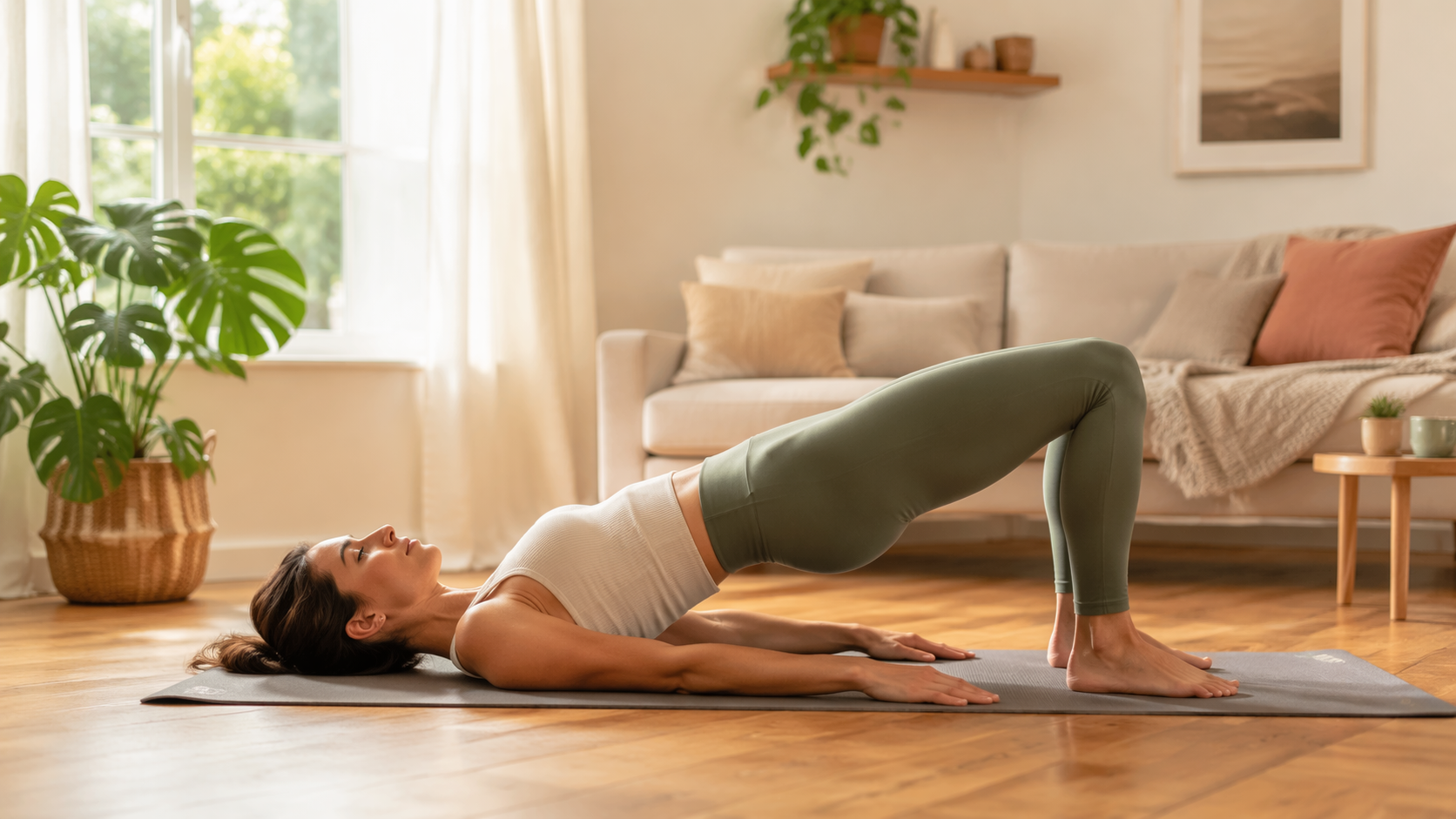
Glute Bridge
- Lie on your back with knees bent, feet hip-width apart, and arms relaxed by your sides.
- Press through your heels and lift your hips until your body forms a gentle line from shoulders to knees.
- Pause for one breath, then lower slowly.
- Do 8 to 10 reps. If that is too much, lift only halfway or hold the top for less time.
Keep the ribs down and avoid arching hard at the top. A bridge should feel like glute work, not a low-back pinch.
Clamshell
- Lie on your side with knees bent and hips stacked.
- Keep your feet together and open the top knee only as far as you can without rolling your pelvis backward.
- Lower with control.
- Do 8 to 10 reps per side. Make the range smaller if the outside hip cramps or the low back takes over.
Bird-Dog
- Start on hands and knees with your spine neutral.
- Slide one leg straight back along the floor first. If that feels good, lift it a few inches.
- For the full version, reach the opposite arm forward while the leg reaches back.
- Hold for 2 to 3 seconds, then return. Do 6 to 8 controlled reps per side.
If kneeling bothers your knees, pad the mat or skip the arm reach. If you need a lower-impact routine for another joint issue, a low-impact workout for knee pain you can do at home may be a better companion on sensitive days.
Choose Your Relief Direction: Extension or Flexion
This is the part that matters most. Press-ups and knee-to-chest stretches are both common sciatica exercises, but they are not interchangeable. Spine-health warns that exercises that help sciatica from lumbar spinal stenosis can harm someone with sciatica from a lumbar herniated disc, and vice versa.[1] That is why this workout asks you to test your response instead of copying a fixed list.
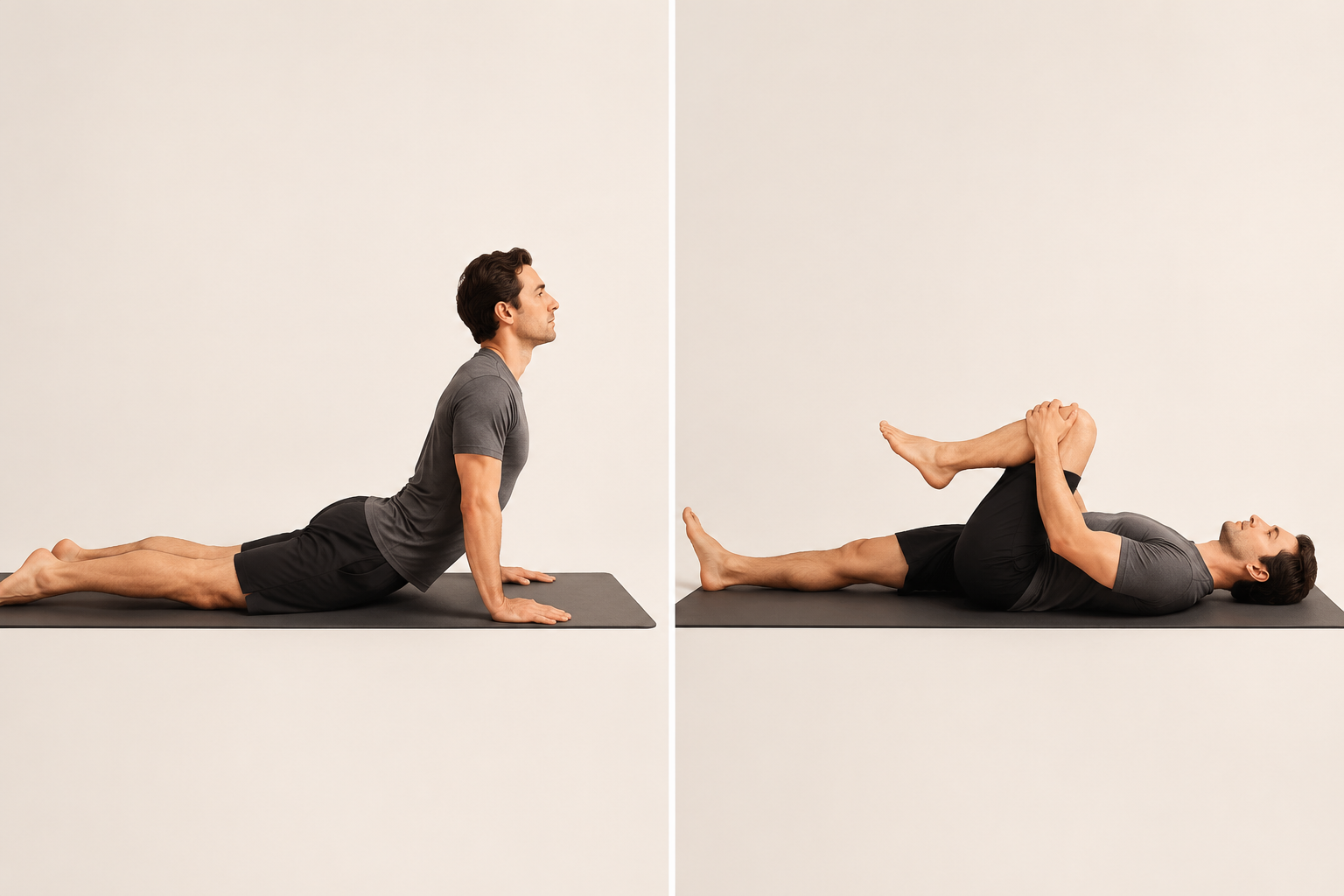
The useful sign is centralization: symptoms move out of the calf, foot, or thigh and settle closer to the buttock or low back. That does not always feel like instant relief. Sometimes the leg pain eases while the back feels more noticeable. That is usually a better response than a stretch that feels intense while symptoms creep farther down the leg.
Option A: Prone Press-Up for an Extension Preference
Use this option only if extension improves or centralizes your symptoms. Spine-health describes extension-based exercises, including press-up variations, as commonly used for sciatica associated with a herniated disc.[4] If you know or strongly suspect spinal stenosis, skip this option unless a clinician has told you otherwise.
- Lie face-down with your hands under your shoulders or forearms on the mat.
- Start with a small press: lift your chest slightly while your hips stay down.
- Lower and repeat 5 times, checking symptoms after each rep.
- If leg symptoms move upward or ease, continue for 8 to 10 gentle reps.
- If pain travels farther down the leg, stop and try the flexion option only if it feels safe.
Option B: Knee-to-Chest for a Flexion Preference
Use this option if bending forward or bringing the knees toward the chest feels relieving and does not send symptoms farther down the leg. NHS sciatica exercise guidance includes knee-to-chest-style movement among basic home exercises, but the same rule still applies: keep it gentle and symptom-led.[5] If you know or strongly suspect a herniated disc and flexion worsens your leg pain, skip it.
- Lie on your back with both knees bent and feet flat.
- Bring one knee toward your chest until you feel a mild stretch, not a hard pull.
- Hold for 5 to 10 seconds, then return the foot to the floor.
- Do 5 reps per side, or hold both knees only if that clearly feels better.
- Stop if numbness, tingling, or pain increases below the knee.
Do not force both options into one session. Choose the direction that centralizes symptoms, then stay with that direction for the day. If neither direction helps, skip this block and use the cool-down position that feels most comfortable.
Add a Gentle Seated Nerve Glide
A nerve glide is not a hamstring stretch with a more medical name. The goal is to slide the nerve through a comfortable range, not to pin it down and pull on it. If you chase intensity here, you are doing the opposite of what this block is for.
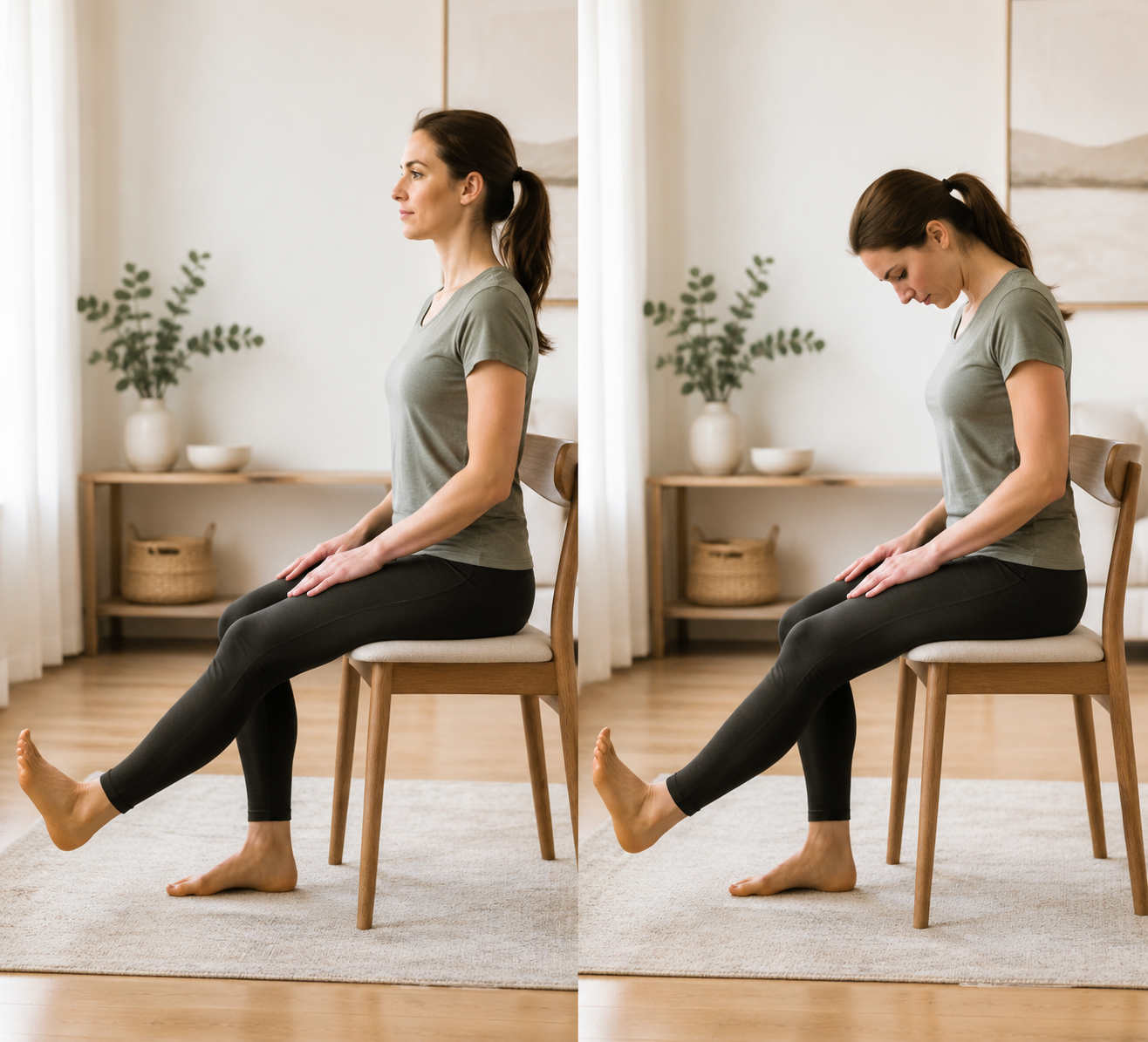
- Sit tall near the front of a chair, hands resting on your thighs.
- Slowly straighten one knee while gently lifting the toes toward you.
- At the same time, keep the neck relaxed or slightly look upward if that reduces tension.
- Bend the knee again and let the foot relax.
- Do 8 to 10 smooth reps per side, staying below a 3 out of 10 discomfort level.
A 2024 randomized controlled trial in Cureus studied 58 people with lumbar radiculopathy and found that neurodynamic mobilization plus conventional exercises improved pain and health-related quality of life more than conventional exercises alone over 14 days.[6] That supports including nerve sliders in a home routine, but it does not prove a permanent effect; the study was short and did not include long-term follow-up.[6]
Cool Down and Recheck Your Symptoms
Spend the final two minutes in the position that left your leg calmest. That may be lying on your back with knees bent, lying on your stomach propped on elbows, or side-lying with a pillow between the knees. Breathe slowly and let the body settle before you stand up.
Before you call the workout done, compare your symptoms with where they were at the start. Better signs include less leg pain, less tingling, easier walking, or symptoms that have moved closer to the low back. Worse signs include sharper pain, new numbness, weakness, or symptoms that have traveled farther down the leg.
If your body generally responds well to structured recovery work, you may also want a broader post-workout recovery routine at home. Keep that separate from the sciatica decision rule: recovery habits are useful, but they do not replace symptom-guided exercise selection.
How Often to Repeat the Routine
Repeat the routine 5 to 6 days per week if symptoms are stable or improving. Keep the strength moves at 8 to 10 reps, use only one directional-relief option, and treat nerve glides as smooth sliders rather than stretches. If the routine helps but leaves you sore, alternate a full 20-minute day with a shorter 8- to 10-minute version using only the warm-up, your chosen relief direction, and the cool-down.
Scale back or pause if symptoms are worse for more than a few hours after exercise, if sleep is disrupted by increased leg pain, or if you need more medication than usual after the workout. Seek professional help if symptoms persist, keep returning, or interfere with normal walking, work, or daily tasks.
This 20-minute plan can be a safe, repeatable set of sciatica exercises for a home workout when symptoms are mild to moderate and your pain response guides the choices. It is not a universal protocol. The right move is the one that calms or centralizes symptoms, not the one that happened to work for someone else.
References
- Sciatica Exercises for Sciatica Pain Relief, Spine-health, https://www.spine-health.com/wellness/exercise/sciatica-exercises-sciatica-pain-relief
- Sciatica: A step-by-step plan you can follow at home, OrthoNJ, https://orthonj.org/sciatica-exercises-sciatica-stretches/
- Stretches and Exercises to Ease Sciatica Pain, from a PT, HSS, https://www.hss.edu/health-library/move-better/sciatica-stretches
- Exercise for Sciatica from a Herniated Disc, Spine-health, https://www.spine-health.com/wellness/exercise/exercise-sciatica-herniated-disc
- Exercises for sciatica problems, NHS, https://www.nhs.uk/live-well/exercise/exercises-sciatica-problems/
- Effects of Neurodynamic Mobilization on Health-Related Quality of Life and Pain in Patients With Lumbar Radiculopathy: A Randomized Controlled Trial, Cureus, 2024, https://pmc.ncbi.nlm.nih.gov/articles/PMC11151706/


Comments
Join the discussion with an anonymous comment.