
You ate the sugar-free candy, changed into workout clothes, started the warm-up, and then your stomach took over the session. Bloating, gas, cramping, or a sudden bathroom sprint is not a discipline problem. It is a chemistry-and-timing problem.
The short version: many sugar-free candies and low-sugar bars use sugar alcohols such as sorbitol, maltitol, xylitol, or mannitol. These sweeteners are poorly absorbed in the small intestine. What does not absorb can pull water into the gut and then get fermented by bacteria in the colon, producing gas and bloating.[1] Exercise piles on by shifting blood away from digestion and toward working muscles, so a snack that was already hard to process becomes even less cooperative.[2]
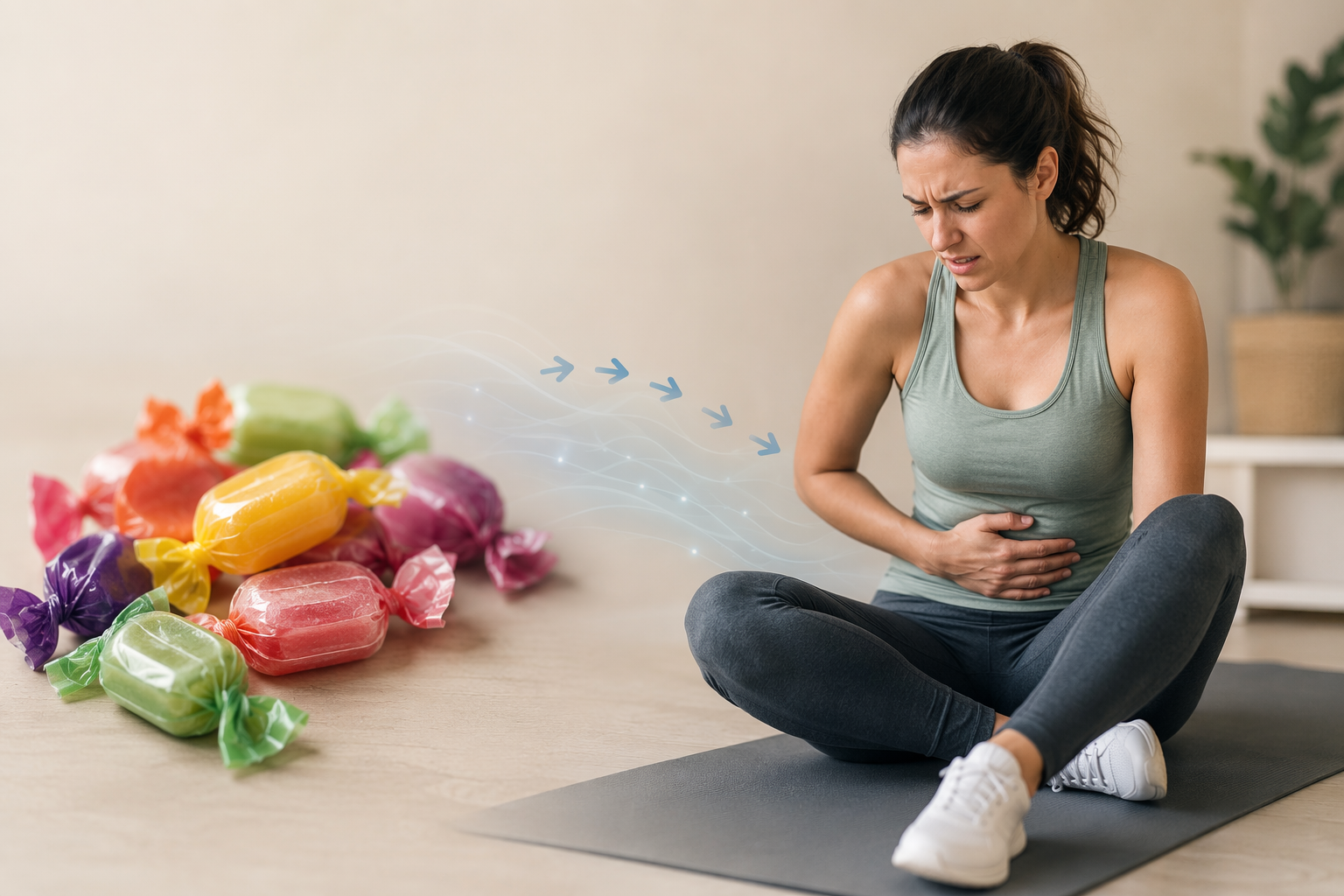
Why Sugar-Free Candy Can Turn Into a Workout Problem
Sugar alcohols sit in an awkward middle ground. They taste sweet and often show up on labels because they contribute fewer calories than regular sugar, but your gut does not handle them like a clean, predictable fuel source. Some of the dose passes through the small intestine without being fully absorbed. Once enough of it remains in the gut, two things matter: water and bacteria.
First, the unabsorbed sugar alcohols create an osmotic effect. In plain English, they pull water into the intestine. More fluid in the gut can mean loose stools or diarrhea, especially when the dose is high enough or the person is sensitive.[1] Second, when these compounds reach the colon, bacteria ferment them. Fermentation produces gases such as hydrogen and methane, which is where the pressure, bloating, and flatulence come from.[1]
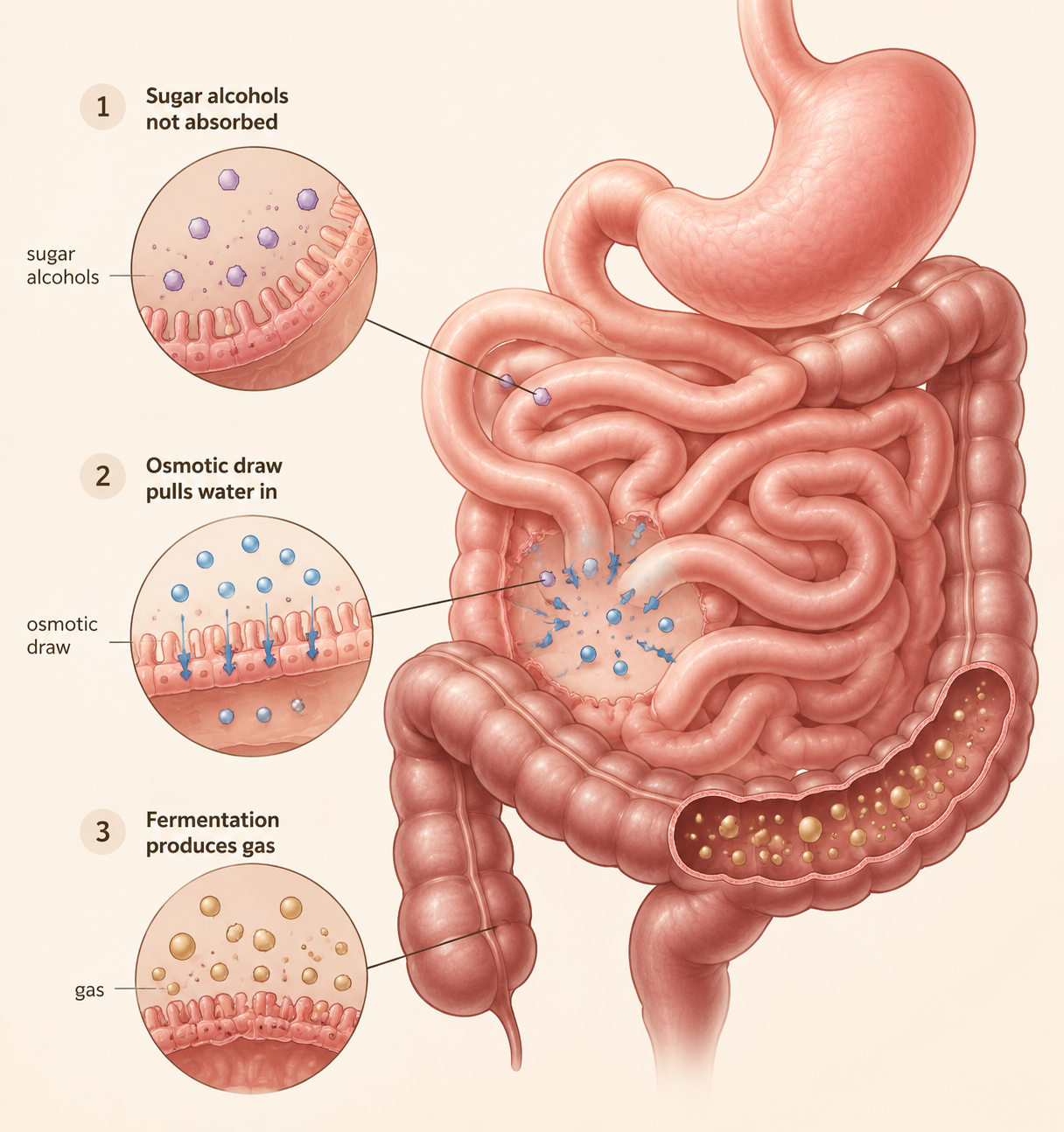
That would be annoying on the couch. During a workout, it is worse. Exercise can reduce splanchnic blood flow by up to 70% to 80% as blood is redirected toward working muscles.[2] The gut is still expected to digest, absorb, move fluid, and manage gas, but it is doing that with less support while you are squatting, jumping, cycling, running on a treadmill, or bracing through core work.
This is why the digestive issues from sugar-free candy often show up during the workout, not just after the snack. The candy may not cause much trouble when eaten after dinner in a small amount. The same candy 20 minutes before a lower-body circuit can become a very different event. You have unabsorbed sweetener pulling water into the gut, bacteria making gas, less blood flow available for digestion, and movement shaking the whole system.
The Label Clues That Matter More Than “Sugar-Free”
The front of the package usually tells you the marketing goal. The ingredient list tells you whether your stomach is about to do extra work. Look for words ending in “-ol,” especially sorbitol, maltitol, xylitol, mannitol, isomalt, lactitol, and erythritol. In low-sugar bars, the same issue may be hiding behind a fitness-looking wrapper instead of a candy wrapper.
| Label term | Why it matters before exercise |
|---|---|
| Sorbitol | Common sugar alcohol linked with gas, bloating, and diarrhea when enough reaches the gut. |
| Maltitol | Often used in low-sugar sweets and bars; can behave a lot like sugar-free candy in the digestive tract. |
| Xylitol or mannitol | Also poorly absorbed for many people and can contribute to osmotic diarrhea and fermentation gas. |
| Total sugar alcohols | The serving size matters, but tolerance is personal; a listed amount is context, not a guarantee. |
| Erythritol | Less likely to follow the same gas-and-diarrhea pathway, but still not a reason to treat the product as ideal pre-workout fuel. |
Dose is where the “I only had one serving” frustration starts. Parkview Health notes that sorbitol can cause gastrointestinal distress at doses above 20 grams per day in adults, and that one serving of sugar-free candy can contain 15 to 30 grams of sugar alcohols.[3] A review in the National Institutes of Health’s PubMed Central reports that maltitol at 40 grams or more triggered symptoms in 85% of people in a cited study.[4]
Those numbers are not a personal calculator. Someone with irritable bowel syndrome, FODMAP sensitivity, a recent stomach bug, a high-stress day, or just a lower tolerance may react below a threshold that another person handles fine. The useful lesson is simpler: a single candy serving or low-sugar bar can land in the range where digestive effects are plausible, especially when exercise starts soon after.
Why Low-Sugar Bars Can Be the Same Problem in Better Packaging
A low-sugar protein bar can look like the responsible pre-workout choice: tidy macros, no candy-store guilt, maybe a few grams of fiber and a big protein number. But if its sweetness comes from maltitol, sorbitol, or a blend of sugar alcohols, your gut does not care that the wrapper looks athletic.
Pre-workout food has a narrow job. It should leave the stomach predictably, provide usable energy, and avoid creating extra fluid or gas in the intestine while you move. A bar that is high in sugar alcohols may check the “low sugar” box while failing the “train without interruption” box.
The Erythritol Exception, Kept in Its Lane
Erythritol is different from sorbitol or maltitol in one important digestive way: it is mostly absorbed in the small intestine and excreted unchanged in urine, so less of it reaches the colon to be fermented. Healthline reports that erythritol is generally tolerated without laxative effects up to about 0.66 to 0.80 grams per kilogram of body weight.[5]
That makes erythritol less likely to cause the same water-draw-plus-fermentation mess. It does not make an erythritol-sweetened candy a perfect pre-workout snack. The product may still contain other sweeteners, fibers, fats, or ingredients that slow digestion, and the bigger issue remains: it is not giving you much useful carbohydrate for training.
A Note for Low-Carb and Keto Eaters
There is an emerging gut-microbiome angle worth watching, especially for people who rely heavily on sugar-free products while eating low carb or high fat. UC Davis Health reported on a 2024 Cell mouse study in which a high-fat diet combined with antibiotic use reduced Clostridia bacteria that help break down sorbitol, creating sorbitol intolerance in mice.[6]
That is interesting, not settled human guidance. It does not prove that a keto diet causes sorbitol intolerance in people. It does make one practical point feel less surprising: gut tolerance is not fixed, and a snack that used to be fine can become a problem after diet changes, illness, antibiotic use, or shifts in your normal eating pattern.
Why Sports Fuel Usually Avoids This Stuff
Performance fueling is boring for a reason. Endurance nutrition products are built around predictable digestion, and The Endurance Dietitian notes that professional sports nutrition brands such as Skratch, Maurten, and GU do not use sugar alcohols in their fueling products. The same source specifically warns endurance athletes with diabetes away from sugar alcohols because of their gastrointestinal effects and poor fit for exercise fueling.[7]
That does not mean every home workout needs a gel or drink mix. It means the standard is clear: fuel should be easy to process under stress. If a food is famous for causing gas when eaten at rest, it has not earned a spot right before burpees.
What to Eat Instead Before a Home Workout
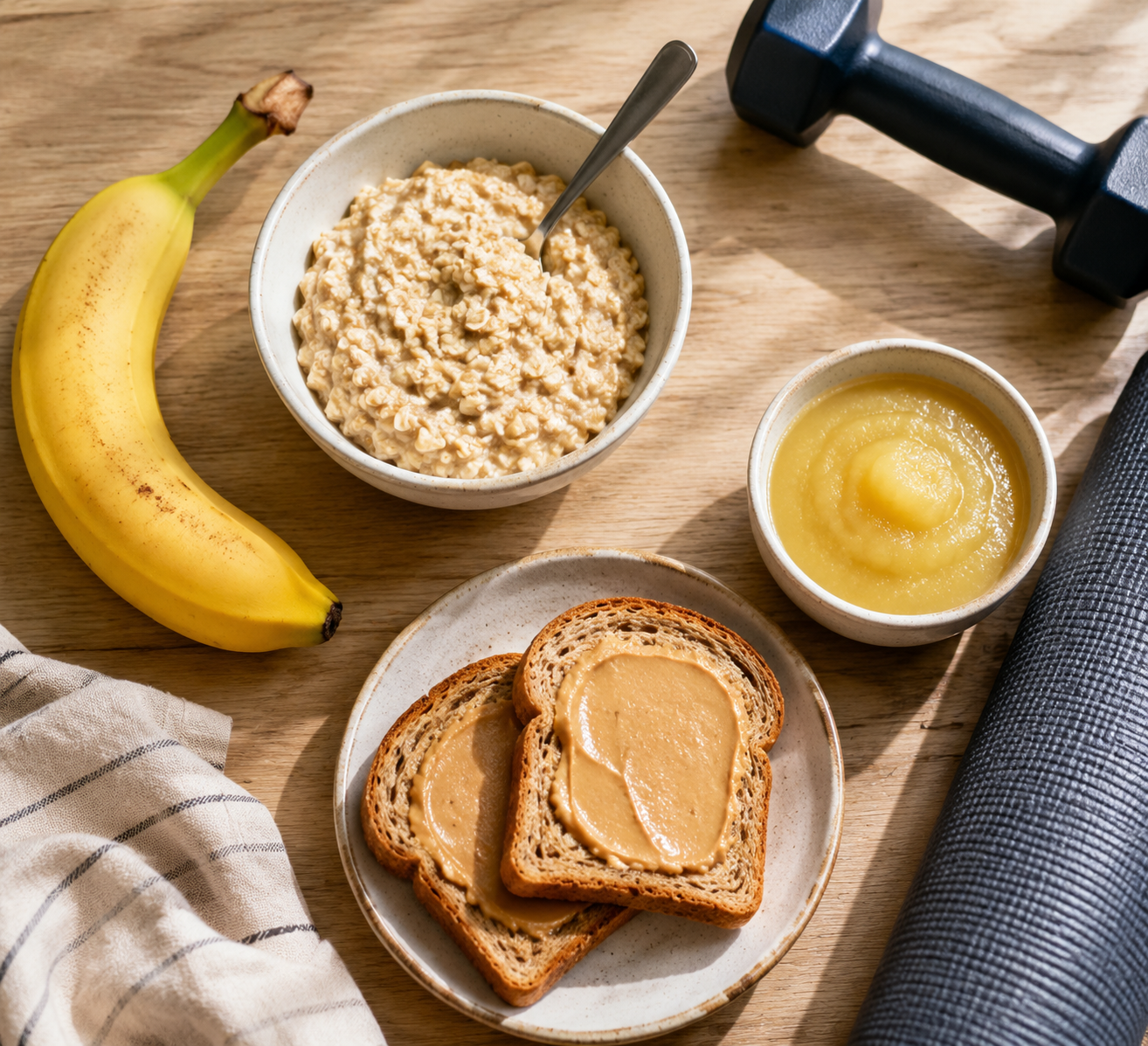
The replacement does not need to be clever. For most home workouts, the better move is a modest amount of digestible carbohydrate, timed so it is available without sitting heavily in your stomach. UCLA Health recommends carbohydrate-containing snacks before exercise and gives examples such as banana, oatmeal, toast with nut butter, and applesauce depending on workout type and timing.[8] Health also lists stomach-friendly pre-workout snacks, including banana and applesauce, for energy without upsetting digestion.[9]
| If training starts... | Better option | Why it fits |
|---|---|---|
| Right away or very soon | Applesauce | Simple carbohydrate with a lighter stomach load and little fiber. |
| About 30 minutes from now | Banana | Quick digestible carbohydrate with potassium and minimal prep. |
| About 60 minutes from now | Toast with nut butter | Carbohydrate plus some fat and protein; better when you have more digestion time. |
| 1 to 2 hours from now | Oatmeal | More substantial and steadier, but not ideal if you are starting immediately. |
The timing matters as much as the food. Oatmeal can be a great earlier snack and a bad last-minute choice if you eat a big bowl and immediately start jump squats. Nut butter on toast works better when there is enough time for the fat to leave your stomach. Applesauce is useful close to training because it is simple and light. A banana sits in the practical middle: easy, portable, and usually predictable.
If your workouts are short and low intensity, you may not need a snack at all. If you are training longer, lifting hard, or coming into the session underfed, a small carbohydrate choice can make the workout feel steadier. For the broader daily rhythm around training, 3 Simple Daily Eating Habits for Home Workout Recovery is a better place to think through meal timing than a candy label.
How to Test Your Own Tolerance Without Ruining Another Session
Do not test sugar alcohol tolerance before the workout you care about. If you still want to eat sugar-free candy or low-sugar bars for personal, medical, or blood sugar reasons, separate the experiment from training. Try a smaller amount at rest first. Check the ingredient list. Notice whether symptoms show up in the next few hours. Then decide whether that product belongs anywhere near exercise.
- Avoid sugar alcohol-heavy candy and bars in the hour or two before workouts, especially sorbitol and maltitol products.
- Do not assume “low sugar” means “easy to digest”; check the ingredient list and total sugar alcohol amount when listed.
- Use simple carbohydrates when you actually need pre-workout energy: banana, applesauce, toast, or oatmeal depending on timing.
- If you manage diabetes, IBS, FODMAP sensitivity, or another digestive or metabolic condition, personalize this with a qualified clinician instead of copying a generic snack rule.
Recurring diarrhea, severe cramping, blood in stool, unexplained weight loss, or symptoms that happen even when you remove obvious triggers are not workout grit tests. They are reasons to get medical guidance. For ordinary pre-workout stomach sabotage, though, the first fix is usually blunt: stop asking sugar-free candy to do a fuel job it was not built to do.
References
- Dangers of Sugar Alcohols, Cleveland Clinic
- Sugar Alcohols, Fleet Feet Columbus / Dr. Steven T. Devor, Ohio State University
- The sour side of sugar free candy, Parkview Health
- Gastrointestinal Disturbances Associated with the Consumption of Sugar Alcohols, PMC/NIH
- What Are Sugar Alcohols, and Are They a Healthy Sugar Swap?, Healthline
- Do sugar-free candy and gum give you gas? Researchers think they know why, UC Davis Health, 2024
- Why Endurance Athletes with Diabetes Should Avoid Sugar Alcohols and What to Choose Instead, The Endurance Dietitian
- What to eat before and after a workout, UCLA Health
- 11 Pre-Workout Snacks That Give You Energy Without Upsetting Your Stomach, Health




Comments
Join the discussion with an anonymous comment.