
Run Outside or Treadmill? Let the Hourly Forecast Decide
Learn four weather thresholds—temperature, dew point, wind speed, and precipitation—that turn any hourly forecast into a quick outside-or-treadmill decision for home gym runners.
Before you start
- Equipment required
- treadmill
- Assumes build tier
- No specific tier required
Shoes by the door, treadmill folded against the wall, hour-by-hour running forecast open on your phone: this is where the decision should get simpler, not more dramatic. Check the next usable running hour for four inputs — temperature, dew point, wind speed, and precipitation — then use the most severe result as your answer.
| Tier | What the forecast says | Best decision |
|---|---|---|
| Green | Temperature near 45–59°F, dew point below 60°F, manageable wind, no meaningful precipitation | Run outside as planned |
| Yellow | One factor is moderately uncomfortable: warmer than ideal, dew point around or above 60°F, breezy wind, or light rain | Run outside with adjustments: easier pace, shorter route, water access, loop close to home |
| Red | Heat stress approaches ACSM Red territory, dew point feels oppressive, wind is strong, or precipitation creates poor footing/visibility | Use the treadmill instead |
| Black | Dangerous heat-stress conditions, severe wind, lightning, flash-flood risk, or other active severe-weather warnings | Cancel the outdoor run; pivot indoors only if conditions at home are safe |

The ACSM heat-stress categories were built for organized races using WBGT, not for a solo runner glancing at a phone app before work. Still, the tier language is useful because it gives the daily decision a backbone: Green is normal running, Yellow is adjusted running, Red is treadmill, and Black is stop treating the outdoor run as negotiable. ACSM race guidance places WBGT Green below 65°F, Yellow at 65–73°F, Red at 73–82°F, and Black above 82°F.[1]
The 60-Second Forecast Check
Start with the hour you would actually run, not the day’s high, the morning low, or the nicest-looking part of the forecast. A 7 a.m. run and a 5 p.m. run can be different workouts before you take a step.
- Temperature: if it is around 45–59°F, conditions are generally in the sweet spot for performance; above that, especially past 59°F, heat begins to matter more.
- Dew point: below 60°F is usually more forgiving; above 60°F deserves attention even when the temperature does not look alarming.
- Wind speed: around 25 km/h is no longer just background weather; around 50 km/h is a safety issue, not a character test.
- Precipitation: light rain can be workable; heavy rain, lightning, poor visibility, slick footing, or flood warnings move the decision indoors.
Do not average the four factors into something that feels fair. One Red factor is enough to make the treadmill the clean choice. Two or three Yellow factors can also behave like Red in practice, especially when heat, humidity, and sun exposure arrive together.
Temperature: Good Running Weather Is Cooler Than Many People Expect
The most comfortable outdoor run is often not the prettiest afternoon. Research on major marathon performances has pointed to roughly 7–15°C, or 45–59°F, as an optimal range for running performance, with losses becoming more noticeable above 15°C rather than following a neat straight line.[2]
That does not mean every 62°F run is a problem. For an easy solo run, temperature alone usually moves the forecast from Green to Yellow before it moves it to Red. The practical question is whether the temperature is paired with a high dew point, direct sun, a hard workout, or a route with no shade or water.
| Hourly temperature | Decision pressure | What to do |
|---|---|---|
| 45–59°F | Green if the other factors cooperate | Run outside normally |
| 60s°F | Often Yellow, depending on dew point and sun | Ease the pace or shorten the route if humidity is up |
| Hotter conditions with heat-stress indicators rising | Red can arrive quickly when dew point is high | Use the treadmill for quality workouts or longer runs |
| ACSM Black-level heat-stress conditions | Danger zone | Cancel the outdoor run |
This is where a home treadmill earns its space. If the workout on the calendar is intervals, tempo work, or a longer steady run, moving inside on a Red heat hour protects the session better than trying to prove the outdoor version counts more.
Dew Point: The Forecast Number That Explains the Ugly Run
Dew point deserves its own glance because it explains the run that looks reasonable on paper and feels strangely heavy after ten minutes. When the air is already holding more moisture, sweat evaporates less effectively, and evaporative cooling is one of the body’s main ways to shed heat during exercise.[1]

That is why a forecast that says 72°F can produce two completely different decisions. At a low dew point, it may be a pleasant Yellow or even close to Green for an easy run. With dew point above 60°F, the same temperature becomes more expensive. Your pace slows, your heart rate climbs sooner, and the run stops feeling like the workout you planned.
| Dew point in the hourly forecast | How to treat it | Running decision |
|---|---|---|
| Below 60°F | Usually manageable for regular training | Green if temperature, wind, and precipitation are also favorable |
| Around or above 60°F | Cooling starts to feel less efficient | Yellow: reduce pace expectations and avoid overreaching |
| High dew point plus heat | Heat stress can stack fast | Red: treadmill is the better default |
| High dew point plus severe heat-stress warnings | Outdoor exercise can become unsafe | Black: cancel or pivot indoors decisively |
Dew point is also where personal tolerance varies the most. Heat-acclimatized runners may handle a sticky hour better than someone returning after a break. Fitness, medication, sleep, illness, and underlying health conditions can change the answer. The threshold is a planning shortcut, not medical clearance.
Wind: Annoying, Expensive, Then Unsafe
Wind is easy to dismiss until the route turns into a long negotiation with a headwind. Around 25 km/h, wind can meaningfully raise the effort of running, and the energy cost is not just psychological. Around 50 km/h, the concern changes: branches, debris, balance, visibility, and traffic interaction matter more than pace.
| Wind speed | Decision pressure | Best adjustment |
|---|---|---|
| Calm to moderate | Green if other factors are fine | Run the planned route |
| Around 25 km/h | Yellow | Choose a sheltered loop, run by effort, or move speed work inside |
| Strong wind approaching hazardous conditions | Red | Use the treadmill, especially for structured workouts |
| Around 50 km/h or severe wind warnings | Black | Skip the outdoor run |
The best outdoor compromise in Yellow wind is usually a loop, not an out-and-back that saves the worst headwind for the final miles. If the route has exposed bridges, open roads, beach paths, or tree-lined sections after storms, move the decision one tier more cautious.
Precipitation: Light Rain Is Different From Weather You Have to Respect
Rain by itself is not a reason to abandon every outdoor run. Light rain with good visibility, safe footing, and mild temperatures may only be Yellow: wear a brimmed hat, avoid painted lines and slick surfaces, and keep the route close enough to bail if conditions change.
The decision changes when precipitation affects safety rather than comfort. Heavy rain, lightning risk, flooded intersections, poor driver visibility, icy surfaces, or active severe-weather alerts should move the run to Red or Black. If the forecast includes severe-weather language, use a dedicated safety guide such as How to Exercise Safely During Severe Weather before deciding whether any outdoor workout still makes sense.
Flash-flood warnings belong outside the normal runner’s bargaining zone. If water is rising or road conditions are uncertain, the choice is not between toughness and convenience; it is between avoidable risk and a workout you can do later. For that edge case, use Avoid Outdoor Exercise During a Flash Flood Warning.
When Several Yellow Factors Stack
Most bad decisions do not come from ignoring an obvious Black forecast. They come from negotiating with three moderate problems at once: a warm hour, a dew point above 60°F, and a breeze that makes the exposed part of the route harder than expected.
Use this rule: one Yellow factor asks for adjustment; two Yellow factors ask for a simpler route and easier effort; three Yellow factors make the treadmill reasonable, especially if the planned run is long, fast, remote, or hard to cut short.
| Forecast pattern | How to read it | Decision |
|---|---|---|
| Green temperature, low dew point, calm wind, dry | The forecast supports the run | Outside |
| Warm temperature, dew point above 60°F, dry, light wind | Heat load is the limiter | Yellow; shorten or slow the run |
| Warm temperature, dew point above 60°F, windy | Several moderate factors are stacking | Treadmill is reasonable |
| Severe heat, severe wind, lightning, or flood warning | Safety issue | No outdoor run |
This is also where renters and apartment runners have a real constraint: treadmill timing. If running indoors at dawn is too noisy, the better move may be to shift the run to a later safe treadmill window or turn the day into a quieter home session. Rainy Day Home Workout Ideas for Any Budget is the practical next stop when the weather decision is already made and you just need a workout that fits the room.
If the Answer Is Treadmill, Set It Up Without Overthinking It
Once the forecast lands in Red, stop re-litigating the outdoor run. The treadmill is not an apology; it is the tool you bought for exactly this kind of day. Keep the workout’s purpose and remove the weather variable.
- Easy run: keep the effort conversational and ignore the outdoor pace you expected.
- Intervals: use speed or effort targets you can complete cleanly without heat or wind distortion.
- Long run: set up water, airflow, towel, and entertainment before you start.
- Recovery day: reduce the grade and pace if indoor heat builds up.
For runners who like a closer outdoor-effort feel, the familiar 1% treadmill grade rule comes from research comparing treadmill and outdoor running energy cost, especially around faster running speeds.[3] It is a calibration note, not a law. If 1% makes an easy recovery run feel needlessly stiff, the recovery goal wins.
The Repeatable Rule
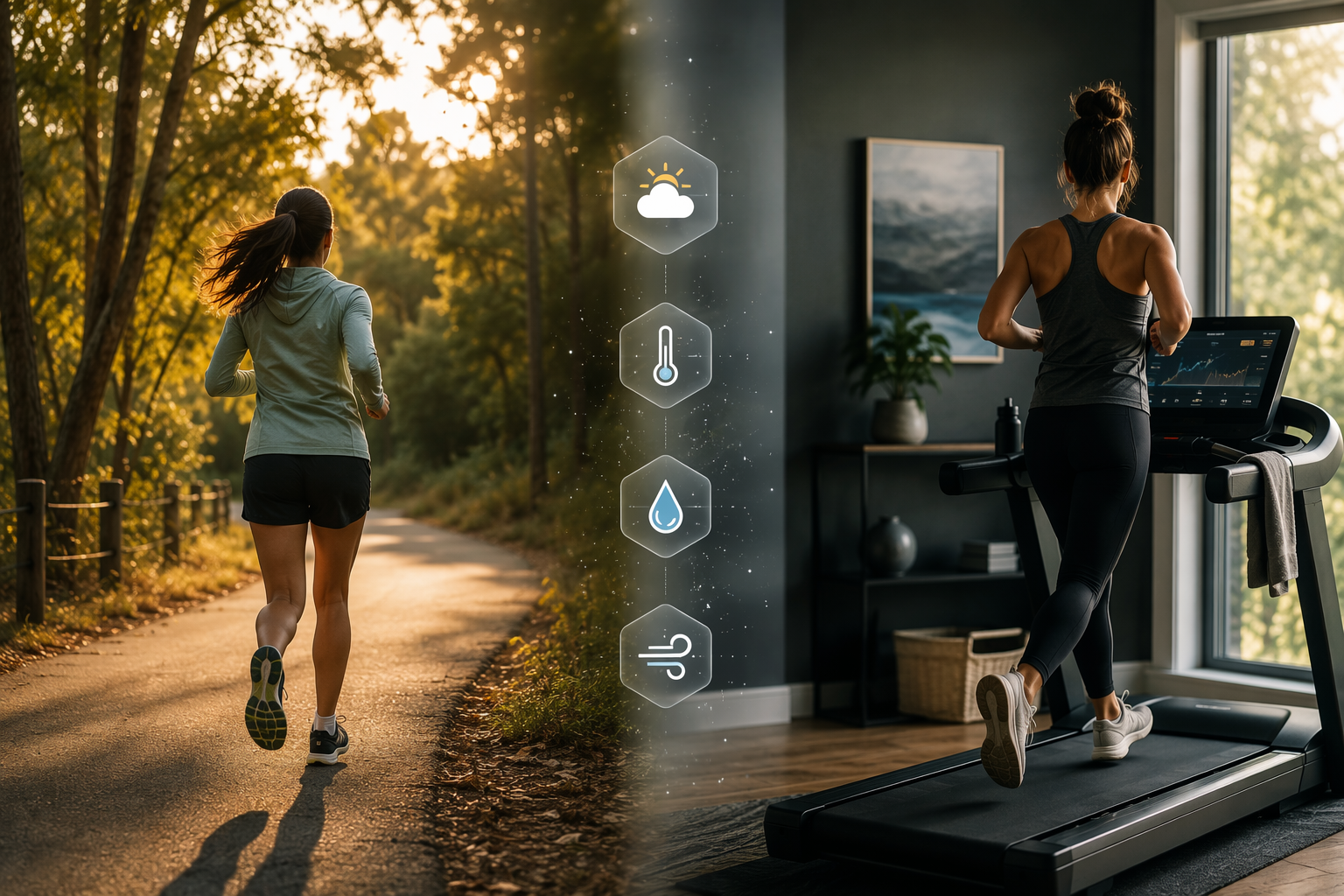
Check the next hour you can actually run. Score temperature, dew point, wind speed, and precipitation. Choose outside for Green. Adjust pace, route, distance, or timing for Yellow. Switch to the treadmill for Red. Cancel the outdoor run or pivot safely indoors for Black.
This guide is a companion decision framework in the routines category, not a live forecast tool and not medical clearance. Use current hourly data from your weather source, account for your own acclimatization and health status, and let the treadmill do its job when the forecast crosses the line.
References
- ACSM Heat Guidelines, Road Race Management
- Weather Score, RunDida
- Treadmill vs Running Outside, RunnersConnect
Don't have the gear this routine assumes? Find the build that covers it.
Wondering how much rest you need after this? Read our ACSM-cited recovery reference.
Questions about form, substitutions, or a correction? Leave it below.
Comments
Join the discussion with an anonymous comment.