
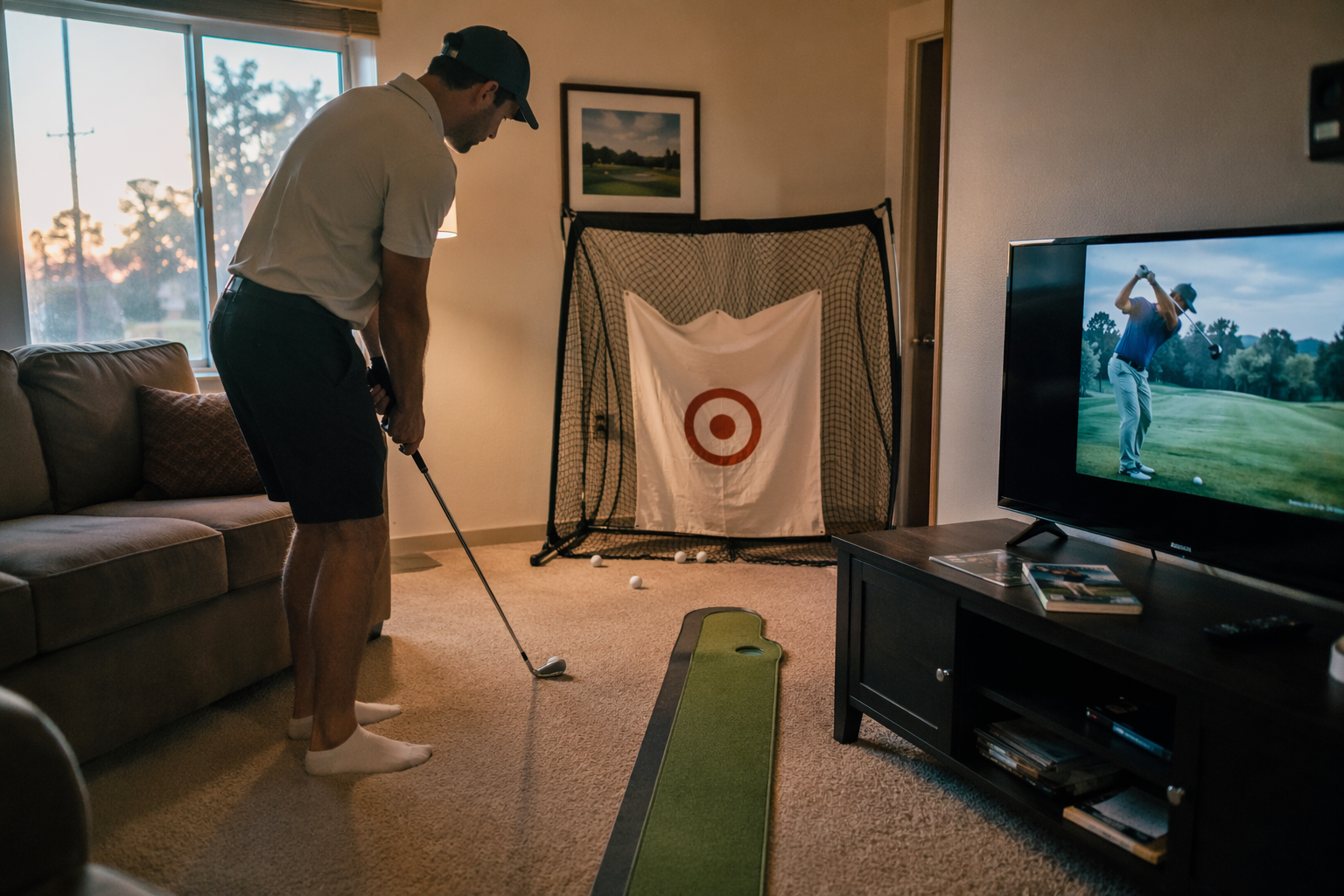
A golf lesson DVD still has a place in 2026 if the plan is modest: buy once, clear a little floor space, and practice without turning the living room into a simulator bay. The catch is that “best” changes quickly. A beginner who needs grip, setup, and basic ball-striking help should not buy the same DVD as someone trying to sharpen chipping touch beside the couch. A player who needs a weekly assignment may get more from structure than from another famous instructor explaining the swing beautifully.
For a practical review of golf lessons at home on DVD, the useful test is simple: does the instruction match the golfer’s level, does it turn into a repeatable home session, and does the total cost still make sense after a putting mat, foam balls, alignment sticks, or an impact bag are added?
| DVD set | Price and format | Best fit | Home-practice suitability | Main caution |
|---|---|---|---|---|
| Tom Watson Lessons of a Lifetime | $44.95; 3 DVDs; about 3.5 hours | Beginners and mid-handicappers who want fundamentals from grip through mental game | Strong: broad lessons can be broken into short carpet, mirror, putting, and slow-swing sessions | Comprehensive rather than scheduled; the buyer must build the routine [1] |
| PGA Tour Academy Home Edition | $180 at launch; 10 DVDs plus impact bag and alignment sticks | Self-directed learners who need a calendar and progression | Very strong: 8-week White Track and Blue Track structure gives the next assignment | Older launch price and availability may not reflect the 2026 secondhand market [2] |
| Phil Mickelson Secrets of the Short Game | $49.95; 2 DVDs plus 10-page booklet | Golfers who can practice chipping, pitching, putting, and touch in small spaces | Excellent: short-game work is the easiest DVD instruction to rehearse indoors | Narrow by design; it will not replace full-swing fundamentals [3] |
| Butch Harmon About Golf | $79.95; single DVD; 4 hours across 57 chapters | Golfers who want a broad reference set from a major instructor | Good: covers many topics, including short game and putting, but less naturally organized as a home plan | Released in 2012 and lacks a structured practice calendar [4] |
| Gravity Golf | $24.95–$34.95; 2.5 hours | Golfers specifically curious about the counter-fall swing method | Moderate: useful for concept and motion work, but philosophy-specific | Better as a supplement than a default first golf DVD [5] |
| Impact Zone Golf Get It All Bundle | $89.98; 4 DVDs | Golfers focused on impact position and compression | Moderate: clear mechanical focus, but best for players who already know impact is their issue | Too specific for someone still sorting out grip, posture, aim, and tempo [6] |
The Short Verdict
If I were buying one DVD set for a returning recreational golfer with limited space, I would start with Tom Watson Lessons of a Lifetime. It is not the flashiest choice, but $44.95 for about 3.5 hours across grip, setup, swing, short game, course strategy, and mental game is the cleanest value in this group for someone rebuilding the basics [1].
If the problem is not information but follow-through, PGA Tour Academy Home Edition becomes more interesting. Its 8-week calendar, with White Track for beginners and Blue Track for more advanced players, solves the Tuesday-night question: what do I do next? The original $180 price is high for a DVD product, but the inclusion of an impact bag and alignment sticks matters because those tools are exactly the kind of low-glamour gear that makes home practice less vague [2].
For pure home usefulness per dollar, Phil Mickelson Secrets of the Short Game is the one I would be least likely to let gather dust. Chipping motion, face control, landing spot practice, and putting setup fit a hallway or carpet better than full-speed driver work ever will. Its hinge-and-hold method will not be every golfer’s forever short-game system, but it gives the hands something concrete to rehearse [3].
Tom Watson Lessons of a Lifetime: Best Value for Fundamentals
Tom Watson’s set is the easiest recommendation for beginners and mid-handicappers because it covers the whole game without acting as if the viewer already owns a launch monitor. The reported package is $44.95, with 3 DVDs and roughly 3.5 hours of instruction moving from grip through the mental game [1]. That breadth matters for the golfer who does not yet know whether the real leak is setup, tempo, chipping, or decision-making.
At home, this kind of instruction works best when it is treated as a menu rather than a movie. A grip chapter becomes five minutes with a club in front of a mirror. A setup lesson becomes rehearsing posture over an alignment stick. A putting segment becomes ten straight starts down a hallway line. Nothing about that feels heroic, which is why it has a chance of happening on a weeknight.
The weakness is that Watson’s set is comprehensive, not heavily scheduled. A motivated learner can turn it into a practice plan, but the DVD itself is not doing as much calendar work as PGA Tour Academy. For a beginner who wants one affordable set and is willing to repeat small drills, that is a fair trade.
PGA Tour Academy Home Edition: Best for People Who Need a Plan
PGA Tour Academy Home Edition is expensive in the older review context, but it is the one set here that seems designed for the learner who wants the DVD to assign the work. The package was described at $180, with 10 DVDs, an impact bag, alignment sticks, and an 8-week calendar split into White Track for beginners and Blue Track for advanced players [2].
That structure changes the value calculation. Ten discs can be too much if they are just a library. Ten discs plus tracks, weeks, and training aids become closer to a boxed course. A golfer practicing in a garage corner may not be able to make a full swing, but an impact bag and alignment sticks are usable in slow-motion rehearsals, half swings, takeaway checks, and setup work.
The caution is availability and current pricing. The $180 figure comes from an older review, and a 2026 buyer may be shopping secondhand, finding incomplete sets, or seeing prices that no longer match the original package. If the bag and sticks are missing, the DVD set is still structured, but the total value changes.
Phil Mickelson Secrets of the Short Game: Most Useful in a Small Room
Phil Mickelson’s short-game DVD has the narrowest scope among the top three recommendations, and that is part of the appeal. The reviewed package was $49.95 for 2 DVDs and a 10-page physical booklet, built around short-game instruction including the hinge-and-hold chipping method [3].
Short-game practice is unusually honest indoors. A golfer can put a towel on the carpet as a landing zone, chip foam balls from three paces away, and learn very quickly whether the club is brushing the floor or stabbing at it. Putting start lines, face control, and distance feel also scale down better than full-swing ball flight. You still need real grass eventually, but the indoor version is not a fantasy.
This is the set I would pair with another fundamentals source rather than ask it to carry the whole game. Buy it if the full swing is serviceable enough and the wasted shots are happening near the green. Do not buy it as the first and only golf instruction DVD if grip, stance, aim, and contact are still unsettled.
Butch Harmon About Golf: Broad, Polished, and Less Prescriptive
Butch Harmon About Golf has the strongest “one instructor explains a lot” profile. The reviewed DVD was $79.95, released in 2012, and offered 4 hours across 57 chapters, including full swing, trouble shots, short game, putting, a TPI fitness segment, and club fitting guidance [4].
For a golfer who likes browsing, that is appealing. It can sit on the shelf as a reference: today, bunker basics; tomorrow, putting; next week, a trouble-shot chapter before a round. The problem for home practice is not the quality of the material but the lack of a built-in progression. A broad chapter list still leaves the viewer deciding what belongs in tonight’s 25-minute session.
The 2012 release date is not disqualifying. Golf fundamentals did not expire. But in a purchase decision, age and structure matter. If the choice is between Harmon as a broad reference and Watson as a cheaper fundamentals set, Watson is easier to justify for a beginner. If the buyer already trusts Harmon’s teaching style and wants range-wide coverage, this remains a legitimate pick.
Gravity Golf and Impact Zone Golf: Better as Targeted Supplements
Gravity Golf is the least expensive option here, listed at $24.95–$34.95 for 2.5 hours of instruction built around a counter-fall swing method [5]. That price makes it tempting, but the method-specific nature of the instruction matters. It is better for a golfer who is deliberately exploring that motion pattern than for someone who simply needs a first home-practice DVD.
Impact Zone Golf’s Get It All Bundle sits at the other end of the supplement category: $89.98 for 4 DVDs focused on impact position mechanics [6]. Impact is a serious subject, and many recreational swings would improve if the strike improved. Still, a DVD centered on impact is most useful when the golfer already knows that contact conditions are the problem. For the player who still needs the whole map, it is too specialized to be the default first buy.
Which DVD Should You Buy?
- Buy Tom Watson Lessons of a Lifetime if you are a beginner or mid-handicapper who wants the best value fundamentals set and can create your own simple practice routine.
- Buy PGA Tour Academy Home Edition if you need a schedule, want beginner and advanced tracks, and can find a complete set at a price that still makes sense.
- Buy Phil Mickelson Secrets of the Short Game if your home practice will mostly happen on carpet, a putting mat, or a small chipping station.
- Buy Butch Harmon About Golf if you want the broadest single-disc reference and do not mind building your own lesson sequence.
- Buy Gravity Golf only if its counter-fall swing philosophy is specifically what you want to study.
- Buy Impact Zone Golf if your main goal is impact-position work and you already have enough basic swing instruction.
The winner changes by goal. Fundamentals point to Watson. Scheduled progression points to PGA Tour Academy. Short-game reps point to Mickelson. A broad reference points to Harmon. Swing-mechanics supplementation points to Gravity Golf or Impact Zone Golf, depending on the problem the golfer is trying to solve.
The Small-Space Setup That Makes a DVD Useful
The DVD is only half the purchase. The other half is a tiny practice station that can survive real life: foam balls in a basket, two alignment sticks, a putting mat, and, if impact work is part of the plan, a small impact bag. This is the same basic logic behind building a small apartment gym in phases: start with the tools that remove the excuse to skip practice, not the tools that make the room look impressive.
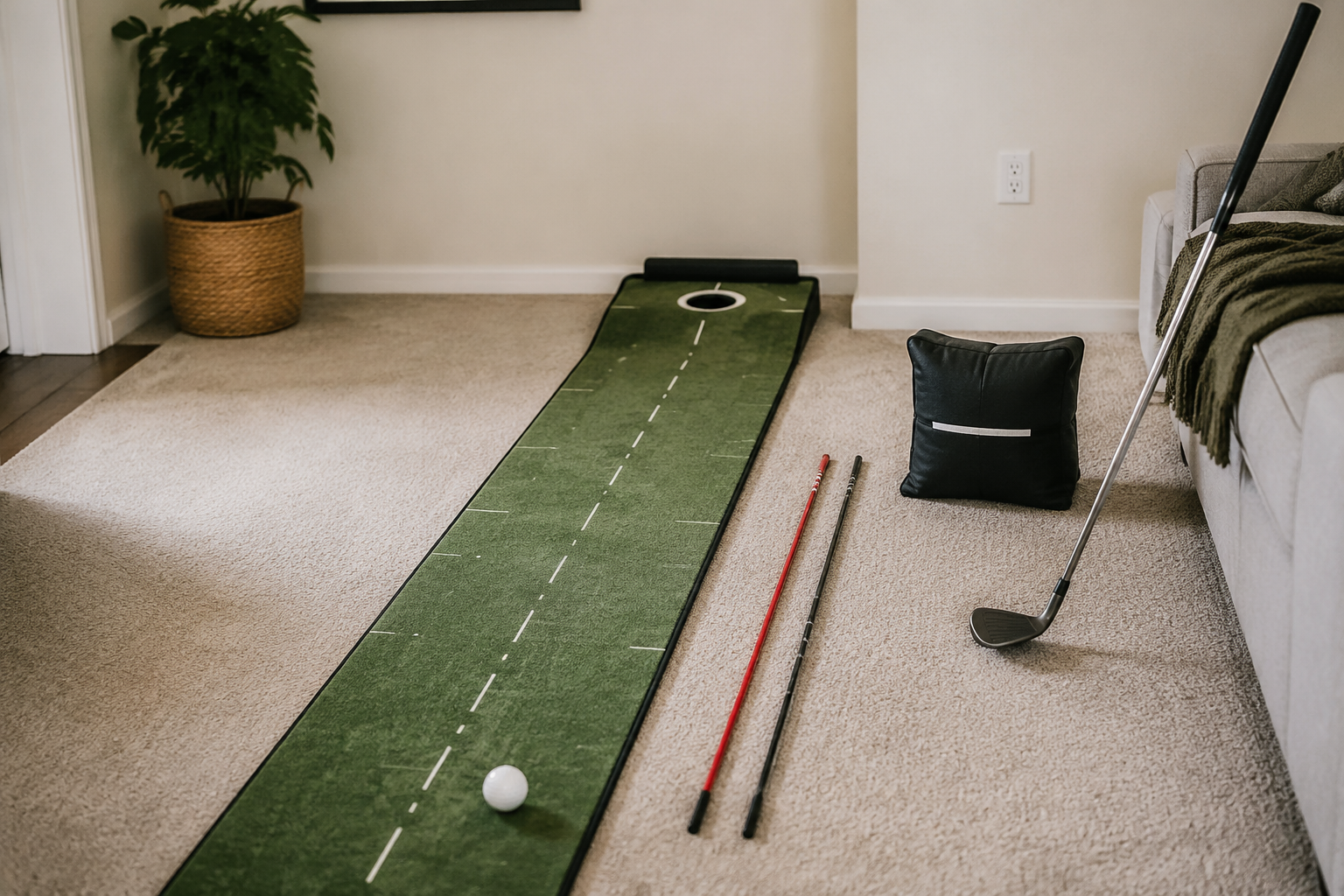
Two drills show why this setup is enough to begin. MyGolfSpy describes a masking-tape strike drill that needs only a 3x3 ft area of floor space, which is about as realistic as home golf practice gets for someone without a net or simulator [7]. Chiputt Golf describes an 8-ft putting mat setup for apartments, which fits the kind of hallway or living-room edge many golfers actually have [8].
| Practice goal | Minimal gear | DVD pairing |
|---|---|---|
| Setup, grip, posture, takeaway | Club, mirror or reflective door, alignment stick | Tom Watson or Butch Harmon |
| Putting start line and pace | 8-ft putting mat, ball gate or simple household markers | Phil Mickelson, Tom Watson, or Butch Harmon |
| Chipping contact | Foam balls, towel landing zone, small carpet area | Phil Mickelson |
| Low-speed impact rehearsal | Impact bag, alignment sticks, foam balls | PGA Tour Academy or Impact Zone Golf |
| Swing concept exploration | Club, open floor space, slow-motion rehearsals | Gravity Golf |
A useful under-$100 add-on kit does not need to be complicated: foam balls, alignment sticks, a basic putting mat, and possibly an impact bag. If that sounds too plain, that is the point. The same starter-kit philosophy behind choosing essential home fitness gear before expensive systems applies here. A golfer who practices three nights a week with four boring tools will get more from a DVD than a golfer who buys a clever training device and never clears the floor.
Why Not Just Use a Streaming Lesson Service?
Streaming instruction can be excellent, especially when a golfer wants current coaching, swing uploads, or ongoing feedback. It is also a different cost model. A 2026 RotarySwing comparison listed Skillest at $240–$480 per year and GOATY at $300 per year [9]. Against that, a DVD set is appealing because it is finite. Buy it, use it, ignore it for two months, come back without another annual renewal quietly justifying itself.
That does not make DVDs better than coaching. It makes them cleaner for a certain kind of buyer: someone who wants instruction that sits on the shelf, does not ping a phone, and can be paired with a mat, foam balls, and a little discipline. For that buyer, Watson is the safest first fundamentals choice, Mickelson is the most home-friendly short-game buy, and PGA Tour Academy is the structured option if a complete set can be found at a sensible price.
References
- Tom Watson Lessons of a Lifetime DVD Review, Plugged In Golf.
- PGA Tour Academy DVDs Review, MyGolfSpy Forum.
- Phil Mickelson Secrets of the Short Game DVD, The A Position.
- Review: Butch Harmon About Golf Instructional DVD, GolfWRX.
- Gravity Golf DVD: How It Works & How to Learn It, Gravity Golf.
- The Impact Zone: The Works DVD/Digital Bundle, Impact Zone Golf.
- 5 Golf Drills You Can Do At Home: No Simulator Required, MyGolfSpy.
- How to Create Perfect Home Golf Practice Space in Small Apartments, Chiputt Golf.
- Best Online Golf Lessons, RotarySwing.
Comments
Join the discussion with an anonymous comment.