
6-Week Progressive Home Leg Workout Plan: From Bodyweight Basics to Loaded Strength
A complete, week-by-week leg training program for home fitness enthusiasts who want a structured progression from bodyweight exercises through unilateral moves and loaded work with household items or affordable dumbbells. Follow the phased A/B workouts to build measurable strength in six weeks.
You searched for leg workouts at home. What did you actually find?
A list of exercises. Squat, lunge, step-up, calf raise — maybe with a rep range, maybe not. No week-by-week path, no benchmark telling you when to move on, no explanation of why you should do this instead of that. That's the core problem with most home leg content: it gives you ingredients but no recipe. If you've been doing random leg days for a few weeks and feel like you're spinning your wheels, you already know what I mean.
This article is the recipe — a specific, 6-week program that moves through three phases: bilateral bodyweight, unilateral bodyweight, then loaded work. The progression ladder is the point. Let me walk you through why the logic holds, then give you the exact workouts.
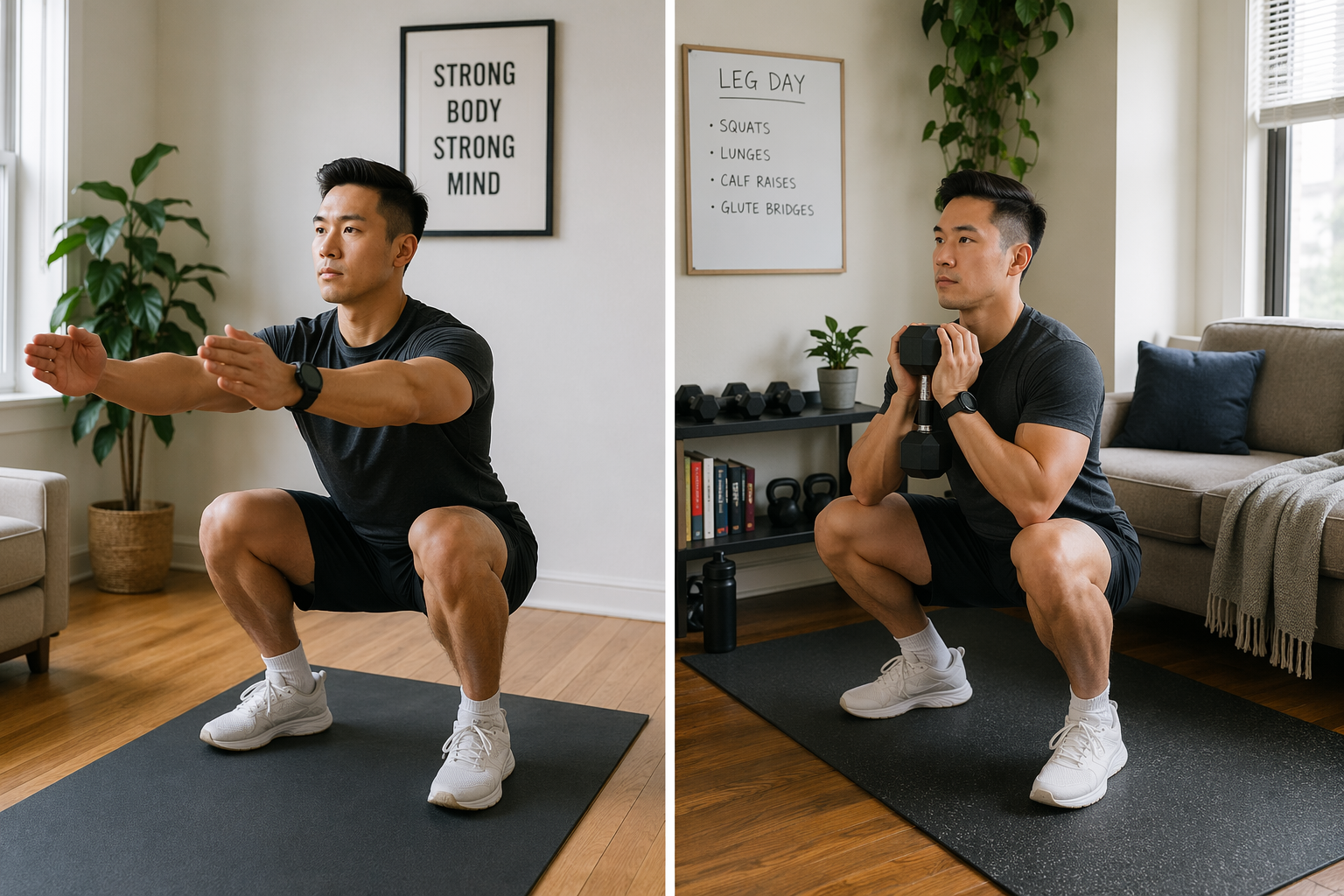
Why this order works
The most common question I get: 'Can you really build leg strength at home without a barbell?' Yes, but only if you keep raising the demand. Bodyweight squats build strength at first, but they stop once you can cleanly do 15–20 reps. After that you're building endurance, not strength. That threshold is where most home leg routines stall — they never graduate to a harder variation.
The fix: unilateral work. A Bulgarian split squat roughly doubles the load per leg because your whole weight is on one side. That's the single best way to keep progress going without adding external weight. And when you eventually need more, household objects — milk jugs, backpacks, laundry detergent bottles — fill the gap.
One more tool: slow eccentrics. Taking 3–5 seconds to lower into a squat or lunge creates tension comparable to adding weight. I've seen the claim that this 'equals adding 20 pounds.' I don't buy that as a precise equivalence — it's a convenience stat. But as a practical intensity trick, it's genuinely useful, especially when you can't add weight yet. Use it.
What you'll need before starting
Space: a 6x6 ft area is enough — roughly the size of a yoga mat with some room to step. Test it: stand with arms outstretched and turn in a circle. If you don't hit anything, your living room works.
Equipment: you'll start with nothing. For the loaded phase, raid your kitchen or closet. Here's what works:
- Milk jugs or laundry detergent bottles (filled with water or sand)
- Backpack stuffed with books or canned goods
- Buckets or small luggage
- Light dumbbells if you have them (they make progression easier)
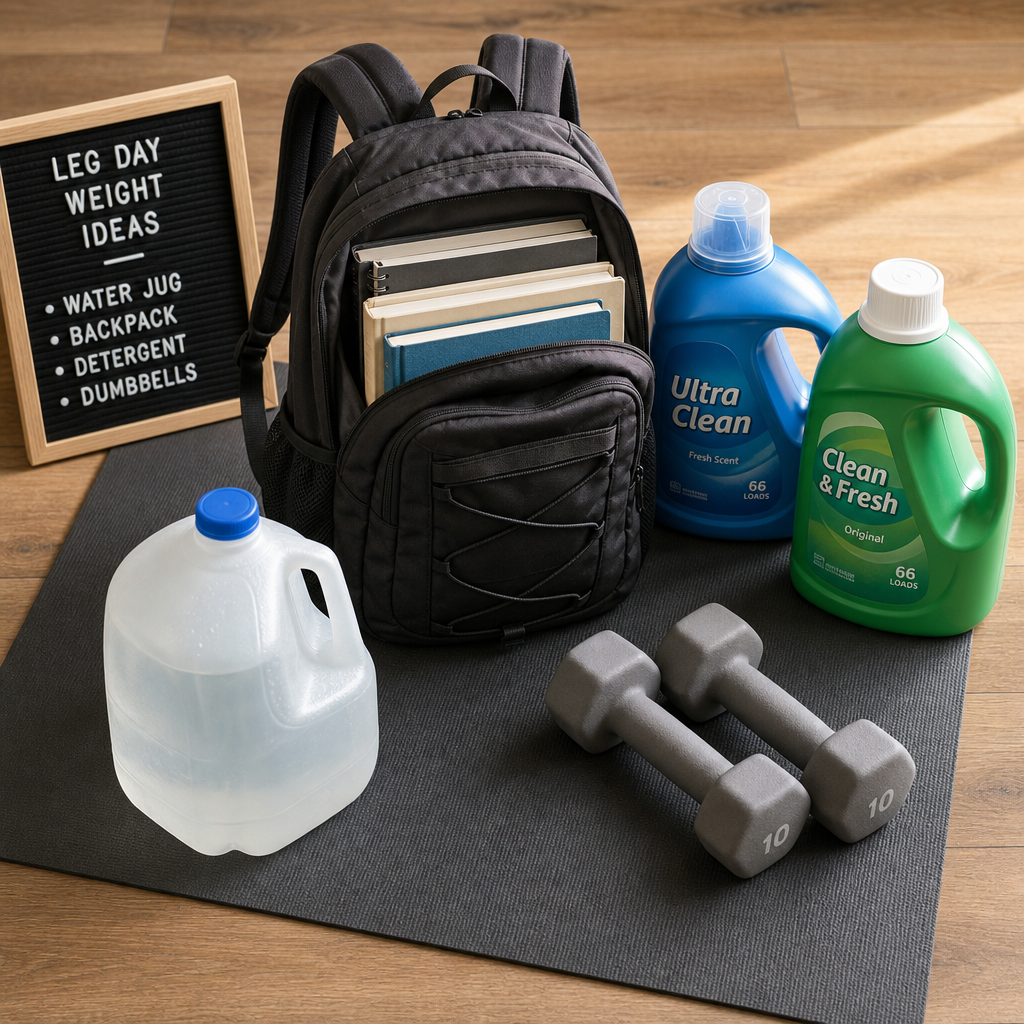
Schedule: train legs 2–3 days per week with at least 48 hours between sessions. That means Monday and Thursday, or Monday, Wednesday, Friday if you recover fast. The A/B workouts below assume a rest day between sessions.
The program: three phases over six weeks
Each phase has two workouts (A and B) that you alternate across two sessions per week. If you train three days, repeat either A or B as the third session. Warm up with 5 minutes of dynamic stretching — leg swings, walking lunges, bodyweight squats. Rest 60–90 seconds between sets.
Phase 1 (Weeks 1–2): Bodyweight bilateral foundation
Goal: build a solid movement pattern and reach 15–20 controlled reps before moving on. Here's the exact setup:
| Exercise | Workout A | Workout B |
|---|---|---|
| Bodyweight Squats | 3 × 15 reps | 3 × 12 reps (tempo: 3s down) |
| Reverse Lunges (alternating) | 3 × 12 per leg | 3 × 12 per leg |
| Glute Bridges | 3 × 15 reps | 3 × 15 reps (single-leg alternating) |
| Calf Raises | 3 × 20 reps | 3 × 20 reps |
Benchmark to advance: can you do 20 bodyweight squats in a row with full depth (hips below parallel) and no pause? If yes by the end of Week 2, move to Phase 2. If not, repeat Phase 1 for another week. Use that benchmark, not the calendar.
Phase 2 (Weeks 3–4): Unilateral bodyweight
This is where the real load increase happens. A Bulgarian split squat with bodyweight alone roughly doubles the load per leg. Use a couch, chair, or low table for the rear foot. Keep your front foot far enough forward so your knee doesn't track past the toe.
| Exercise | Workout A | Workout B |
|---|---|---|
| Bulgarian Split Squats | 3 × 10 per leg | 3 × 12 per leg (tempo: 3s down) |
| Single-Leg Glute Bridges | 3 × 12 per leg | 3 × 12 per leg |
| Lateral Lunges | 3 × 10 per leg | 3 × 10 per leg |
| Single-Leg Calf Raises | 3 × 15 per leg | 3 × 15 per leg |
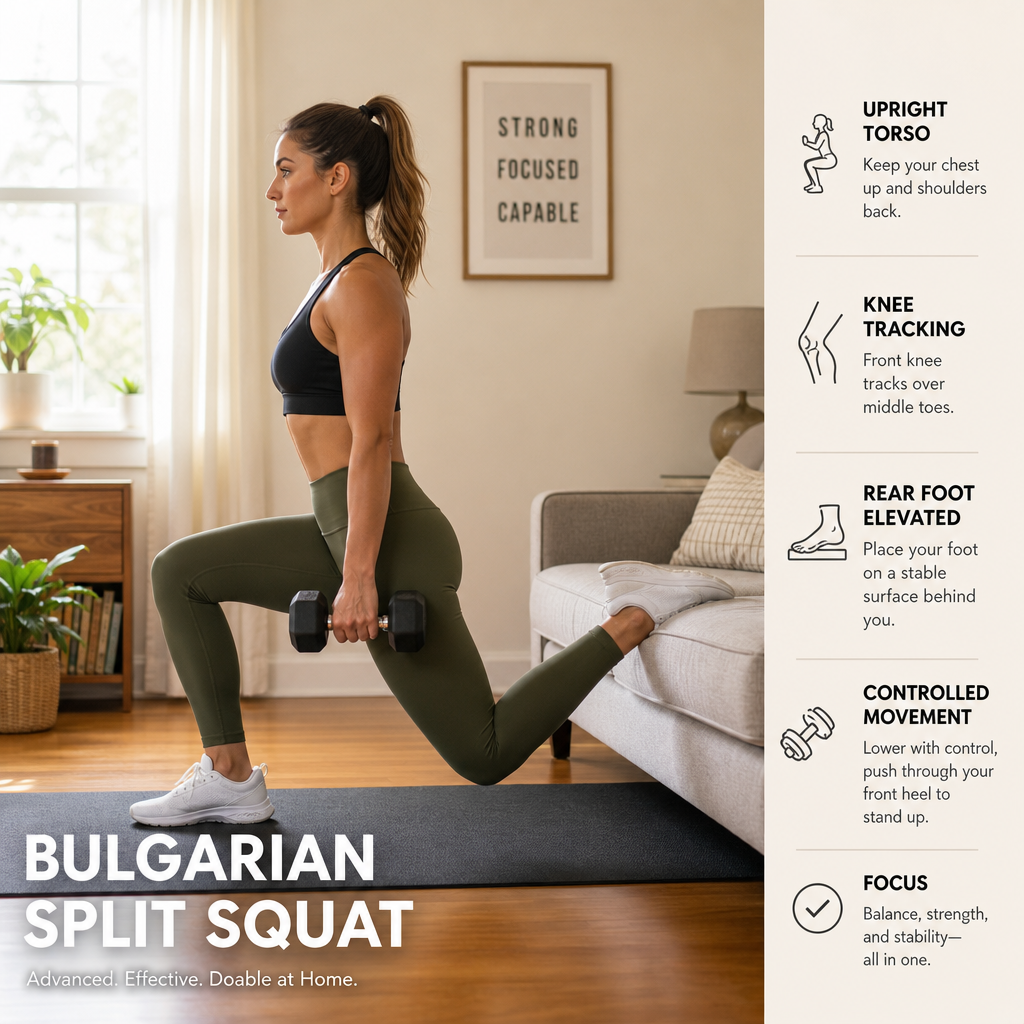
If balance feels unstable, rest a hand on a wall or table. The goal is the legs working, not perfect wobble control.
Benchmark to advance: can you do 12 controlled Bulgarian split squats per leg on each side using the slow tempo? If yes, you're ready to load up.
Phase 3 (Weeks 5–6): Loaded bilateral and unilateral
Now you grab the milk jugs, the backpack, or the dumbbells. If using a backpack, start with 5–6 books (about 10–15 lbs) and adjust by adding or removing a book. If a 2-liter jug is too light but a backpack is too heavy, slow down the eccentric (3–5 seconds) and add a pause at the bottom — that makes the same weight feel much harder.
| Exercise | Workout A | Workout B |
|---|---|---|
| Goblet Squats (hold weight at chest) | 3 × 10 reps | 3 × 8 reps (tempo: 3s down, 2s pause) |
| Weighted Reverse Lunges (alternating) | 3 × 10 per leg | 3 × 10 per leg |
| Weighted Step-Ups (onto a sturdy chair/step) | 3 × 8 per leg | 3 × 10 per leg |
| Single-Leg Calf Raises with weight | 3 × 12 per leg | 3 × 12 per leg |
Benchmark for the end of Week 6: can you do 3 sets of 8 goblet squats with a weight that makes the last two reps tough but not sloppy? That's measurable strength gain, mirror or no mirror.
When your milk jug is too light but the backpack is too heavy
Household objects come in lumpy weight increments. That's the biggest practical complaint about home loading, and it's valid. You have three workarounds:
- Use tempo. A 4-second eccentric with a 2-second pause at the bottom can make a 10-lb jug feel like 15–20 lbs. This is where the slow-eccentric trick pays off.
- Add sets. If you can't increase weight, increase volume from 3 sets to 4 sets while keeping form clean.
- Refine the backpack. Use smaller books, magazine stacks, or canned goods so you can add in smaller increments. A single adjustable dumbbell avoids this whole problem and is worth the investment if you plan to keep training at home.
For more on these techniques, see our guide on progressive overload for legs at home, which covers tempo, pause reps, unilateral loading, and other tricks in detail.
How to know if it's working
Some sources promise visible gains in 6 weeks. That's possible for a motivated beginner who trains consistently, but it's not universal. Your genetics, diet, sleep, and how hard you push each set all matter. I'd rather you track these concrete markers:
- Rep count increase: Can you now do 20 clean bodyweight squats when you started at 12? That's progress.
- Time under tension: Are you controlling the lowering phase for 4 seconds instead of dropping? That's a strength and control gain.
- Load increase: In Phase 3, can you go from a 5-lb jug to a 12-lb backpack? That's real.
- Movement depth: Are you able to squat lower, lunge longer, or hold the bottom position without losing balance? Range-of-motion win.
The visible-results claim is marketing. Judge the plan by whether you can do more work at the end of 6 weeks than you could at the start. If you can, it worked.
What if you stall?
Two weeks with no progress? Check form first — poor squat mechanics can hide a plateau. If form is solid, try a deload week: reduce sets by half and focus on tempo. Then re-enter the same phase with more weight or more controlled reps. If you're genuinely stuck, the progressive overload guide mentioned above has a full troubleshooting section.
Consistency beats perfect execution. Miss a session? Don't double up. Just pick up with the next workout in the rotation.
Start today
Every phase has a benchmark, every workout has a rep target, every day has a place in the progression. That's what's been missing from the home leg workouts you've tried before. Start with Workout A of Phase 1. Track your reps. In six weeks, you'll be doing goblet squats with a loaded backpack — and you'll know exactly how you got there.
What a small equipment investment adds
We don't have a build tagged to this exact tier yet. Browse all builds.
How often should you repeat this?
See our recovery and rest reference for citation-anchored rest-interval guidance.
Spot something off?
Tell us if a movement, tier assumption, or duration didn't match your experience.