
The Original Paper Was a Proposal, Not a Proof
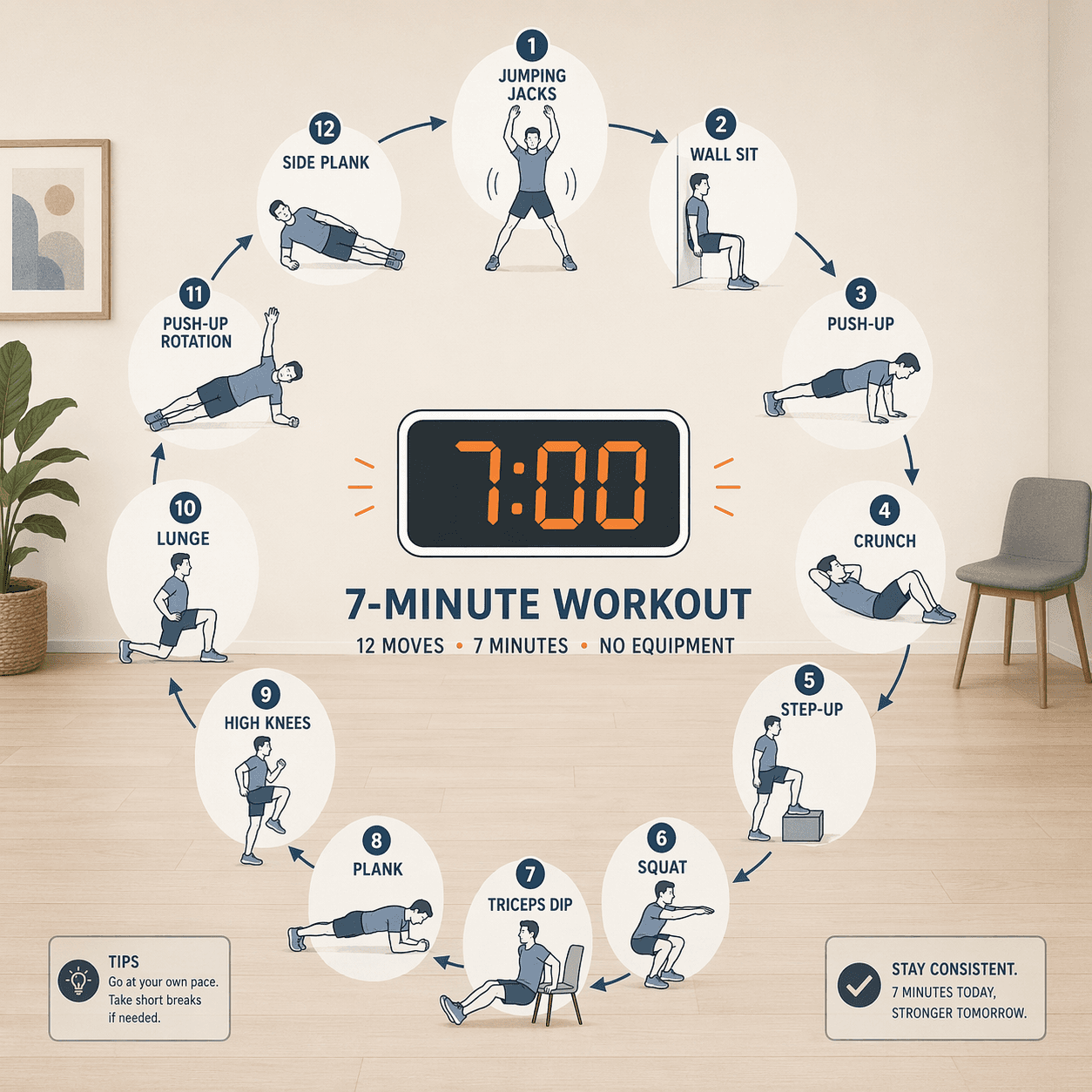
Brett Klika and Chris Jordan’s 2013 article in an ACSM journal was a protocol design — 12 exercises, thirty seconds of work, ten seconds of transition. It was not a clinical trial, though many readers assume that publication in a peer-reviewed journal means it was validated on the spot. The authors themselves were upfront about the limits: they wrote that the protocol “may be inferior to create absolute strength and power.” They also noted that a single round falls below the ACSM guideline of at least twenty minutes of high-intensity exercise and recommended repeating the circuit two or three times. That honest admission sets the tone for everything that follows. The 7-minute workout is not a magic bullet. It is a reasonable, time-efficient option for certain goals — if you know what those goals are.
What the Longer Studies Found
The strongest longitudinal evidence comes from Schmidt et al. 2016, a randomized trial with 96 recreationally active college students. After eight weeks, both the 7-minute circuit (CT-7) and a 14-minute version (CT-14) significantly improved push-up endurance. Males gained some muscular strength. But the improvements were uneven: aerobic capacity increased only in females doing the longer circuit. So the workout can boost muscular endurance, but its cardiovascular effect depends on dose and sex.
Mattar et al. 2017 reported an average waist circumference reduction of about 4 cm and decreased fat mass in 29 adults who did the workout daily for six weeks. I have to note a caveat: the PubMed entry for this study was behind a CAPTCHA during my research, so those numbers come from a secondary source (NTI School). The figure is plausible and consistent with other short-duration HIIT research, but I treat it as a directional signal rather than a precise, verified finding. Both studies used small samples (29 and 96). The results are real but not broad enough to apply to every population. Take the numbers as supporting evidence, not guarantees.
How It Stacks Up Against Real HIIT
If the 7-minute workout is supposed to be “high intensity,” it should hold up against established HIIT formats. Riegler et al. 2017 put that to a direct test. Fourteen active adults did both the 7-minute bodyweight circuit and a time-matched cycling HIIT protocol. The results were clear:
| Measure | Bodyweight Circuit | Cycling HIIT | Significance |
|---|---|---|---|
| Mean VO₂ | 1.44 L/min | 1.83 L/min | p < 0.001 |
| Mean Heart Rate | 140.7 bpm | 159.0 bpm | p < 0.001 |
| Blood Lactate | Similar | Similar | p = 0.07 |
| RPE (Perceived Exertion) | Lower | Higher | p = 0.008 |
The bodyweight circuit produced significantly lower oxygen consumption and heart rate. Blood lactate was comparable, which means it is still vigorous work — but the cardiorespiratory demand is not in the same league as traditional HIIT. The authors noted that the circuit produced bursts approaching 90% of HRmax and significant lactate accumulation, but the average intensity is lower. In plain terms: it is a solid workout, but it is not the peak-intensity stimulus that cycling HIIT provides.
Not All Bad News: Some Metrics Are Comparable
You might read the above and think the 7-minute workout is worthless for anything other than mild effort. That is not true either. Armas et al. 2020 compared the same bodyweight circuit to cycling HIIT in 12 healthy adults and found that post-exercise glucose and triglyceride responses were similar between the two. Systolic blood pressure showed no difference. The circuit actually produced a lower diastolic BP and a higher post-exercise heart rate. So on some key cardiometabolic markers, the 7-minute workout does not lag behind. But the sample size was only 12. The results are statistically significant, but they come from a small, young, healthy group. They tell us the bodyweight circuit is not inferior on every metric — but they do not tell us how it works in larger, more diverse populations.
The Authors Never Claimed More
"this type of training may be inferior to create absolute strength and power" — Klika & Jordan, ACSM's Health & Fitness Journal, 2013
That is the boundary. If your goal is maximal strength, hypertrophy, or peak athletic performance, this is the wrong tool. If your goal is to get off the couch, improve muscular endurance, and chip away at body fat over a few weeks, it is a viable starting point.
The Sticky Factor
Eric Tsz-Chun Poon’s 2023 study (reported in the Washington Post) found that inexperienced exercisers enjoyed the 7-minute workout more than moderate cycling or traditional HIIT. They found it “less boring.” I treat this as a secondary report — the full study was not accessible — but it aligns with broader adherence literature. Workouts that feel less tedious are more likely to be repeated. For a beginner who struggles to stay consistent, enjoyment may be the single most important variable. This does not make the 7-minute workout superior. It makes it sticky. And a sticky workout that you actually do beats a theoretically better workout that you abandon after two weeks.
So What’s the Verdict?
Let me synthesize what the research actually supports:
- The 7-minute workout improves muscular endurance (push-ups) in 8 weeks.
- It can reduce waist circumference and fat mass, though the exact magnitude is still being clarified.
- It produces meaningful cardiometabolic responses — similar to cycling HIIT for glucose and triglycerides, slightly better for diastolic BP.
- It is not a strength or hypertrophy program. One circuit does not meet ACSM volume guidelines. Two to three circuits are better.
- Its cardiorespiratory intensity is lower than traditional HIIT (like cycling sprints), so do not expect the same peak conditioning effects.
- Beginners find it more enjoyable, which drives adherence — a real advantage.
If you are a time-pressed beginner who wants a structured, evidence-based starting point, the 7-minute workout is a legitimate option. Use it for 6–8 weeks, track your push-up count and waist measurement, and when you plateau, graduate to a longer circuit or a different method. If you are an experienced exerciser looking for a stand-alone training program, keep looking — this is not it.
The research supports modest, specific benefits. The original authors never claimed more. Honest framing builds more trust than overpromising. That is the truth of the 7-minute workout.
Comments
Join the discussion with an anonymous comment.