
You squat. You lunge. Nothing changes.
You squat. You lunge. You add a dumbbell when you remember. After a few weeks, the numbers don’t move. The mirror doesn’t change. You start wondering whether leg workouts at home can actually build strength.
They can. But most home leg content skips the one thing that turns a list of exercises into actual progress: a progression framework. Without a clear signal for when to add weight, change reps, or shift exercises, you stall. A 2013 study found that full range-of-motion squats produced twice the muscle growth of partial squats over 8 weeks. That’s a big difference from a single form change. But that result comes from one 8-week study—do not expect to double your gains every 8 weeks. The lesson is that execution detail matters, not that full squats are a magic bullet. Even the best exercises won’t save you if you don’t know when to move to the next level.
Three movement patterns, that’s it
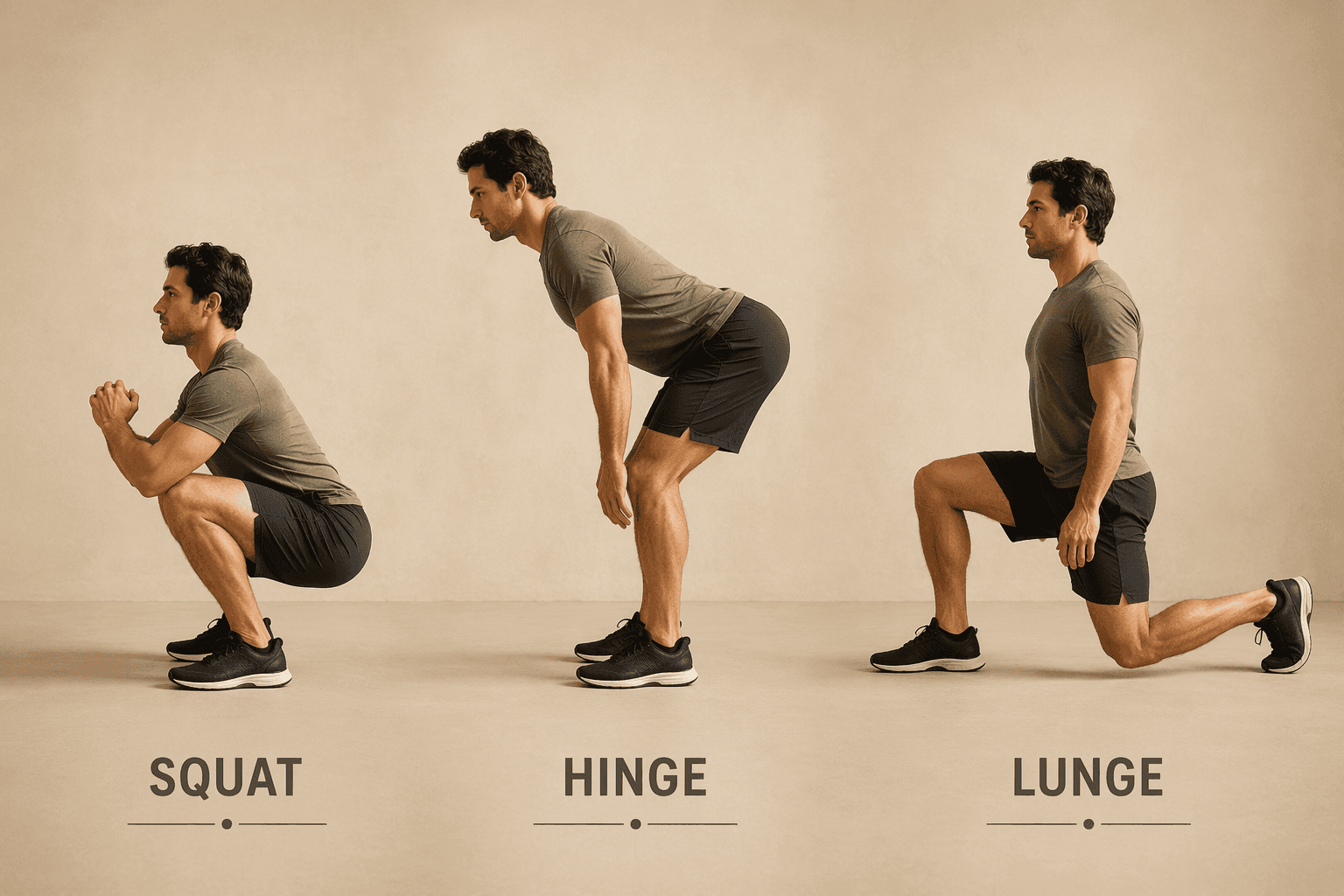
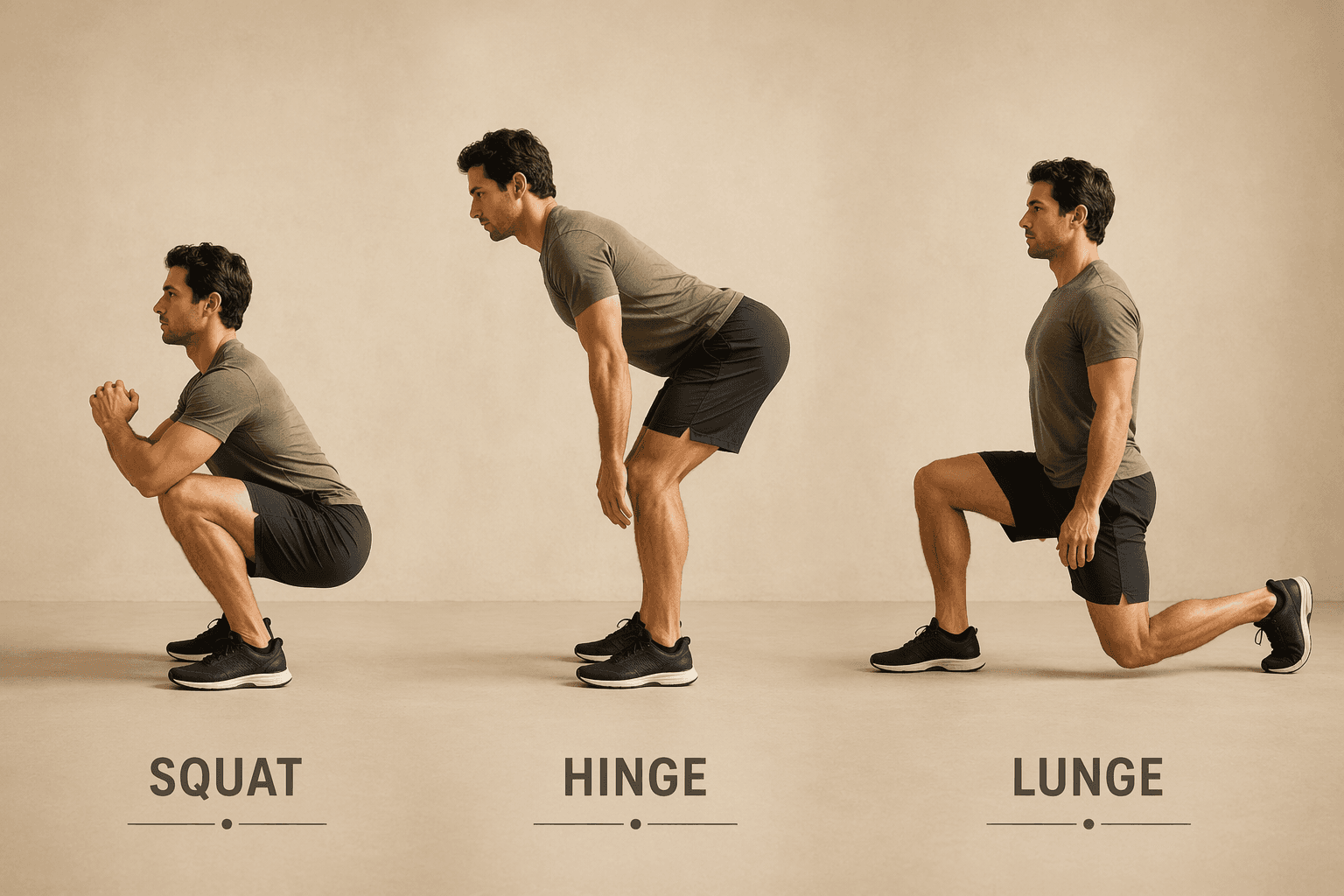
You do not need a dozen exercises. An effective home leg program rests on three movement patterns: squat, hinge, and lunge. Each targets different muscle groups and movement demands. Leave one out and your development becomes lopsided.
Squats (squat pattern) hammer the quads and glutes. Deadlifts and glute bridges (hinge pattern) load the hamstrings and glutes. Lunges (lunge pattern) build single-leg strength and balance. That is the foundation. Healthline and SELF both emphasize these three as the core of any leg day. Our progression will take each pattern through the same levels.
Level 1: Bodyweight first
Before you touch a dumbbell, you need a baseline. That means 15 clean bodyweight squats with your chest up and knees tracking over your toes. No wobble. No heel lift. If you cannot do that, you are not ready for load.
Start with two sets of 12–15 reps per exercise, building to three sets. That’s the entry point recommended by SELF and Verywell Fit. Exercises: bodyweight squats, reverse lunges, glute bridges, and step-ups onto a sturdy chair or box.
- Squat: feet shoulder-width, lower until hips drop below knees, drive through heels.
- Reverse lunge: step back, keep front shin vertical, lower back knee toward ground.
- Glute bridge: lie on back, feet flat, push hips up until body forms a straight line from shoulders to knees.
- Step-up: use a low box or stair, step up with control, no push-off from the back leg.
Progression criterion: when you can complete 3 sets of 15 reps of each exercise with perfect form, you are ready for Level 2. If you cannot, regress to a shallower squat (box squat) or work on ankle mobility. Do not rush. The foundation determines everything above it.
Bodyweight exercises build muscle through progressive overload: adding reps, cutting rest, or switching to harder variations. Nerd Fitness has a good breakdown of these methods.
Level 2: Add load, go unilateral
You have the bodyweight base. Now you need load. Start with dumbbells in the 10–20 lb range, as Healthline advises, and add 5 lb every one to two weeks. But do not just do bilateral squats with dumbbells—that misses the real opportunity of this level.
Unilateral (single-leg) exercises force each leg to handle about 100% of the load, doubling the per-leg stimulus compared to bilateral work. The Bulgarian split squat, in particular, has evidence behind it. A 2015 study found that Bulgarian split squats may be as effective as the back squat for improving back squat 1RM, with less spinal loading. I want to be clear: that study measured 1RM improvement in the back squat, not overall leg development or hypertrophy. It justifies including the exercise but does not mean it fully replaces bilateral work. Still, for home training where heavy barbells are not available, this is a strong candidate.
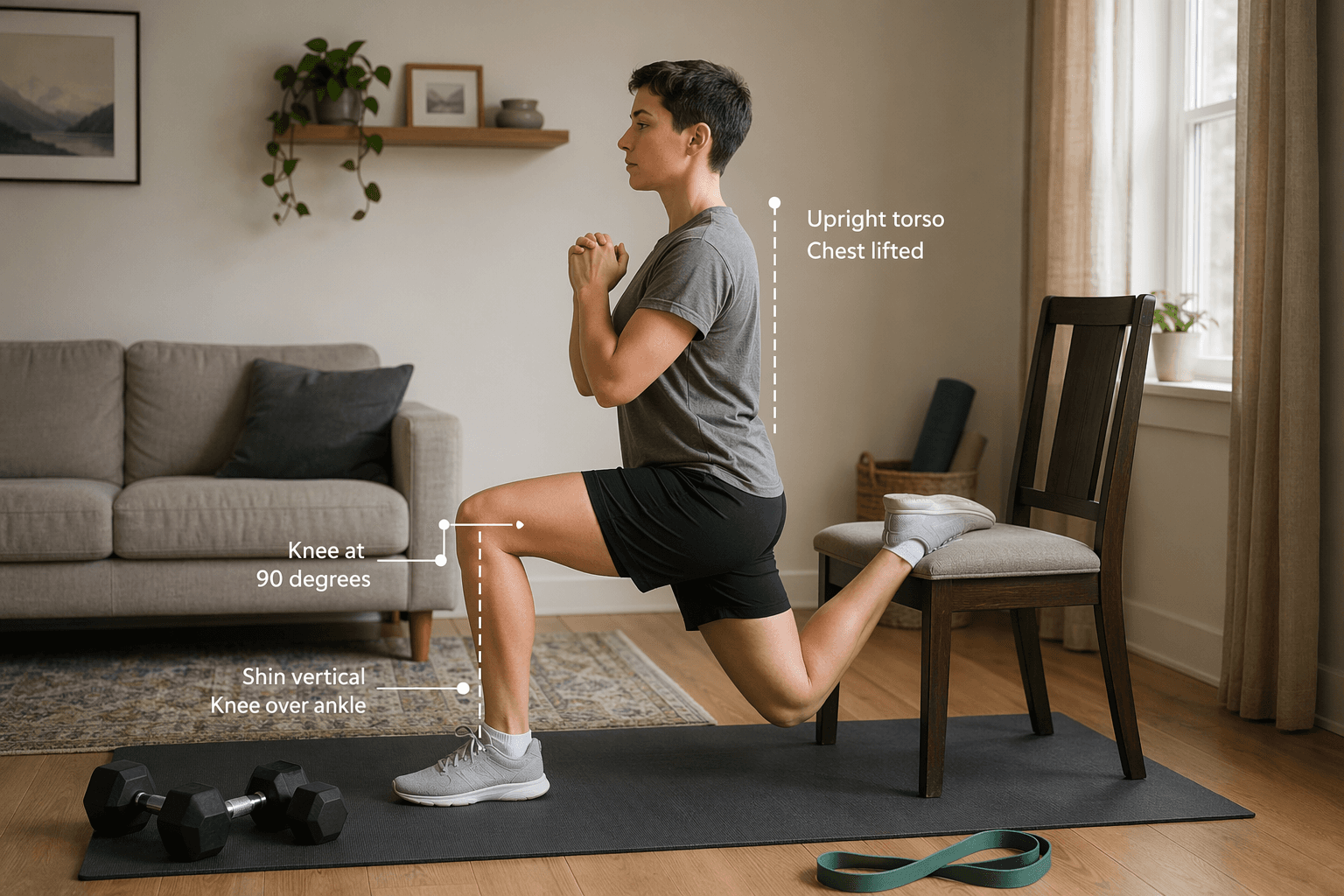
Key exercises for this level: dumbbell goblet squats, Bulgarian split squats, single-leg Romanian deadlifts (RDLs), and walking lunges with dumbbells.
- Goblet squat: hold one dumbbell at chest, lower to full depth.
- Bulgarian split squat: back foot on a chair, front foot forward, lower until front thigh is parallel.
- Single-leg RDL: hold dumbbells or one dumbbell, hinge forward, keep back straight.
- Walking lunge: dumbbells at sides, step forward into a lunge, alternate legs.
A practical problem: grip strength often gives out before your legs do. I see this all the time. When that happens, you have options. Use lifting straps, switch to higher reps with a lighter dumbbell, or substitute resistance bands for the holding load. Healthline specifically notes that when grip fails first, increasing reps is the better move.
Progression criterion: 3 sets of 12 reps on each leg with a weight that leaves you with no more than two reps in the tank. If you hit that, move to Level 3. If you cannot, stay at this level and add reps or reduce rest.
Level 3: Tempo, dropsets, plyos – when you can't add weight
You are comfortable with moderate dumbbells. Maybe you cannot buy heavier ones. Or maybe your grip has hit a ceiling. Advanced techniques let you continue progressing without adding weight.
Tempo work: slow the lowering (eccentric) phase to 3–5 seconds, hold the bottom position for a 3-second pause, then drive up. Centr (Chris Hemsworth’s training platform) claims this creates time under tension equivalent to adding roughly 20 lb of weight. I would not treat that as a precise equivalence—it is expert guidance, not a measured fact. But it is a useful tactic when you cannot add real load. A 2016 study in the Journal of Strength and Conditioning Research showed that slower eccentrics produce greater muscle hypertrophy in the quads, so the idea has mechanistic support even if the 20 lb number is loose.
Drop sets: after you reach failure on a set, immediately reduce the weight by about 20–30% and continue for as many reps as possible. One drop set per exercise, not more. This increases metabolic stress without heavy loading.
Plyometrics: jump squats, box jumps (use a low, sturdy bench), and lunge jumps. These are high-impact but build explosive power. Only attempt them after you have a solid foundation in Levels 1 and 2.
Progression criteria: for tempo, you can control the 5-second eccentric without shaking through the full range. For plyos, you can do 15 controlled bodyweight jump squats without knee valgus or landing noise. If not, stick to step-ups and low box jumps.
Sample 6-week plan
Here is a concrete 6-week plan that applies the progression system. Train legs 2–3 times per week with at least 48 hours between sessions. Each week builds on the previous. If you miss reps on any session, repeat the previous week before advancing. Do not power through failure.
| Week | Focus | Sample Exercises | Sets x Reps | Intensity |
|---|---|---|---|---|
| 1–2 | Level 1: Bodyweight Foundation | Squats, Reverse Lunges, Glute Bridges, Step-ups | 3 x 12–15 | Bodyweight, 60s rest |
| 3–4 | Level 2: Add Load + Unilateral | Goblet Squats, Bulgarian Split Squats, Single-Leg RDL, Walking Lunges | 3 x 10–12 | Dumbbell 10–20 lb, 90s rest |
| 5–6 | Level 3: Tempo & Plyos | Tempo Goblet Squats (3-1-3), Bulgarian Split Squats (normal), Box Jumps, Drop Set on last set of squat | 3 x 8–10 (tempo); 3 x 10–12 (others) | Dumbbell 15–25 lb, 120s rest; add tempo or plyo per session |
Centr suggests that beginners can see visible lower-body strength gains within six weeks using bodyweight movements. That is optimistic for many. Some people see changes in 6 weeks, others need 8–12. Consistency matters more than the calendar. The plan is a template, not a promise.
How to know you're progressing
Without tracking, the progression criteria are just words. You need objective numbers to decide when to move up.
- Rep targets: hit the required reps with clean form. For Level 1, 3 sets of 15. For Level 2, 3 sets of 12 per leg. For Level 3, controlled tempo or 8–10 explosive reps.
- Thigh circumference: measure the widest point and 4 inches above the knee every 2–4 weeks, same time of day. A gain of 0.5–1 inch over 8–12 weeks signals real muscle growth.
- Progress photos: same lighting, same angle, same clothes every 4 weeks. The mirror lies. Photos do not.
The rep criteria come directly from the levels above. The measurement methods are from Centr’s tracking recommendations. They are not essential for everyone, but if you are serious about knowing whether the system works, do them.
Recovery: the part most people skip
Leg muscles are large. They take longer to recover than smaller muscle groups. The 48-hour minimum rest between sessions is not optional. If you train legs on Monday, your next leg session should not be before Wednesday.
After a leg workout, your body needs protein and carbs for repair and glycogen replenishment. Aim for 15–25 grams of protein with a 1:1 carb-to-protein ratio within 30–60 minutes. A simple shake or a chicken-and-rice meal works. Hydration matters too—leg cramps often follow dehydration.
Sleep is where growth actually happens. Most people underestimate how much rest quality affects leg recovery. If you are sleeping less than 7 hours consistently, the progression system will seem to stop working. It is not the system—it is the recovery.
Comments
Join the discussion with an anonymous comment.