Most home workouts do not stall because the person is lazy. They stall because the usual progress buttons run out. Add weight? There may be only one pair of dumbbells. Add space? The coffee table is not moving. Jump harder? The downstairs neighbor may disagree. Do more reps? At some point that turns a strength set into a long negotiation with boredom.
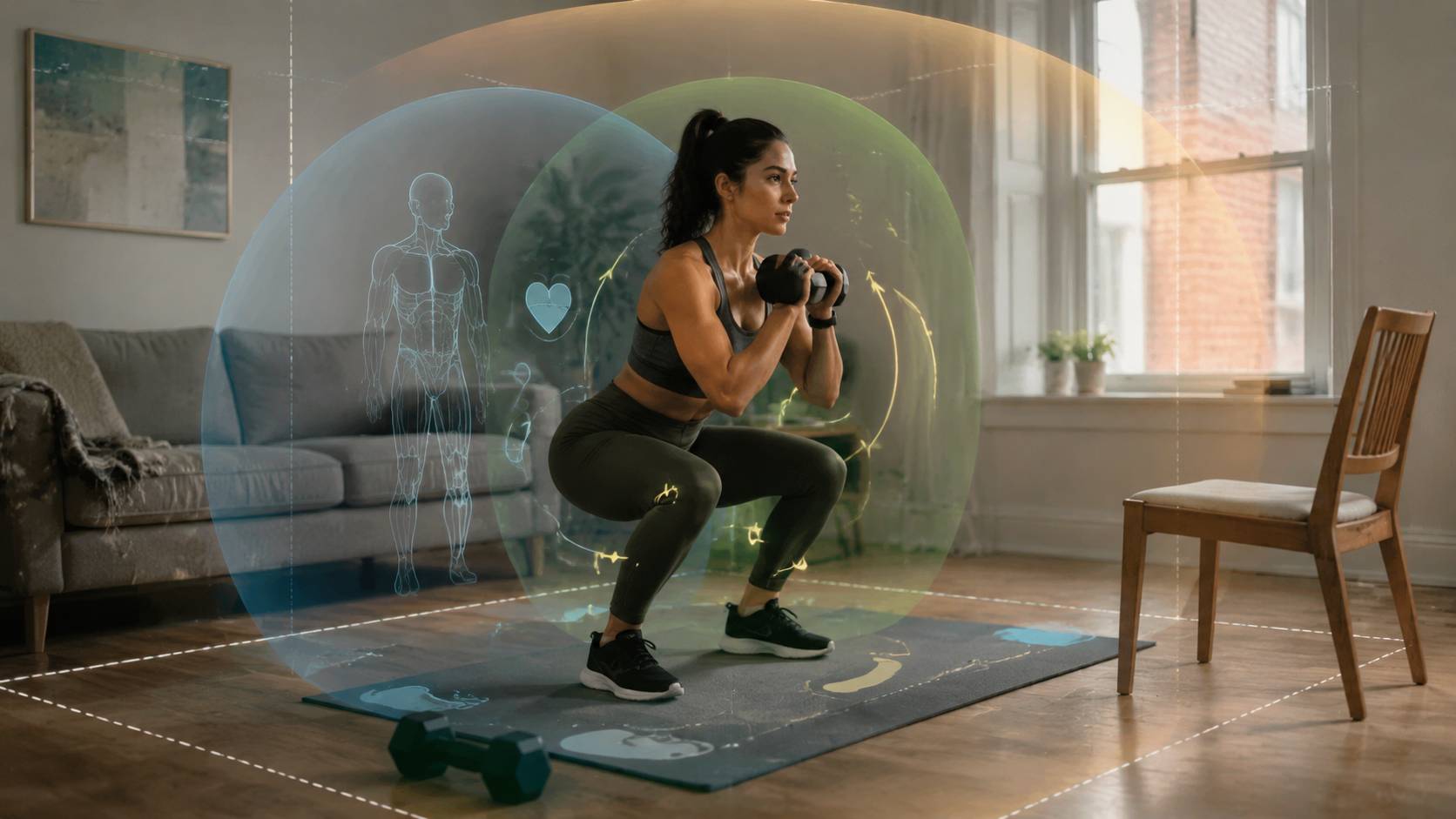
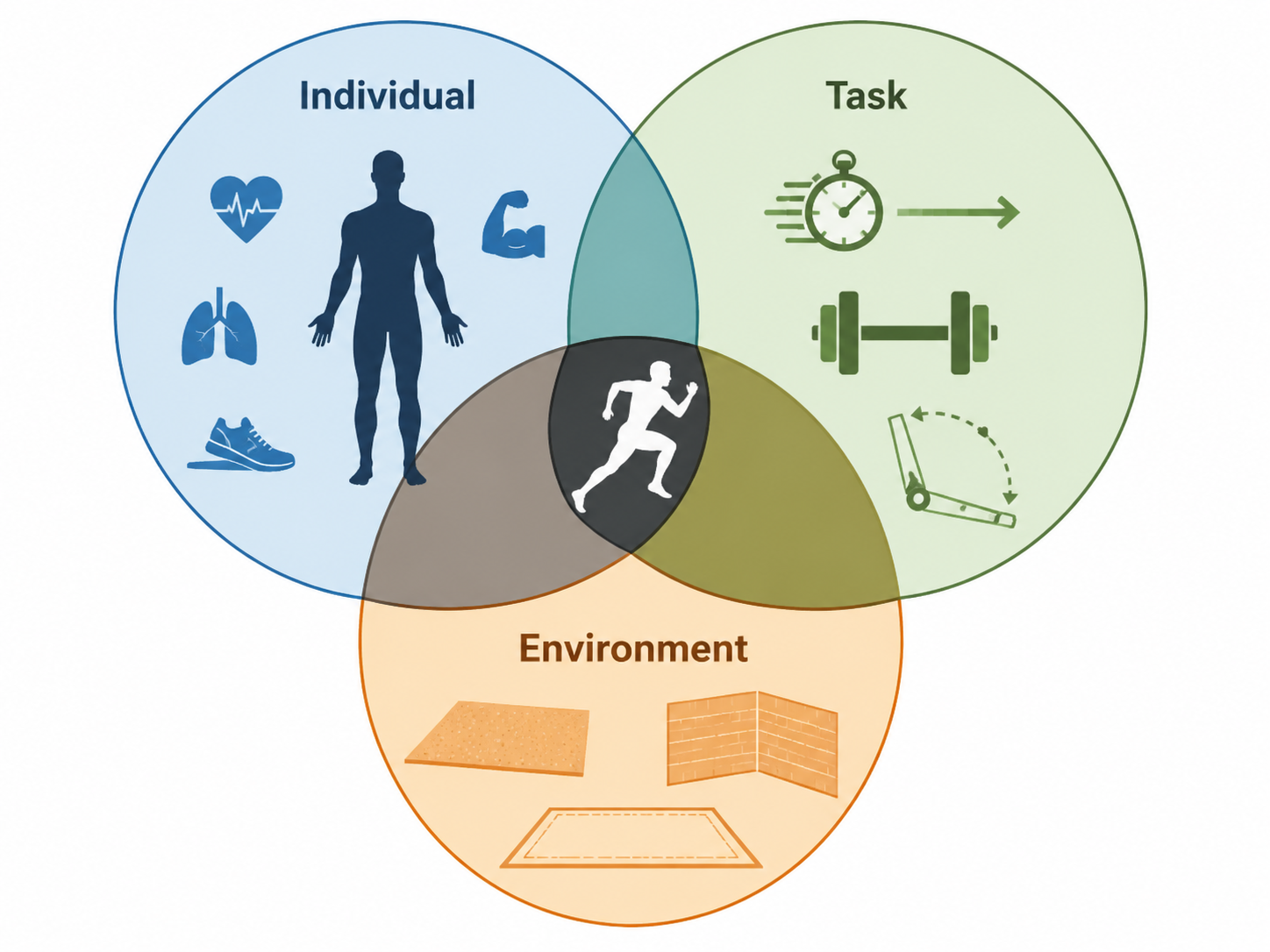
The constraints-led approach (CLA) to training in sports gives home exercisers a better set of buttons to press. In plain language, a constraint is a training variable you can adjust. Some variables belong to you: your strength, mobility, fatigue, confidence, injury history, and attention. Some belong to the task: tempo, range of motion, hand position, load, target, rule, or equipment. Some belong to the environment: floor surface, room size, noise limits, visual feedback, lighting, and the awkward fact that your “gym” may also be your living room.
Karl Newell’s 1986 model groups constraints into three interacting categories: individual, task, and environment.[1] That sounds like coaching theory until you put it next to a pushup. Your shoulder comfort is an individual constraint. A 3-second lowering phase is a task constraint. Doing the set with your hands aimed at two tape marks on the floor is an environmental or informational constraint. Change one of them, and the movement often changes without another lecture about where your elbows should go.
The useful part of “constraints” is control
Home training usually over-relies on exercise selection. If squats are easy, people search for a harder squat. If planks are boring, they search for a harder plank. CLA asks a slightly different question: what variable can you change so the same basic movement demands a better solution?
| Constraint category | Home workout examples | What it changes |
|---|---|---|
| Individual | Fatigue, pain history, strength level, confidence, mobility, recovery | What movement options are realistic today |
| Task | Tempo, range of motion, load, stance, leverage, unilateral work, target, rule | What the exercise asks your body to solve |
| Environment | Room size, floor surface, ceiling height, noise limits, mirror use, wall or chair placement | What information and boundaries shape the movement |
Individual constraints deserve respect before any clever tweak. A narrow-stance squat is not a useful progression if your hip pinches every rep. A slow pushup tempo is not productive if your wrist pain is getting louder. Training alone removes the coach who might notice when “challenging” has become “concerning,” so pain, dizziness, numbness, or a movement change that worries you should stop the experiment and point you toward qualified help.
For most healthy home exercisers, the richest levers are task and environmental constraints. They are the ones you can deliberately manipulate tomorrow without buying a barbell or clearing a garage. A slower descent, a reduced base of support, a target on the wall, a chair that limits depth, or removing mirror feedback can all change what your body has to organize.
Why changing the setup can change the movement
The logic behind CLA is not that the body needs less coaching. It is that the body learns partly by solving problems. Kelso’s work on self-organization describes how movement patterns can reorganize when constraints change.[2] In a workout, that means a small design change can make a cleaner pattern more likely instead of asking you to consciously micromanage every joint.
This is where the approach becomes useful for people training alone. A cue such as “keep your knees out” may help, but it also asks you to monitor a body part while lifting. Research associated with Gabriele Wulf’s external-focus work has repeatedly argued that directing attention toward the movement outcome or environment tends to support better movement than an internal body-part focus.[3] A floor target, a wall touch, a quiet landing rule, or a reach toward an object gives your attention somewhere practical to go.
Robert Bjork’s idea of desirable difficulties also fits here: practice conditions that are a little harder can support adaptation when they force useful effort rather than random struggle.[4] A pushup with a slower lowering phase is not magic. It simply removes the option of dropping through the weak range and makes control more visible. A split squat with the front foot aimed at a tape mark narrows the problem. A balance drill without a mirror may make your foot and hip feedback more important.
Bernstein’s “repetition without repetition” is the better antidote to chasing one frozen perfect rep. Skill is not copying the exact same movement forever; it is achieving the goal through adaptable movement solutions.[1] For home workouts, that gives permission to vary stance, tempo, target, and range. It does not give permission to ignore pain or let every rep become a different collapse.
The barbell cases that make the idea visible
The cleanest examples do not come from living rooms. That matters. Much of the CLA evidence sits in coached sport, skill learning, and strength-and-conditioning settings rather than unsupervised home workouts. A 2019 systematic review by Clark and colleagues found that 77.7% of included studies reported positive effects of constraints-led training on skill development in interceptive sports.[5] That is a useful confidence signal for the approach, not proof that every home exerciser can self-coach any movement safely.
Still, the power-clean examples are hard to ignore because they show how little talking may be needed when the setup is right. In work reported by the Canadian Strength and Conditioning Association, Verhoeff and colleagues placed agility poles in front of a barbell during power cleans. Bar distance from the body reportedly decreased from 17 cm to 6 cm, without the change being driven by verbal instruction.[6]
In another Verhoeff example, a chalk mark on the barbell gave athletes a simple reference for thigh contact. Barbell rearward displacement changed from 0.82 cm to 7.14 cm.[6] The point for a home exerciser is not to imitate Olympic-lift coaching with a broomstick. The point is smaller and more useful: information in the environment can change the solution your body selects.
A tape line on the floor can ask your feet to land consistently. A pillow behind the hips can give a squat depth target. A wall can tell you whether a hinge is drifting into a squat. A chair can set the end point of a split squat. These are not decorations. They are quiet coaching tools.
Task constraints: make the same exercise ask a different question
Task constraints are usually the easiest place to start because they sit inside the exercise itself. You are not changing your apartment. You are changing the rule of the rep.
- Tempo: slow the lowering phase, pause at the hardest position, or use a controlled up-and-down rhythm such as a 3-second descent and 3-second ascent.
- Range of motion: elevate the hands for an easier pushup, use a deficit for a harder one, or limit depth temporarily when control or comfort requires it.
- Leverage: move the hands farther forward in a plank, adjust foot position in a bridge, or change torso angle in a row.
- Unilateral work: shift from two-leg to split-stance or single-leg variations when load is limited.
- Base of support: narrow, widen, stagger, or offset the stance to change balance and force control.
- Rules: add a quiet landing rule, a pause before each rep, or a target-touch requirement.
This is how progressive overload can continue after the dumbbells stop getting heavier. A goblet squat with one dumbbell may be easy for 15 fast reps. The same squat with a 3-second descent, a 1-second pause just above the chair, and a narrower stance may create a very different training demand. The load did not change. The problem changed.
For a ready-made example of this logic, the quiet strength plan uses controlled tempos, unilateral moves, and isometric holds to make bodyweight strength training harder without jumping, dropping weights, or needing more room.
Environmental constraints: let the room become part of the program
The home environment is often treated as the obstacle. In CLA, it can also be the design material. The wall, floor, chair, doorway, rug edge, and amount of available silence all shape what movements are practical.
A small room limits sprinting, but it can support deceleration steps, shadow footwork, split squats, crawling patterns, wall-supported hinges, or anti-rotation holds. A no-noise apartment rules out repeated jumping, but it makes slow eccentric work, isometrics, and controlled single-leg strength more attractive. A slippery floor is not a fun challenge; it is a reason to change footwear, surface, or exercise.
Visual feedback is another environmental constraint. Mirrors can help beginners notice obvious positions, but they can also turn every rep into a performance review. Many home exercisers train in a dark window reflection or a phone camera propped against a shoe. Try removing the mirror for some balance or hinge work and replacing it with an external target: touch the wall with the hips, reach the hands toward a mark, or keep the knees tracking between two tape lines. That change may reduce overthinking and make the movement goal clearer.
Sport-specific home training often lives or dies on environmental design. A tennis player without a court cannot recreate tennis, but they can still build footwork, rotation, braking, and conditioning inside a defined space. The tennis fitness routine at home is a useful example of shaping a session around limited floor area and simple equipment instead of pretending the limitation is not there.
A home workout menu of constraint changes
The mistake is changing everything at once. If your pushups feel stale, do not simultaneously slow the tempo, elevate the feet, narrow the hands, remove the mirror, and add a pause. You will not know what helped. Choose one lever, watch what happens, and keep the rep quality high enough that you can learn from it.
| If the goal is... | Try changing... | Example |
|---|---|---|
| More strength from light load | Tempo or pauses | Goblet squat with a slow descent and controlled pause |
| More control | Range of motion | Pushup to a yoga block before progressing lower |
| More challenge without more weight | Leverage | Long-lever plank instead of standard plank |
| More left-right balance | Unilateral demand | Split squat, single-leg bridge, one-arm row |
| Better balance or landing control | Base of support | Narrow-stance squat or quiet step-down |
| Less overthinking | Information source | Replace mirror checking with a floor or wall target |
| Apartment-friendly intensity | Noise rule | No-jump conditioning with controlled transitions |
Absolute beginners may not need this much design freedom yet. If you are still deciding what kind of home training fits your body, schedule, and confidence, start with a broader home fitness decision guide before trying to build every session from scratch.
Use GROW to turn CLA into a weekly habit
The hardest part of using CLA alone is not understanding the categories. It is deciding what to change next. Kennedy and O’Brien noted in 2024 that the field still lacks exact applied guidelines telling practitioners when and how to manipulate constraints.[7] That is mildly inconvenient for coaches and very relevant for home exercisers. Trial-and-error is not a side effect of the method. It is part of the method, provided the trials are small and observed.
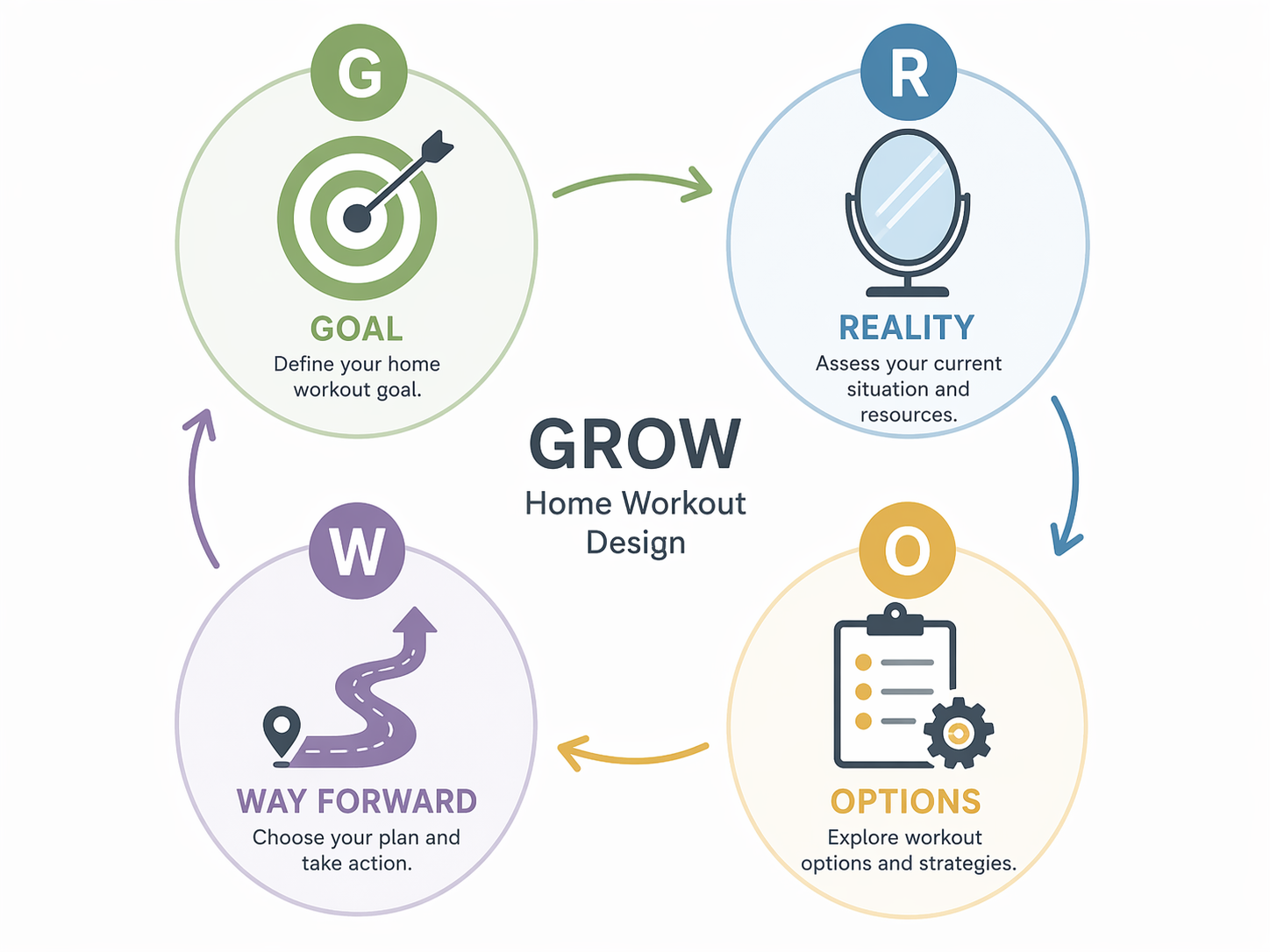
The GROW structure used in CLA coaching discussions gives that trial-and-error a simple shape: Goal, Reality, Options, Way Forward.[8] It works well at home because it keeps you from changing variables just because a variation looks interesting online.
Goal: choose the movement problem, not just the exercise
A useful goal is specific enough to guide the constraint. “Get fitter” is too broad. “Make pushups harder” is better, but still vague. “Build controlled full-range pushups without shoulder irritation” gives you something to design around. It tells you that tempo, range of motion, hand elevation, and pain monitoring matter more than chasing the hardest variation.
The same applies to lower-body work. “Improve squats” could mean depth, balance, knee comfort, strength, endurance, or quiet control. Each goal points to different constraints. Depth may call for a target. Strength with limited load may call for tempo. Balance may call for stance changes. Quiet control may call for a no-noise rule.
Reality: check today’s actual constraints
Reality is where many home programs become more honest. How much space do you have today? How much energy? Which joint is irritated? Is the floor safe? Are you training during a quiet hour? Do you have enough attention to learn a new variation, or do you need a familiar movement done well?
This step is not meant to talk you out of training. It prevents bad constraint choices. A single-leg Romanian deadlift may be a smart balance and hinge progression on a clear floor. It may be a poor choice when the dog is underfoot, the rug slides, and your lower back already feels guarded. The exercise did not become bad. The constraint mix did.
Options: pick one or two levers
Once the goal and reality are clear, choose from task or environmental options. For a pushup plateau, options might include elevating the feet, slowing the descent, adding a bottom pause, using a narrower hand target, or elevating the hands to restore full range with better control. For a squat plateau, options might include a chair target, a slower tempo, a heel-elevated variation, a split squat, or a no-noise rule that forces softer transitions.
A good option changes the demand without hiding the goal. If the goal is cleaner pushups, a variation that makes you twist, shorten the rep, and rush through discomfort is not a useful difficulty. If the goal is more leg strength with light dumbbells, a slow split squat may be more honest than a jump variation you cannot land quietly.
Way Forward: test, track, and decide the next small change
The way forward should be concrete enough that next session is not a fresh guess. Write down the constraint you changed, the set and rep range, and one observation. That observation can be simple: “left side wobbled after rep six,” “3-second tempo made eight reps hard,” “chair target fixed depth,” or “shoulder felt worse after bottom pause.”
Keep the test short. One week of slow-tempo pushups tells you more than one day of six new pushup variations. If the movement improves and discomfort stays quiet, keep the constraint long enough to adapt. If the movement becomes confusing, painful, or less controlled, remove the constraint or step back to an easier version. Progression is not proved by making the exercise uglier.
| GROW step | Home workout question | Example answer |
|---|---|---|
| Goal | What movement outcome do I want? | Stronger pushups with full range and no shoulder irritation |
| Reality | What is true today? | Hands-on-floor pushups lose control near the bottom |
| Options | Which constraint could help? | Elevate hands, slow the descent, or use a target depth |
| Way Forward | What will I test next? | Three sets of elevated pushups with a 3-second descent, then note control and comfort |
What CLA can and cannot promise at home
The constraints-led approach does not remove the limits of home training. A light dumbbell still weighs what it weighs. A small room still limits speed work. Training alone still means you may miss things a coach would catch immediately. The evidence base is also not a direct map of living-room workouts; it leans more heavily on coached sports, skill acquisition, and strength-and-conditioning examples.
What CLA does offer is a cleaner way to experiment. Instead of asking only, “What harder exercise should I do?” you can ask, “Which individual, task, or environmental constraint is shaping this movement, and which one can I safely adjust?” That question is often enough to turn a stale session into a useful one.
Small changes are the point. A chalk mark, a target, a slower tempo, a narrower stance, a different viewing setup, or a quiet landing rule can make the body solve a more specific problem. Track the result, keep what works, drop what makes movement worse, and get outside guidance when pain or uncertainty stops being simple workout feedback.
References
- Newell’s model of constraints, Skilled Athleticism / Hooper University, 1986
- Dynamic Patterns: The Self-Organization of Brain and Behavior, Skilled Athleticism, 1995
- External Focus Cues, Hooper University
- The Conditions of Learning: Training Conditions and Principles of Training, Skilled Athleticism, 1994
- The Effectiveness of Constraints-Led Training on Skill Development in Interceptive Sports, shura.shu.ac.uk, 2019
- Verhoeff et al. constraints-led power clean examples, Canadian Strength and Conditioning Association, 2018
- Kennedy & O’Brien constraints-led approach applied guidelines, Basketball Immersion, 2024
- The GROW Model, Basketball Immersion, 2019
Comments
Join the discussion with an anonymous comment.