
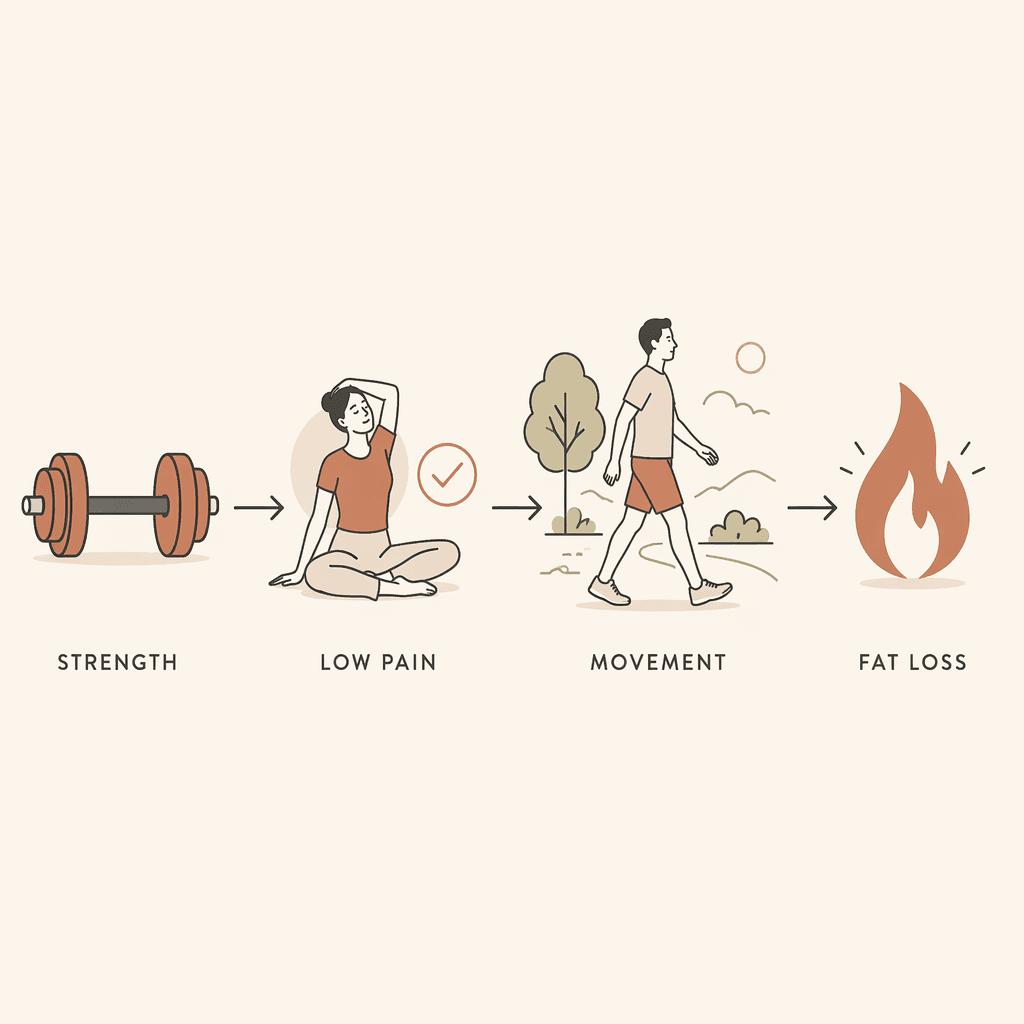
Why your last fat-loss workout left you too sore to move
You finish a heavy leg day on Monday, spend Tuesday on the couch because walking downstairs is a problem, and by Wednesday you have burned maybe 200 more calories than a rest day. That deep soreness you took as proof the workout worked may be working against you. Not because muscle damage is bad, but because it drains the energy you would otherwise spend on everything else: walking the dog, fidgeting at your desk, standing while you cook dinner.
That daily movement outside formal exercise has a name – non-exercise activity thermogenesis, or NEAT – and it accounts for a surprisingly large slice of total daily energy expenditure. When your legs ache, you unconsciously reduce NEAT. The workout burned 300 calories; the couch cost you 400. Net negative for fat loss.
The obvious counter: pick a training style that does not leave you wrecked the next day. That is where full-body dumbbell training enters the picture.
What two studies actually measured (and what they didn't)
A 2024 study in the European Journal of Sport Science put 23 experienced lifters on 5 days of training per week for 8 weeks, with 75 sets per week at 70–80% of 1RM. Half trained full-body each session, half used a body-part split matched for total volume. The full-body group lost significantly more whole-body fat mass, measured by DXA scan – the gold standard for body composition – compared with the split group.
The same study also tracked delayed onset muscle soreness (DOMS). The full-body group reported consistently lower soreness across all muscle groups, and in the lower body the difference was up to 7.5 times less. That is not a rounding error.
A 2016 study in Biology of Sport found that over 4 weeks full-body training burned nearly three times as much fat mass as split training in male rugby players. I want to like that number, but it comes from a secondary source – Garage Gym Reviews citing PubMed – and I have not seen the original paper. The figure is suggestive but not settled.
The 2024 study used DXA, which is reliable, but had only 23 participants. DOMS was self-reported, not measured by any objective marker. The 2016 '3×' figure needs original verification before I would cite it as fact.
The DOMS-to-NEAT chain: plausible, but not proven
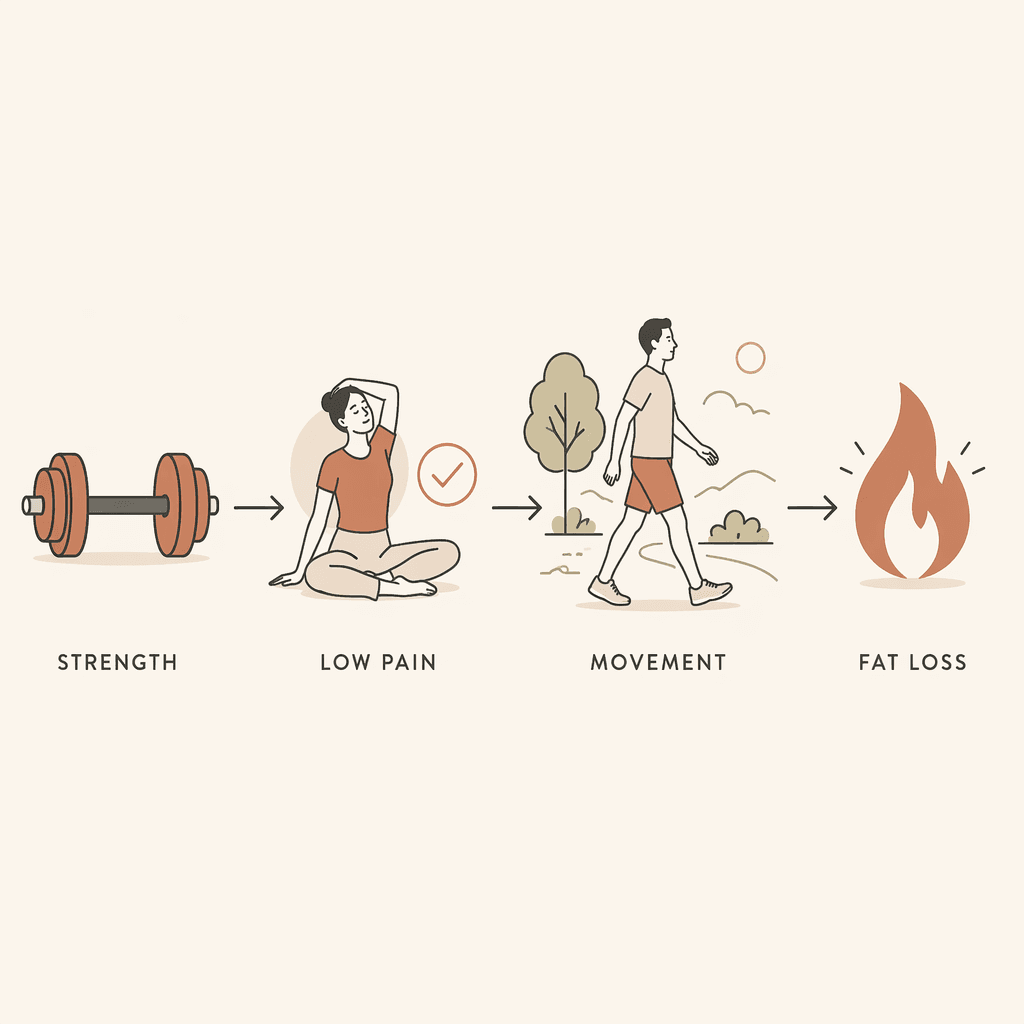
Here is the logical line: lower delayed soreness → you move more during the day → your non-exercise activity thermogenesis goes up → total energy expenditure rises → more fat loss. It makes sense. The 2024 study measured soreness and fat mass, but it did not track NEAT. The link is an inference, not a direct finding.
I am comfortable presenting it as a plausible mechanism because the behavioral chain is well established in other contexts – people in pain move less – and the soreness difference in the study was large enough to produce a meaningful behavioral gap. But the article should not sell it as proven. This suggests, not this proves.
How to apply this with dumbbells only
The studies used barbell and machine training, but the principles transfer cleanly to dumbbells. Full-body, compound movements done with moderate loads and shorter rest intervals produce the same metabolic stimulus. A 2017 Frontiers in Physiology study showed that programs built around multi-joint exercises are more efficient for improving both strength and VO₂ max than single-joint programs. Compound lifts with dumbbells – squats, rows, presses, lunges – are multi-joint by nature. No bench or barbell needed.
The circuit format (short rest, continuous movement) further amplifies the metabolic demand. You are not resting long enough to fully recover, so your heart rate stays elevated and your body draws on fat stores for a larger portion of the energy bill.
The 30-minute circuit protocol
The following protocol is my design based on the principles above. It is not taken from any study – the evidence supports the full-body approach in general, but the specific exercise order and rest intervals are a reasonable application, not a prescription pulled from a paper.
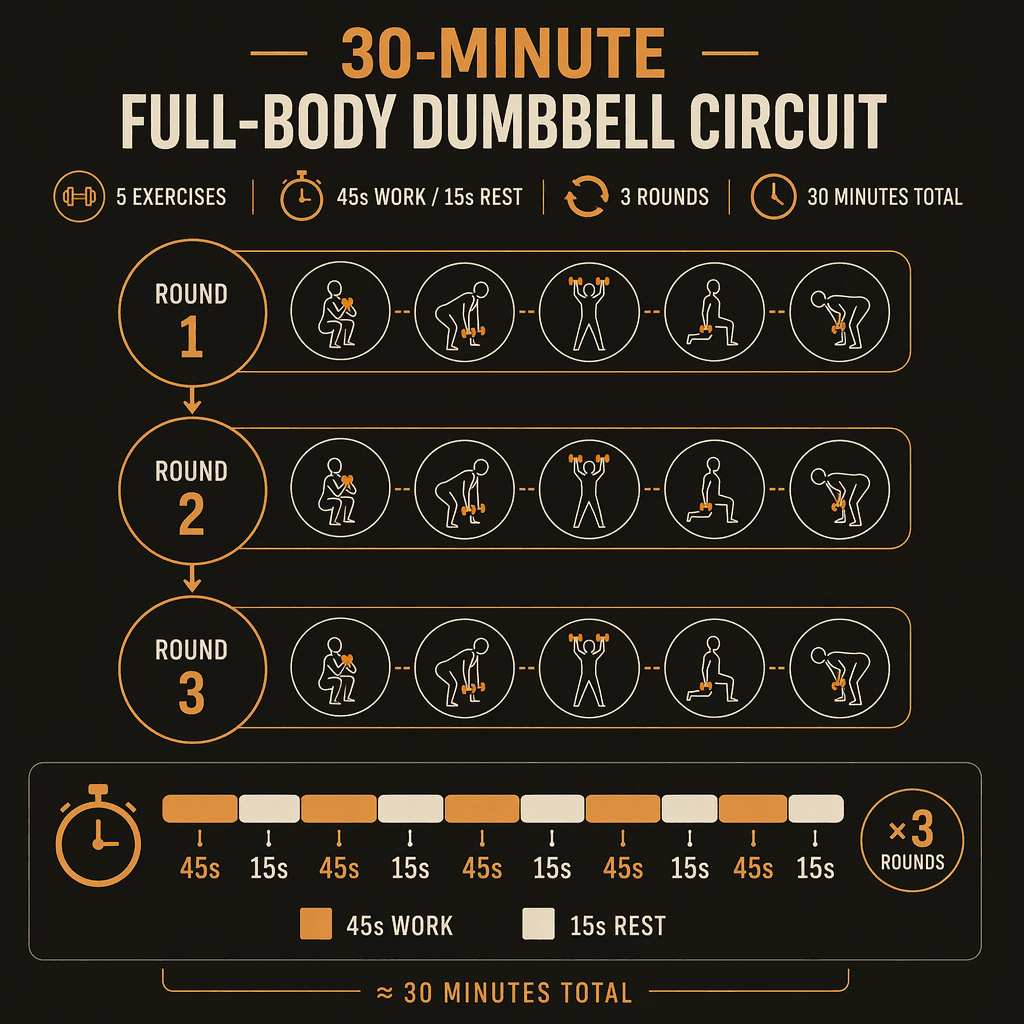
Perform 5 exercises as a circuit: 45 seconds of work, 15 seconds of rest, moving from one exercise to the next without extra rest. Complete 3 rounds total. That is roughly 15 minutes of work and 7.5 minutes of rest – the whole session fits in 30 minutes including a short warm-up.
| Exercise | Sets x Duration | Rest |
|---|---|---|
| Goblet Squat | 3 x 45s | 15s between exercises, 60s between rounds |
| Dumbbell Row (each side) | 3 x 45s | same |
| Dumbbell Bench Press (floor or bench) | 3 x 45s | same |
| Standing Overhead Press | 3 x 45s | same |
| Dumbbell Reverse Lunge (each side) | 3 x 45s | same |
Choose a weight you can control for a full 45 seconds without failing before the round ends. The last few reps of each set should be challenging but not a grind. If you have to stop at 35 seconds, the weight is too heavy.
How to keep progress (and when to move on)
You can run this circuit for weeks before it stops working. When it does, three levers are available:
- Add a 4th round. Total work time jumps to 20 minutes, session to about 35.
- Reduce rest from 15 seconds to 10 seconds between exercises. Keeps work time the same but increases density.
- Increase the load. Add 5 lbs per dumbbell once you can complete all three rounds with perfect form and no breakdown in the last reps of each set.
For a more structured progression approach, see the step-by-step framework that lays out how to move from beginner to advanced within a full-body dumbbell setup. And if 30 minutes feels too short and you want a higher-volume routine, the 4-day program uses similar principles across four weekly sessions – a different time commitment, not a better one.
What the evidence doesn't tell us
The 2024 study had 23 participants – enough to find statistical significance, but far from definitive. DOMS was self-reported, not objectively measured. NEAT was not tracked. The 2016 '3×' figure is from a secondary source and needs original verification. The circuit protocol is writer-designed, not study-derived. This is a reasonable tool, not a miracle prescription.
A full-body dumbbell circuit is a practical, evidence-consistent choice
The comparative evidence suggests full-body training is favorable for fat mass reduction. The lower-soreness-to-higher-NEAT path is a plausible mechanism. The 30-minute circuit offers a time-efficient way to apply those principles at home with nothing but a pair of dumbbells.
None of this means split training is useless, or that this circuit is the only path. It means the full-body approach deserves a real trial if your current routine leaves you too sore to move the next day. Try it for 4 weeks. Track how you feel the morning after and whether your daily step count holds steady. The evidence is not airtight, but it is good enough to act on.
Comments
Join the discussion with an anonymous comment.