
The reason to practice golf putting drills at home is not that carpet is a perfect substitute for a green. It is that too many mid-handicap rounds leak shots from inside six feet, and that is one of the few putting problems you can attack in a hallway without pretending you are reading grain.
Shot Scope’s make-rate table puts a useful number on the problem. From 0–6 feet, scratch golfers make 92.8% of putts, 10-handicap golfers make 87.6%, 20-handicap golfers make 84.4%, and 25-handicap golfers make 82.5%.[1] That gap is not trivia. It is the difference between a player who expects the ball to start online and a player who spends the next week trying three new YouTube fixes because the same four-footer keeps escaping.
Closing even part of that short-putt gap is a fair place to look for a meaningful scoring gain. The 2–3 strokes-per-round upside is an estimate, not a promise, because it depends on how many short putts you face and what kind of misses you currently own. But the practice target is clear enough: build a repeatable start line, a stable face, centered contact, usable tempo, and distance control that survives outside the living room.
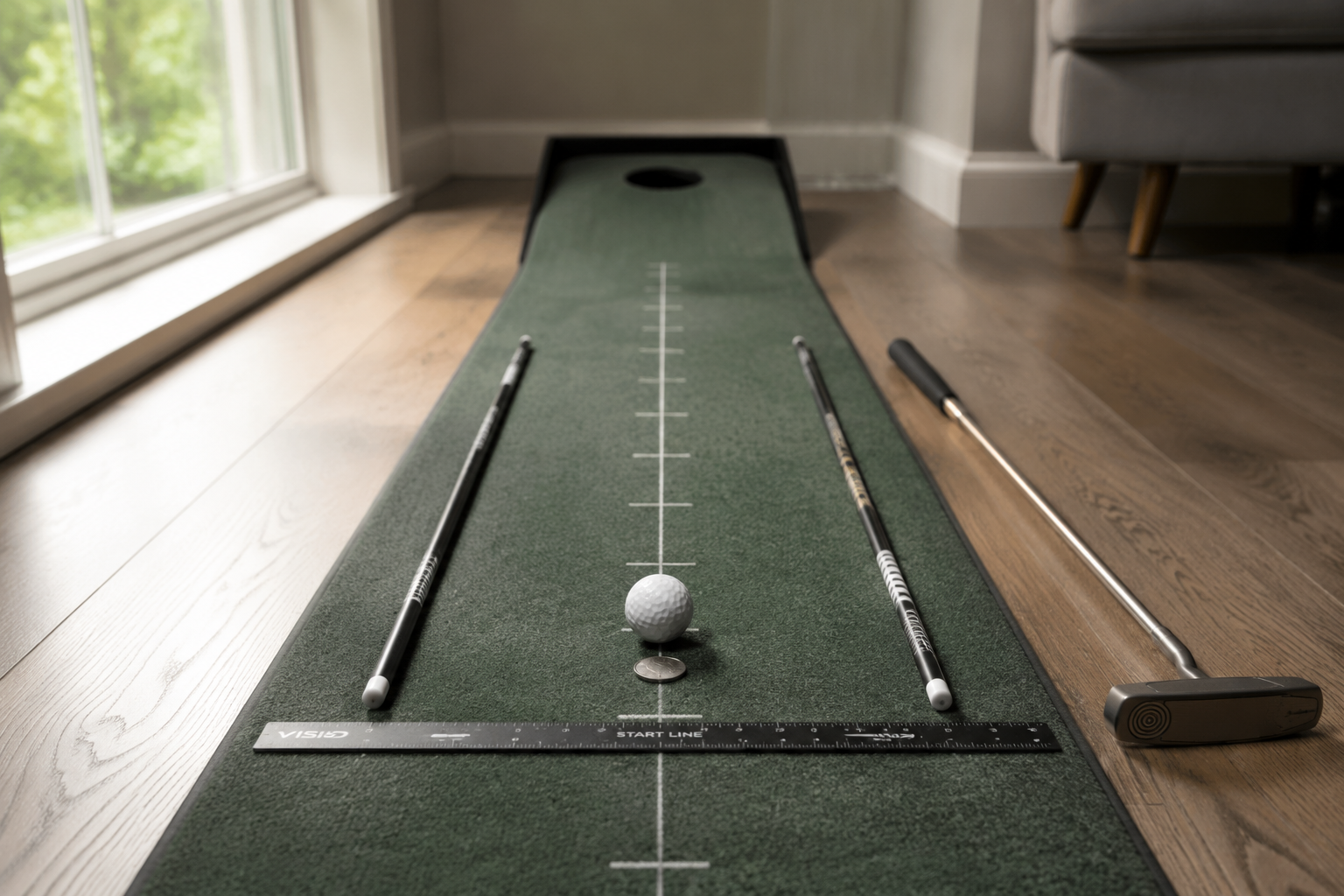
The 25-Minute Session
The routine below borrows the useful part of a five-skill home rotation: wrist control, face stability, center contact, tempo, and distance control. HackMotion presents that structure through a wrist-sensor lens, so the drills are useful without treating the device claims as independent proof.[2] You can run the same session with a putting mat, two alignment sticks, a ruler, a coin, and five balls.
| Time | Skill | What You Do | What Counts |
|---|---|---|---|
| 0:00–2:00 | Setup | Build the station: target line, ball position, coin or gate, and a return spot. | Same ball position and target every rep. |
| 2:00–8:00 | Face control | Roll short putts through a narrow start gate or along a ruler. | Ball starts on line without clipping the gate or falling off the ruler. |
| 8:00–12:00 | Wrist stability | Make short strokes while keeping the lead wrist quiet through impact. | No flip, scoop, or visible face wobble. |
| 12:00–16:00 | Center contact | Strike putts from a marked sweet-spot station using coins, tees, or two objects beside the putter head. | Solid roll and no heel/toe strike pattern. |
| 16:00–20:00 | Tempo | Make equal-length backstroke and through-stroke reps with a steady count. | Stroke finishes without a jab or late hit. |
| 20:00–25:00 | Distance control | Roll balls to different finish zones instead of a single hole. | Ball finishes in the intended zone more often than not. |
Do not turn this into 25 minutes of making three-footers and calling it confidence. The point is to leave the session knowing which piece behaved. If the ball started on line but finished short, that is a different problem from a ball that immediately jumped left. The station should expose the miss before your brain starts writing excuses about the floor.
Face Control Is the First Six Minutes That Matter
For short putts, the ball’s starting direction carries most of the practical burden. A good read does not save a face that points somewhere else at impact. That is why the routine starts with face control rather than a vague warm-up.
Set a ball three to six feet from a target. The target can be the printed cup on a mat, a coaster, a strip of tape, or the leg of a chair if that is all the room allows. Place two coins just wider than the ball about a foot in front of it. Your job is simple: roll the ball through the gate without touching either coin.
Start with ten putts from three feet. If you can roll eight or more through the gate, move back a foot. If you miss the gate twice in a row, do not move farther away; make the gate wider for three reps, then tighten it again. That adjustment matters. A gate that is too hard becomes a punishment drill, and punishment drills usually teach steering.
A ruler works even better when you want honesty. Golf Digest’s indoor putting advice from Stan Utley and Kevin Weeks points to simple tools such as alignment sticks, a ruler, and a coin as enough for productive practice.[4] Put the ball on the end of the ruler and try to roll it down the full length without falling off either side. You will find out quickly whether the putter face is square enough, because the ball has no room to be politely wrong.
Luke Kerr-Dineen wrote about building a daily at-home alignment station and using it for 15 minutes a day, which is the kind of home-practice story that matters here: not a miracle move, just the same start-line station repeated until the stroke stopped wandering.[3] That is the standard for this part of the session. Same station. Same target. Same feedback.
What to Track
- Gate makes: count how many of 20 putts roll through cleanly.
- Directional bias: note whether most misses hit the left coin, right coin, or both.
- Distance where control breaks: write down the longest range where you can still start eight of ten on line.
- No correction reps: after a miss, repeat the same setup instead of immediately changing grip, stance, ball position, and stroke thought.
That last line saves the session. Random practice usually fails because every miss gets a new diagnosis. Structured practice lets the same miss appear often enough that you can actually recognize it.
Four Minutes for Wrist Stability
Wrist stability does not need a lecture. It needs a short block where the face stops being manipulated through impact. Put a coin or small object on the back of your lead wrist if your grip and sleeve allow it, or simply rehearse in front of a mirror with the goal of keeping the lead wrist from cupping or flipping as the putter passes the ball.
Hit ten putts from three feet using a shorter-than-normal stroke. Then hit ten more with your normal stroke length. A good rep is not just a made putt. A good rep is a stroke where the putter face does not visibly twist and the ball starts on the intended line. If the ball still goes in after a flip, do not count it as a good rep. Home floors are too generous sometimes.
This is where a wrist sensor can add feedback if you already own one, but it is not the point of the routine. HackMotion’s plan is useful because it separates wrist control from other skills; the commercial layer should not make the basic drill seem more complicated than it is.[2]
Center Contact Without Buying a New Toy
Center contact is the indoor drill that exposes a surprising amount of fake competence. A putt can start close to line and still roll poorly because the strike came from the heel or toe. On a real green, that becomes distance inconsistency. At home, it shows up as a ball that skids, hops, or reaches the target with a different pace from the same stroke.
Place two coins, bottle caps, or sleeves of balls on either side of the putter head, leaving just enough room to swing through. Hit 15 putts from four feet. If the putter clips the object on the heel side, your path or setup is crowding the ball. If it clips the toe side, you may be reaching or pulling the handle away from you. Do not fix everything at once. Move the objects wider, make five clean strokes, then narrow the station again.
Pyramid Golf lists several no-green home drills, including coin, towel, doorway, paper, and mirror variations.[5] The useful idea across those drills is not novelty; it is constraint. A small object placed near the putter head gives the stroke a boundary. Boundaries make misses visible.
Tempo: Stop Hitting the Ball at the Bottom
Tempo practice is where a lot of indoor work gets too precious. You do not need a metronome unless you like one. You need a stroke that does not panic at impact.
Set up to a four-foot putt. Count “one” to the end of the backstroke and “two” to the finish. Make the follow-through at least as long as the backstroke for these reps. Hit five balls with no target at all, just rolling them down the mat. Then hit ten balls to a target while keeping the same count.
A good rep finishes quietly. A bad rep has a jab, a deceleration, or a little rescue move with the hands. If your mat has a ramped cup, avoid letting the ramp dictate the stroke. Pick a flat spot and roll to a line or zone instead.
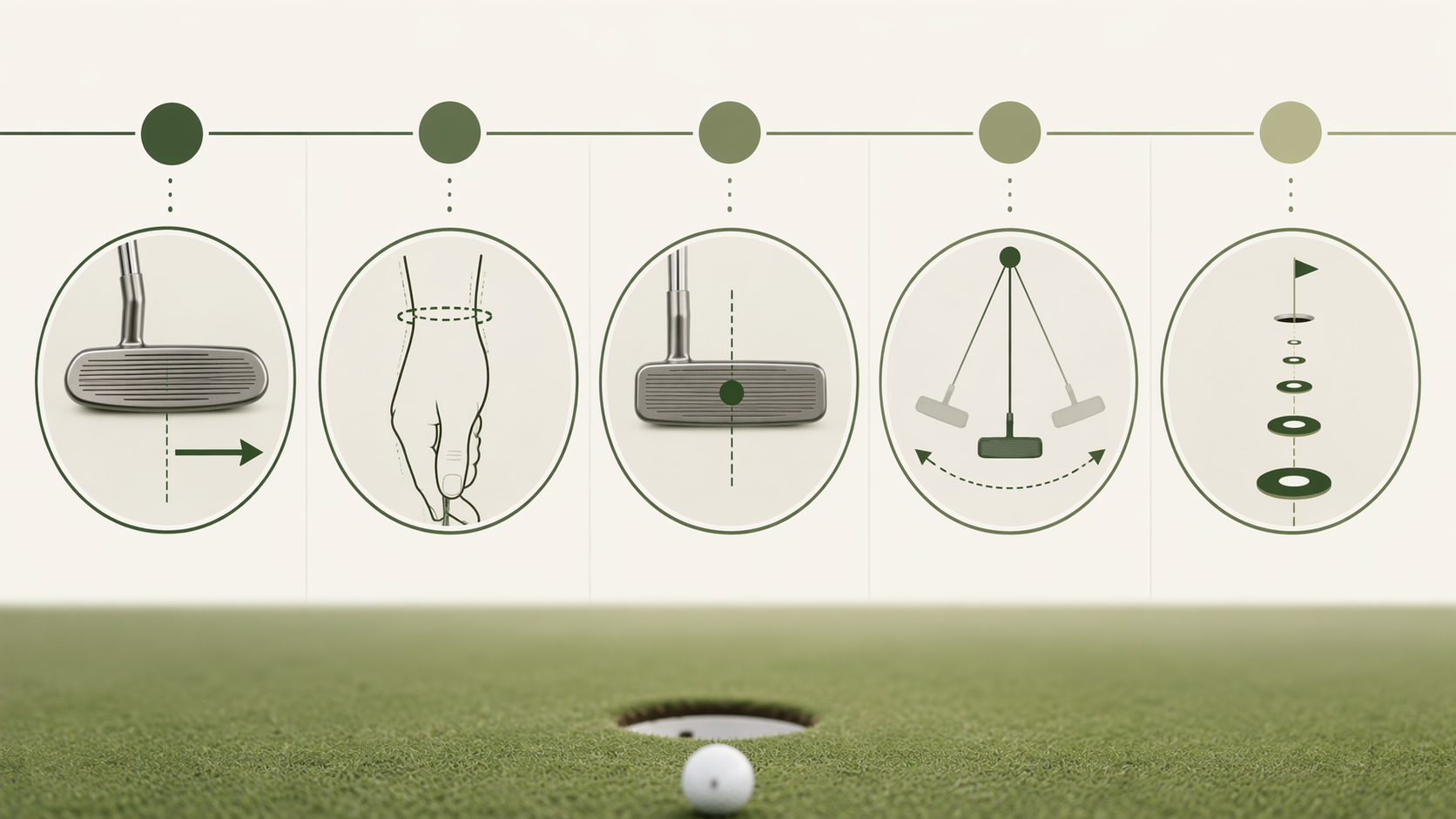
Distance Control Belongs in a Home Routine
The obvious complaint about indoor putting is that your carpet or mat does not run like the greens at your course. Fair. But that does not make distance-control practice useless. You are not trying to memorize carpet speed. You are training stroke length, contact quality, and the ability to send the ball different distances on purpose.
Use three finish zones instead of one hole. Put a towel, sheet of paper, or strip of tape at short, medium, and long distances within your available space. If you have eight feet, use three, five, and seven feet. If you have twelve feet, stretch the zones. Roll one ball to the short zone, one to the medium zone, and one to the long zone. Then reverse the order.
Golf Monthly’s collection of putting drills includes work from coach Ben Emerson and emphasizes practical scoring drills rather than only stroke mechanics.[6] That is the right spirit for this block. The target is not a perfect-looking stroke. The target is whether the ball finishes where the stroke intended.
Run this as a ladder for five minutes. One point for finishing in the correct zone. Zero for missing it. Do not subtract points unless that keeps you interested; the main job is to see whether distance changes are deliberate or random. If you hit the short zone long and the long zone short, your stroke lengths are probably too similar. If every ball dies early, contact or tempo is leaking speed.
A Better Distance Drill for Very Short Spaces
If you only have six feet, do not give up on distance control. Make the zones narrower. Roll to the front edge, middle, and back edge of a towel. The ball only travels a few feet, but the demand changes: now you have to land the ball in a small window without a hole doing the judging for you.
The No-Mat Version
A putting mat helps because it gives you a repeatable surface and a known line. It is not mandatory. The no-mat version just needs a flat-enough strip of floor, a target, and the discipline not to blame every miss on the surface.
| If You Lack | Use This | Keep the Same Standard |
|---|---|---|
| Putting mat | Painter’s tape, string, or a floorboard seam | Ball must start on the chosen line. |
| Alignment sticks | Two books, clubs, yardsticks, or strips of tape | Feet, putter face, and ball path stay organized. |
| Cup | Coaster, mug, paper circle, or towel edge | Roll to a target, not just toward empty space. |
| Gate tool | Coins, bottle caps, poker chips, or folded paper | Misses must show left, right, heel, or toe. |
| Long hallway | Three small zones inside six feet | Change speed intentionally. |
The doorway drill is useful here: putt through an open doorway or between two fixed objects and treat the opening as your start gate. The paper drill works the same way for distance control: roll the ball so it finishes on or near a sheet of paper rather than trying to ram everything into a cup.[5]
How to Run the Week Without Making It Complicated
The same 25-minute session can run every day. If you want a weekly emphasis, change only the scoring focus, not the whole routine. Monday can be gate makes. Tuesday can be wrist-stable reps. Wednesday can be center contact. Thursday can be tempo. Friday can be distance zones. On the weekend, test from 0–6 feet.
- Daily floor: complete all five blocks, even if one block is ugly.
- Daily score: write one number only, such as gate makes out of 20 or distance-zone points out of 15.
- Weekly test: hit 30 putts from 0–6 feet, mixing distances rather than camping at three feet.
- Weekly note: record your main miss pattern, not a swing theory.
The weekly test is where the Shot Scope gap becomes personal. If you are a 10- to 20-handicap golfer, the published 0–6 foot range for those handicap levels sits between 87.6% and 84.4%.[1] Your home test is not the same as on-course putting under pressure, but it tells you whether your start line and contact are becoming more repeatable.
What Indoor Practice Can and Cannot Prove
Indoor practice can prove that you started the ball through a gate. It can prove that you struck the center of the face more often. It can prove that your stroke length changed when the target changed. It cannot prove that you read a breaking six-footer correctly, handled downhill speed, or matched a real green after rain.
That distinction keeps the routine honest. A slow carpet is not a green-speed simulator. A ramped putting mat is not a pressure test. A perfect hallway session does not automatically become a lower score on Saturday. The transferable pieces are mechanical and behavioral: face control, contact, tempo, distance intention, and the habit of practicing one thing long enough to measure it.
This is also why the routine should stay small. Twenty-five minutes is long enough to do real work and short enough that you cannot hide inside tinkering. Set the station, run the five blocks, write down one or two numbers, and stop. The next day, use the same station again.
Judge progress by repeatability: more balls starting through the gate, fewer heel-and-toe strikes, cleaner tempo, and better distance-zone control. If the carpet rolls oddly but the ball keeps starting on the line you chose, the session still did its job. Structured practice is not magic. It is just a better use of 25 minutes than hoping random reps eventually find the hole.
References
- Putting make percentages by handicap – how do you compare? Shot Scope
- How to Practice Putting at Home: 9 Drills & Practice Plan HackMotion
- This daily at-home putting station legitimately improved my putting Golf.com
- At-home golf tips: How to effectively practice your putting stroke indoors Golf Digest
- Putting Practice at Home: 5 Effective Putting Drills That Don’t Require a Putting Green Pyramid Golf
- 5 putting drills for lower scores Golf Monthly
Comments
Join the discussion with an anonymous comment.