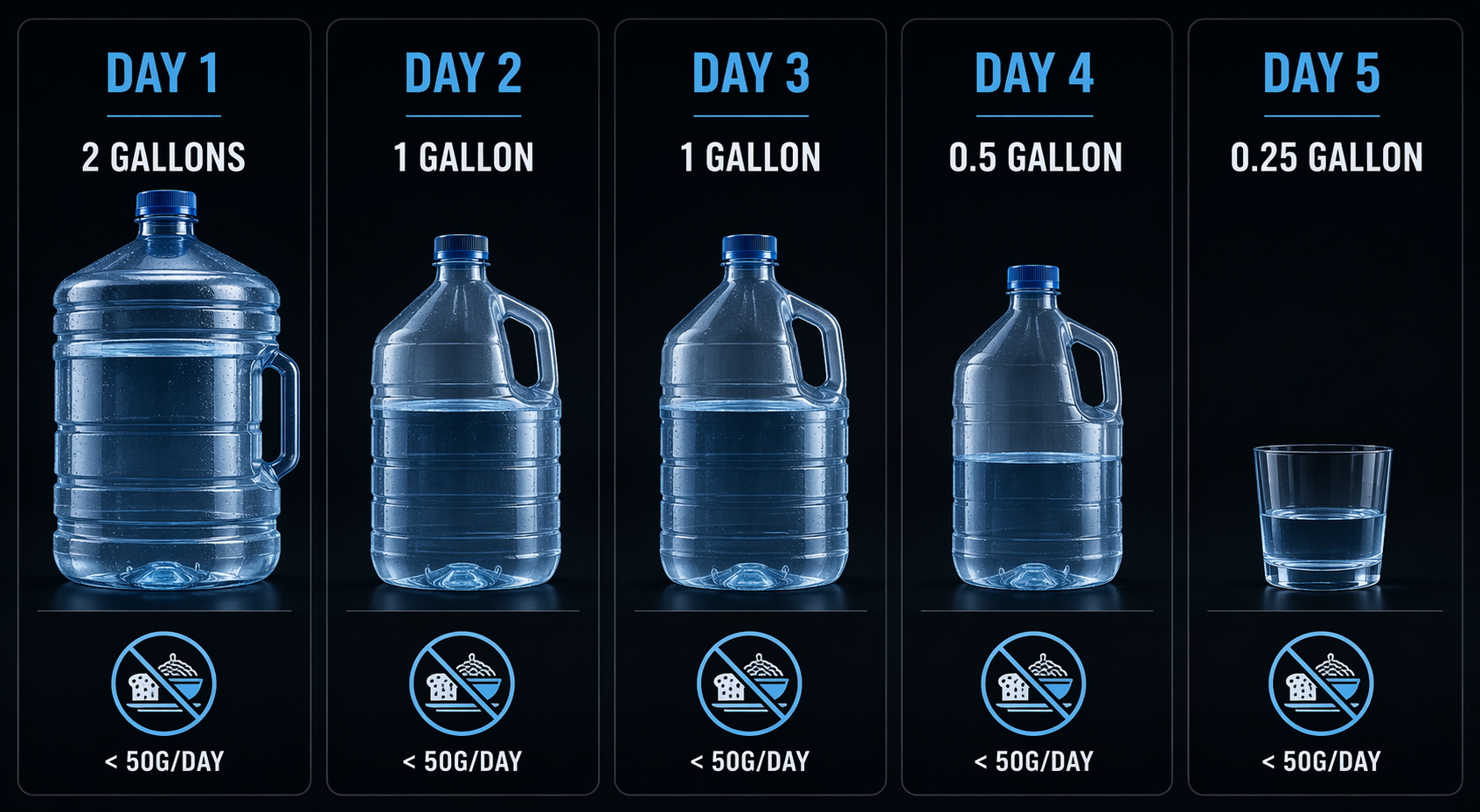
A UFC fighter weight cut routine at home is usually described as a five-day sequence: drink a lot of water, then drink very little; keep carbohydrates extremely low; use heat at the end to sweat out the last pounds. That sequence is real enough to explain. It is also a professional weigh-in protocol, not a fat-loss plan.
| Fight-week day | Water intake | Carbohydrate target | Main purpose |
|---|---|---|---|
| Day 1 | 2 gallons | Below 50g | Start water loading while glycogen stores begin dropping |
| Day 2 | 1 gallon | Below 50g | Keep urine output high while intake begins stepping down |
| Day 3 | 1 gallon | Below 50g | Continue depletion and prepare for the sharper restriction |
| Day 4 | 0.5 gallon | Below 50g | Exploit continued water loss as intake falls |
| Day 5 | 0.25 gallon | Below 50g | Use final dehydration methods, often including passive sweating |
The sharp drop on the scale comes mostly from water and stored carbohydrate, not from losing meaningful body fat in five days. That distinction matters. A person copying the scale movement without the weigh-in context is not doing a more intense version of fitness; they are deliberately becoming dehydrated.
How Common This Is in the UFC
Weight cutting is not a fringe ritual in high-level MMA, but it is not identical across divisions. In a study of 616 UFC athletes from 2020 to 2022, fighters were down an average of 6.7% of body weight 72 hours before weigh-in, 4.4% at 24 hours before weigh-in, and then regained an average of 9.7% after weigh-in before competing [1].
The same data show why “UFC fighters cut weight” is too broad unless the division is named. Featherweights had the most aggressive pattern, with an 8.2% loss and 12% regain, while heavyweights barely cut compared with lighter classes [1]. The practice is real, measurable, and unevenly distributed.
That post-weigh-in regain is the clue a home reader should not miss. If a fighter regains close to a tenth of body weight after weighing in, the process was never mainly about fat loss. It was a temporary manipulation of body water, gut contents, glycogen, and fluid balance to meet a contractual number for a short window.
What Each Part of the Five Days Is Trying to Manipulate
Water loading is the setup, not the cut itself
The first odd-looking part is the two-gallon day. The fighter drinks far more water than normal, then reduces intake over the next several days. The intended effect is hormonal: after two to three days of high water intake, aldosterone activity drops, and the body continues flushing water even when fluid intake falls [2].
That is the mechanical elegance of the protocol. The athlete is trying to create a lag between what comes in and what still goes out. When intake drops to half a gallon and then a quarter gallon, urine output may remain high for a period, accelerating the late weight loss. This is also where the clean explanation becomes dangerous, because the same mechanism that moves the scale is pushing the athlete toward dehydration.
Low carbohydrates release bound water
Carbohydrates are usually restricted below 50 grams per day during the cut. The purpose is not moral discipline or “clean eating.” It is storage chemistry. Glycogen, the stored form of carbohydrate in muscle and liver, binds water; the protocol often uses the estimate that each gram of glycogen is stored with about 2.7 grams of water [3].
Using that estimate, depleting 200 grams of glycogen can release roughly 1.2 pounds of bound water. The fighter sees a lower scale weight, but the body has not created 1.2 pounds of fat loss. It has given up stored carbohydrate and the water stored with it.
Food volume gets smaller too
Many fight-week cuts also reduce bulky, high-residue foods. That part is less dramatic than a hot bath, but it affects the weigh-in number because food and fluid in the gut still have mass. Again, the athlete is trying to be lighter on a scale at a specific time, not fitter in any normal training sense.
Passive sweating is the final lever
At the end of the cut, fighters often use passive sweating: sauna, hot baths, sweatsuits, or a combination. For a person at home, the hot bath gets attention because it is more accessible than a sauna. Accessibility is not the same as safety.
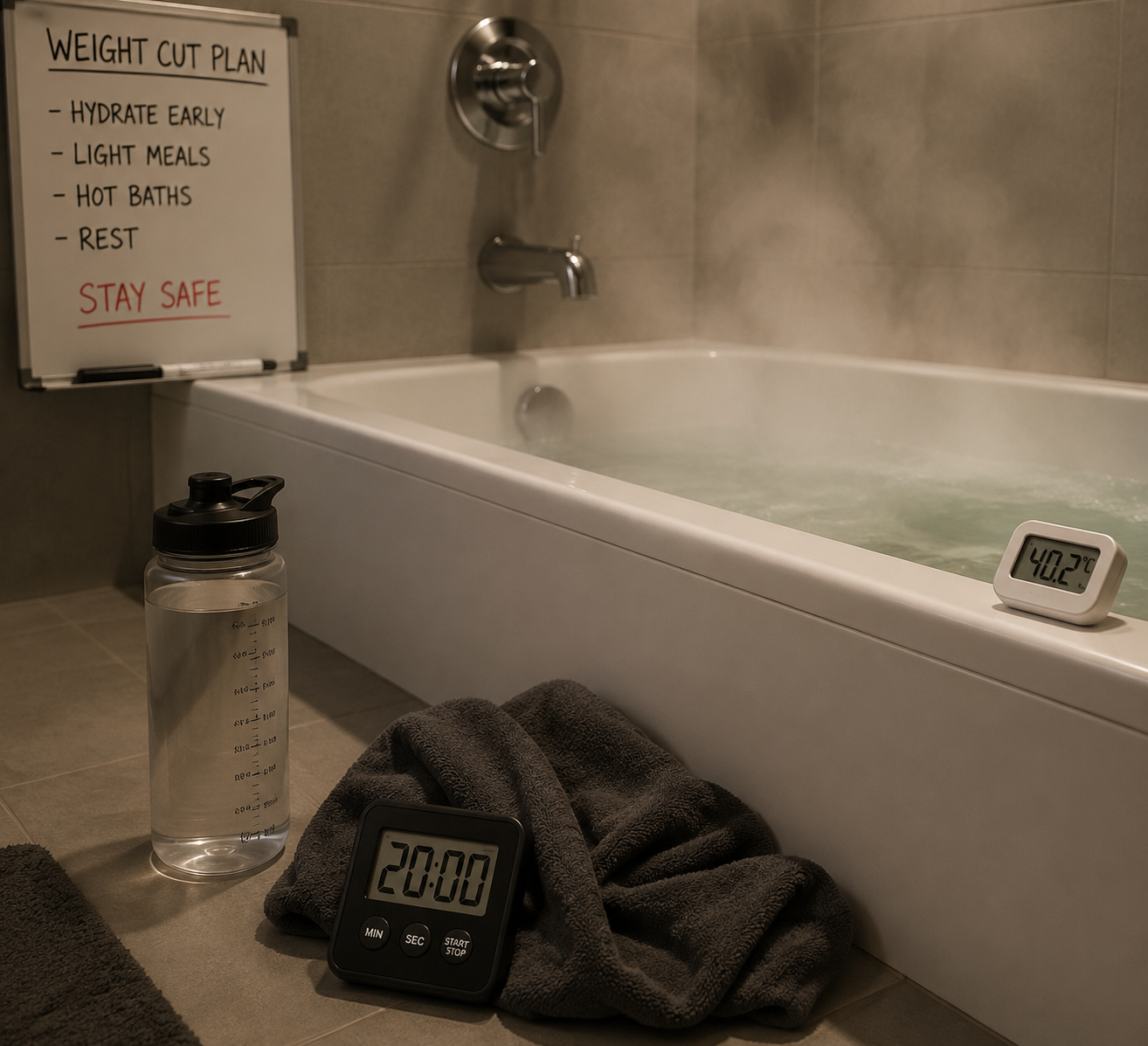
One commonly described hot-bath approach uses 10 minutes in hot water, then 10 minutes out, repeated in cycles. Protocol sources claim that roughly 2% of body mass can be lost in about two hours through this method, and hot baths are sometimes presented as preferable to saunas at home because water temperature can be controlled more directly [4].
The number is exactly why this part deserves more caution, not less. A 2% body-mass drop from sweating is dehydration. In a bathroom, the failure points are blunt: fainting when standing up, overheating, confusion, nausea, cramping, and electrolyte collapse. A fighter with a team has someone watching skin color, alertness, time in the bath, body weight, and whether the athlete can rehydrate. A person alone has a locked door and a tub of hot water.
- Never treat hot-bath weight loss as fat loss or conditioning progress.
- Never do aggressive heat-based dehydration alone.
- Stop immediately if dizziness, confusion, chills, nausea, or unusual weakness appears.
- Do not extend cycles because the scale is “almost there.”
- Do not combine heat stress with full-day water avoidance.
What the Cut Costs Before Rehydration
The body does not give up water and glycogen politely. Nate Green’s documented cut, published by Tim Ferriss in 2013, is useful because it measured performance before the athlete had fully recovered. His vertical jump fell from 31.7 inches to 27.6 inches, a 13% drop. His 225-pound bench press went from 15 reps to 5 reps, a 67% decline. His treadmill sprint time worsened from 46 seconds to 71 seconds, a 55% decline [5].
Those are not cosmetic changes. They are the kind of losses a coach, cornerman, or training partner would notice if they were not distracted by the scale. The athlete is lighter, but also weaker, slower, and more fragile until rehydration and refueling restore enough function.
Rocky Fielding’s cut offers a second, more recent fight-sport illustration. Dr. James Morehen has described Fielding losing 5 kilograms, or 11 pounds, in the final five days, with most of that loss occurring in the last 24 hours [6]. Jordan Sullivan, who has worked with Leon Edwards, has described fighters losing about 10% of body weight in five to seven days, largely through stored carbohydrate and the water bound with it [7].
The pattern is consistent: the most dramatic movement happens close to the weigh-in, when the athlete is least buffered. That is also when home experimentation becomes least forgiving.
Where Safe Home Training Ends
Sports nutrition and exercise-medicine safety guidance commonly places safe weight loss at no more than 1% of body mass per 24 hours. Most serious fight-week cuts exceed that limit during the final 24 to 48 hours [8]. That is the central boundary for anyone reading this from a home gym: understanding the routine is different from running the routine.
The full five-day sequence stacks several stressors at once: water loading, water restriction, carbohydrate depletion, reduced food bulk, heat exposure, sweat loss, and then rapid rehydration. Each piece may look simple in isolation. Together, they create a moving target for blood volume, electrolytes, temperature regulation, blood pressure, and cognition.
One MMA literature review reported that 39% of fighters said they had gone entire days without water to cut weight, a behavior associated with acute kidney injury risk [9]. That finding should not be read as a toughness standard. It is a sign of how far competitive incentives can push athletes beyond what would be reasonable in normal training.
A supervised fighter may have a nutritionist, coach, physician access, check-ins, a fixed weigh-in time, and a rehydration strategy. A home exerciser usually has a bathroom scale and motivation. Those are not equivalent support systems.
What You Can Safely Take From the Routine
The useful lesson for home training is not “copy the cut.” It is learning what the scale can and cannot tell you. A sudden drop after low carbohydrates, sweating, or reduced food volume may be mostly water and gut content. A sudden rebound after eating and drinking again may be restored glycogen and fluid, not failure.
- Safe to observe: how carbohydrate intake, sodium, sweat, and food volume can temporarily move body weight.
- Safe to borrow: routine weigh-ins under normal hydration to understand your own weight fluctuations.
- Not safe to borrow: deliberate dehydration, all-day water avoidance, or heat-based last-pound cutting.
- Not a fitness goal: losing several percent of body weight in a day or two.
If there is no sanctioned weigh-in, medical oversight, rehydration plan, and experienced support person watching the process, the full five-day UFC-style cut is outside safe home training practice. You can learn the physiology. You can understand why supervised athletes use it. You do not need to turn the bathroom into a fight-week experiment.
References
- Weight Cycling in Professional Ultimate Fighting Championship (UFC) Athletes, National Library of Medicine, 2022, link
- Fight Week: The Role of Water Loading, Sigma Nutrition, link
- How to Cut Weight for a Fight: A Nutritionist’s Guide, Science for Sport, link
- Hot Bath Weight Cut Guide, The Fight Dietitian / Top King Boxing, link
- How to Lose 20–30 Pounds in 5 Days: The Extreme Weight Cutting and Rehydration Secrets of UFC Fighters, Tim Ferriss, May 6, 2013, link
- How to Cut Weight for a Fight: A Nutritionist’s Guide, Science for Sport, link
- How UFC Fighters Cut Weight, Men’s Health UK, link
- BodySpec Guide to Cutting Weight Safely, BodySpec, link
- Rapid Weight Loss and Dehydration in Mixed Martial Arts, National Library of Medicine, link
Comments
Join the discussion with an anonymous comment.