
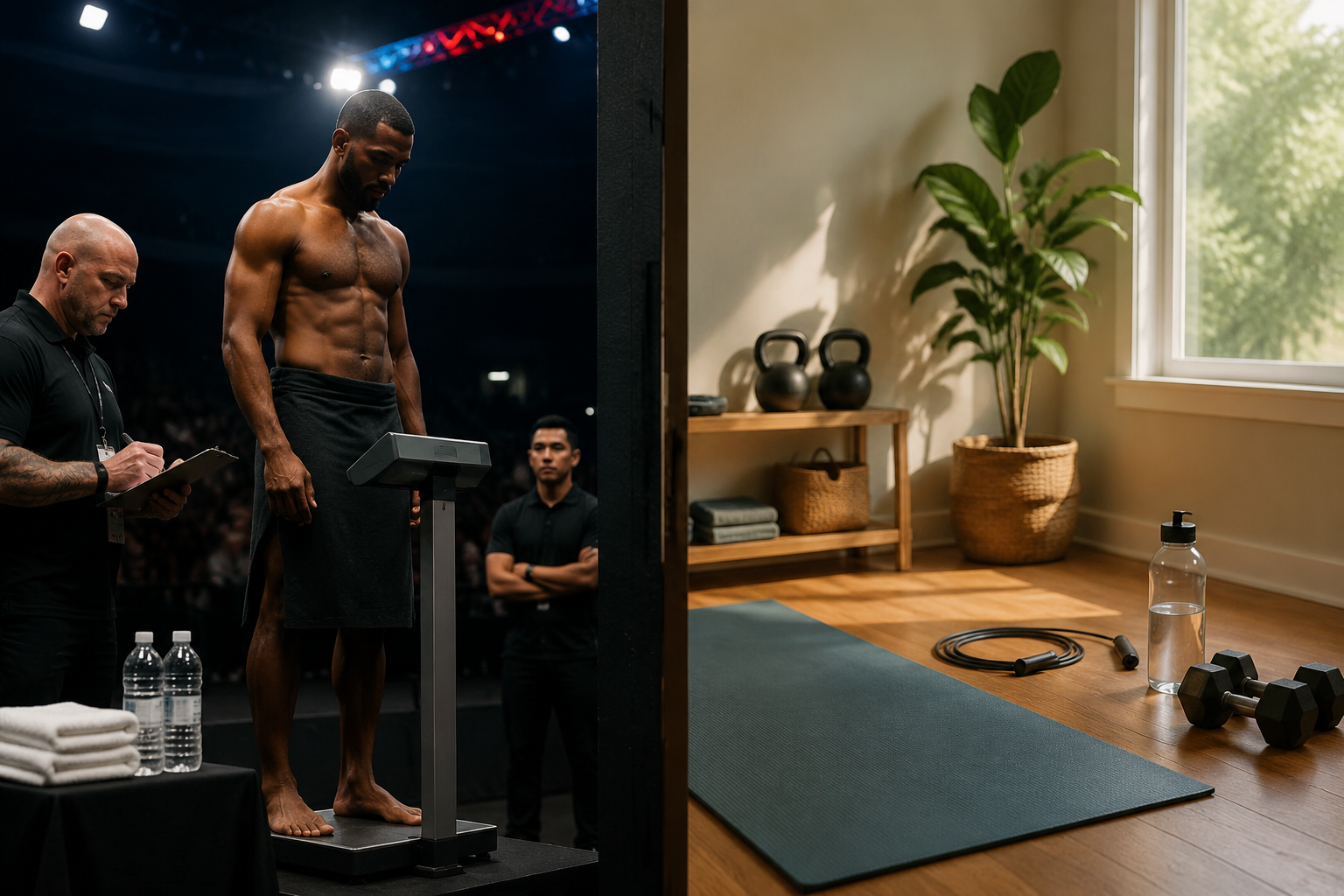
The phrase “how UFC fighters cut weight safely at home” contains a problem before the workout even starts. UFC fighters do not simply “work out” weight off. They run a staged weight-management process around a contract weight, a weigh-in time, and a supervised rehydration window. The part most people recognize — sweating, water restriction, scale tricks, looking drawn under bright lights — is the least appropriate part to copy alone in a living room.
The useful lesson is earlier and quieter. Fighters typically build the cut from a foundation phase: a gradual calorie deficit, high protein intake, less processed food, consistent sleep, and low-intensity conditioning. That phase can translate well to home training. The acute final-week dehydration protocol cannot. It belongs inside fighter conditions: coaches, medical checks, a weigh-in deadline, and a recovery plan.
What Fighters Are Actually Cutting
Body weight is not one thing. In a fight camp, the number on the scale can move because a fighter has lost body fat over weeks, stored less carbohydrate and water, carried less food residue in the gut, or temporarily held less extracellular water. Those changes may all show up as “weight loss,” but they do not carry the same meaning or risk.
| What Changes | Typical Scale Effect | What It Means for a Home Trainee |
|---|---|---|
| Body fat | Gradual change over weeks through a sustained energy deficit | Transferable when the deficit is moderate and training is recoverable |
| Glycogen plus bound water | About 1–2 kg of acute weight change | Partly influenced by carbohydrate intake, but aggressive depletion is not needed for general fitness |
| Gut content | About 0.5–1 kg of acute weight change | Mostly relevant to weigh-ins, not meaningful fat loss |
| Extracellular water | About 2–5 kg of acute weight change | Professional-only territory because the risk rises quickly |
Sports-science summaries describe acute fight-week manipulation across glycogen-bound water, gut content, and extracellular water, with extracellular water accounting for roughly 2–5 kg in some protocols while glycogen-bound water and gut content account for smaller ranges.[1][2] That distinction matters because losing fat and forcing water out of the body are not two versions of the same habit. They are different interventions.
A home trainee who sees a fighter drop several pounds in a few days is usually watching temporary mass management, not a secret fat-loss method. Some of that weight is meant to come back after weigh-in. If there is no weigh-in, no doctor, no coach, and no reason to be lighter for a single hour on a scale, the highest-risk part of the process has very little upside.
The Foundation Phase Is the Part Worth Copying
The foundation phase usually begins 6–8 weeks before the goal. This is the part that looks least dramatic and does most of the honest work: a moderate 300–500 kcal daily deficit, high protein intake, lower processed food intake, consistent sleep, and low-intensity conditioning.[1][2] It is also the part that makes sense if the “training camp” is a garage mat, a hallway, a jump rope, and a kitchen scale.
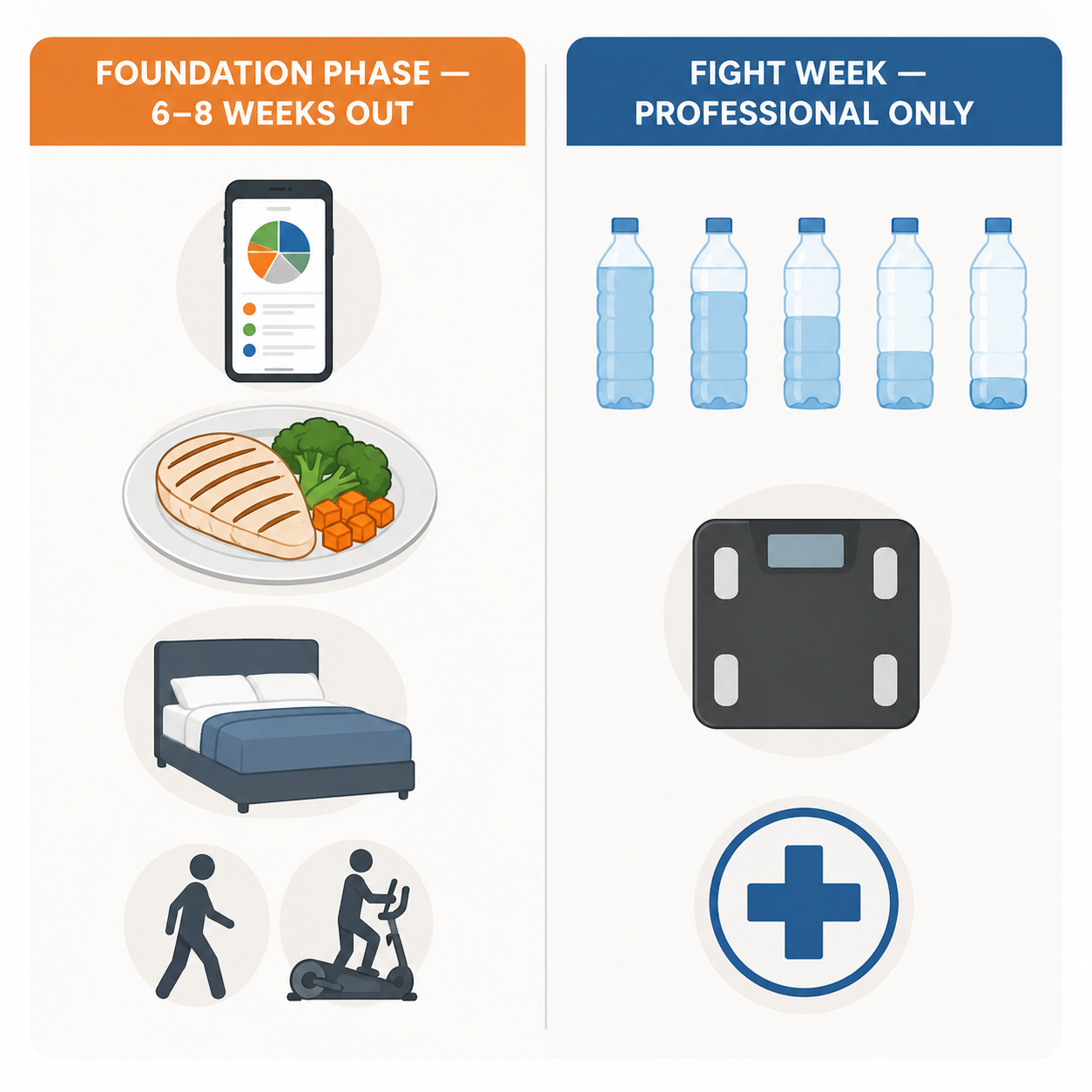
A moderate deficit leaves room to train. It does not require skipping water, wearing trash bags, or turning every cardio session into a punishment test. The practical target is simple: eat slightly less than you burn, keep protein high enough to support muscle repair, choose meals that are easier to regulate, and build a repeatable conditioning base.
For home training, that can look like a week built around walking, light cycling, shadow boxing, mobility work, and short jump-rope sessions. If you need more structure, start with a constraint-based approach to cardio at home rather than trying to recreate a fight camp from clips. Walking is especially underrated here; a beginner weighted vest walking plan gives progression without turning every session into a redline effort.
The food side should be just as unspectacular. Build meals around lean protein, fruit, vegetables, whole-food carbohydrates, and enough fluids to train normally. Reducing processed foods often lowers sodium and calorie intake without making hydration a game. That is different from aggressively cutting sodium or carbohydrates in the final days, which fighters may do for weigh-in purposes but which most home trainees do not need.
A Home-Safe Version of the Foundation Phase
- Set a moderate daily calorie deficit rather than chasing a large weekly scale drop.
- Prioritize protein at each meal so weight loss is not built around simply eating less of everything.
- Reduce processed snacks, takeout, and liquid calories before manipulating sodium or carbohydrates aggressively.
- Use low-intensity cardio often enough that it supports the deficit without wrecking recovery.
- Keep sleep and hydration consistent, because poor recovery makes the plan harder to follow and easier to overcorrect.
Beginners should make the training entry point even smaller. A short bodyweight routine or a modified interval session is enough if it can be repeated. A safe on-ramp such as the 7-minute workout for complete beginners or a progressive home leg workout pairs better with a foundation phase than a copied fight-week sweat session.
What Happens in Fight Week
Fight week is where the process changes character. The goal is no longer just fat loss. Fighters may reduce carbohydrate intake to lower glycogen and associated water, reduce fiber to lower gut residue, alter sodium, and manipulate water intake before the weigh-in.[1][3] These tactics are designed around a short-term scale target, not around health, appearance, or long-term conditioning.
Jackson Wink MMA describes one water-loading sequence this way: 2 gallons on day 1, 1 gallon on days 2 and 3, 0.5 gallon on day 4, 0.25 gallon on day 5, then no water until after weigh-in.[3] That is a useful example because it shows what “professional protocol” actually means. It is not “drink a little less water.” It is a deliberate stressor layered onto diet changes, training changes, heat exposure in some cases, and a rehydration plan.
Science for Sport reports that a 1–8% body-mass reduction in the final week can be achieved safely under professional guidance, while cuts above 10% are dangerous and have been associated with documented fatalities in combat sports.[1] That sentence should draw a hard border for anyone training alone. A fighter with a team may accept a calculated risk for a contracted bout. A person at home trying to look leaner by Saturday is not in the same situation.
The water behavior around combat sports is not theoretical. A survey cited in sports-science discussion found that 39% of MMA fighters reported going entire days without water to make weight, a practice associated with reduced blood volume, impaired heart-rate recovery, and increased cardiovascular strain.[1] Acute dehydration can also reduce cerebrospinal fluid volume, which may increase brain-injury risk during impacts.[2] Even outside sparring, that matters if someone is doing high-intensity intervals, jumping, burpees, or hard bag work while dehydrated.
The Home Version Should Not Include Dehydration
At home, the safest adaptation is to keep the structure and remove the acute dehydration. That means you can borrow the timeline, the food quality, the steady conditioning, and the discipline. You do not borrow full-day water restriction, sauna cuts, plastic suits, spitting, laxatives, diuretics, or last-minute “drying out.”
A mild carbohydrate or sodium adjustment through food quality is different from a fight-week cut. If your usual dinner is salty takeout and dessert, replacing it with lean protein, vegetables, and a reasonable portion of whole-food carbohydrate may reduce next-day scale noise. That is not the same as driving carbohydrates toward a weigh-in target or cutting sodium while also restricting water.
The same distinction applies to cardio. Walking, light cycling, shadow boxing, and jump rope are common low-intensity tools around weight-management periods because they can increase energy expenditure without draining the athlete the way hard sparring or maximal intervals would.[3][4] For home use, keep that logic intact: cardio should help you accumulate work, not force you into a recovery hole.
| Fighter Tactic | Home-Safe Adaptation |
|---|---|
| 6–8 week foundation phase | Use a gradual fat-loss block with consistent meals, sleep, and low-intensity cardio |
| 300–500 kcal daily deficit | Use a moderate deficit if appropriate for your body, health status, and goals |
| High protein intake | Include protein at each meal and around training when possible |
| Final-days carbohydrate, sodium, and fiber manipulation | Improve food quality and reduce processed foods instead of performing a weigh-in cut |
| Water loading and water restriction | Do not copy without medical supervision |
| Sauna or sweat-based dehydration | Avoid as a weight-loss method for home fitness |
A Practical At-Home Week
If the goal is to apply UFC-level discipline without UFC-level dehydration, the week should feel almost boring. Most sessions should end with the sense that you could train again tomorrow. That is not lack of effort; it is load management.
| Day Type | Training Focus | Nutrition Focus |
|---|---|---|
| Low-intensity conditioning day | 30–60 minutes of walking, light cycling, or easy shadow boxing | Protein-forward meals, normal hydration, mostly whole foods |
| Strength or circuit day | Bodyweight or dumbbell work kept technically clean | Protein at each meal and enough carbohydrate to train well |
| Short skill day | Light jump rope, footwork, mobility, or shadow boxing | Avoid turning a light day into a sweat-cut session |
| Recovery day | Walking, stretching, or full rest | Consistent fluids, consistent meal timing, no compensation fasting |
This kind of week leaves room for adjustment. If your legs are flat, replace jumping with walking. If the calorie deficit is making sessions sloppy, bring food up slightly. If the scale jumps after a salty meal, wait before changing the whole plan. The point is to create conditions where the trend can move without forcing the body into an emergency.
A hypothetical home trainee might run three walking sessions, two short strength sessions, and two mobility or shadow-boxing sessions across a week while keeping meals protein-centered and minimally processed. There is no weigh-in trick in that setup. The “cut” comes from repeated small decisions that can be recovered from.
After Hard Training, Use the 4 R’s
Combat-sport recovery after weigh-in is often described through the 4 R’s: Rehydrate, Refuel, Repair, and Restore.[2][5] For home training, the same framework works after hard sessions, without needing the dangerous part that came before it.
- Rehydrate: replace fluids steadily instead of using thirst as a toughness test.
- Refuel: include carbohydrates when training volume or intensity demands them.
- Repair: keep protein consistent so muscles have the raw material to recover.
- Restore: prioritize sleep, downshifting, and enough easy days to absorb the work.
Anyone making significant nutrition, hydration, or training changes should speak with a healthcare provider, especially with a history of cardiovascular issues, kidney problems, disordered eating, heat illness, medication use, or rapid weight change. If you want the useful part of how UFC fighters cut weight, copy the patience and structure of the foundation phase. Leave the dehydration protocols to supervised fight camps.
References
- Weight cutting in combat sports: What is it and how can you minimise the risks? — Science for Sport
- Weight Cutting: A Safe Guide for Combat Athletes — BodySpec
- The Weight-Cutting Techniques of UFC Fighters — Jackson Wink MMA
- MMA Weight Cutting Used by Fighters: Different Strategies — Made4Fighters
- Acute Weight Management In Combat Sports — GSSI / Gatorade Sports Science Exchange
Comments
Join the discussion with an anonymous comment.