
Josh Kerr’s 3:42.66 mile world record on July 18, 2026, is the kind of result that makes runners go looking for secrets.[1] The useful question is narrower: if you are trying to learn how to train for a mile run like Josh Kerr from a garage, spare room, or driveway, what part of his training can you actually repeat this week?
Not the altitude camps. Not the professional support structure. Not a copied weekly schedule with the context stripped out. The most transferable piece is his strength work: bodyweight circuits, running drills, plyometrics, and carefully placed power sessions that support fast running instead of turning every day into another grind.
The companion overview, How Josh Kerr’s Mile Record Training Helps Home Runners, covers the broader training framework. This piece stays in the part that home runners can control: two disciplined strength sessions per week, built around force, coordination, stiffness, and late-race power.
The Useful Part of Kerr’s Strength Work Is Surprisingly Plain
Kerr’s early strength foundation under coach Eric Fisher was not a glossy gym montage. It included push-ups, sit-ups, mountain climbers, planks, and burpees, and those bodyweight patterns remain part of the story of his adult routine.[2] That matters because a lot of intermediate runners hear “no gym” and quietly translate it into “no strength training.” Kerr’s example points in the opposite direction.
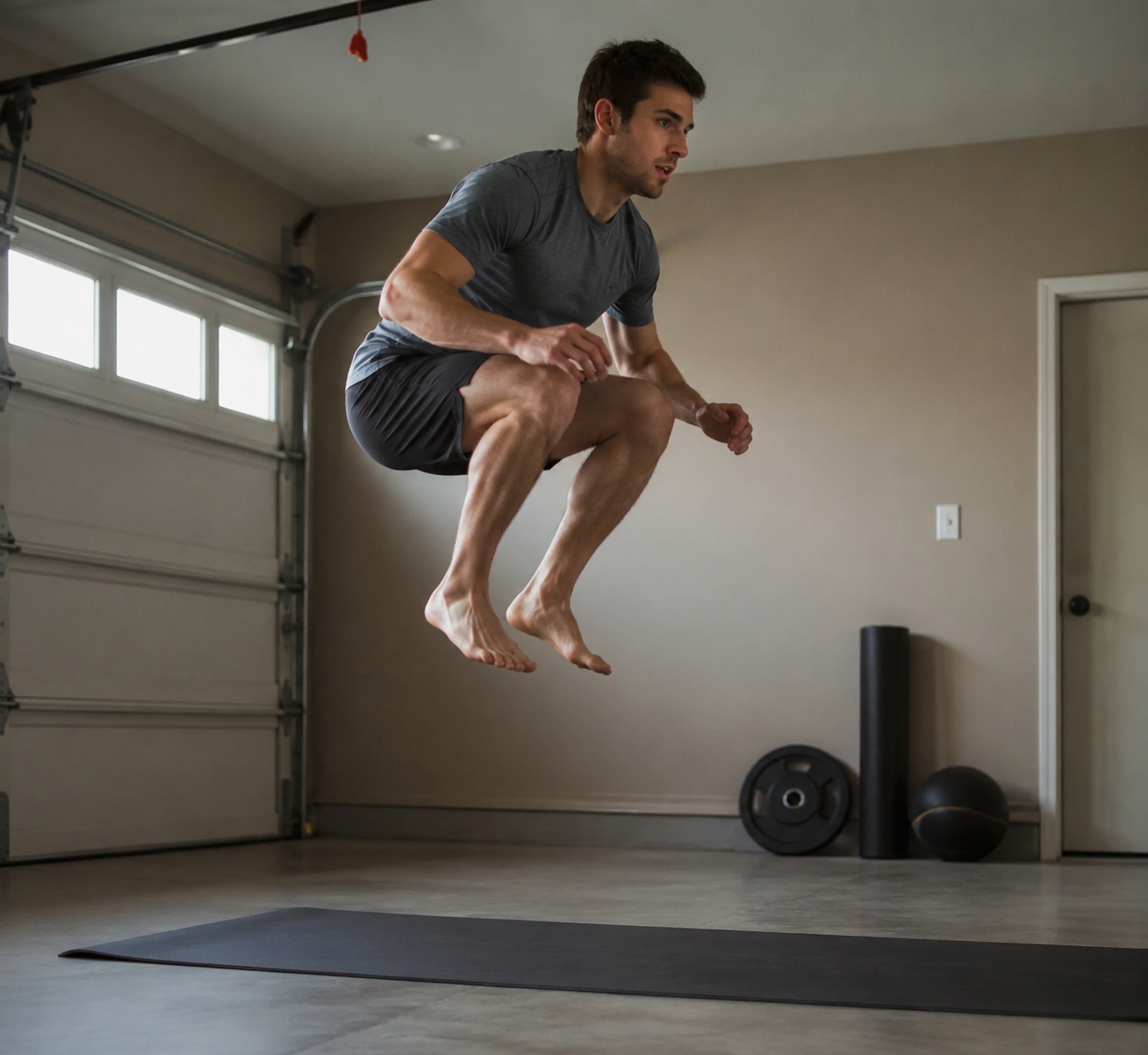
The more advanced ingredients are still recognizable: A-skips, B-skips, bounding, high knees, pogo hops, squat jumps, and single-leg hops appear across published descriptions of his strength and plyometric work.[2][3] None of those require a squat rack. Most require only space, patience, and the willingness to stop a set before it gets sloppy.

That last part is not cosmetic. Plyometrics are not conditioning circuits wearing faster shoes. For mile runners, the point is to apply force quickly and leave the ground cleanly. When hops become ankle survival, when bounds become lunges with airtime, or when squat jumps turn into a race against fatigue, the exercise has drifted away from the thing it was supposed to train.
Power-to-Weight Is the Filter
Kerr has framed the strength goal bluntly: “I need to create more power,” and he ties that to power-to-weight ratio as a route to running faster.[3] That is the right filter for a home mile plan. The goal is not to collect harder exercises. It is to build the kind of strength that lets you hit the ground, return force, and keep your mechanics alive when the last 200 meters starts asking questions.
For a home runner, that points to four categories:
- Bodyweight foundation: push-ups, planks, mountain climbers, sit-ups, and controlled burpees that build basic trunk and shoulder capacity.
- Running drills: A-skips, B-skips, and high knees that teach posture, rhythm, and foot placement.
- Elastic plyometrics: pogo hops, hops, bounds, and squat jumps that train quick force without chasing bulk.
- Optional load: dumbbell swings, goblet squats, and single-leg Romanian deadlifts for runners who already move well and own basic equipment.[3]
That sequence matters. If you cannot hold a clean plank, land quietly from a squat jump, or keep your ankle from collapsing during a low pogo, bounding is not the next badge to earn. It is a tax your calves and tendons will collect later. Spend a few weeks with a basic no-equipment plan or a bodyweight strength block before adding higher-impact contacts.
Put Strength on Hard Days, Not Recovery Days
Kerr reportedly performs 2–3 strength sessions per week, with sessions around 75 minutes, and Danny Mackey places strength on the same days as hard running, such as Tuesday and Friday.[3] That scheduling choice is one of the most useful details for non-elite runners.
A runner stuck at the same mile time often does not need more medium-hard work. They need better separation. Hard days should be genuinely hard, and easy days should be allowed to do their job. If you run intervals Tuesday morning and then add strength later Tuesday, Wednesday can stay easy. If you scatter hops, burpees, and dumbbell work across “recovery” days, you end up with calves that never quite reload.
For this home version, use two weekly strength sessions. Put them after your two harder run days or at least several hours apart from them. A simple week might look like this:
| Day | Run | Strength |
|---|---|---|
| Monday | Easy run or rest | None |
| Tuesday | Mile-specific intervals, hills, or faster repetitions | Session A |
| Wednesday | Easy run | None |
| Thursday | Easy run, strides, or rest | None |
| Friday | Tempo, hill reps, or controlled speed | Session B |
| Saturday | Easy run or longer aerobic run | None |
| Sunday | Rest or very easy movement | None |
This does not copy Kerr’s private program. His exact rep schemes and loads are not fully public. The plan that follows is an adaptation from the published exercise menu and scheduling principles, scaled for an intermediate home runner who is already running consistently.
The 12-Week Home Strength Progression
Each session should take about 30–45 minutes, not 75. That is intentional. Kerr’s training sits inside a professional system; yours has to survive work, sleep, family, and the next run. Keep the quality high and leave a little in reserve.
| Phase | Weeks | Main Job | What Changes |
|---|---|---|---|
| Foundation | 1–4 | Build trunk control, landing skill, and basic stiffness | Bodyweight circuits, low pogo hops, simple skips |
| Coordination and Elasticity | 5–8 | Make drills sharper and contacts more reactive | A-skips, B-skips, high knees, squat jumps, short bounds |
| Mile-Specific Power | 9–12 | Convert strength into cleaner, faster late-race mechanics | More single-leg work, controlled bounds, optional dumbbells |
Weeks 1–4: Build the Floor Before You Bounce Off It
The first month should feel almost too sensible. That is fine. If your feet, calves, and hips are not used to crisp contacts, the foundation phase is where you earn the right to do the louder work later.
| Session A | Prescription |
|---|---|
| Warm-up | 5–8 minutes easy mobility: ankle rocks, hip circles, leg swings, bodyweight squats |
| Push-ups | 3 sets of 6–12 clean reps |
| Front plank | 3 sets of 25–45 seconds |
| Mountain climbers | 3 sets of 20–30 controlled total reps |
| A-march to A-skip | 4 rounds of 10–15 meters or 10–15 seconds in place |
| Low pogo hops | 4 sets of 10–15 seconds, quiet and springy |
| Squat jumps | 3 sets of 4–6 reps, full reset between reps |
| Session B | Prescription |
|---|---|
| Warm-up | 5–8 minutes easy mobility |
| Sit-ups or dead bugs | 3 sets of 8–15 reps |
| Side plank | 2–3 sets of 20–35 seconds per side |
| Burpees | 3 sets of 4–6 smooth reps, not a race |
| High knees | 4 rounds of 10–15 seconds |
| Split squat | 3 sets of 6–8 reps per leg |
| Two-leg line hops | 3 sets of 10–20 seconds |
Use the first two weeks to find clean ranges. In weeks 3 and 4, add one set to one or two exercises only if the contacts still feel sharp. Do not add volume to every line. The easiest way to ruin a good plyometric plan is to treat it like a punishment circuit.
Weeks 5–8: Make the Drills Look More Like Running
This is where the plan starts to feel more mile-specific. The strength work still begins with simple bodyweight movements, but the center of the session shifts toward posture, rhythm, and faster ground contact.
| Session A | Prescription |
|---|---|
| Warm-up | 5–8 minutes mobility plus 2 rounds of easy A-march |
| Push-ups | 3–4 sets of 8–12 reps |
| Plank with shoulder taps | 3 sets of 12–20 total taps |
| A-skips | 5 rounds of 10–20 meters or 10–20 seconds in place |
| Pogo hops | 5 sets of 10–15 seconds |
| Squat jumps | 4 sets of 5 reps |
| Short bounds | 3 sets of 6–8 total contacts |
| Session B | Prescription |
|---|---|
| Warm-up | 5–8 minutes mobility |
| Mountain climbers | 3 sets of 30–40 total reps |
| Side plank | 3 sets of 25–40 seconds per side |
| B-skips | 4 rounds of 10–20 meters or 10–20 seconds in place |
| High knees | 5 rounds of 10–15 seconds |
| Reverse lunge | 3 sets of 6–10 reps per leg |
| Single-leg pogo hold or mini-hop | 3 sets of 6–10 contacts per side |
The short bounds are not a broad-jump contest. Think tall hips, quick contact, and a foot that lands under you rather than reaching far ahead. If you need a hallway version, use marching bounds in place: drive one knee, pop through the standing foot, land balanced, reset.
Weeks 9–12: Keep the Volume Bounded and the Power Clean
By the final month, the temptation is to add more. Resist that unless your running is also improving. This phase should make your mile workouts feel snappier, not leave you negotiating with your Achilles every morning.
| Session A | Prescription |
|---|---|
| Warm-up | Mobility plus A-skips and two easy acceleration buildups if space allows |
| Push-ups or decline push-ups | 3 sets of 8–15 reps |
| Hollow hold or plank | 3 sets of 25–45 seconds |
| A-skips | 4–5 rounds, crisp |
| Pogo hops | 5 sets of 12–20 seconds |
| Bounds | 4 sets of 6–10 total contacts |
| Squat jumps | 3 sets of 4–6 reps |
| Session B | Prescription |
|---|---|
| Warm-up | Mobility plus high knees |
| Burpees | 3 sets of 5–8 controlled reps |
| Side plank with top-leg lift | 2–3 sets of 8–12 reps per side |
| B-skips | 4 rounds, smooth rather than forced |
| Single-leg hops | 3–4 sets of 5–8 contacts per side |
| Split squat jump or fast split squat | 3 sets of 4–6 reps per side |
| Optional dumbbell movement | 2–3 sets of goblet squats, dumbbell swings, or single-leg RDLs |
If you add dumbbells, add them to strength patterns, not to every jump. Goblet squats can teach position. Single-leg Romanian deadlifts can help you control the hip. Dumbbell swings can add a hinge-power element if you already know how to hinge. None of those need to become heavy bodybuilding work for this plan to do its job.
How to Progress Without Turning It Into a Fitness Test
Progression should show up first as better movement: quieter landings, quicker contacts, less wobble, cleaner posture during skips, and fewer heavy-footed final reps. Only after that should you add contacts, sets, or load.
- Add contacts slowly: increase one plyometric exercise by one set, or add 2–4 contacts per set, not both in the same week.
- Protect the calves: if your lower legs feel flat for two runs in a row, cut plyometric volume by a third for the next session.
- Keep drills technical: A-skips and B-skips should feel rhythmic, not like you are forcing range you cannot control.
- Stop jumps before failure: the final rep should still look like the first good rep.
- Deload when mile workouts matter: in a test week or race week, keep the drills but reduce jumps and loaded work.
A runner coming from no strength background should not start at week 5 because it looks more interesting. Spend four weeks on basic no-equipment strength first, or use a bodyweight routine such as Build Gymnast Strength at Home with a 4-Week Bodyweight Routine before adding bounds and single-leg hops. If push-ups, planks, and split squats are still a workout by themselves, the 4-Week Beginner Home Workout Plan is the better entry point.
Where This Fits With Mile Training
This strength plan will not replace mile workouts. It should sit beside them. If Tuesday is your faster repetition day, strength follows that day. If Friday is your tempo, hill, or controlled speed day, strength follows that day. The next day should feel easy enough that you are not proving anything.
The transfer you are looking for is specific. In the middle of a mile, you want posture that does not fold as soon as breathing gets ugly. In the last lap, you want enough stiffness and coordination to put force into the ground without overstriding. In the last 200, you want legs that still rebound instead of only pushing harder and moving slower.
That is why the plan keeps returning to the same family of movements rather than inventing a new circuit every week. Push, brace, skip, hop, bound, jump, recover. The work is not glamorous, but it is close enough to running to matter and simple enough to repeat.
When to Scale Back
Scale back if your easy days stop feeling easy, if calf tightness changes your stride, if jump landings get loud, or if your hard runs lose quality for more than one session. The fix is usually not to quit strength. It is to reduce contacts, remove single-leg hops for a week, or keep only the drills and bodyweight foundation until your running rhythm returns.
The home runner cannot recreate Josh Kerr’s full elite system. That is not the assignment. The repeatable piece is the strength component most suited to home training: twice-weekly bodyweight power work, running drills, and careful progression placed on hard days so recovery stays protected. Done well, it gives your mile training a better chance to show up where most plateaus reveal themselves: posture, pop, and power when the race gets late.
References
- Chasing 3:42: Inside Josh Kerr’s attempt to break the mile world record — LetsRun.com, July 2026
- Josh Kerr’s Training Routine: How the Mile World Record Holder Trains — The Peaceful Runner
- Josh Kerr swears by power-to-weight training to improve his speed – here’s how and why you should do the same — Runner’s World UK
Comments
Join the discussion with an anonymous comment.