
Josh Kerr made the mile feel freshly dangerous on July 18, 2026. At the London Diamond League, he ran 3:42.66, breaking Hicham El Guerrouj's 27-year-old world record by 0.25 seconds.[1] For about two days after a race like that, a lot of sensible runners become temporarily unreasonable. The treadmill looks faster. The watch looks underused. The idea of a mile personal best starts making bad decisions on your behalf.
The useful part of Kerr's record is not that a home runner should try to train like a world-record miler. Kerr's world includes roughly 70-mile weeks, bespoke support, and enough recovery infrastructure to make most recreational schedules look like a weather event.[2] The useful part is that one of the strangest details of his preparation happened at home: he slept in an altitude-simulating tent in his bedroom.[2] That does not mean you need an altitude chamber. It means the home part of training was not casual, ornamental, or separate from performance.

So the real question behind mile world record training tips for home runners is narrower and better: which principles survive when the track disappears, weekly mileage is 15 to 30 miles instead of elite volume, and the recovery team is mostly a foam roller, a watch, and the decision to go to bed?
The Transferable Part of Kerr's Mile Training
Kerr's coach Danny Mackey gave the least glamorous and most useful explanation of the preparation: "consistency is king."[2] That line matters because it immediately pushes the home runner away from the obvious trap. The record was not created by one cinematic workout. It was revealed by one. The training that mattered was the structure Kerr could absorb, recover from, and repeat.
| Elite Principle | What Kerr's Version Looked Like | Home-Runner Translation |
|---|---|---|
| Consistency first | Repeatable training under Mackey's "consistency is king" approach [2] | Build weeks you can repeat for several weeks, not workouts that require several days of damage control |
| Mostly easy running | High-volume training supported by an easy-hard structure [2] | Keep about 80% of running easy and reserve about 20% for hard efforts |
| Specific speed | A 1200m readiness session at world-record pace, closing hard [3] | Use time-based treadmill intervals instead of trying to copy elite splits |
| Strength twice weekly | Two 90-minute strength sessions [5] | Use two 20- to 30-minute bodyweight or dumbbell circuits |
| Recovery as training | A 9-hour sleep target, bedroom altitude setup, and regular physio [2][5] | Protect sleep and easier days so hard work turns into adaptation |
That table is enough to keep ambition pointed in the right direction. If you run 15 to 30 miles per week, the goal is not to shrink Kerr's week until it barely fits your life. The goal is to preserve the logic: regular running, restrained easy days, controlled speed, simple strength, and recovery that is treated as part of the plan.
Keep the 80/20 Rule, Not the 70-Mile Week
The most important scaling decision is also the least exciting one: do not copy Kerr's mileage. Around 70 miles per week is elite context, not a dare.[2] For a home runner at 15 to 30 miles per week, the transferable idea is the easy-hard ratio. About 80% of running should feel genuinely easy, with roughly 20% reserved for harder work.
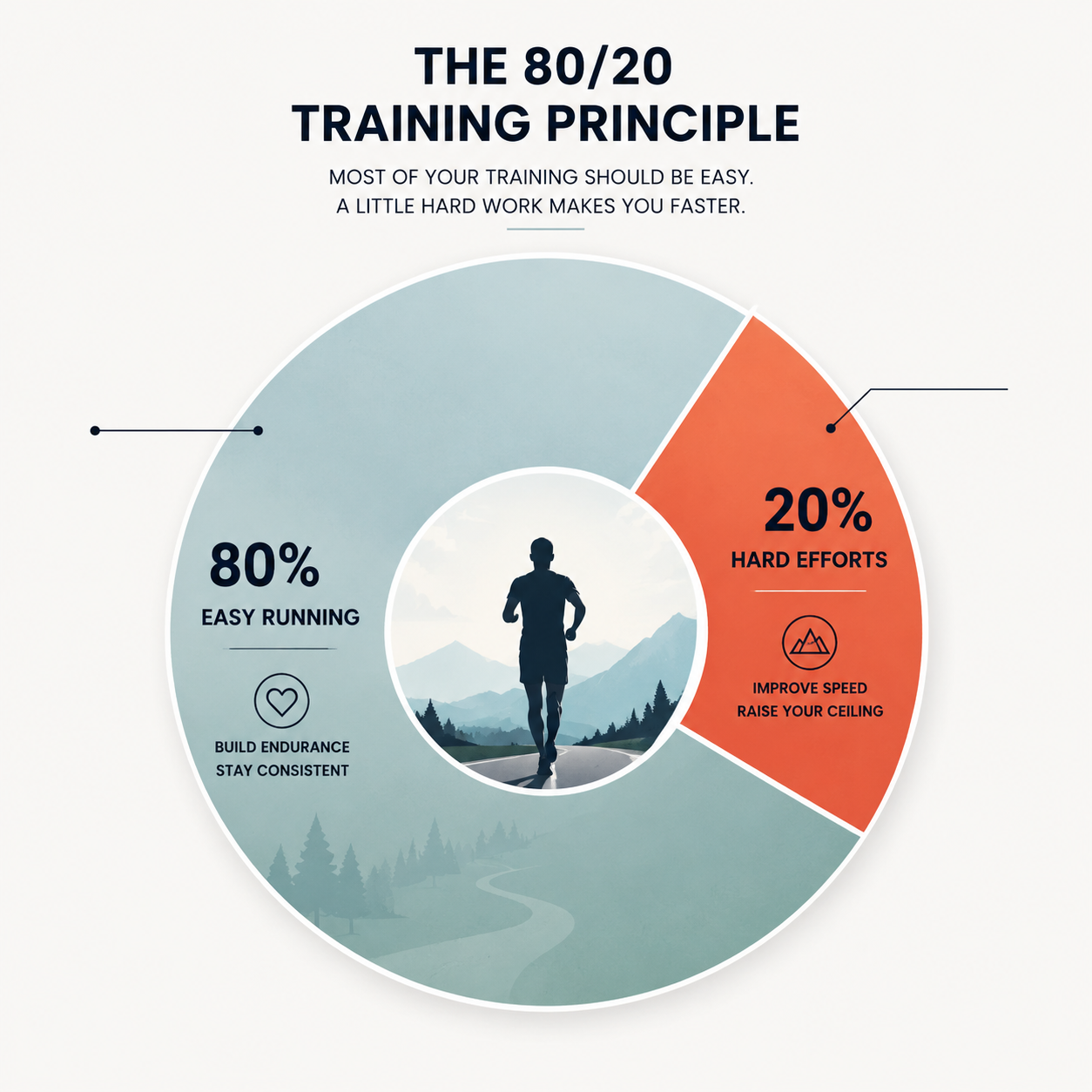
This is not just elite folklore. Two-time Olympic medalist Nick Willis used the 80/20 rule while coaching an average runner toward a sub-5-minute mile, with most runs kept easy and a smaller share of work made deliberately hard.[4] That does not prove every average runner can run under five minutes. It does show that the easy-hard structure has value outside the professional tier.
At 20 miles per week, 80/20 means about 16 miles easy and about 4 miles hard. At 30 miles, it means about 24 easy and 6 hard. The hard portion includes intervals, hill efforts, mile-pace reps, and fast finishes. It is not an extra category you add after doing all your normal training.
| Weekly Mileage | Approximate Easy Running | Approximate Hard Running | Practical Shape |
|---|---|---|---|
| 15 miles | 12 miles | 3 miles | Three easy runs plus one short interval or tempo session |
| 20 miles | 16 miles | 4 miles | Three easy runs, one quality session, optional short strides |
| 25 miles | 20 miles | 5 miles | Four easy runs, one quality session, one controlled faster finish |
| 30 miles | 24 miles | 6 miles | Four to five easy runs, one main interval session, one light speed touch |
The phrase "easy" needs protection. Easy is not whatever pace your watch says is respectable. It is the pace that lets tomorrow's run still happen. If you use heart rate, easy days should stay in a range you can hold without bargaining with yourself; if you are still sorting out zones, a practical guide to using your Apple Watch as a home fitness hub can help make easy-day discipline less dependent on mood. Runners who care about cleaner interval data may also want to compare wrist, chest strap, armband, and smart ring tracking before treating any one device as gospel.
For the mile, easy running is not filler. It is what lets the harder work stay sharp. A runner who turns four easy runs into medium-hard runs does not become more disciplined; they spend the week's limited recovery budget before the actual speed session arrives.
Translate Kerr's 1200m Workout Before It Hurts You
The most tempting Kerr detail is the one that needs the most adult supervision. Before the record, he ran a 1200m time trial in 2:42.45 at 5,300 feet of elevation in Colorado, hitting world-record pace and closing the final 400m in 51.88 seconds.[3] That session mattered because it tested whether he could move at record rhythm while still having the ability to finish brutally fast.
It is a terrible workout to copy literally. The value is the pattern: run controlled work near goal-mile effort, then ask for a brief faster finish while you are already carrying fatigue. On a treadmill, that pattern is easier to manage by time than by distance. You do not need a track mark, a perfect GPS reading, or a fantasy version of your current fitness.

A Safer Treadmill Version
Use effort first, speed second. If your current mile fitness is unknown, run these by feel: hard but controlled for the main reps, then faster but still smooth for the short finish. Set the treadmill incline only if you already tolerate it well; adding incline and speed at the same time is how a sensible session becomes a calf complaint.
- Warm up for 10 to 15 minutes easy, then add 4 relaxed 20-second strides with full easy jogging between them.
- Run 3 rounds of 2 minutes at controlled mile effort, with 2 to 3 minutes easy between rounds.
- After the third round, jog easy for 3 minutes, then run 4 x 30 seconds faster than mile effort with 90 seconds easy between reps.
- Cool down for 10 minutes easy.
That is the home-runner translation of the Kerr signal. The 2-minute reps stand in for sustained rhythm. The 30-second reps stand in for the fast closing demand. The recoveries keep the workout from becoming a private time trial with furniture nearby.
If you already know your mile pace, the treadmill can be more precise. Run the 2-minute reps around current mile pace rather than goal mile pace. Make the 30-second reps slightly faster only if your form stays organized. If your shoulders climb, your stride slaps, or your foot strike starts reaching forward, the speed increase has stopped helping.
If You Have No Treadmill
The same session works outdoors by time. Find a flat road, path, or gentle loop. Ignore GPS pace during the rep and review it later if you want. For mile training, a slightly imperfect surface with consistent effort is usually better than staring at your watch while your mechanics unravel.
Do this kind of workout once per week at most while building toward a mile attempt. A second hard day can be lighter: short strides after an easy run, a controlled tempo segment, or hill sprints if your legs are used to them. Two full mile-pace sessions in one week is rarely the missing ingredient for a 15- to 30-mile runner.
Strength Work Should Make the Next Run Better
Kerr's strength work is serious: two 90-minute sessions per week.[5] That establishes the priority, not the prescription. A home runner does not need to build a small performance center in the garage to benefit from twice-weekly strength. The target is enough leg, hip, trunk, and upper-body durability to hold form when mile pace starts to bite.
A 20- to 30-minute circuit is plenty if it is done consistently and placed where it will not sabotage quality running. The simplest version uses movements most runners already understand: squats, lunges, glute bridges, planks, and push-ups. For a more complete lower-body template, use a no-equipment leg day blueprint and keep the volume modest during harder run weeks.
- 2 rounds of 10 to 15 bodyweight squats
- 2 rounds of 8 to 10 reverse lunges per leg
- 2 rounds of 12 to 15 glute bridges
- 2 rounds of 20 to 40 seconds of plank work
- 2 rounds of 6 to 12 push-ups, elevated if needed
Put one strength session after an easy run and one after the weekly quality day, or leave at least a day between heavier leg work and intervals. The mistake is not doing a short circuit. The mistake is turning strength into a separate fatigue sport and then wondering why the next speed session feels like wet cement.
Recovery Is Where the Elite Lesson Gets Most Practical
Kerr's bedroom altitude tent is vivid because it is strange enough to remember. But the more useful recovery facts are simpler: he has targeted 9 hours of sleep and used regular physio support, with reports describing 3 to 4 physio sessions per week.[5] Most home runners cannot imitate that support. They can imitate the order of importance.
Hard workouts do not make you faster while they are happening. They create a demand. The body answers later, if it gets the resources to answer. Runner's World UK's mile plan describes hard sessions as a way to prepare the mind for the discomfort of the mile, but the adaptation still depends on what happens between those sessions.[6]
For a home runner, that means recovery has to be scheduled with the same seriousness as intervals. The day after mile-pace work should usually be easy or off. If sleep has been poor, move the quality session rather than forcing it because the calendar said Tuesday. If your resting effort feels unusually high during an easy warmup, make the workout shorter before it makes the next week worse.
Recovery tracking can help, but it should not become another scoreboard. Heart rate, sleep duration, and perceived fatigue are useful because they change decisions. If a wearable tells you that recovery is poor and your warmup agrees, the adult move is to downshift. If the device is noisy but your legs feel normal and the session is controlled, train. The point is not obedience to a gadget; it is fewer avoidable interruptions.
A 15- to 30-Mile Week Built From the Same Logic
A useful home mile week does not need to look exotic. It needs to leave you able to do another useful week afterward. This sample assumes you already run regularly and can tolerate one quality session per week. If you are returning from injury or building from a lower base, reduce the running days before adding intensity.
| Day | Session | Purpose |
|---|---|---|
| Monday | Easy run or rest | Protect recovery from the previous week |
| Tuesday | Treadmill mile-pace intervals | Main quality session |
| Wednesday | Easy run | Aerobic volume without extra strain |
| Thursday | Short strength circuit | Leg, hip, and trunk durability |
| Friday | Easy run with 4 relaxed strides | Light speed touch without a full workout |
| Saturday | Longer easy run | Aerobic support for mile training |
| Sunday | Rest or short strength circuit | Absorb the week |
The exact days can move. The spacing matters more than the names. Keep the hardest running away from the hardest strength. Keep easy days honest. If life compresses the week, drop the light speed touch before you drop sleep. If a treadmill is your main tool, let it solve the pacing problem without using it to manufacture punishment.
This is also where constraint becomes useful instead of annoying. A runner with no track learns to use time. A runner with limited weekly mileage learns to protect intensity. A runner with only dumbbells learns to keep strength simple. If you want a broader framework for adapting training instead of copying it, the constraints-led approach to home workouts is a better model than trying to recreate an elite camp in a spare room.
What to Ignore From the Record Attempt
The spikes, speed suits, and race-day staging are interesting because elite racing is interesting. The Athletic's preview of Kerr's world-record attempt covered those performance details, along with the broader attempt to set up the fastest possible mile.[5] For a home runner, they sit near the bottom of the list. Gear can refine a prepared athlete. It does not rescue a week built from too much intensity and too little sleep.
The altitude tent belongs in the same category. It is memorable, and in Kerr's case it fit a professional recovery environment.[2] For most runners, the equivalent is not buying an artificial-altitude setup. It is making the bedroom boring enough to sleep in, cutting off late caffeine, and refusing to treat recovery as optional because the workout was done at home.
Kerr's record does not give home runners a shortcut to 3:42. It gives them a standard for training like adults: repeatable weeks, mostly easy miles, controlled speed, simple strength, and enough recovery to absorb the work.
References
- Josh Kerr Breaks Mile World Record — Runner's World, July 2026
- How Josh Kerr Trained for the Mile World Record in His Bedroom — Runner's World
- The Crucial Workout That Told Josh Kerr He Was Ready to Break the Mile World Record — Runner's World, July 2026
- How Our Totally Average Runner Broke the Sub-Five-Minute Mile — Outside/RUN
- Inside Josh Kerr's mile world-record attempt: Bespoke spikes, speed suits and 800m races — The Athletic, July 17, 2026
- 6-week training plan to help you run a mile PB — Runner's World UK
Comments
Join the discussion with an anonymous comment.