
The useful part of the Mindy Kaling weekly running routine is not that it looks like a perfect celebrity training calendar. It is that the public descriptions of it point to a flexible weekly target: about 20 miles of running, hiking, walking, or some mix of the three, supported by strength training and recovery work. Runner’s World reported in 2023 that Kaling hikes or runs 20 miles a week, and the same benchmark was echoed in coverage from USA Today and E! News that year.[1][2][3]
That distinction matters. No single source publishes her exact Monday-through-Sunday schedule. The version below is reconstructed from interviews across several years, not copied from her trainer’s notes. Earlier coverage emphasized running and hiking; later coverage puts more weight on walking, strength training, and a broader “any movement counts” approach.[4][5][6] That makes the routine more useful for normal life, not less.

What 20 Miles a Week Looks Like in Real Life
Twenty miles sounds tidy until you have to place it inside a week with work, school drop-offs, sleep debt, errands, and one day when your legs simply do not want to participate. The point is not to run 20 miles in the most impressive way possible. The point is to create enough structure that the week does not vanish.
At a 10- to 11-minute mile pace, 20 miles adds up to roughly 200 to 220 minutes of cardio. USA Today connected that volume to the American Heart Association’s 150-minute weekly minimum for moderate-intensity aerobic activity, and quoted an NASM-certified trainer calling Kaling’s target “very attainable” and “a great, sustainable track for cardio.”[2]
| Part of the week | Flexible target |
|---|---|
| Total movement mileage | Up to 20 miles from running, hiking, walking, or a mix |
| Movement days | About 5 to 6 days, depending on recovery and schedule |
| Typical daily distance | Often 3 to 5 miles when walking or hiking is part of the week |
| Strength training | 2 to 3 sessions using basic home-friendly moves |
| Recovery options | Yoga, Pilates, easy walking, or a true rest day |
Kaling has described early starts, including waking around 5:45 a.m. in a 2025 Parade interview, and later sources have described morning walking, strength sessions, and off-day yoga or Pilates as part of the bigger picture.[4][5][6] Treat those as clues about how the routine has fit into her life at different times, not as a rule that anyone has failed if they run at lunch.
A Reconstructed Weekly Template
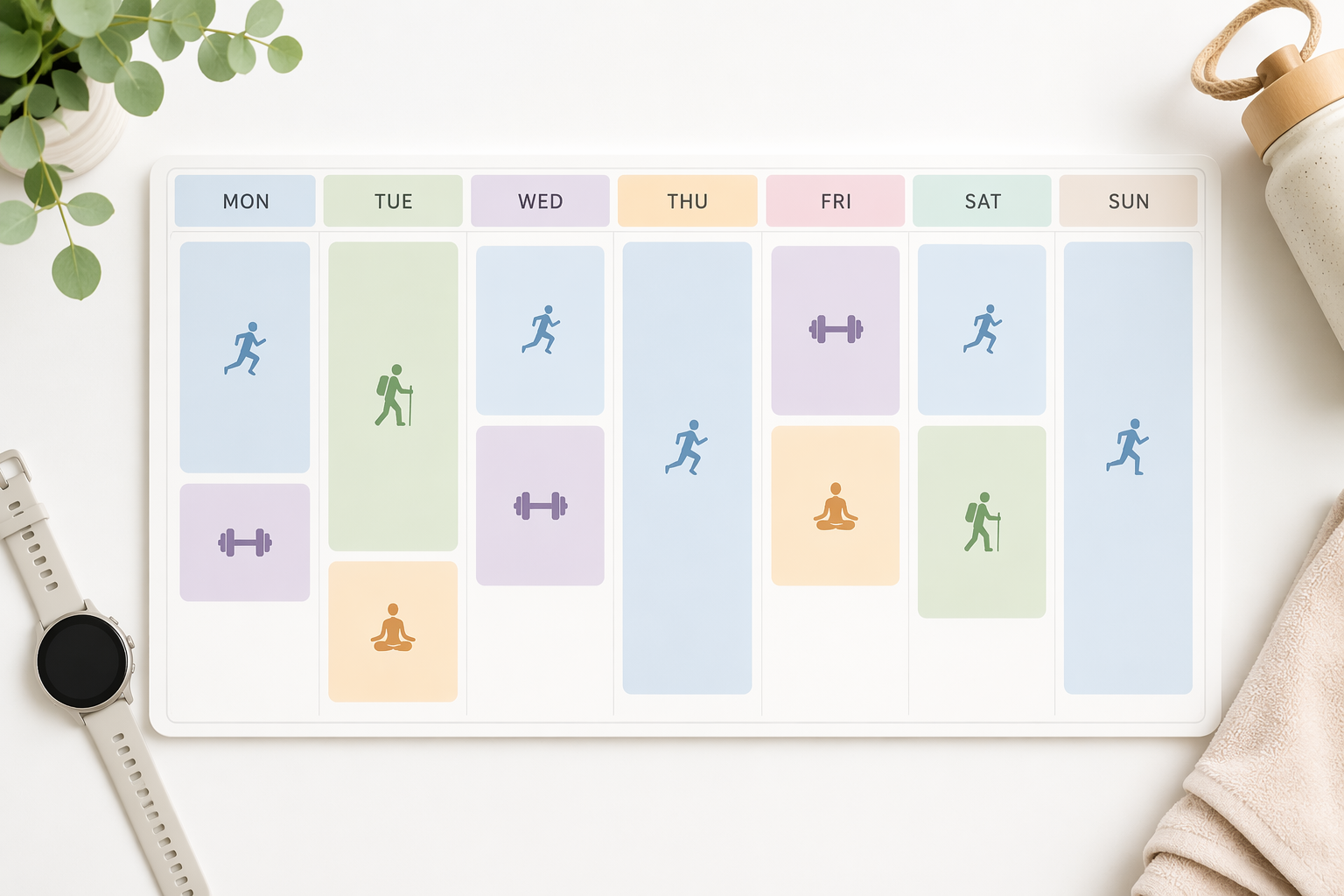
If you want the cleanest home-runner version of the routine, start with this: five movement days, two strength sessions, and one or two easier days. The running does not have to carry the whole plan. A hike can replace a run. A brisk walk can fill in mileage. A shorter run can still count if it keeps the week alive.
| Day | Example session | Mileage counted |
|---|---|---|
| Monday | Easy run or run-walk | 3 miles |
| Tuesday | Strength training plus optional easy walk | 1 to 2 miles if walking |
| Wednesday | Morning walk, hike, or easy run | 4 miles |
| Thursday | Strength training plus short recovery walk | 1 to 2 miles if walking |
| Friday | Easy run | 3 miles |
| Saturday | Longer hike, walk, or relaxed run | 5 miles |
| Sunday | Yoga, Pilates, easy walk, or rest | 0 to 2 miles |
This lands near 18 to 21 miles depending on whether the strength days include short walks. It is not meant to imitate Kaling’s exact current week. It is a practical translation of the pattern her interviews keep circling: frequent morning movement, a 20-mile container, walking or hiking counted without apology, and strength work layered in rather than treated as a separate fitness life.
The most beginner-safe version of this template is not “run five days.” It is “move five days, run only as much as your joints and recovery can handle.” If that means two short runs, two walks, and one weekend hike, the structure is still doing its job.
How to Scale the 20-Mile Goal Without Overreaching
A 20-mile week is sustainable only if it is earned gradually. For someone already running several days a week, it may be a reasonable next container. For someone restarting after months away, it is a destination. The mistake is turning a celebrity benchmark into a first-week assignment.
| Level | Weekly target | Best structure |
|---|---|---|
| Restarting beginner | 6 to 10 total miles | 2 run-walk days, 2 walking days, 1 optional easy walk or yoga day |
| Comfortable beginner | 10 to 15 total miles | 3 run-walk or easy run days, 2 walking or hiking days, 2 strength sessions |
| Intermediate home runner | 16 to 20 total miles | 3 to 4 running days, 1 longer walk or hike, 2 strength sessions, 1 easier recovery day |
For the restarting beginner, the win is frequency without punishment. A week might include a 2-mile run-walk, a 2-mile walk, another 2-mile run-walk, a 3-mile weekend walk, and one short recovery walk if energy allows. That is not a lesser version of the plan. It is the version that lets your calves, feet, hips, and schedule adapt at the same time.
For the comfortable beginner, the weekly question becomes distribution. Instead of pushing one heroic long run, spread the load: 3 miles, 3 miles, 4 miles, and a 4- to 5-mile walk or hike. Add strength twice a week, but keep it short enough that it does not sabotage the next day’s movement.
For the intermediate runner, 20 miles can look like three easy runs, one longer relaxed run or hike, and one walking day. The pace does not need to prove anything. If the routine is supposed to support a full life, the runs should leave enough in the tank to climb stairs, carry groceries, and sleep normally.
Why Walking and Hiking Count
One of the better things about Kaling’s publicly described routine is that walking and hiking are not treated as consolation prizes. E! News described her weekly exercise as including a 20-mile walk or hike, while TODAY later covered her easy walking routine and noted daily 3- to 5-mile morning walks in Hoka sneakers.[3][9]
That is useful for anyone who has made running too all-or-nothing. Walking mileage can keep the habit attached to the day when running would be too much. Hiking adds time on feet and cardiovascular work with a different rhythm. Neither replaces the specific adaptation of running if your goal is to race faster, but both can support a weekly cardio habit without asking every session to be high impact.
- Count a brisk walk toward your weekly total when it is intentional movement, not just a few scattered steps between errands.
- Count hiking mileage even if the pace is slower, especially when hills make the effort feel steady.
- Use walking the day after a harder run if your legs feel heavy but you still want the routine to continue.
- Do not use walking mileage to hide pain. If impact hurts, reduce running first and treat the walking as recovery, not proof of toughness.
There is also a morale benefit here that is hard to overstate. If the only successful day is a run day, a busy week can feel ruined by Wednesday. If the container is 20 miles of movement, the week has more doors back in.
The One-Mile Trick Is the Quiet Engine
In a 2021 Bustle interview, Kaling described telling herself she only had to run one mile, then usually continuing once she had started.[7] That is not a glamorous training philosophy, which is why it is so good. It works with the most fragile part of the run: the beginning.
For a home runner, the rule can be very plain: get dressed, go outside, and complete one easy mile. After that, you may stop, walk, or continue. The permission to stop is what makes the start less dramatic. Many days, the body warms up and the planned 3 miles become possible. Some days, the one mile is the workout. That still protects the habit.
This is also where Kaling’s routine becomes more adaptable than a rigid celebrity plan. A fixed schedule asks you to obey. A low-bar start asks you to begin.
Where Strength Training Fits
Kaling works with a trainer, which is a real advantage and should not be blurred into a casual detail. Most people following along at home will not have someone adjusting their form or choosing loads for them. But the strength moves named in Women’s Health UK are not exotic: squats, Romanian deadlifts, forward lunges, upright rows, biceps curls, Arnold presses, and push-ups.[8]
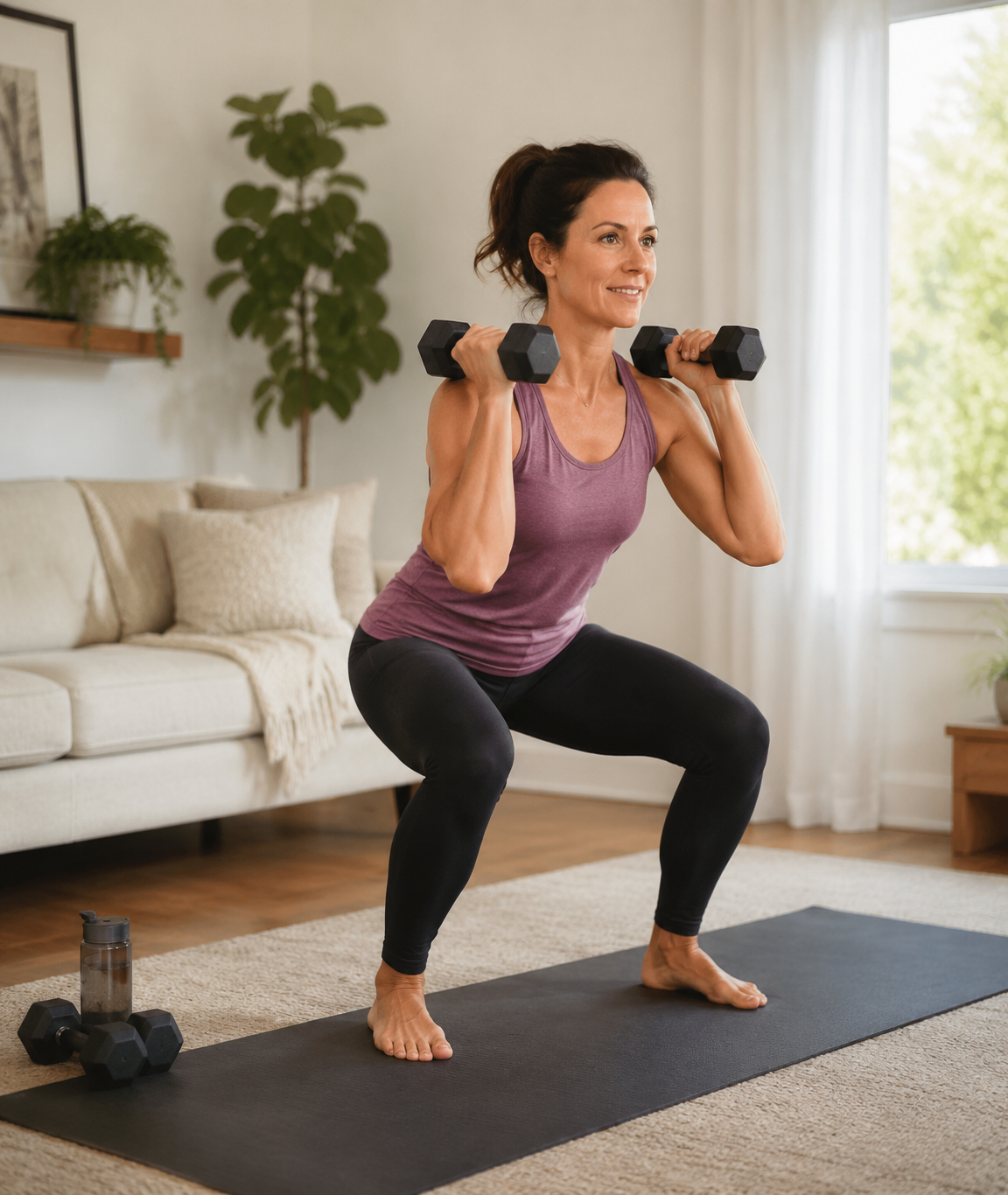
Two short full-body sessions are enough for most beginner-to-intermediate runners building toward this kind of week. Put them after an easier run, after a walk, or on a separate day when you can recover before your next harder session. If you are building leg strength at home, a progression like The Home Leg Workout Progression Guide can help you make squats, lunges, and hinge patterns more systematic without turning strength work into a second full-time hobby.
| Strength day | Simple home version |
|---|---|
| Session A | Squat, Romanian deadlift, push-up, row or upright row |
| Session B | Forward lunge, glute bridge or deadlift variation, Arnold press, biceps curl |
| How hard | Stop with a few good reps left rather than grinding to failure |
| When to progress | Add reps first, then weight, when form stays steady across all sets |
The legs do not need to be destroyed for strength training to “count.” In a running week, useful lifting often feels almost modest. You want stronger hips, hamstrings, calves, back, and shoulders; you do not want soreness that turns tomorrow’s easy run into a negotiation.
The Supporting Habits Are Optional, Not the Plan
Some of the celebrity-adjacent details are interesting, but they should stay in their proper place. Parade reported that Kaling drinks 50 ounces of water before 7 a.m.; Women’s Health UK mentioned magnesium at night for muscle cramping prevention; E! News covered her use of Crossrope jump rope workouts while traveling.[4][8][3] Those habits may support consistency, but they are not the reason the weekly template works.
Shoes matter if they keep your feet comfortable. Hydration matters if it helps you feel better during morning movement. Magnesium may be relevant for some people with cramping concerns, though supplement choices belong in a conversation with a clinician if you have medical conditions or take medication. Jump rope can be a compact travel option, but it is also higher impact than walking and may not be the best swap for every runner.
The sturdier habits are simpler: choose tomorrow’s route before bed, keep one easy day truly easy, and do not let one missed run cancel the whole week. A routine built around movement mileage gives you room to repair the week while it is still happening.
A Practical Week for Three Different Runners
Here is the same idea translated three ways. The sessions are deliberately ordinary. That is the point.
| Day | Restarting beginner: 6–10 miles | Comfortable beginner: 10–15 miles | Intermediate: 16–20 miles |
|---|---|---|---|
| Monday | 1–2 mile run-walk | 3 mile easy run-walk | 3 mile easy run |
| Tuesday | Strength, no mileage required | Strength plus 1 mile walk | Strength plus 2 mile walk |
| Wednesday | 2 mile walk | 3 mile easy run | 4 mile easy run |
| Thursday | Rest or yoga | Strength | Strength or yoga |
| Friday | 1–2 mile run-walk | 2–3 mile walk or run-walk | 3 mile easy run |
| Saturday | 2–3 mile walk or hike | 4–5 mile walk or hike | 5–6 mile relaxed run, walk, or hike |
| Sunday | Rest | Rest or easy walk | Easy walk or rest |
The beginner plan has more walking than running because restarting is a musculoskeletal project, not just a cardio project. Your lungs may be ready before your shins, knees, or feet are ready. The comfortable beginner plan increases total time on feet without forcing every day to be a run. The intermediate plan gets closer to the 20-mile benchmark while still leaving space for strength and one quieter day.
If you want to move up a level, do it by adding a little distance to one or two days, not by upgrading the whole week at once. A 2-mile walk becomes 3 miles. A run-walk becomes a mostly easy run. A 4-mile hike becomes 5 miles. The routine should feel like it is widening, not snapping into a harder identity overnight.
What to Copy, and What to Leave Alone
Kaling has spoken over time about moving away from exercise as something punishing and toward movement that she actually enjoys. SELF covered that shift in 2022, and later coverage has continued to frame her routine around walking, moderation, strength, and health rather than a single appearance-driven goal.[10][9][5] That is the part worth borrowing.
Do not copy the wake-up time unless mornings work for your household. Do not copy 20 miles if 8 miles is the honest current number. Do not copy trainer-designed strength work so aggressively that it leaves you too sore to move for three days. Copy the container: frequent movement, flexible mileage, strength work that supports the week, and a low enough starting bar that you can begin on a messy Tuesday.
The best version of a Mindy Kaling-inspired plan is not a performance of discipline. It is a week you can repeat. Start with the first mile, give yourself permission to count the walk, and let the 20-mile target become something you grow toward rather than something you use to punish yourself.
References
- Mindy Kaling Hikes or Runs 20 Miles a Week, Runner's World, 2023
- Mindy Kaling exercise routine: She runs, hikes 20 miles a week, USA Today, 2023
- Mindy Kaling's Exercise Routine Includes a Weekly 20-Mile Walk or Hike, E! News, 2023
- Mindy Kaling on Her Exact Workout Routine (Exclusive), Parade, 2025
- What To Know About Mindy Kaling's Diet And Workout Routine, Women's Health, 2025
- Mindy Kaling Shares Diet and Fitness Routine Amid Weight Loss, Prevention, 2024
- Mindy Kaling's Brilliant Hack For Pushing Through Runs, Bustle, 2021
- Mindy Kaling, 47, shares the 7 strength exercises behind her sustainable weight loss, Women's Health UK, 2025
- Walking and moderation: Mindy Kaling talks about her new approach to weight loss, TODAY.com, 2024
- 3 Ways Mindy Kaling Went From Hating Exercise to Actually Enjoying Her Workouts, SELF, 2022
Comments
Join the discussion with an anonymous comment.