
How John Goodman Lost 200 Pounds at Home
John Goodman's documented routine — daily walking, steady-state cardio, and boxing-style bag work — is buildable at home, but each pillar lands in a different budget, noise, and floor-protection tier. This guide maps those tiers for renters in small spaces and marks where the public record runs out.
- Equipment tier required
- none
- Duration
- varies min
- Difficulty
- beginner
- Target area
- full body
- Space footprint needed
- compact
- Noise level
- quiet base; optional boxing adds impact noise
The honest answer to “how did John Goodman lose 200 pounds at home” is narrower than the search query. Goodman has been reported to have lost about 200 pounds from a peak described as close to 400 pounds or in the high-300s, and the documented method included walking, steady-state cardio, boxing-style work, and diet changes. [1][2]
What is not documented is a neat product list from his house. His trainer, Mackie Shilstone, did say he set up equipment in Goodman’s California home, and he gave clear training targets. That supports an at-home build. It does not prove that every workout was done at home, or that a renter should go buy the exact treadmill, elliptical, or bag Goodman may have used. [2]
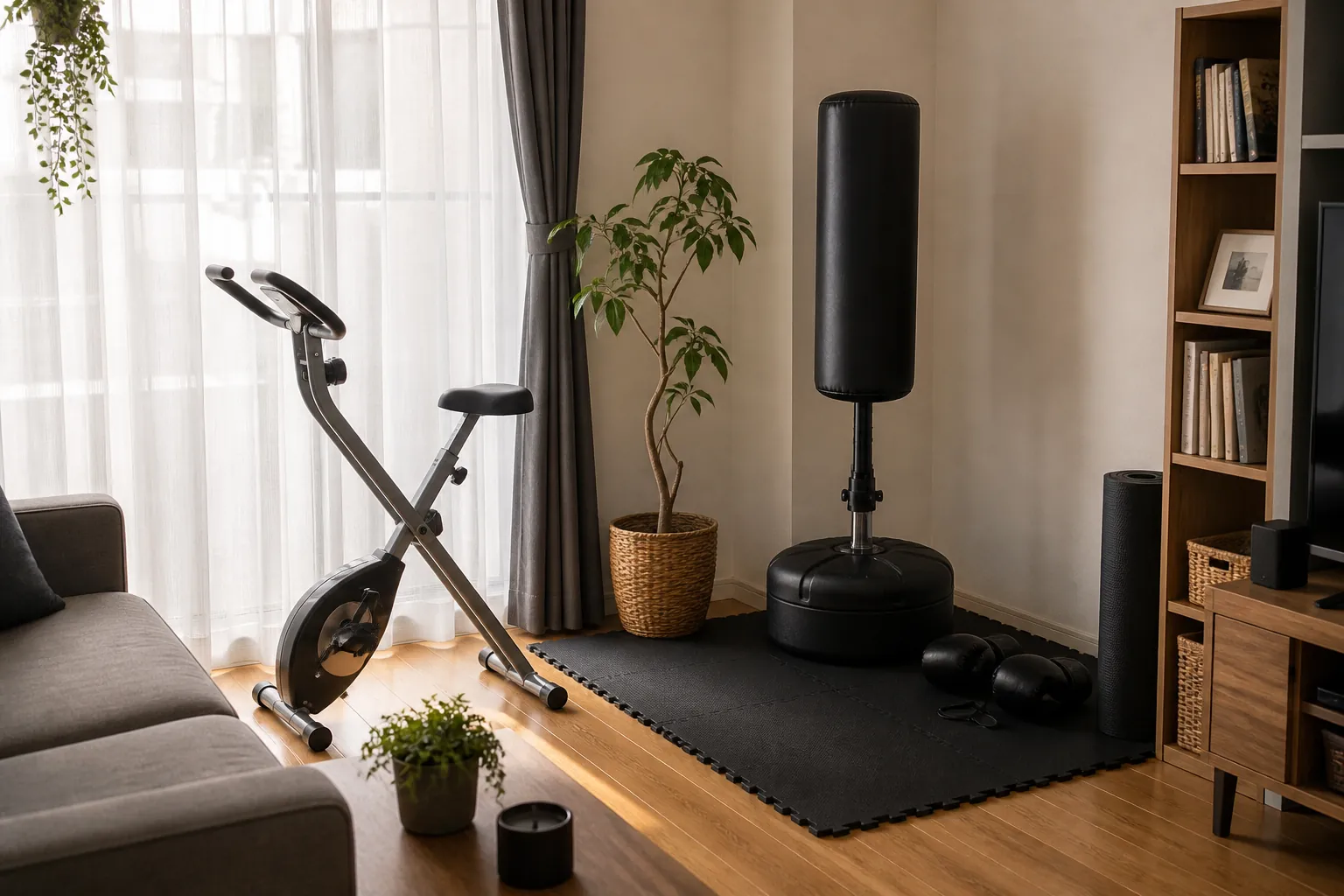
What the public record actually supports
The best-supported version of Goodman’s routine is a template, not a replica: a daily step target, treadmill or elliptical-style cardio six days a week, boxing-style mitt or bag work, and a Mediterranean-style diet with portion control. [2][3][4]
Shilstone’s account is the most useful for anyone trying to build the home version because it gives two things celebrity weight-loss stories often skip: a 10,000-to-12,000-step walking target and a six-days-per-week treadmill or elliptical component. [2]
TODAY’s framing adds the intensity ceiling: Goodman’s work was described as “breaking a sweat but not going nuts.” That matters in an apartment. It points less toward dramatic jumping intervals and more toward repeatable, steady work that can be done without rattling a ceiling fan downstairs. [1]
For a more traditional routine breakdown, use the site’s tiered home workout plan. This article stays with the harder home question: what each part costs in space, noise, floor protection, and landlord risk.
The $0 pillar: walking
Walking is the part of Goodman’s documented routine that transfers cleanly to almost any living situation. It does not need a lease-friendly modification, a power outlet, a mat, a ceiling clearance check, or a purchase that becomes a coat rack by October.
It also should not be oversold. A pedometer-based walking meta-analysis found modest average weight loss: about 1.27 kg over a median 16 weeks, roughly the pace of about 1 pound every 10 weeks, with longer programs associated with greater loss. The authors also recommended pairing walking programs with a dietary component. [5]
That fits Goodman’s reported combination better than the cleaner headline version. Walking was not a magic explanation for a 200-pound change. It was the cheap, repeatable movement layer that sat beside diet changes and additional cardio work.
For renters, the practical build is simple: outdoor walks when the weather and neighborhood cooperate; indoor mall, hallway, or workplace steps when they do not; and short step breaks during the day if one long walk keeps getting crowded out. A walking-first plan also leaves room in the budget for the only upgrades that actually solve a problem.
If the free version is the only version that fits right now, it is still a real version. The site’s walking-first apartment plan inspired by Jelly Roll’s weight-loss approach is a better next stop than shopping for equipment before the habit exists.
Steady-state cardio: the bike usually beats the treadmill upstairs
Goodman’s documented cardio included treadmill or elliptical work six days a week. [2] At home, that does not automatically mean a full treadmill is the best translation. The method is steady-state cardio. The machine is a way to get there.
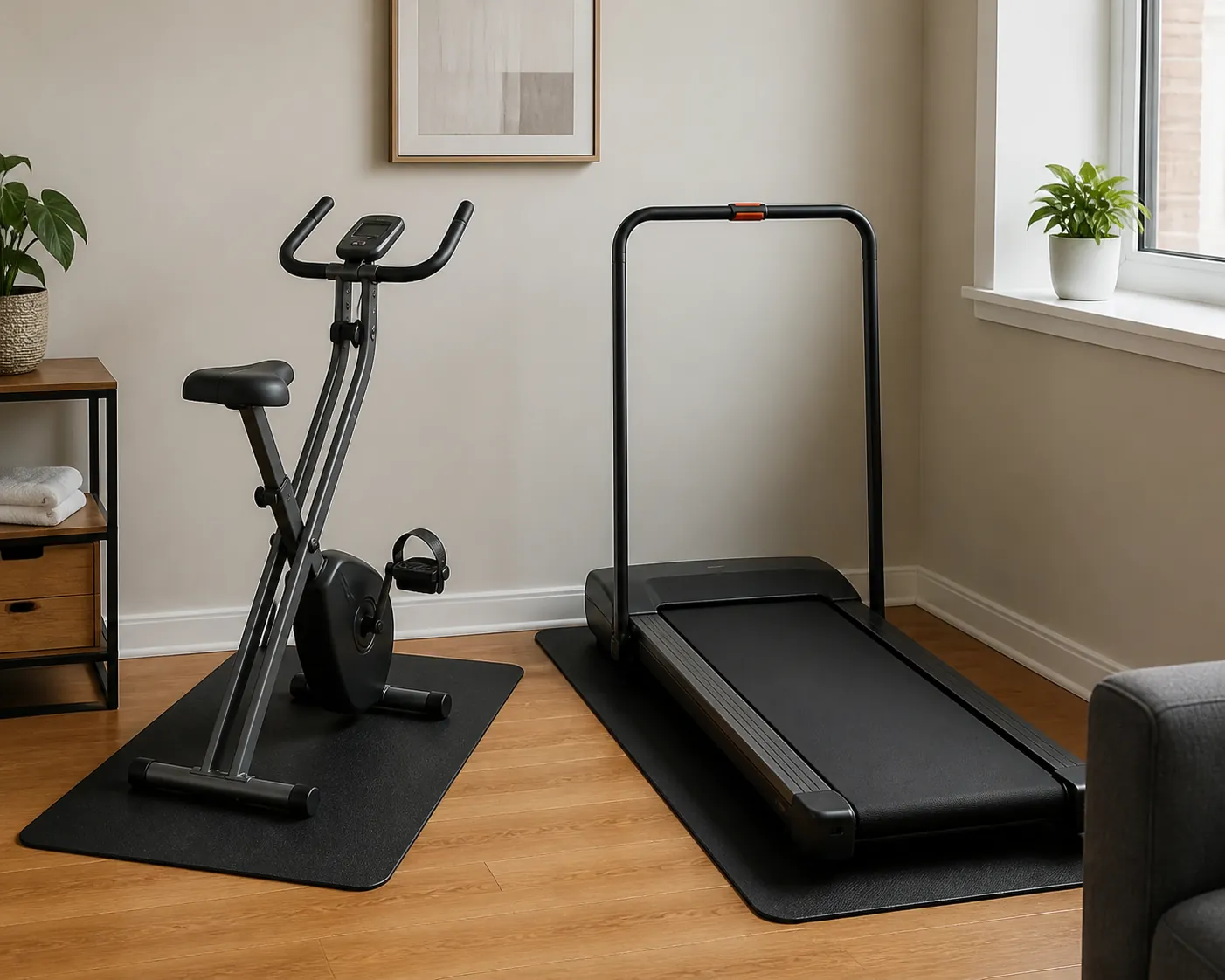
| Option | What it mirrors | Apartment advantage | Apartment problem |
|---|---|---|---|
| Outdoor walking | Daily step target and low-intensity cardio | Free, silent at home, no storage | Weather, sidewalks, safety, and schedule can limit consistency |
| Compact exercise bike | Steady sweating without impact | Usually easier on floors, easier to mat, often easier to fold or roll away | Can feel boring; seat comfort and posture matter |
| Walking pad or compact treadmill | Treadmill-style walking cardio | Closest home match to treadmill walking | Footfall vibration can travel through floors; storage and weight are real issues |
| Full treadmill | Treadmill-style cardio with more speed and incline range | More stable and capable than many compact units | Heavy, harder to move, harder to hide, and riskier for upstairs noise |
| Elliptical | Low-impact steady-state cardio | Less foot-strike impact than running | Larger footprint; ceiling clearance can become the hidden dealbreaker |
If you live above someone, the bike is often the first machine to consider because it removes the repeated foot strike. That does not make it silent. A loose pedal, uneven floor, or hard plastic feet on laminate can still broadcast a workout through the building. But the problems are usually easier to manage with a thick mat, stable placement, and a time of day that does not turn your neighbor’s ceiling into a drumhead.
A treadmill or walking pad is more literal, but literal is not always kinder to the room. The belt motor is only one part of the sound. The bigger issue in many apartments is vibration: repeated steps traveling through the frame, the mat, the subfloor, and then into someone else’s evening. If a product page advertises quiet operation, treat that as a starting claim, not proof of how it will sound in your building.
The renter test is not “Can it fit?” Plenty of machines fit if you measure the floor rectangle and ignore the rest of life. The better test is this:
- Can you place it on a mat without blocking the normal path through the room?
- Can you use it during the hours you are actually free without creating a neighbor problem?
- Can you move it for cleaning without scratching the floor?
- Can you store it without making the room feel permanently surrendered to exercise?
- Can you maintain a sweat-but-not-going-nuts pace without turning every session into a negotiation with the building?
Budget-wise, the cardio tier is where “at home” stops being free. A compact bike can be the lowest-risk machine upgrade. A walking pad may be reasonable if you are on a ground floor or have forgiving floors. A full treadmill belongs in the plan only after weight, delivery, storage, vibration, and matting are solved. If you are pricing a whole setup rather than a single machine, the site’s home gym cost breakdown is the better place to compare tiers.
Boxing-style work is the least renter-proof part
The boxing piece is real, but it is the part that gets sloppiest when translated into a small apartment. Goodman’s reporting includes boxing-style mitt or bag work, with Shilstone involved as a trainer. [2][3][4] That is different from telling a renter to hang a heavy bag from a ceiling joist and hope the lease stays friendly.
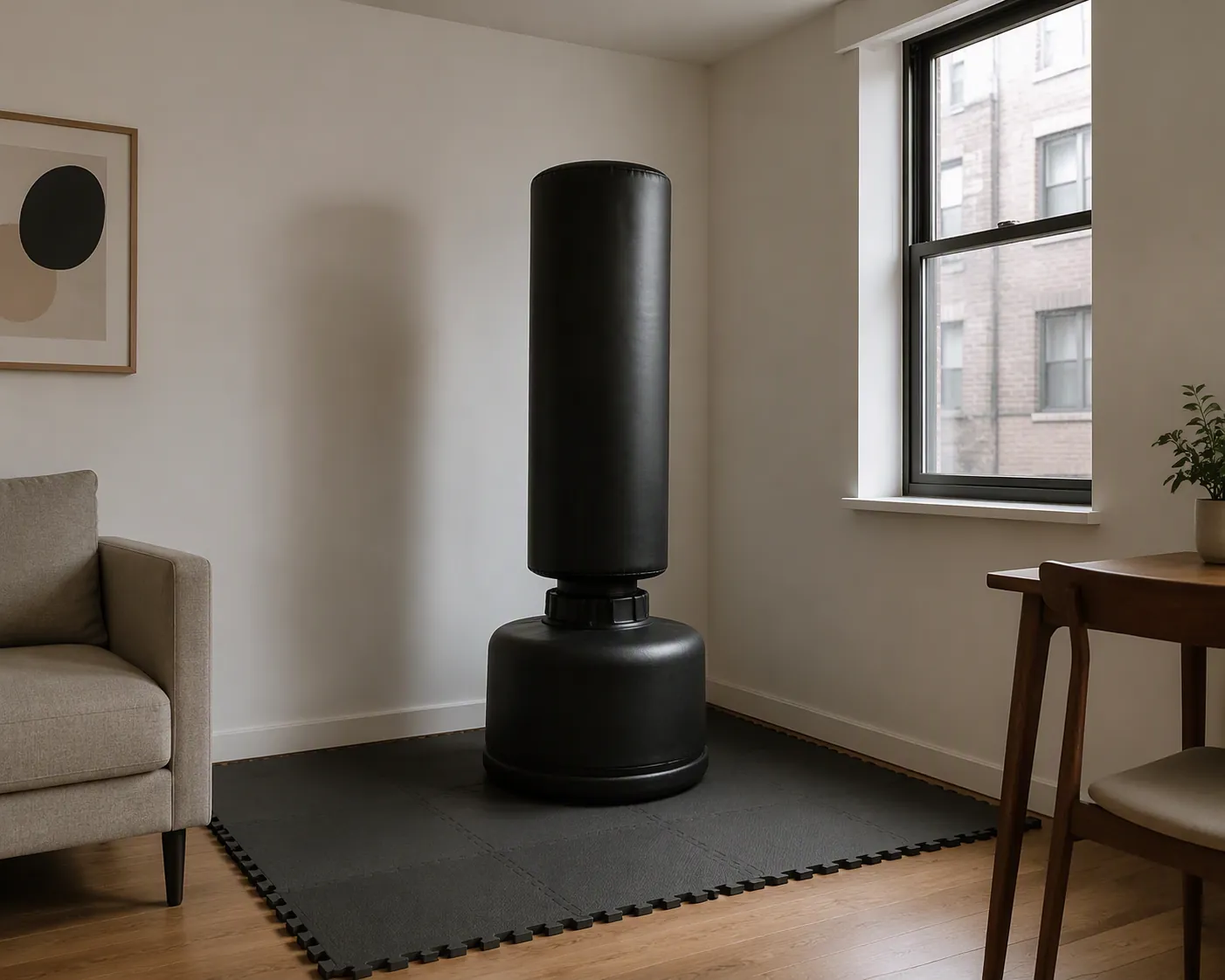
A traditional hanging heavy bag creates three apartment problems at once: anchoring, swing space, and impact transfer. If it needs drilling, a ceiling mount, or a wall bracket, it is no longer just fitness equipment. It is a lease question. Even if the hardware is secure, the bag can send vibration into framing in a way that a floor mat cannot fully erase.
Freestanding bags are the more renter-friendly translation because the weight sits on the floor instead of the wall or ceiling. They still need a wide base, enough clearance for the bag to rebound, and floor protection under the base. A thick mat is not just for noise; it helps prevent scuffing, sliding, and pressure marks that become very interesting during move-out inspection.
| Boxing option | Renter fit | What to check before buying |
|---|---|---|
| Shadowboxing | Best for noise and deposit safety | Enough space to rotate, no low lights, no furniture corners near your hands |
| Mitts with a partner or coach | Good if you have space and supervision | Partner skill, hand protection, and whether the session stays controlled indoors |
| Freestanding bag | Most plausible bag option for many renters | Base size, fill method, mat thickness, rebound space, and whether impacts travel through the floor |
| Doorway or no-drill light target | Possible for light contact only | Door strength, movement, manufacturer limits, and whether it marks trim or paint |
| Ceiling or wall-mounted heavy bag | Usually the riskiest rental option | Lease permission, structural support, professional installation, vibration, and repair obligations |
There is also a training-quality issue. A bag invites people to hit harder than they planned. In a gym, that is part of the point. In an apartment, harder punches mean more base movement, more floor noise, and more chance that the bag walks across the mat. If boxing is mainly there to mirror Goodman’s conditioning style, shadowboxing rounds or controlled mitt work may solve the fitness problem with fewer housing problems.
The safest buying order is not bag first. Try shadowboxing first. Then test whether you actually want boxing in the week. Then consider a freestanding bag only if you have the corner, the mat, the base clearance, and a time window when impact noise will not make the routine socially expensive.
Diet is the no-gear pillar
The least visible part of the home setup may be the most important for scale. Goodman’s weight-loss coverage repeatedly ties the exercise to diet changes, including Mediterranean-style eating and portion control. [3][4]
That does not require a machine, a bag, or a dedicated corner. It requires food decisions that repeat when the motivation story is no longer fresh. The walking research points in the same direction: walking programs are more convincing for weight management when paired with a dietary component. [5]
This is also where the public record should stay clean. There is no need to pretend a specific smoothie, supplement, or exact daily menu is documented if the stronger sources do not document it. For food context, use the Goodman diet and routine companion rather than filling the gaps with borrowed meal-plan folklore.
How to combine the tiers without recreating a fantasy setup
The home version works best when each pillar earns its place instead of being treated as a celebrity shopping list. Start with the parts that have the least friction, then add only the equipment that solves a real consistency problem.
| Tier | Home version | When it makes sense | What it does not prove |
|---|---|---|---|
| $0 base | Walking plus diet changes | You need the routine to survive without equipment, noise, or storage | That walking alone caused a 200-pound loss |
| Quiet cardio upgrade | Compact bike, walking pad, or treadmill-style machine | Weather, safety, schedule, or consistency makes outdoor steps unreliable | That Goodman used your machine or model |
| Boxing-style add-on | Shadowboxing, mitts, or a freestanding bag on protective flooring | You have space, noise tolerance, and a safe way to train | That the documented boxing work was a fully home-only program |
| Higher-risk build | Wall-mounted, ceiling-mounted, or heavy bag installation | Only if the structure, lease, and repair obligations are solved first | That renter convenience is the same as gym equipment |
A practical week might keep walking as the daily default, use a bike or treadmill-style option for steady sweating when outdoor movement is not enough, and treat boxing-style work as optional conditioning rather than mandatory apartment theater. If you want exact session structure, the tiered workout-plan article is built for that layer.
The fact-check companion is useful when a claim sounds too specific: exact foods, exact session lengths, or named products. The safer rule is simple enough to use before buying anything: if a source documents the method, mirror the method; if it does not document the gear, do not promote the gear to fact.
The renter verdict
Goodman’s documented approach can be mirrored at home as a tiered template. Walking is the free base. Diet is the no-gear pillar. Steady-state cardio is the first real equipment decision, and a compact bike is often easier on an apartment than a treadmill. Boxing-style work is the last piece to add, not the first, because it brings anchoring, floor protection, rebound space, and neighbor tolerance into the room.
That is the honest “at home” answer: build the parts the record supports, leave the undocumented product claims alone, and do not let a celebrity headline talk you into equipment your floor, lease, or downstairs neighbor cannot absorb.
References
- John Goodman lost 200 pounds. What he’s said about his weight loss journey — TODAY
- John Goodman’s trainer talks weight loss intervention at cemetery — New York Post, June 20, 2023
- John Goodman's 200-Pound Weight Loss Transformation — Men’s Health
- John Goodman's 200-Pound Weight Loss: His Diet and Exercise Routine — E! Online
- A Meta-Analysis of Pedometer-Based Walking Interventions and Weight Loss
What a small equipment investment adds
We don't have a build tagged to this exact tier yet. Browse all builds.
How often should you repeat this?
See our recovery and rest reference for citation-anchored rest-interval guidance.
Spot something off?
Tell us if a movement, tier assumption, or duration didn't match your experience.