
Can You Lose Weight at Home Without GLP-1 Drugs?
Losing weight at home without GLP-1 drugs is realistic, but the evidence is specific about the workload: diet creates the deficit, while 200–300 weekly minutes of cardio and strength work protect muscle and keep weight off. This small-space plan mixes walking, bodyweight strength, and low-impact cardio with calorie-burn estimates and the evidence-backed pace to expect.
- Equipment tier required
- none
- Duration
- 45 min
- Difficulty
- beginner
- Target area
- full body
- Space footprint needed
- enough floor space to lie down
- Noise level
- low
Yes: home workouts to lose weight without GLP-1 weight loss drugs can work. The unglamorous catch is that the workout plan cannot carry the whole job by itself. For most people, the food side creates the calorie deficit; the exercise side raises weekly expenditure, preserves strength and muscle, improves health markers, and makes regain less likely when the first burst of motivation is gone.
Start with the honest expectation. Mayo Clinic frames a 500–750 kcal/day reduction as the kind of deficit that can produce about 1.5 lb of weight loss per week. CDC puts a sustainable pace at 1–2 lb per week and notes that losing even 5% of body weight can improve blood pressure, cholesterol, and blood sugar markers.[1][2]
That is not a miracle. It is also not nothing. For a 220 lb person, 5% is 11 lb. For a 180 lb person, it is 9 lb. Those changes do not require a drug-centered plan, but they do require more than a random ten-minute sweat session three times a week.
The weekly plan, before we decorate it
The useful target is roughly 200–300 minutes of weekly movement, with at least two strength sessions. If you are currently doing very little, do not jump straight to the full version. Build toward it. But this is the workload the plan is aiming at, not a fantasy version where five minutes of marching cancels out the rest of the week.
| Day | Home workout | What it contributes |
|---|---|---|
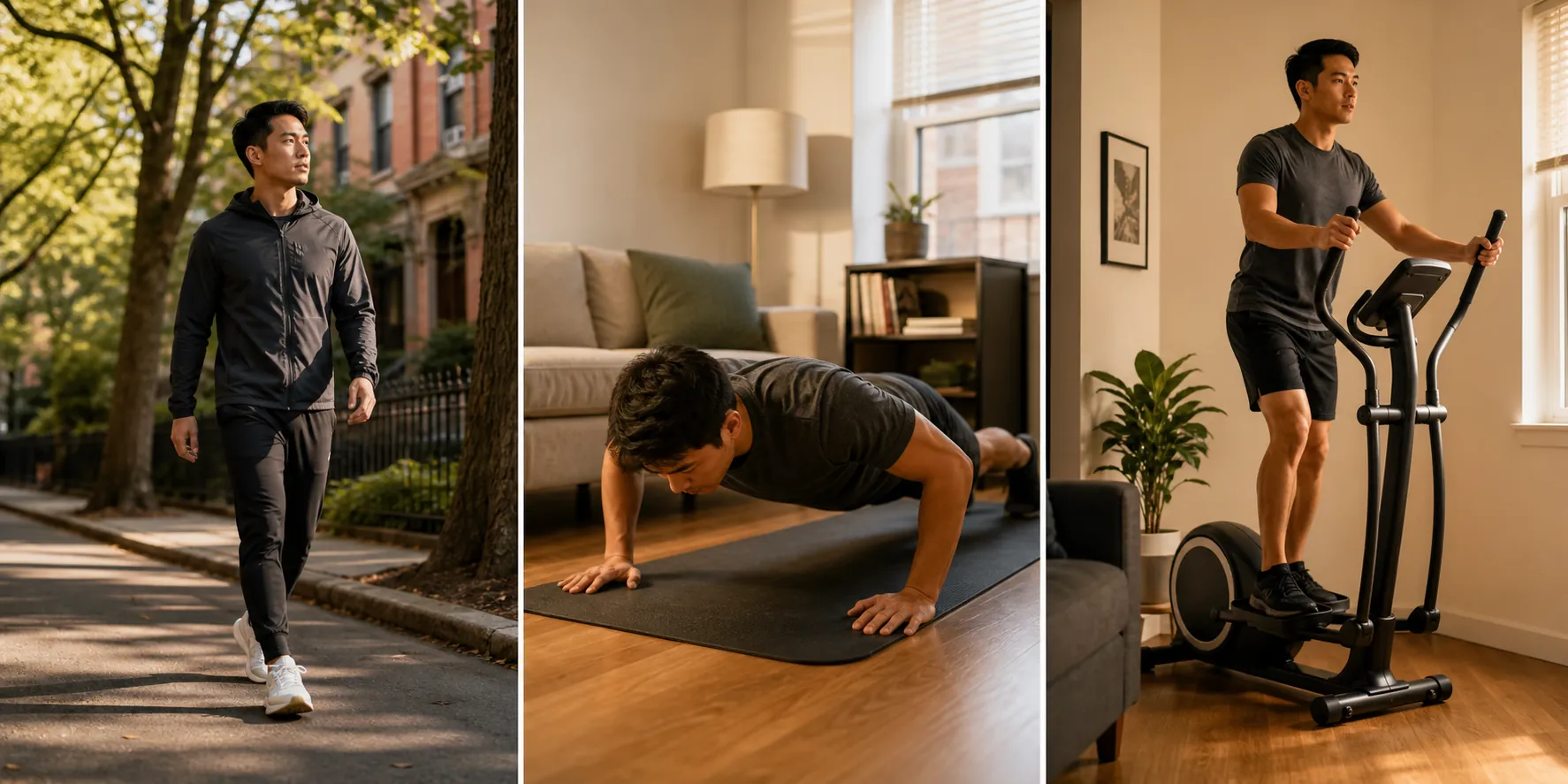
| Monday | 45-minute brisk walk, outside or indoors | Moderate cardio, low skill, easy to repeat |
| Tuesday | 30–40-minute bodyweight strength circuit | Muscle-preserving work: squat, push, hinge, row, core |
| Wednesday | 40–50 minutes low-impact cardio | Apartment-friendly aerobic work without jumping |
| Thursday | 45–60-minute walk with short faster blocks | Higher expenditure without turning the session into punishment |
| Friday | 30–40-minute strength circuit plus optional 15–20-minute easy walk | Second strength day; extra easy minutes if recovery is good |
| Saturday | 60-minute longer walk | The simplest place to add meaningful weekly volume |
| Sunday | Rest, mobility, or 20–30-minute easy walk | Recovery, or a quiet way to reach the weekly total |
Why the target is higher than the health minimum
The general adult health baseline is lower than the best weight-loss workload. Mayo Clinic summarizes the federal guideline as at least 150 minutes of moderate aerobic activity or 75 minutes of vigorous aerobic activity per week, plus strength training at least twice weekly.[1] That is a good floor. It is not where most weight-loss plans should stop.
ACSM/ADA guidance discussed in Diabetes Spectrum is blunter about the dose problem: when relying on exercise for weight loss, as much as 60 minutes per day may be needed. The same review discusses Midwest Exercise Trial 2, where daily exercise targets of 400 or 600 kcal produced average losses of about 3.9 kg and 5.2 kg over 10 months.[3]
Those trial numbers are not a promise that your body will respond on schedule. They do make one thing hard to dodge: the effective exercise dose for weight loss is usually closer to a serious weekly habit than to the bare minimum for health.
This is also why diet and exercise should not be forced into a fake rivalry. Cutting calories is usually the cleaner way to create a daily deficit. Exercise is the part that makes the plan more physically durable: more movement, better conditioning, more strength practice, and less of the “I lost weight but feel weaker” problem.
Walking is the base, not the warm-up
Walking earns its space because it is repeatable. A brisk outdoor walk works. So does walking a hallway, pacing during calls, using a treadmill, or doing indoor intervals when weather, safety, or time make outdoor walking unrealistic.
A practical build looks like this: start with the longest walk you can repeat without turning the next day into a negotiation, then add minutes before you add intensity. Once 30 minutes feels ordinary, extend one or two walks toward 45–60 minutes. If boredom is the problem, use alternating blocks: comfortable pace, brisk pace, comfortable pace again. The point is not to make walking theatrical. The point is to accumulate enough minutes that it matters.
If you need more structure, use a dedicated walking progression such as a Japanese walking workout at home or a longer walkathon training plan at home. If your feet are the limiting factor, fix that early; home walking in worn-out slides is a silly reason to miss easy volume. A basic home-walking footwear check is more useful than buying a machine you will avoid.
The strength work should be boring in the best way
Two strength days are the minimum I would protect. Three are fine if recovery is good, but the first win is consistency. You do not need a barbell, a rack, or a garage. You need repeated practice in a few movement patterns: squat, push, hinge, row, and brace.
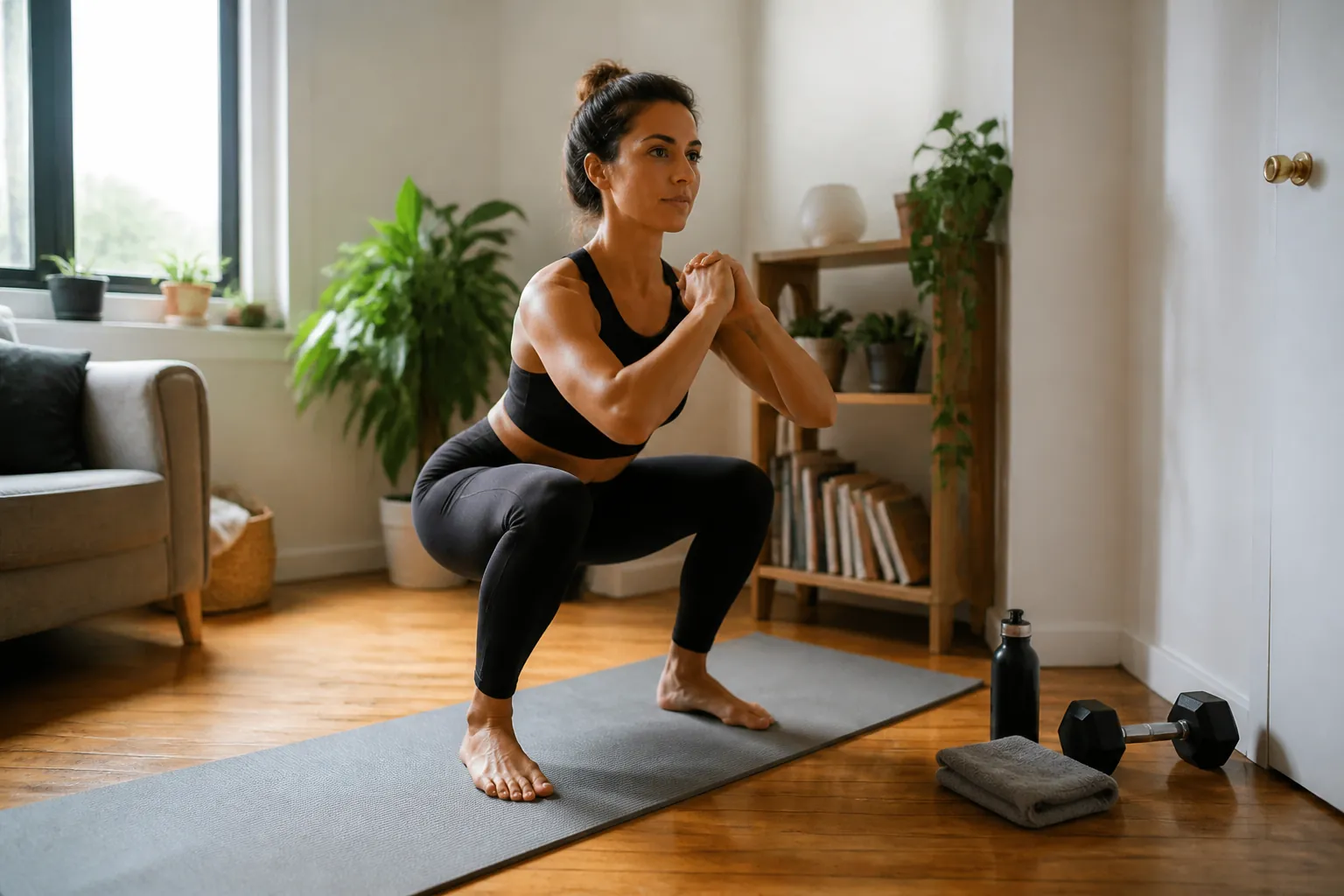
The circuit below follows the simple full-body logic of the CPT-reviewed Nerd Fitness beginner bodyweight workout, then makes the swaps that matter in a small apartment: quieter lower-body work, incline pushing, and rows that can be done with a backpack or a single dumbbell.[4]
| Movement | Standard version | Low-impact or small-space version | How to use it |
|---|---|---|---|
| Squat | Bodyweight squat | Sit-to-stand from a chair | Use a range of motion you can control; add a backpack later |
| Push | Push-up | Wall, counter, or couch incline push-up | Choose the incline that lets you keep a straight body line |
| Hinge / glutes | Glute bridge | Glute bridge with a pause at the top | Quiet, knee-friendly, and easy to load with tempo |
| Row | One-arm dumbbell row | Backpack row | Pull the elbow toward the ribs; avoid shrugging every rep |
| Lunge pattern | Reverse lunge | Supported split squat or step-back tap | Hold a wall or chair if balance steals the exercise |
| Core | Plank | Dead bug or elevated plank | Stop before your low back becomes the prime mover |
Run it as 2–3 rounds. Most sets can live in the 8–12 rep range, with enough rest that the next movement is clean. If you finish every set feeling as if you could do twenty more reps, make the exercise harder before you add more exercises. Slow the lowering phase. Add a pause. Use a backpack. Move from wall push-ups to counter push-ups. Progression does not need to be dramatic; it needs to be visible.
Low-impact cardio fills the gap without making your apartment hate you
The cardio slot is where people often get trapped between two bad options: jump-heavy videos that punish knees and downstairs neighbors, or “easy” routines that never accumulate enough work. The middle is better: step-ups to a low platform, marching intervals, shadow boxing without bouncing, low-impact dance, a compact elliptical, a bike, or brisk incline walking if you have a treadmill.
Mayo Clinic’s calorie table gives a useful scale for a 160 lb adult: about 314 kcal per hour walking at 3.5 mph, 365 kcal per hour on a moderate elliptical, and 606 kcal per hour running at 5 mph.[1] Your number changes with body size, pace, and efficiency, but the comparison is still helpful: a 20-minute session is roughly one-third of an hour, not a loophole in physics.
| Mode | Mayo Clinic estimate for a 160 lb adult | What that means at home |
|---|---|---|
| Walking at 3.5 mph | About 314 kcal/hour | Excellent base volume; easier to repeat often |
| Moderate elliptical | About 365 kcal/hour | Quiet, compact, useful when weather or joints limit walking |
| Running at 5 mph | About 606 kcal/hour | Higher burn, but not required and not always apartment-friendly |
For a small-space session, use blocks instead of choreography: five minutes easy, ten to twenty minutes alternating steady and brisk efforts, five minutes easy. If you want to map options to your room, floor, noise limits, and budget, use a constraint-based complete guide to cardio at home rather than collecting thirty exercises you will never repeat.
Where GLP-1s fit into this, briefly
GLP-1 medications are not fake, and this is not an argument against using them. They are medical decisions. The problem is the cultural side effect: once the drug conversation gets loud enough, movement starts sounding optional, almost quaint. Trial data do not support treating it that way.
In the S-LiTE post-treatment analysis, one year after treatment ended, weight regain was about 6.0 kg larger in the liraglutide-only group than in the supervised exercise-only group. That was a structured trial population, not a crystal ball for any one person, but it is a useful reminder that exercise has a maintenance role medication does not erase.[5]
The STEP 1 extension tells a similar cautionary story from another angle: after semaglutide withdrawal, participants regained about 11.6 percentage points of body weight, roughly two-thirds of their prior weight loss. Again, that is trial data from a specific protocol and population, not a personal forecast.[6]
There is also a newer signal worth watching, with the right caveat. Data presented at ENDO 2026 from All of Us wearable records reported that daily steps fell from about 5,047 before GLP-1 initiation to about 4,487 after starting. That finding was presented at a conference, so it should not be treated as settled peer-reviewed evidence, but it reinforces the concern: movement can quietly disappear.[7]
If you are currently using one of these medications, the better counterpart is a plan built around training while on treatment, such as this GLP-1 weight-loss home workout plan. This article is for the person doing the non-drug version for ordinary reasons: cost, access, side effects, stopping a prescription, or simply not wanting medication to be the center of the plan.
How to know the plan is working
Use the scale, but do not let it be the only instrument. Track body weight trends, waist fit, walking pace, resting fatigue, and whether your strength exercises are moving forward. A plan that lowers weight while every push-up, squat, and walk gets worse is sending a message.
If weight is not moving at all, look first at the food side and the actual weekly minutes. Many people are not failing because they chose the wrong bodyweight exercise. They are failing because the deficit exists on paper and the exercise volume exists in memory. Write down the walks. Write down the strength sessions. Write down the obvious calorie leaks before blaming your metabolism for everything.
If recovery is poor, reduce intensity before you abandon the habit. Keep the walk but slow it down. Keep the strength day but do fewer rounds. Keep the cardio slot but choose the quieter version. The weekly structure matters more than any single heroic session.
A simple progression that does not require much gear
Start with shoes, a mat or towel, a backpack, and enough floor space to lie down. That covers walking, squats, glute bridges, incline push-ups, dead bugs, and loaded rows. If the routine has lasted long enough to deserve money, a quiet step platform, resistance bands, adjustable dumbbells, or a compact cardio machine can make progression easier, but none of that is step one.
For a cheap setup, look at the $0–100 Builds tier. If you already know you will train at home for the long run, the $100–300 Builds tier is the point where equipment can start removing friction instead of pretending to create discipline.
References
- Exercise for weight loss: Calories burned in 1 hour — Mayo Clinic.
- Losing Weight — CDC.
- Exercise Training and the Prevention and Treatment of Type 2 Diabetes — Diabetes Spectrum, 2017.
- Beginner Body Weight Workout: Burn Fat, Build Muscle — Nerd Fitness.
- Healthy weight loss maintenance with exercise, liraglutide, or both combined: the S-LiTE randomized trial post-treatment analysis — eClinicalMedicine, 2024.
- Weight regain and cardiometabolic effects after withdrawal of semaglutide: The STEP 1 trial extension — Diabetes, Obesity and Metabolism, 2022.
- GLP-1 weight loss drugs linked to reduced physical activity — Endocrine Society, 2026.
What a small equipment investment adds
We don't have a build tagged to this exact tier yet. Browse all builds.
How often should you repeat this?
See our recovery and rest reference for citation-anchored rest-interval guidance.
Spot something off?
Tell us if a movement, tier assumption, or duration didn't match your experience.