
Walkathon Training Plan You Can Do at Home
Signed up for a 5K or 10K walkathon but have no gym or measured outdoor route nearby? This plan lays out a week-by-week schedule — steady walks, one long walk, speed and strength days, and a taper — with each session mapped to a walking pad, treadmill, or indoor loop.
- Equipment tier required
- none
- Duration
- 30 min
- Difficulty
- beginner
- Target area
- lower body
- Space footprint needed
- small
- Noise level
- low
If you know your walkathon distance and your event date, you can train for it at home. Use time when you cannot measure distance, keep one longer walk each week as the anchor, and build the habit before you worry about perfect route math. A 5K is 3.1 miles and is often around 45 minutes at a typical walking pace, though beginners may need more than an hour; a 10K is 6.2 miles and often takes many walkers about 90 minutes to 2 hours. [1][2]
The weekly formula is simple enough to run from a walking pad, treadmill, hallway, apartment loop, or living room circuit: two or three steady walks, one speed or interval day, one strength day, one longer walk, and real rest. If your event is a 5K, six weeks is a comfortable beginner runway. If your event is a 10K, give yourself eight weeks when you can; the longer distance needs more time-on-feet, especially for the weekly long walk.
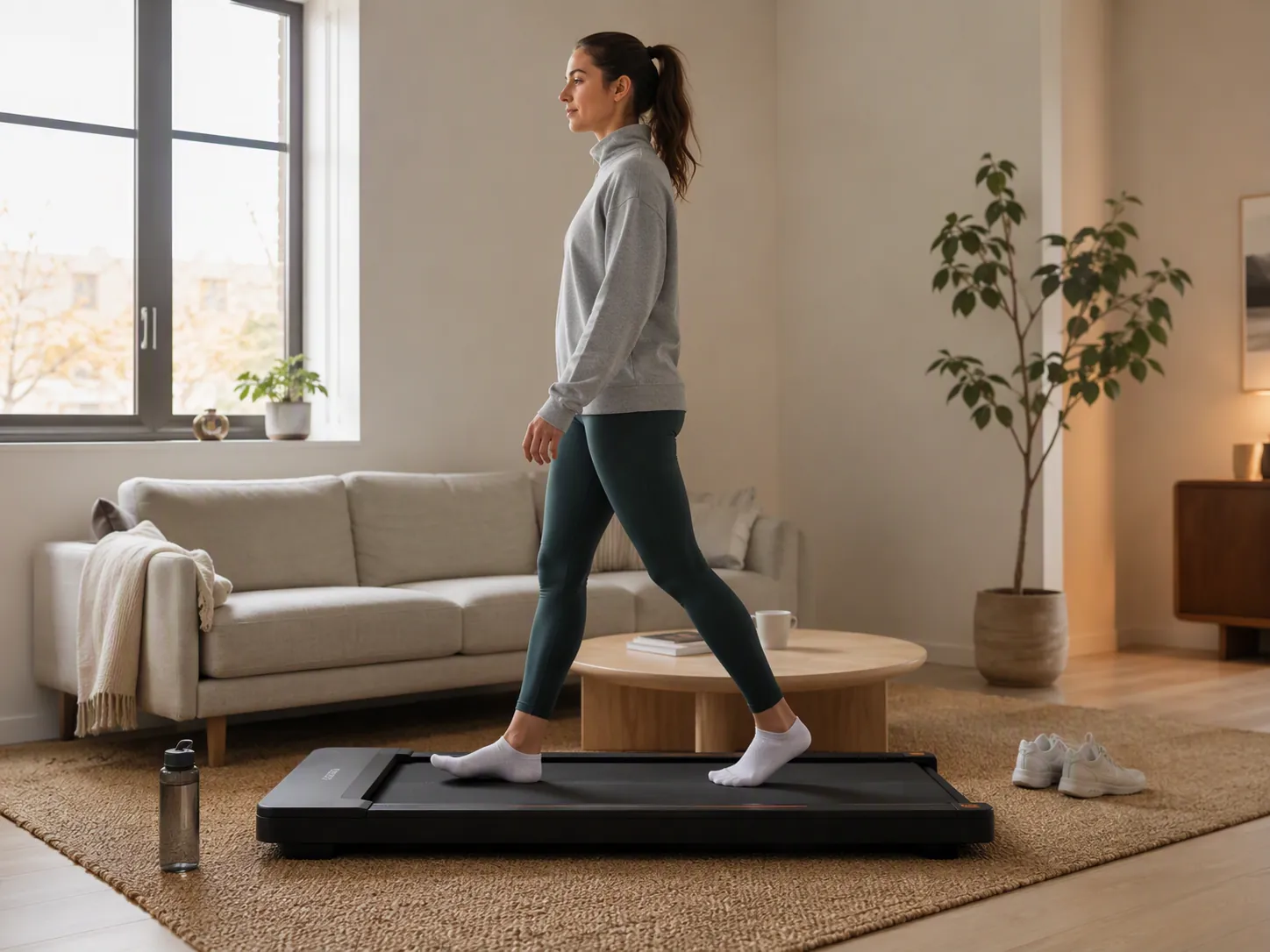
Pick the distance first, then count backward
Do not start by asking how fast your walking pad should go. Start with the event distance and the number of weeks you have left. Published walking plans vary in length, but they keep returning to the same shape: regular midweek walking, gradual increases, a longer weekend walk, rest days, and a shorter taper before the event. Hal Higdon’s 10K walker plan, for example, moves midweek walks from 30 to 60 minutes, builds Saturday distance walks from 3 to 6 miles, includes Sunday longer time-based walks from 45 to 90 minutes, and tapers before the event. [3]
The 5K version starts smaller. Hal Higdon’s 5K walker plan begins with 15-minute walks and adds 5 minutes every other week. [4] Verywell Fit’s beginner 5K plan also begins with 15-minute walks 4 to 5 days per week, builds toward 30-minute walks 4 days per week plus a 60-minute long walk by Week 6, and then adds intervals in Weeks 7 and 8 for walkers who want more. [1]
| If your event is… | Use this runway | Your main job |
|---|---|---|
| 5K | 6 weeks for a beginner-friendly at-home build | Get from short regular walks to a 60-minute long walk without making every session hard |
| 10K | 8 weeks when possible | Build enough long-walk time that 90 minutes to 2 hours on event day does not feel like a surprise |
| Less time than this | Use the closest week that matches your current ability | Do not jump to the final week; repeat or trim sessions so you arrive healthy |
Charity organizers also publish shorter and longer options. Cancer Research UK provides 4-, 6-, and 8-week 10K walk plans, along with longer 8-, 12-, and 16-week walking plans for half-marathon and marathon-distance events; its 10K materials also group finish expectations into under 1.5 hours, under 2 hours, and under 3 hours. [5][6] That is useful if your event date is close, but for at-home training, the safer translation is still the same: choose the version that fits your calendar, then make each session executable in the space you actually have.
Choose your home setup without over-measuring it
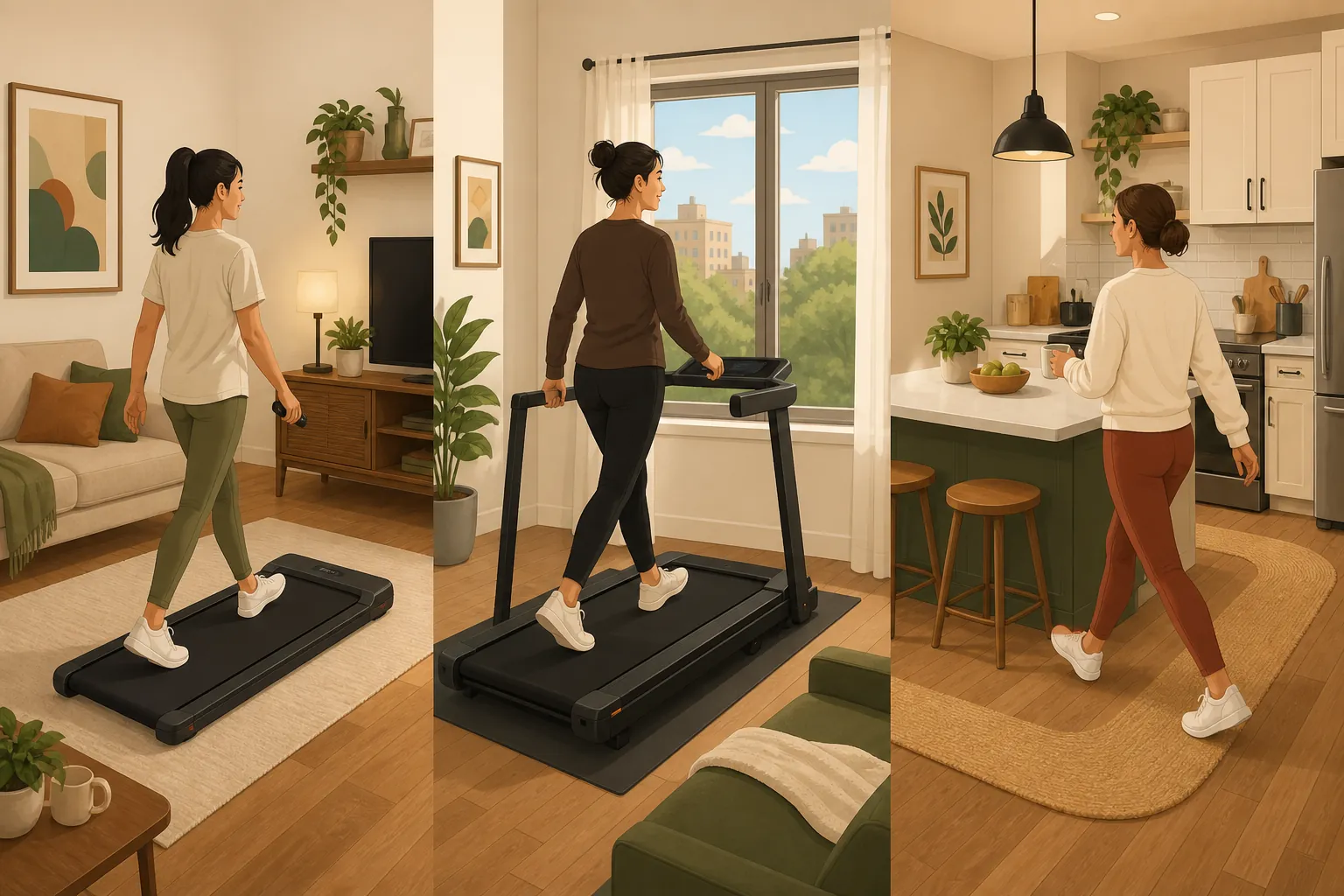
A treadmill gives you time, distance, pace, and sometimes incline. A walking pad usually gives time and speed, sometimes distance. A hallway loop gives you neither unless you count laps, which gets old quickly. All three can work. For most sessions, time is the cleanest unit because it avoids fake precision: 25 honest minutes at an easy effort is more useful than a guessed 1.37 miles around the kitchen island.
| Setup | How to run the plan | What to ignore |
|---|---|---|
| Walking pad | Use minutes and effort. Keep the remote close. For speed days, alternate easier and brisker periods. | Do not chase an exact mph from someone else’s plan. |
| Treadmill | Use minutes for most walks. Use distance only when the plan specifically calls for it or when it helps your confidence. | Do not treat incline as mandatory. It is optional hill practice. |
| Indoor loop | Clear a repeatable path through a hallway, living room, or kitchen loop. Set a timer and change direction occasionally. | Do not count every lap unless counting keeps you calm rather than irritated. |
| No-equipment small space | Use marching walks, step-through laps, and gentle direction changes. Keep it walk-like, not a high-impact cardio class. | Do not turn easy days into jumping or plyometric days. |
If you have trained indoors during bad air, storms, or heat advisories, use the same principle here: preserve the planned effort and duration, even when the scenery disappears. The same indoor-substitution logic in our home workout alternatives for heat advisories applies to walkathon prep.
The 6-week at-home 5K walkathon plan
This 5K schedule is time-based on purpose. It follows the beginner-friendly shape of published 5K walker plans—starting around 15-minute walks, building toward 30-minute regular walks, and using a 60-minute long walk as the confidence builder before event week. [1][4]
| Week | Steady walks | Speed day | Strength day | Long walk | Rest |
|---|---|---|---|---|---|
| 1 | 15 min easy, 3 days | None yet | 1 short session | 20 min easy | 2 days |
| 2 | 20 min easy, 3 days | None yet | 1 short session | 30 min easy | 2 days |
| 3 | 25 min easy, 2 days | 20 min with 4 brief brisk pickups | 1 short session | 40 min easy | 2 days |
| 4 | 30 min easy, 2 days | 25 min with 5 brisk pickups | 1 short session | 45–50 min easy | 2 days |
| 5 | 30 min easy, 2 days | 30 min with 6 brisk pickups | 1 short session | 55 min easy | 2 days |
| 6 | 25–30 min easy, 2 days | 20 min light brisk work early in the week | Light mobility only | Event: 5K, or 60 min easy if practicing before event week | 2–3 days |
Place the long walk on the day that most resembles event day. If your walkathon is Saturday morning, practice at least some Saturday morning walking. If the only quiet time in your home is Sunday evening, use that. The body is learning time-on-feet; the calendar is just the container.
For walking pad and treadmill sessions, the steady walks are the easiest to execute: start the belt, settle into an effort where you can speak in full sentences, and stop when the timer ends. For an indoor loop, set a timer and use a route you can repeat without tight turns every two steps. If you have to turn often, slow down before the turn instead of trying to keep a perfect pace.
The 8-week at-home 10K walkathon plan
A 10K plan needs more patience. Verywell Fit’s beginner 10K schedule progresses from 15-minute easy walks in Week 1 to 30-minute walks four days a week plus a 60-minute long walk in Week 4, then to a full 10K walk in Week 7. [2] Hal Higdon’s 10K walker schedule is more distance-forward on Saturdays and time-forward on Sundays, but the training message is the same: keep showing up during the week and let the longer walk expand gradually. [3]
| Week | Steady walks | Speed day | Strength day | Long walk | Rest |
|---|---|---|---|---|---|
| 1 | 15–20 min easy, 3 days | None yet | 1 short session | 30 min easy | 2 days |
| 2 | 20 min easy, 3 days | 20 min with 4 brisk pickups | 1 short session | 40 min easy | 2 days |
| 3 | 25 min easy, 2–3 days | 25 min with 5 brisk pickups | 1 short session | 50 min easy | 2 days |
| 4 | 30 min easy, 3 days | 30 min with 6 brisk pickups | 1 short session | 60 min easy | 2 days |
| 5 | 35 min easy, 2 days | 30 min intervals | 1 short session | 70 min easy | 2 days |
| 6 | 40 min easy, 2 days | 35 min intervals | 1 short session | 80 min easy | 2 days |
| 7 | 30–40 min easy, 2 days | 25–30 min light brisk work | Light strength or mobility | 90 min easy, or full 10K practice if you can recover well | 2 days |
| 8 | 20–30 min easy, 2 days | 10–15 min with a few relaxed pickups | Mobility only | Event: 10K | Extra rest as needed |
If Week 5 or Week 6 feels like too much, repeat it. That is not falling behind. Verywell Fit’s 10K plan explicitly uses rest days and allows repeating a week before moving on, and Hal Higdon’s schedule is built around a hard/easy rhythm rather than constant pressure. [2][3] A walkathon is not improved by arriving with sore shins and dread.
How each session should feel indoors
Easy walks
Easy means you can talk in full sentences and finish feeling like you could have kept going. On a treadmill or walking pad, that may be slower than your pride wants. On an indoor loop, it may mean smaller steps and more patience around turns. These walks are not filler; they are the repeated practice that makes event day feel familiar.
Long walks
The long walk is the session to protect. PBS’s 18-week walking program shows the same endurance logic at a larger scale: two 45-minute easy walks stay steady midweek while weekend walks build from 40 minutes to 4.5 hours. [7] For a 5K or 10K walkathon, you are not copying that volume; you are borrowing the principle. The weekly long walk teaches your feet, calves, hips, attention span, and socks what sustained walking feels like.
At home, long walks fail for boring reasons: the room feels stale, the belt display becomes hypnotic, or the loop starts to feel ridiculous after 12 minutes. Plan for that before the timer starts. Put water where you can reach it. Queue a podcast or playlist. If you are walking loops, change direction every few minutes. If you are on a treadmill, cover the distance display if it makes you bargain with yourself. Time matters more than watching the decimal crawl upward.
For the longest 10K sessions, a split is acceptable when home life demands it, but make at least some of your long walks continuous. A 45-minute morning walk plus a 35-minute evening walk is useful on a crowded day. It is not the same as learning how your shoes feel after 80 uninterrupted minutes.
Speed or interval day
Speed day is not a secret race workout. It is a controlled change of pace so event-day walking does not feel like one long shuffle. After 5 to 10 minutes easy, alternate short brisk periods with easy walking. Brisk means you can still speak, but not in long relaxed paragraphs. Easy means you recover before the next pickup.
- Beginner version: 30 seconds brisk, 90 seconds easy, repeated 4 to 6 times.
- More practiced version: 1 minute brisk, 2 minutes easy, repeated 5 to 8 times.
- Small-space version: use shorter brisk segments and keep turns controlled; do not sprint the straightaway and twist through corners.
If you like structured interval walking, the Japanese walking workout at home can give this day a clearer rhythm. Keep the spirit, not the ego: the next day should still be walkable.
Strength day
Strength day supports the walking plan; it should not hijack it. Use 20 to 30 minutes of simple lower-body and trunk work: sit-to-stands or squats, step-ups on a stable low step if you have one, calf raises, glute bridges, side steps, and a basic carry or plank variation. Stop with good form left. If you make strength day so hard that the long walk suffers, you solved the wrong problem.
For a broader routine library, use FitAtHome’s workout-routines section. If you want general activity-baseline context alongside walking and strength, our home workouts and dementia-risk evidence piece covers the public-health baseline without turning your walkathon plan into a medical lecture.
Taper
Tapering means you reduce volume while keeping the legs moving. It is not a week of panic training. Hal Higdon’s 10K walker plan includes a taper before the event, and the practical home version is straightforward: keep a couple of short easy walks, include a few relaxed pickups early in the week if you like them, and avoid the late urge to prove fitness. [3]
When a week is too hard
The cleanest adjustment is to repeat the week. The second-cleanest is to trim the speed day first, then the steady walks, while protecting the long walk at a manageable length. Do not add missed sessions to the next week like debt. That is how a reasonable plan becomes six crowded days and one resentful rest day.
| Problem | Adjustment |
|---|---|
| You finished every walk but felt unusually wiped out | Repeat the same week before increasing. |
| The long walk felt too long after halfway | Keep next week’s long walk the same length or reduce it by 10–15 minutes. |
| Your feet or calves are getting sore | Replace the speed day with an easy walk and check shoes, surface, and recovery. |
| You missed one steady walk | Let it go. Continue the schedule. |
| You missed the long walk | Do a shorter easy walk if time allows, then resume. Do not double the next long walk. |
This is where at-home training is quietly useful. You can lower the walking pad speed, flatten the treadmill, shorten the loop session, or split a recovery walk without needing a new route. Use those adjustments early, not after soreness has become the main feature of the week.
A compact safety and gear check
Check with a doctor before starting training if you have heart disease, type 1 or type 2 diabetes, kidney disease, arthritis, are having cancer treatment, or have high blood pressure; Cancer Research UK lists these as conditions worth checking before charity-walk training. [5] A charity walk is not the place to discover that a known condition needed a conversation first.
Gear can stay boring. Wear walking shoes that already feel good for your longest training walks. Do not debut new shoes, socks, insoles, or blister patches during event week. If you are still choosing footwear, start with our podiatrist-recommended walking shoes, best Hoka walking shoes, or supercritical foam running shoes testing notes early enough to walk in them before race day.
Event week at home
The final week is smaller on purpose. For a 5K, take two short easy walks of 20 to 30 minutes, add a few relaxed brisk pickups early in the week if they leave you feeling better, and rest the day before if that suits you. For a 10K, keep the same idea but respect the longer event: two easy walks, no hard strength work, no surprise incline session, and no last-minute attempt to simulate the entire course in your hallway.
Lay out the shoes and socks you already tested. Charge the watch if you use one, but do not let it run the day. Eat and drink in a way your training walks have already tolerated. If the event has hills and your treadmill has incline, a little earlier hill practice can help you feel prepared, but event week is not the time to discover what a steep grade does to your calves.
If this walkathon turns into a taste for longer events, the next step is not a mysterious upgrade. It is the same honest progression stretched over more weeks. Our beginner marathon training plan at home and national park hiking prep plan use the same apartment-friendly lesson: build the long effort, keep easy days easy, and do not pretend a perfect outdoor route is required.
Show up having already practiced the time-on-feet your event will ask for. That is the part home training can give you, even if the route was a hallway, a belt, or 400 quiet laps around furniture.
References
- Walking a 5K Race? Use This Training Plan — Verywell Fit
- 10K Walk Training Schedule for Beginners — Verywell Fit
- Walkers 10K — Hal Higdon
- Walkers 5K — Hal Higdon
- Shine Night Walk training — Cancer Research UK
- 10k training plans — Cancer Research UK Race for Life
- 18-Week Walking Program — PBS
What a small equipment investment adds
We don't have a build tagged to this exact tier yet. Browse all builds.
How often should you repeat this?
See our recovery and rest reference for citation-anchored rest-interval guidance.
Spot something off?
Tell us if a movement, tier assumption, or duration didn't match your experience.