
The Full Home Workout Week for GLP-1 Weight Loss
The full home workout week for GLP-1 weight loss: 2–3 resistance sessions of 20–30 minutes, aerobic movement toward 150 minutes a week, a 1.2–2.0 g/kg protein range, and a low-energy-day fallback so the plan still counts on rough weeks.
- Citation source
- CDC; Frontiers review
- Evidence level
- General guideline
- Recommended frequency
- 2–3 full-body resistance sessions/week, 20–30 min each; aerobic toward 150 min/week
Start with the actual week
A useful GLP-1 home workout plan does not start with a lecture. It starts with the calendar. The target week is simple: 2–3 full-body resistance sessions of 20–30 minutes, easy aerobic movement building toward about 150 minutes per week, and protein planned daily instead of treated as an afterthought. The CDC baseline for adults is 150 minutes of moderate-intensity aerobic activity, or 75 minutes of vigorous activity, plus muscle-strengthening on 2 or more days that works all major muscle groups [1]. A GLP-1-focused review gives a similar practical frame: gradually build from about 10 minutes per day of movement toward 150 minutes per week of moderate activity, with resistance training 2–3 times weekly for 20–30 minutes using bands, weights, or bodyweight [2].
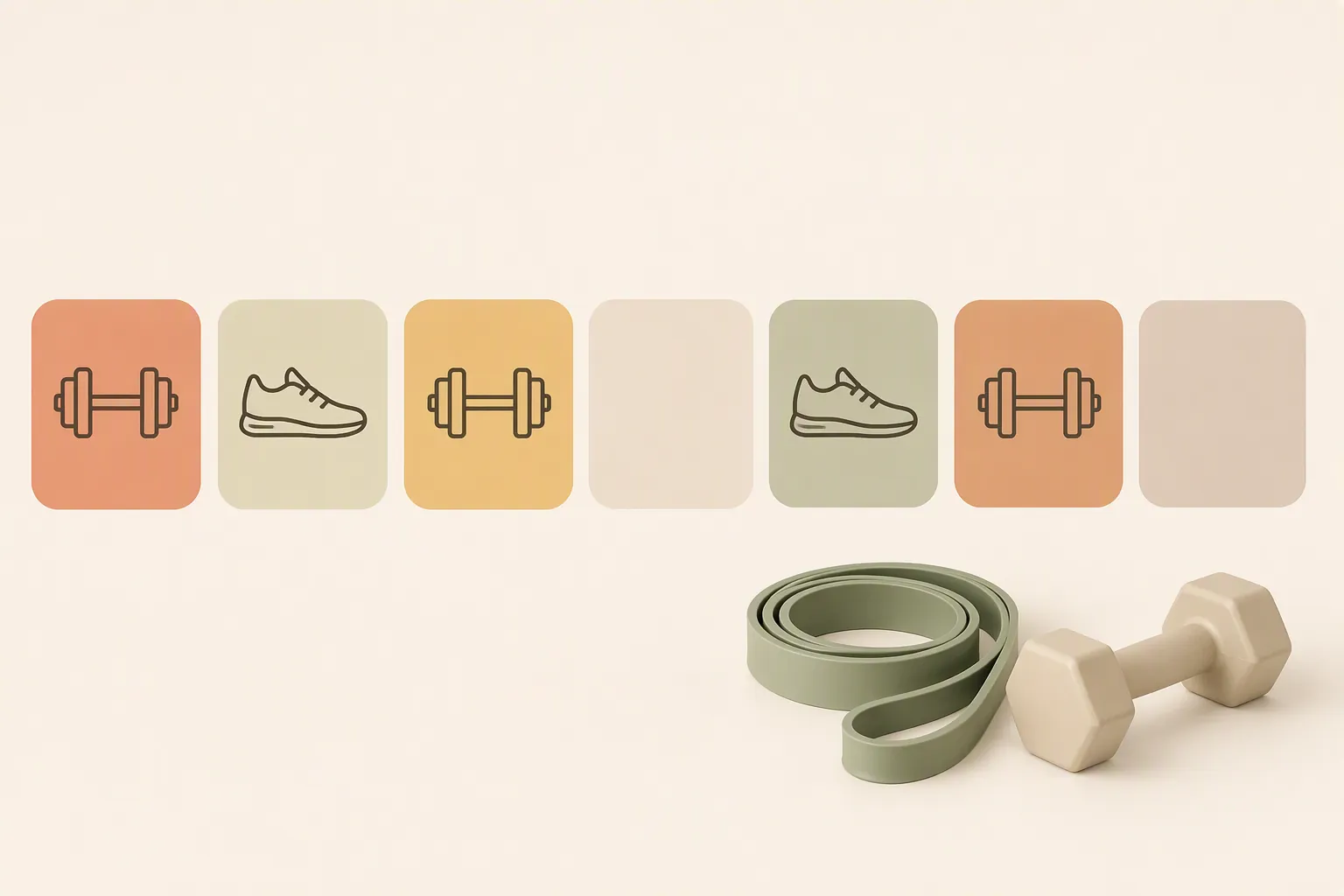
| Day | Main workout | If energy is low | What counts |
|---|---|---|---|
| Monday | Full-body resistance, 20–30 minutes | Do the 3-set fallback | Squat or sit-to-stand, push, pull or row |
| Tuesday | Easy walk or indoor march, 10–25 minutes | Walk 5–10 minutes after a meal | Comfortable movement you can repeat |
| Wednesday | Full-body resistance, 20–30 minutes | Do 1 round of each main move | Lower body, upper body push, upper body pull, core |
| Thursday | Easy aerobic movement, 10–30 minutes | Break it into 2 short blocks | Walk, step-ups, cycling, dancing, or low-impact cardio |
| Friday | Optional third resistance session or mobility | Mobility only | Use this as strength if recovery is good |
| Saturday | Longer easy movement, 20–40 minutes | Do 10 minutes | Accumulate weekly aerobic minutes without chasing intensity |
| Sunday | Rest, mobility, or gentle walk | Rest | No make-up punishment |
That table is the plan. If you are starting from very little activity, do not pretend you are already at 150 minutes. Start with 10 minutes most days, or even 5 minutes after meals, then add minutes before you add difficulty. If you already walk regularly, keep the walks and add the resistance days first. If you are nauseated, under-fed, or wiped out, use the fallback instead of quitting the week.
The reason resistance training gets this much space is not because everyone on semaglutide or tirzepatide needs to become a lifter. It is because weight loss can include lean mass loss, and GLP-1 weight loss is not exempt from that. Across GLP-1 evidence discussed in recent reviews, lean mass has been reported as roughly 15–40% of total weight lost, depending on the drug, dose, population, and measurement method [2]. In STEP-1 body-composition reporting, participants lost about 9.7% lean mass and 19.3% fat mass, while the proportion of total body mass that was lean rose by about 3 percentage points [2]. SURMOUNT-1 body-composition findings reported weight loss at roughly 75% fat mass and 25% lean mass [3]. Those numbers are not a panic button. They are the reason the week needs strength work, movement, and protein in the same plan.
For a fuller walk-through of the trial numbers and body-composition nuance, use the deep dive on GLP-1 muscle preservation. This article is the working week.
How to build the resistance sessions
Each resistance session should cover the major muscle groups without needing a garage gym. Think in movement jobs, not exercise names. You need a lower-body move, an upper-body push, an upper-body pull, a hip-hinge or glute move, and a simple core or carry option. Bands, dumbbells, a backpack, a chair, a wall, or bodyweight can all work.
| Movement job | Home-friendly options | Make it easier | Make it harder |
|---|---|---|---|
| Lower body | Sit-to-stand, chair squat, supported split squat | Use a higher chair or hold a wall | Hold dumbbells or slow the lowering phase |
| Push | Wall push-up, counter push-up, floor push-up, dumbbell floor press | Use a wall or counter | Lower the surface or add load |
| Pull | Resistance-band row, one-arm dumbbell row, towel row setup if safe | Use lighter band tension | Pause at the top or use more tension |
| Hinge and glutes | Glute bridge, Romanian deadlift with dumbbells, banded good morning | Use bodyweight only | Add dumbbells or a band |
| Core | Dead bug, bird dog, side plank from knees, suitcase carry in place | Shorten the hold | Add time or light load |
A normal 20–30 minute session can be as plain as this: warm up for 3–5 minutes, do 2–3 rounds of 4–5 exercises, rest as needed, and stop while your form is still decent. You do not need a complicated split. A small-space Monday might be chair squats, counter push-ups, band rows, glute bridges, and dead bugs. Wednesday might be supported split squats, dumbbell floor press, one-arm rows, Romanian deadlifts, and bird dogs. Friday, if you use it as a third strength day, can be lighter: one or two sets per move, more mobility, less grinding.
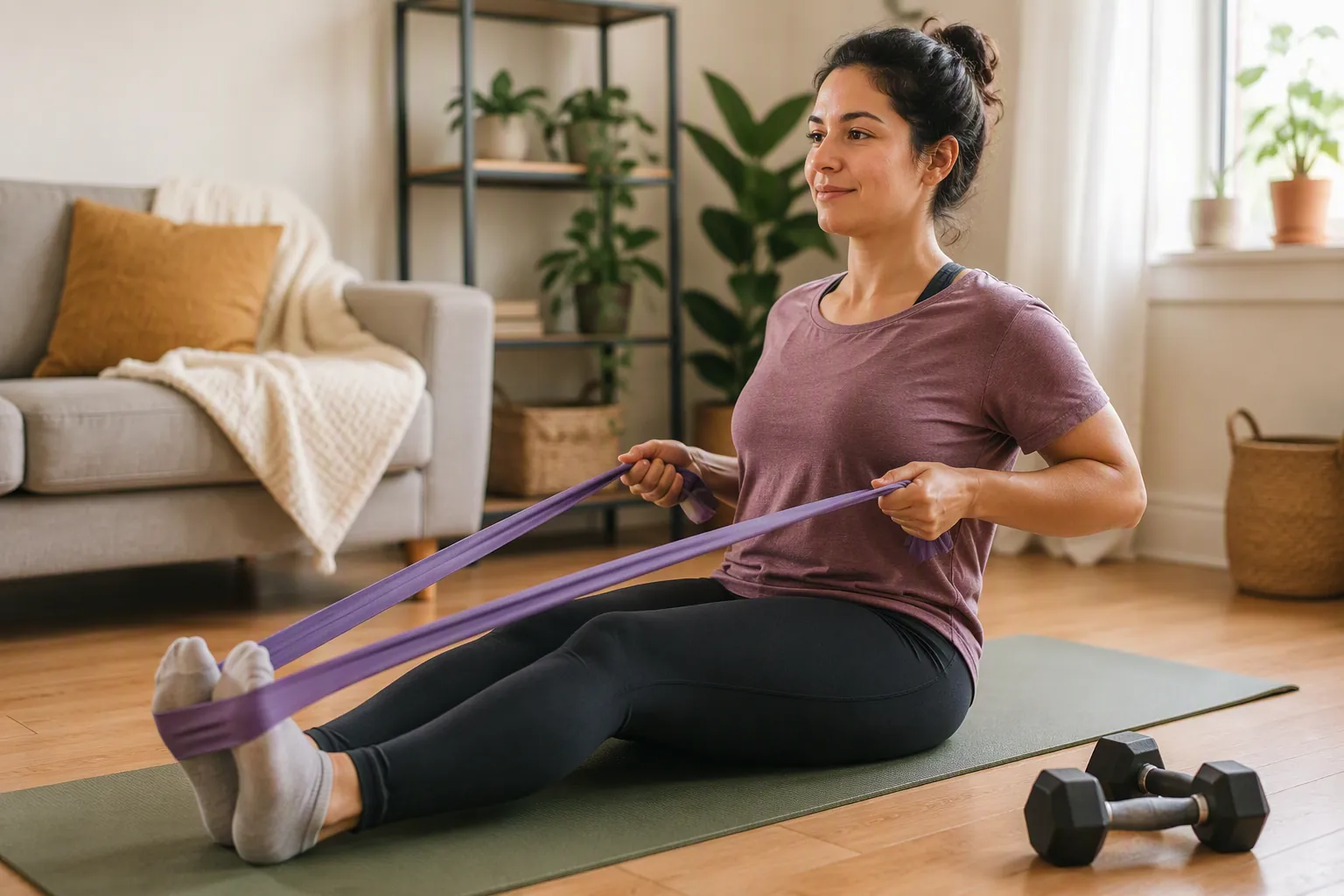
If the phrase “full-body resistance” still feels too abstract, use this 20-minute home session as a template and swap in quieter floor options when needed. For dumbbell-and-band examples, this full-body home workout gives you movements that can be scaled down instead of reinvented.
A simple Monday resistance session
- Warm-up: 3–5 minutes of easy marching, shoulder circles, hip hinges, and gentle squats.
- Chair squat or sit-to-stand: 2–3 sets of comfortable reps.
- Counter or wall push-up: 2–3 sets.
- Resistance-band row or dumbbell row: 2–3 sets.
- Glute bridge: 2–3 sets.
- Dead bug or bird dog: 1–3 short sets.
Use a weight or band that leaves a few reps in reserve. On a GLP-1, the win is not proving you can crush a session on low fuel. The win is repeating enough good sessions that your body keeps getting the signal to maintain muscle while weight is coming down.
Aerobic movement: build the minutes without making it dramatic
The aerobic part of the week is where many home plans get too ambitious too fast. The guideline target is about 150 minutes per week of moderate activity, but the GLP-1-specific recommendation to build gradually from about 10 minutes per day matters here [1][2]. If appetite is low and energy is uneven, a 10-minute walk you actually do is more useful than a 45-minute session you keep postponing.
Moderate activity can be a walk, indoor marching, low-impact cardio, easy cycling, step-ups, or a short dance session in the living room. You should be able to talk in short sentences. If you are gasping, dizzy, or pushing through nausea, that is no longer the right intensity for this plan.
| Current capacity | First target | Next target | Eventually |
|---|---|---|---|
| Very little activity | 5–10 minutes most days | 10–15 minutes most days | Accumulate toward 150 minutes weekly |
| Some walking already | Keep the walks | Add 2 resistance days | Add minutes to easy days |
| Already near 150 minutes | Keep aerobic minutes steady | Prioritize resistance quality | Add a third strength day only if recovery is good |
Post-meal movement can be especially practical because it is short, easy to remember, and less likely to feel like a formal workout. A 10–15 minute easy walk after a meal can fit the aerobic target without turning the day into a second job. If that sounds more realistic than a single long workout, use this easy post-meal walking guide and keep the pace gentle.
The low-energy fallback is part of the plan, not a failure
A GLP-1 week can go sideways for boring reasons: low appetite, a missed protein meal, poor sleep, constipation, nausea, dehydration, or the dose-change week your calendar did not care about. A plan that only works when you feel normal is not much of a plan.
Here is the rule: if you were scheduled for resistance training and you feel low but safe to move, do the sub-15-minute fallback. It counts. Do not add punishment sets later. Do not turn Sunday into a make-up exam.
The 3-set fallback
- Set 1: sit-to-stand or supported squat.
- Set 2: wall push-up, counter push-up, or dumbbell floor press.
- Set 3: resistance-band row, dumbbell row, or band pull-apart.
- Optional finish: 2–5 minutes of slow walking or mobility if it feels good.
That is enough to keep the habit alive and send a basic muscle-maintenance signal. It is not supposed to feel heroic. If even that feels like too much, switch to 5–10 minutes of gentle walking or mobility and resume the next planned day. The important part is that you do not let one rough Tuesday erase the rest of the week.
Use the fallback when you are tired, mildly under-fueled, short on time, or mentally done with the day but otherwise safe to exercise. Do not use it to push through dizziness, significant nausea, trouble breathing, or symptoms that could suggest low blood sugar; those are reasons to stop and contact a healthcare provider or prescriber, not reasons to negotiate with yourself for “just one more set” [4].
If you want the smallest possible version of this plan, start with the bare-minimum GLP-1 home workout tips. If your knees, hips, back, or balance need more accommodation, use the joint-friendly GLP-1 alternative protocol instead of forcing standard squats and lunges.
Protein belongs on the same calendar
The workout plan is weaker if protein is left to chance. A review from the Journal of the International Society of Sports Nutrition discusses protein targets of about 1.2–2.0 grams per kilogram per day during an energy deficit, while noting that needs vary by person and context [5]. That upper range should not be treated like a command for every GLP-1 user; the source has industry funding, and other materials often cluster closer to the lower-to-middle part of that range. Still, the practical point is hard to ignore: when appetite drops, protein can drop with it.
Put protein where missed meals usually happen. If breakfast is now coffee and two bites of toast, that is where the first fix goes. If dinner is fine but lunch disappears, make lunch easier. This does not require a perfect macro spreadsheet. It requires a few reliable meals you can tolerate on lower-appetite days.
- Anchor each meal with a protein source before adding extras.
- Keep one low-effort option available for nausea or low appetite days.
- Do not schedule harder workouts on days when you have barely eaten.
- Ask your clinician or dietitian before using high protein targets if you have kidney disease or another condition that changes nutrition guidance.
For a practical meal-prep example, this high-protein beef taco meal prep is the kind of repeatable structure that helps more than vague advice to “eat more protein.”
Progress by adding what you can recover from
The order of progression matters. Add consistency first, then minutes, then load or difficulty. If you currently train zero days, two short strength sessions and a few 10-minute walks are progress. If you can already do two strength days, add aerobic minutes before chasing harder circuits. If you are near the aerobic target and recovering well, a third lighter resistance session can make sense.
| If this is true | Change this first | Do not rush this |
|---|---|---|
| You miss workouts because they feel too long | Use 15–20 minute sessions | Adding a third day |
| You finish strength sessions but barely walk | Add 5–10 aerobic minutes on easy days | High-intensity intervals |
| You walk often but do no strength work | Add 2 full-body resistance sessions | More walking volume before strength exists |
| You are sore for days | Reduce sets or load | Training to failure |
| You feel flat during workouts | Check food, fluids, sleep, and timing | Pushing intensity |
Expect the first month to be a setup phase. The goal is to learn which days usually feel best, which meals make training easier, and which exercises your joints tolerate. If weight-loss expectations are making you chase more exercise than you can recover from, reset the pacing with realistic weight-loss expectations instead of using workouts as punishment.
When to stop and contact your provider
Exercise should bend around medication side effects and fueling problems, not bulldoze through them. Stop the workout and contact your prescriber or healthcare provider if you have dizziness, significant nausea, trouble breathing, symptoms that could suggest low blood sugar, or anything that feels concerning during exercise [4]. If fatigue is persistent and tied to low intake or dehydration, treat that as a plan problem to solve, not a character flaw; sports-medicine guidance commonly points to under-fueling and dehydration as contributors to fatigue in people using GLP-1s [6].
A repeatable home week is enough: 2–3 full-body resistance sessions, aerobic movement building toward the guideline target, protein planned daily, and a fallback session that still counts when the week gets rough.
References
- Adult Activity: An Overview, Centers for Disease Control and Prevention.
- Frontiers review, PMCID: PMC12683586, Frontiers.
- ADA 85th Scientific Sessions press release, American Diabetes Association, June 2025.
- Exercise for GLP-1 Use, Cleveland Clinic.
- JISSN review, PMCID: PMC12419545, Journal of the International Society of Sports Nutrition.
- GLP-1 Medications and Exercise, Princeton Sports & Family Medicine.
This is general fitness education, not medical advice. For diagnosis or treatment of pain or injury, consult a qualified clinician.
Pick your next session
Browse all routines to find an appropriately-spaced next session.
Spot something off?
This content sits adjacent to health guidance — tell us if a citation or figure needs a correction.