
What Fart Walking Does for Digestion and Metabolism at Home
Walking after meals is real physiology, not just a trend: a short, easy stroll can ease gas and bloat and blunt the post-meal blood-sugar rise. The effective dose is roughly 10–15 minutes — small enough to make the habit work at home, with zero equipment, no noise, and no deposit risk.
- Equipment tier required
- none
- Duration
- 15 min
- Difficulty
- beginner
- Target area
- legs
- Space footprint needed
- minimal (in place or short hallway loop)
- Noise level
- quiet (no jumping/impact)
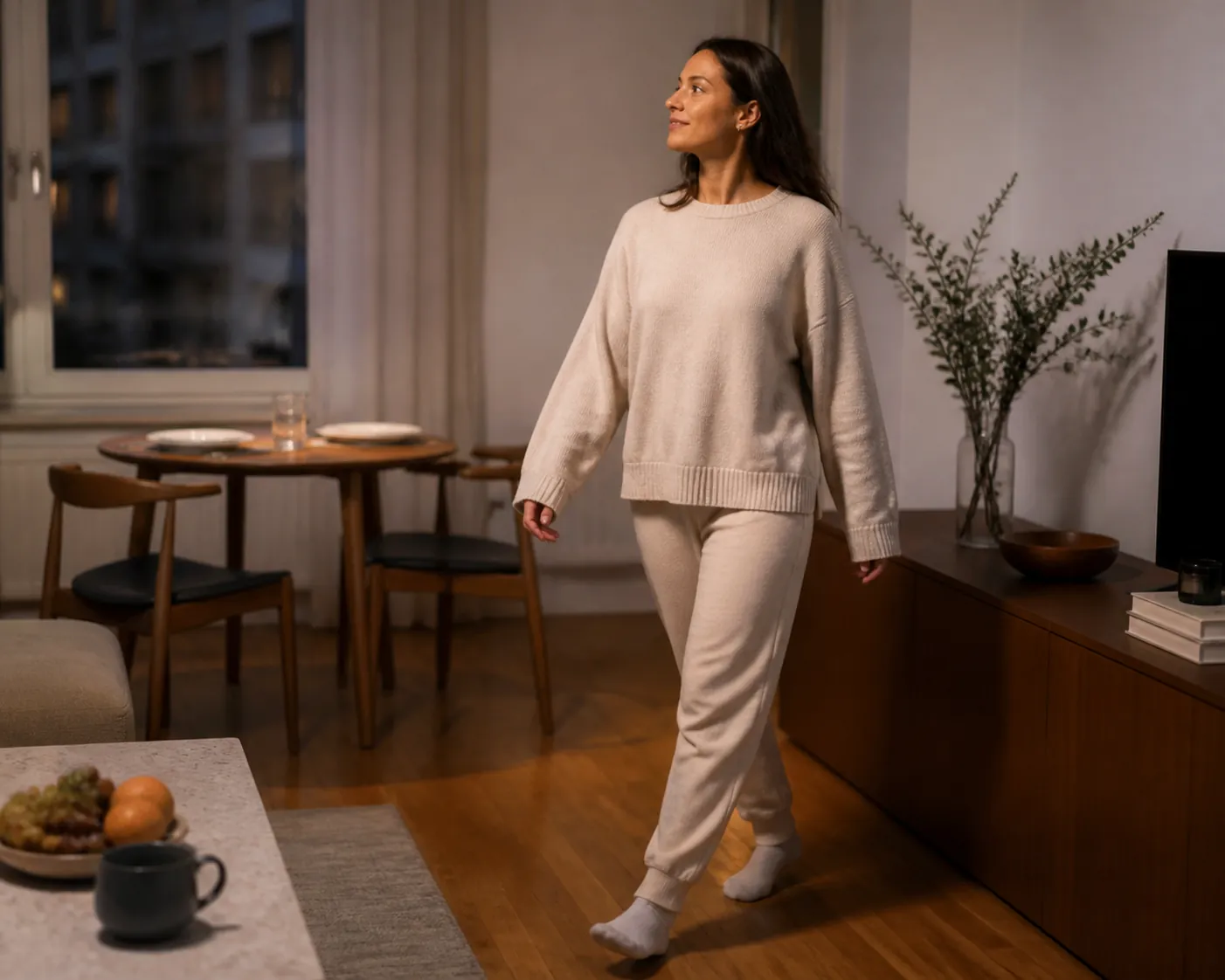
If dinner is over and the realistic choices are a narrow hallway, a patch of kitchen tile, or the couch, the indoor version still counts. A “fart walk” is just an easy walk after a meal: a crude internet label for gentle post-meal movement that can help digestion and blunt the blood-sugar rise after eating. The useful part is not the name. It is the timing, the low intensity, and the fact that it can be done in socks without turning your apartment into a workout studio.
The evidence is not for “fart walking” as a branded intervention. No one has put the meme itself through a clinical trial. The studies worth caring about are on postprandial walking — walking after meals — and they support a smaller, more apartment-friendly claim: a few minutes can help, 10–15 minutes is a practical target, and harder is not automatically better right after eating.
What it does for digestion first
The digestion argument is the one that makes the silly name feel least silly. Gentle walking after eating gives the gut a nudge: movement and upright posture can support motility, which is the coordinated movement of food and gas through the digestive tract. That does not make walking a cure for every bloated stomach, but it does explain why an easy after-dinner loop can feel different from collapsing sideways on the sofa.
The most directly relevant trial here is not about TikTok. It is a 2021 randomized clinical trial that tested 10–15 minutes of walking after each meal for 4 weeks and found reductions in gastrointestinal symptoms including bloating, burping, and gas; in that trial, post-meal walking was reported as more effective than the digestive medications used for comparison. That is a narrow but useful finding: ordinary walking after meals improved the exact symptoms the phrase “fart walk” jokes about. [1]
That is also why the indoor version is not a consolation prize. Digestion does not know whether your route has trees, a sunset, or an annoyed cat watching from the hallway. For this purpose, the body mostly needs low-intensity movement soon enough after eating, not outdoor scenery.
The metabolism part is muscle contraction, not wellness magic
After a meal, blood glucose rises as digestion moves carbohydrate into the bloodstream. A short walk gives working muscles a place to use and store some of that glucose. That mechanism does not require a sweaty workout. Contracting leg muscles, even at a modest pace, can help clear glucose from the blood during the period when it would otherwise be climbing.
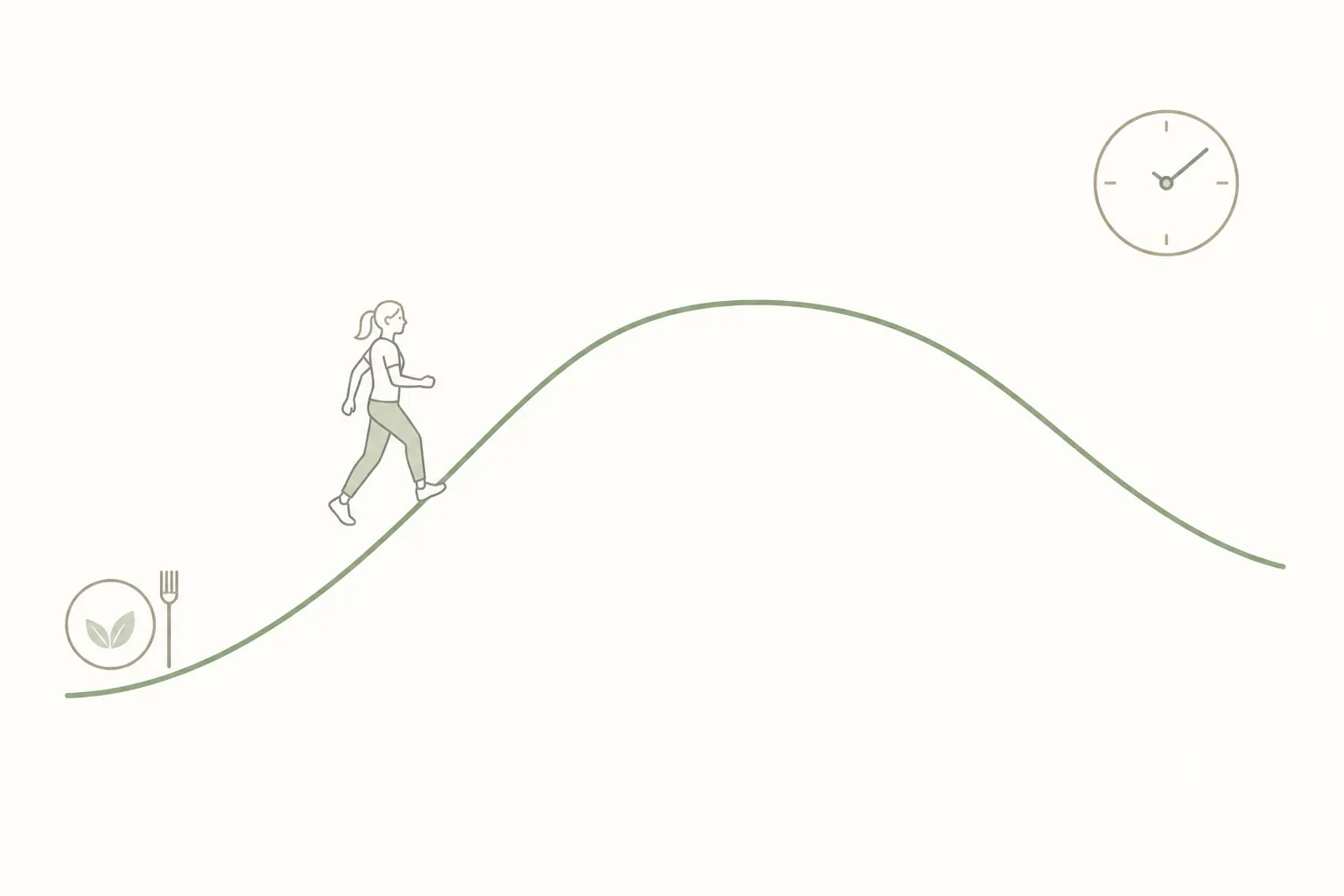
The exact best starting time is where public guidance gets messier, and it is better to treat it as a range than a magic minute. NPR and Food & Wine describe the useful window as roughly within 30 minutes after eating; TIME describes starting within about an hour; UW Medicine notes that blood sugar often spikes in the 60–90 minute post-meal window; and Peloton cites a gastroenterologist’s suggestion to wait 10–15 minutes before starting if immediate movement feels uncomfortable. [2][3][4][5][6]
The stronger metabolic backbone is a 2023 Sports Medicine meta-analysis of 8 randomized controlled trials with 116 participants. It found that post-meal exercise reduced postprandial glucose excursions compared with control conditions, with a standardized mean difference of 0.55 and a 95% confidence interval of 0.34–0.75. The analysis also found the 0–29 minute early postprandial window to be optimal among the timing windows studied. [7]
One practical pacing clue comes from a Rome study that used a 120-steps-per-minute cadence. In that study, a 30-minute brisk walk starting 15 minutes after a meal reduced the 30-minute glucose peak from about 6.7–7.0 mmol/L to about 5.2 mmol/L. That does not mean every apartment fart walk needs to become a 30-minute brisk march; it means cadence and timing matter, and that ordinary stepping can be metabolically meaningful. [8]
The smallest useful dose
For a renter, the best dose is the one that survives Tuesday night. Cleveland Clinic’s expert framing puts the floor very low: even 2–5 minutes after eating can help, while longer walks may produce more noticeable effects. [9] The realistic sweet spot for digestion and blood sugar is usually 10–15 minutes, because it is long enough to matter and short enough to fit before the next meeting, bedtime routine, or sink full of dishes.
| If this is your constraint | Do this | Why it works |
|---|---|---|
| You have 2–5 minutes | March in place or walk one quiet loop through the apartment | This is the minimum-dose version; useful when the alternative is doing nothing |
| You have 10–15 minutes | Do easy hallway or room-to-room laps soon after eating | This is the practical home target for digestion symptoms and the post-meal glucose window |
| You have 20–30 minutes | Keep it comfortable rather than turning it into a workout | More time may produce a more pronounced glucose effect, but intensity can make digestion feel worse |
| You feel reflux or sloshing | Wait 10–15 minutes, shorten the walk, and keep the pace gentle | The habit should reduce discomfort, not prove toughness |
The pace should feel almost underwhelming. Think relaxed-to-moderate, roughly dog-walk energy, not “I am now doing cardio.” Healthline and Peloton both flag the same common-sense limit: intense exercise right after eating can be uncomfortable because it may compete with digestion rather than support it. [10][6]
How to fart walk indoors without annoying the building
Indoor fart walking is not a miniature treadmill class. It is a quiet movement choice made under constraints: floor type, downstairs neighbors, hallway width, time, and whether you are wearing shoes. NPR’s Life Kit coverage is useful here because it treats the home version as legitimate: marching in place, using stairs, and adding arm movement all count because muscle contraction is the relevant metabolic action. [2]
Apartment laps
The simplest version is a repeatable loop: dining area to hallway, hallway to bedroom door, turn, repeat. Keep the turns slow enough that you are not pivoting hard on vinyl, laminate, or old wood. If your apartment has a rug runner, use it. If the only path crosses creaky boards, shorten the route and soften the foot strike.
In FitAtHome’s renter-focused testing, the quietest successful versions had the same boring traits: socks or soft indoor shoes, short steps, no stomping heel strike, no abrupt direction changes, and no furniture shuffling. Those are not clinical study findings; they are apartment-preservation findings. The goal is to finish the walk with calmer digestion, not a new scratch line across the floor.
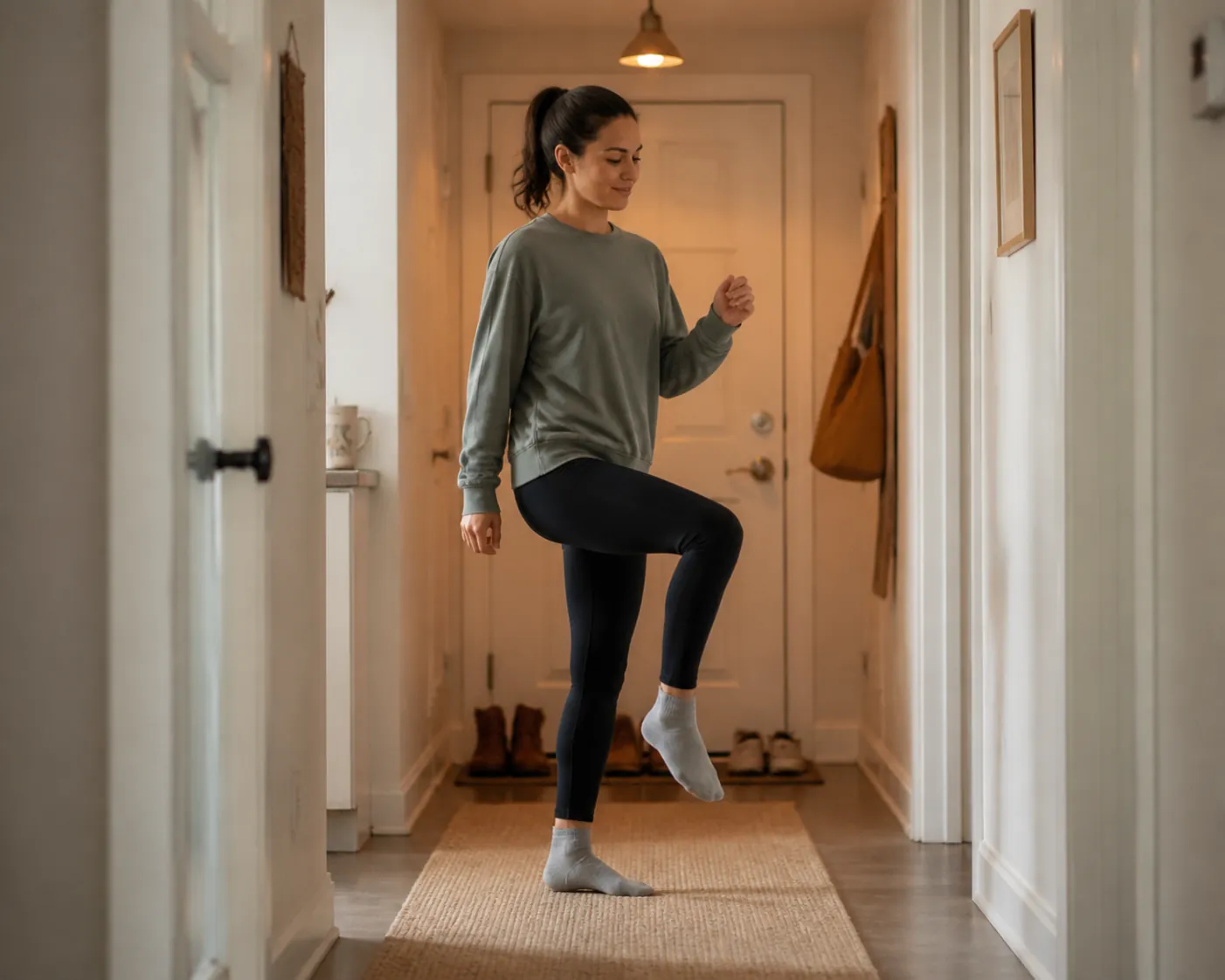
Marching in place
Marching in place is the best option when the apartment is too small for laps or when a work call starts in 12 minutes. Keep the knees low, the feet close to the floor, and the rhythm smooth. If you can hear each step as a thud, the floor below you can probably hear it too.
A thin rug helps with traction, but a thicker rug or mat helps more with sound. This is the same floor-awareness problem that shows up in renter-safe core work; the notes in our quiet 30-day abs challenge apply here too: protect the surface, reduce impact, and assume the downstairs neighbor notices more than you think.
Stairs, if you have them
Stairs are efficient, which is both the appeal and the problem. One or two easy flights can create plenty of muscle contraction after a meal. Repeated stair climbing can quickly stop being a gentle digestion walk and become a leg workout. If you use stairs, go slower than your ego wants, use the handrail, and stop before breathing hard.
Arm movement when your feet need to stay quiet
If noise is the limiting factor, make the walk smaller and let the upper body help. Easy arm swings, gentle shadow-boxing without snapping the joints, or a slow carry-free “power walk” posture can add muscle activity without adding footfall. This is not as elegant as a walk around the block. It is much more useful than sitting perfectly still because the perfect version is unavailable.
Walking pad, optional and not required
A walking pad can make post-meal walking automatic for some work-from-home setups, but it is not necessary to get the digestion or metabolism benefits at home. If you use one, put it on a protective mat, check whether vibration travels through the floor, and avoid dragging it in and out after every meal. The equipment should reduce friction, not create a new renter problem.
If you are choosing among indoor options by space, noise, time, and equipment, our constraint-based home cardio framework is the broader decision tree. A fart walk is the smallest branch on that tree: the one you can do after dinner without changing clothes.
A simple apartment protocol
- Finish the meal and clear only what you must. Do not let kitchen cleanup become a 45-minute delay if the walk is the priority.
- Start soon, unless your stomach asks for a short wait. For many people that means within the first half hour; reflux-sensitive people may do better waiting 10–15 minutes.
- Set a soft target of 10–15 minutes. If you only have 3 minutes, take the 3 minutes.
- Keep the pace easy enough that conversation would be normal. You are trying to support digestion and glucose handling, not win the hallway.
- Pick the quietest movement available: laps, marching, stairs, or a walking pad on a mat.
- Stop if symptoms sharpen, reflux worsens, dizziness appears, or the walk starts feeling like punishment.
A cadence target can help if you tend to drift into a shuffle and want structure. The Rome study’s 120 steps per minute was a brisk research cadence, not a requirement for every living-room loop. [8] For a quiet apartment version, use it as an upper reference point. If matching that rhythm makes your steps louder or your stomach unhappier, back off.
The habit also pairs well with other small, no-equipment movement snacks. A 5-minute dance break is a different tool, but the same principle applies: make the movement smaller than the resistance to doing it.
When indoors is the better choice
Outside is lovely when outside is available. It is not always available. Heat, wildfire smoke, ice, darkness, unsafe sidewalks, childcare, and work-from-home calls all change the calculation. If the weather is the barrier, the same indoor logic that applies during a heat advisory or while waiting for smoke-clearing times applies after dinner too: keep the movement inside and remove the heroic part.
The older after-dinner-walk tradition did not need a viral name, but the viral name has done one useful thing: it made the habit memorable. Mairlyn Smith helped popularize the “fart walk” phrase on TikTok, and coverage of the trend has tied it back to the long-standing idea that a gentle walk after supper helps the body settle the meal. [3][5][10]
Where the habit has limits
Reflux changes the timing. If walking immediately after eating makes acid reflux or nausea worse, wait a little, shorten the walk, and reduce the pace. Peloton’s gastroenterologist-sourced guidance to wait 10–15 minutes is a reasonable starting adjustment, not a moral failure of the routine. [6]
Diabetes medications also change the stakes. Because post-meal walking can lower postprandial glucose, people using glucose-lowering medication should treat the effect as real and follow their clinician’s guidance on monitoring, timing, and hypoglycemia risk. [7] The same medication-awareness principle matters in broader metabolic training contexts, including home routines built around GLP-1-related weight loss; our GLP-1 home workout plan handles that with more context.
Persistent bloating, new digestive symptoms, severe pain, unexplained weight loss, blood in stool, or symptoms that keep escalating are not a walking-program problem. A short walk may help ordinary post-meal gas. It should not be used to explain away symptoms that need medical evaluation.
There is also a diminishing return to making the walk impressive. The 30-minute brisk-walk data are interesting, but the habit’s practical power is that 10–15 easy minutes can be repeated. Once the walk becomes loud, sweaty, reflux-provoking, or annoying to the people below you, it is no longer the best version of the tool.
So after a meal, the renter’s decision can stay simple. If an outdoor walk is easy, take it. If it is dark, smoky, icy, too hot, or just not happening between calls, do a quiet indoor loop or march for 10–15 minutes. Start reasonably soon, keep it easy, protect the floor, and treat the fart walk as a small digestive and metabolic assist — not a cure, not a performance, and not something that requires shoes by the door.
References
- The effect of walking after meal on gastrointestinal symptoms in patients with functional dyspepsia: a randomized clinical trial — Gastroenterology and Hepatology from Bed to Bench, 2021
- How a walk after a meal can help control your blood sugar — NPR Life Kit
- Fart Walks Are the Latest Wellness Trend Taking Over TikTok — Food & Wine
- What Is a Fart Walk? — TIME
- Do ‘Fart Walks’ Really Help With Digestion and Blood Sugar? — UW Medicine Right as Rain
- What Is a Fart Walk? Benefits of Walking After Eating — Peloton
- The Effect of Postprandial Exercise on Glucose Control in Individuals with Type 2 Diabetes: A Systematic Review and Meta-analysis — Sports Medicine, 2023
- A Short Bout of Postprandial Brisk Walking Reduces Glycemic Response After a Mixed Meal — Nutrients
- Is Walking After Eating Good for You? — Cleveland Clinic
- ‘Fart Walking’ Is the Digestive Health Trend Taking Over TikTok — Healthline
What a small equipment investment adds
We don't have a build tagged to this exact tier yet. Browse all builds.
How often should you repeat this?
See our recovery and rest reference for citation-anchored rest-interval guidance.
Spot something off?
Tell us if a movement, tier assumption, or duration didn't match your experience.