
Which Foot Health Sandal Slot Is Your Home Walk Missing?
The 'best foot health sandal' framing misses what home walkers actually need: three separate footwear roles — a grippy shoe for the walking pad, a recovery sandal for the 30–60 minutes after a session, and a supported house sandal for hard floors. This guide maps those three slots, shows which one your routine is missing, and names tested picks at budget, mid-range, and premium price points.
- Equipment tier required
- none
- Duration
- 30-60 min
- Difficulty
- beginner
- Target area
- feet
- Space footprint needed
- compact
- Noise level
- low
If you are searching for the best foot health sandals for home walking workouts, the first useful answer is probably annoying: sandals are the wrong tool for the workout itself. A home walking routine usually needs three separate footwear slots, and trying to make one cushy slide cover all three is how a lot of small-apartment setups turn into sore arches.
The three slots are simple: a closed, cushioned, grippy shoe for the walking pad or treadmill; a recovery sandal for the short window after the session; and a supportive house sandal for the rest of the day on laminate, tile, or other hard floors. The sandal may be useful in two of those slots. It should not be on the belt.
There is not a neat, established product category behind this exact search. The intent is inferred from nearby categories — treadmill shoes, recovery slides, house shoes, and walking sandals — so the honest answer is a slot check before a product pick.
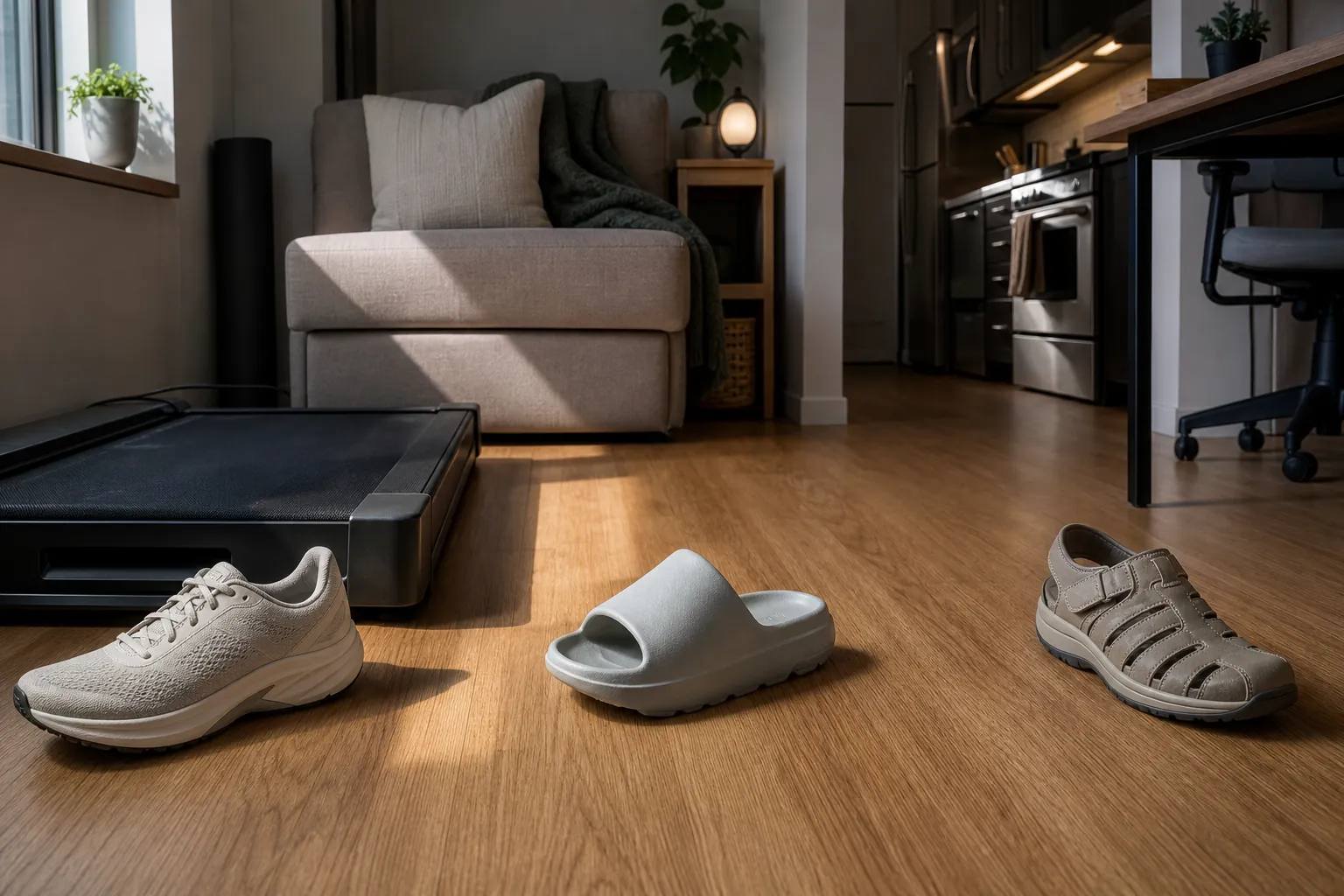
The walking pad has a footwear rule, and sandals fail it
RunRepeat’s treadmill walking guidance is unusually direct for this category: 30–60 minute walking-pad sessions call for real shoe shock absorption, with at least 100 SA heel shock absorption in its lab framework, and shoes should not have aggressive 3 mm-plus lugs. It also says not to use the pad barefoot, in socks, slippers, or sandals [1]. UREVO, a walking-pad manufacturer, gives similar practical context about wearing suitable athletic shoes for pad workouts, but that is manufacturer guidance, not an independent testing standard [2].
That boundary matters more than the logo on the sandal. A walking pad belt is narrow, moving, and repetitive. A slide can shift under the foot. A backless sandal can make you grip with your toes. A very soft platform can feel pleasant at the first step and still be unstable over thousands of belt contacts. For the actual session, the slot belongs to a closed walking or running shoe with enough cushioning, predictable traction, and no chunky trail outsole that can feel grabby on a belt.
If the shoe part of your setup is shaky, start there before buying another recovery slide. FitAtHome’s podiatrist-recommended walking-shoe explainer is useful for separating real design features from the vague “doctor-approved” halo, and the apartment shoe testing is closer to the problems renters actually notice: grip, noise, floor protection, and repeatable use in a small room.
Find the missing slot before shopping
Most “best sandals” roundups start with products. For home walking, that is backwards. The pain pattern usually tells you which job is uncovered.
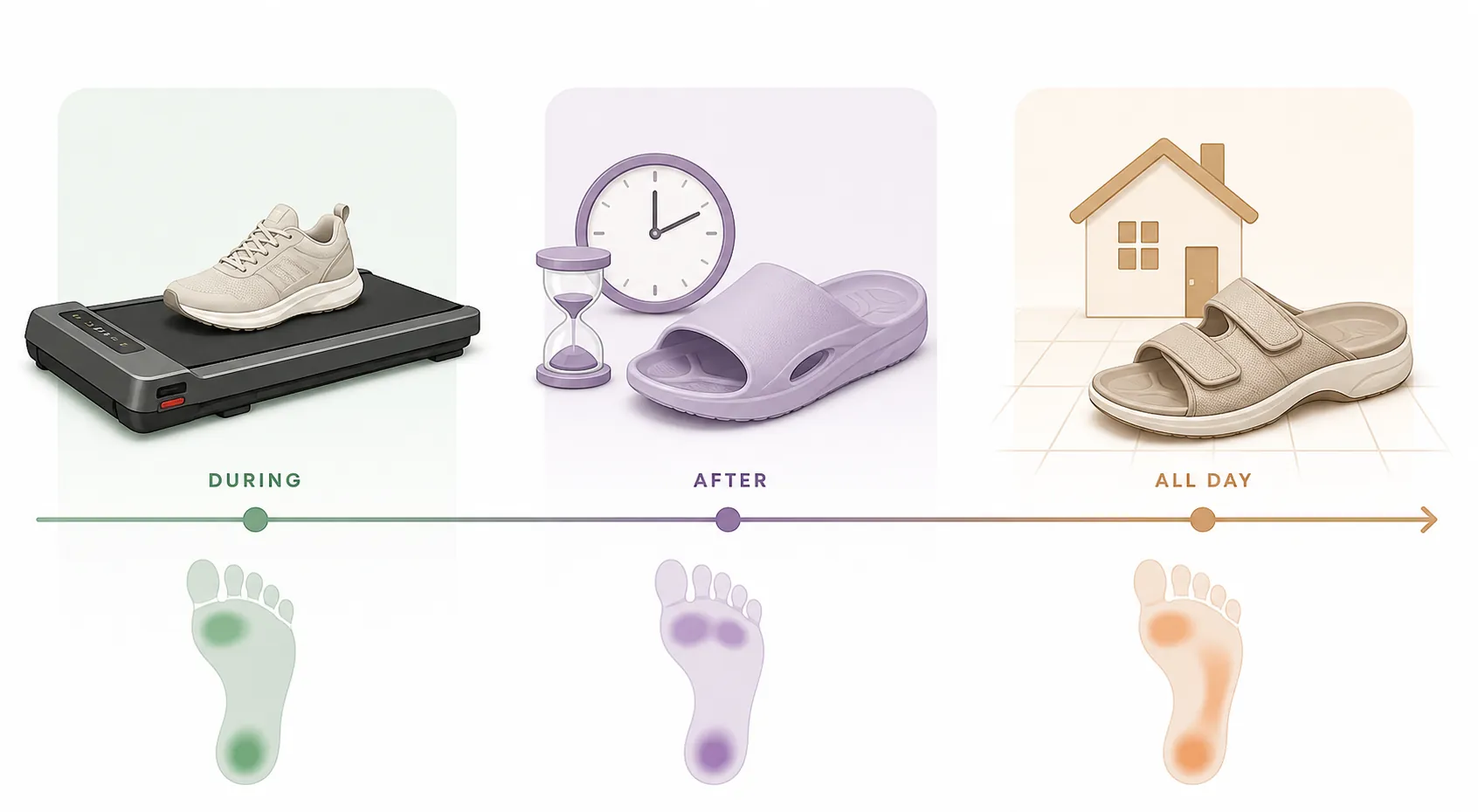
| When your feet complain | Likely missing slot | What to change first |
|---|---|---|
| During the walking-pad session | Walking-pad shoe | Use a closed, cushioned, grippy walking or running shoe. Keep sandals, slippers, socks, and bare feet off the belt. |
| In the first hour after the session | Recovery sandal | Use a soft, contoured recovery slide briefly after the workout, especially if your feet feel beaten up from impact. |
| While cooking, doing chores, or walking desk-to-kitchen | Hard-floor house sandal | Use a more supportive house sandal or house shoe with arch support and enough structure for repeated standing. |
| All day, no matter what you wear | Not a shopping problem yet | Reduce the load, check your walking volume, and consider professional care if pain persists, worsens, or changes. |
That second row is where recovery sandals earn their keep. CNN Underscored’s 2026 recovery-sandal guide quotes podiatrists describing recovery sandals as useful after workouts because they can help offload the plantar fascia and support post-exercise comfort, but the same category is not presented as structured enough for 24/7 wear [3]. That distinction is easy to lose when every soft slide is sold as “foot health.”
The third row is a different problem. If your workout feels fine but your arches throb after a morning of kitchen, laundry, and desk laps, a recovery slide may be too soft or too unstable for the job. You may need a house sandal with more support, not a more dramatic pillow under your foot.
Slot 1: the shoe you wear during the walking workout
This is the least sandal-friendly part of the setup, so it should be handled plainly. A walking-pad shoe should be closed, secure, cushioned, and not overbuilt like a mud trail shoe. If you are doing at-home walking plans or a regular dose of home cardio, the repeated contacts are the point. The shoe has to manage those contacts.
- Use a closed shoe that holds the heel and midfoot without making you claw your toes.
- Choose enough cushioning for your session length, especially if you walk 30–60 minutes.
- Avoid aggressive 3 mm-plus lugs on the belt; they belong outdoors, not on a walking pad.
- Do not use recovery slides, house slippers, socks, or barefoot walking for pad sessions.
This is also where a lot of budget mistakes start. Someone spends $70 on a recovery slide because the arch aches, then keeps walking on the pad in dead fashion sneakers or socks. The slide may feel good after the session, but it cannot fix the impact and stability problem happening during the session.
Slot 2: the recovery sandal for the first 30–60 minutes after
The recovery slot is the easiest one to oversell because it feels good immediately. After a pad walk, a rocker-shaped or contoured slide can give your foot a softer place to land while you cool down, stretch, make coffee, or move from the walking corner to the sofa. That does not make it an all-day house shoe.
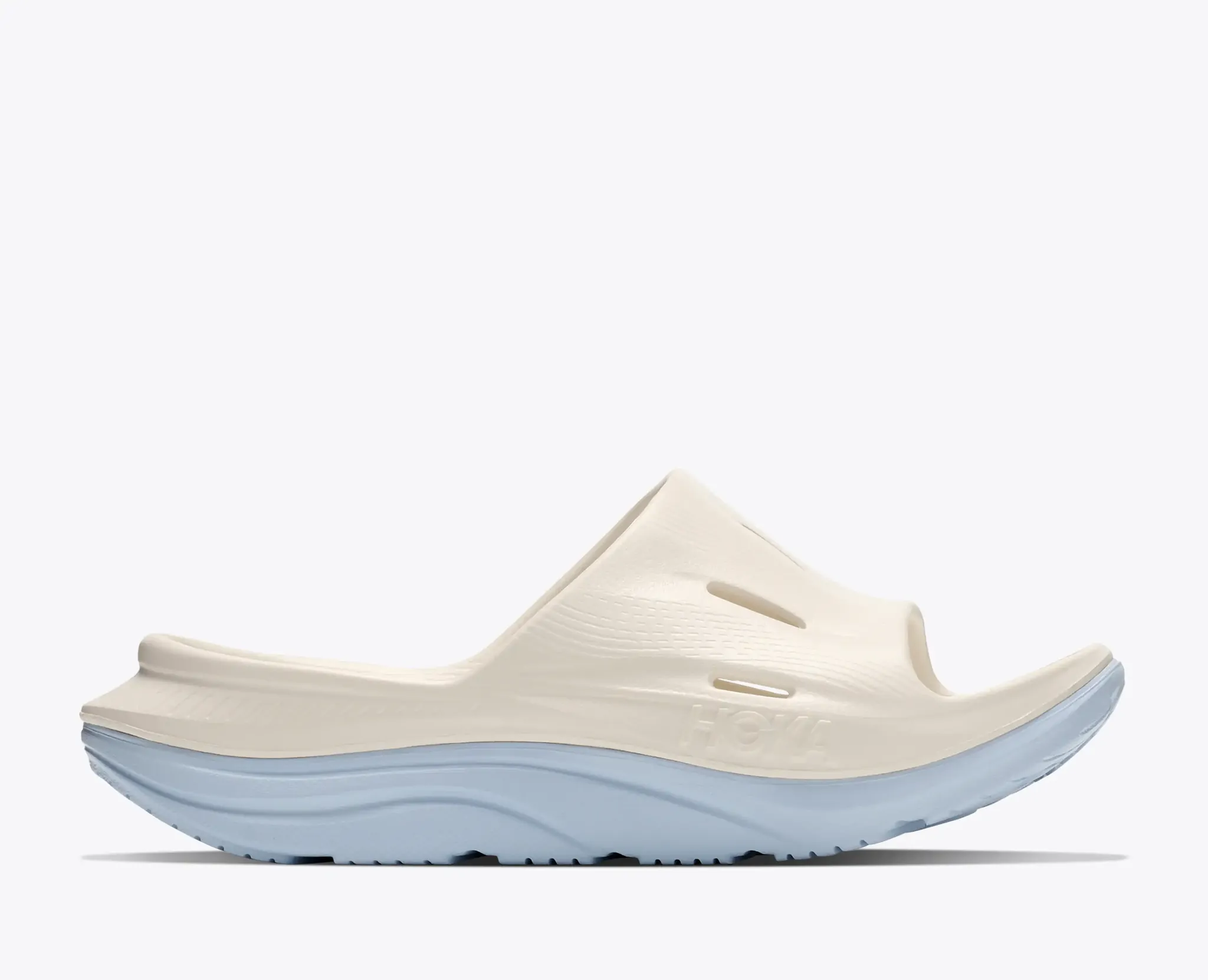
Two names come up repeatedly in the stronger recovery-slide sources: HOKA and OOFOS. Outside Online’s 2026 recovery-sandal testing called the HOKA Ora Recovery Slide 3, roughly a $60 slide at mid-2026 roundup pricing, notable for support; APMA spokesperson Dr. Priya Parthasarathy described it there as having the “most supportive footbed” [4]. That is a useful attributed expert judgment, not a guarantee that it fits every arch.
OOFOS deserves a more careful sentence. The OOahh is frequently treated as a top recovery slide in running and outdoor gear coverage, usually around the $60–70 range in mid-2026 roundups [4][5]. The brand also says its foam absorbs 37% more impact, but Outside explicitly flags that figure as a brand-reported claim it could not independently verify [4]. That number can explain the marketing; it should not be used as settled proof.
A good recovery slide for this slot should feel easy for short post-session movement. It should not make you shuffle, twist, or grip. If it feels unstable when you carry a laundry basket or stand at the stove, that is not a small flaw. It is the shoe telling you it belongs in the recovery slot, not the all-day house slot.
Recovery-sandal buying paths
| Budget tier | Examples to compare | Best use |
|---|---|---|
| $0–50 | Crocs Mellow — about $40 in mid-2026 roundup pricing [4][9] | A lower-cost recovery slide if you want soft post-walk comfort and are not asking it to be your all-day support shoe. |
| $50–120 | HOKA Ora Recovery Slide 3 — about $60; OOFOS OOahh — about $60–70; Kane Revive OB — about $78; VKTRY — about $79 [4][5][9] | The main comparison zone for post-session recovery slides. Pick based on stability, arch feel, and whether the rocker/platform feels controlled in your apartment. |
| $120+ | Topo Revive — about $125 in mid-2026 roundup pricing [9] | Worth considering only if the shape and support solve a specific fit need. Do not pay premium pricing just to own a “healthier” sandal. |
If you already own one of these and it helps for the first hour after walking, keep using it that way. The mistake is expanding its job description until it becomes your walking-pad shoe, your cooking shoe, your cleaning shoe, and your evening slipper. Soft foam has limits.
Slot 3: the house sandal for hard floors
Hard floors are where the “but they feel comfortable” argument gets expensive. A recovery slide can feel wonderful after a workout and still be the wrong shoe for three hours of standing, tidying, cooking, and walking between a desk and kitchen. For that use, the better word is support, not squish.
The plantar-fasciitis concern is not invented by sandal marketing. Health.com, citing Umar et al. 2022, reports that about 85% of plantar fasciitis patients aggravate the condition with unsupportive footwear [6]. Podiatrists quoted in consumer health coverage also warn that barefoot walking on hard indoor floors can aggravate plantar fasciitis symptoms, and house-shoe guides tend to emphasize arch support over flat slippers for this reason [7][8].
That does not mean every healthy adult must fear bare feet at home. Minimalist and barefoot-style research is more mixed than many house-shoe roundups admit; for example, research comparing minimally shod and conventionally shod populations has linked footwear use with differences in foot strength and stiffness [10]. The practical distinction is narrower: if you already have plantar-fasciitis symptoms, sore arches, or pain that predictably builds on hard floors, a flat slipper or barefoot day may be a poor match for your current tolerance.
A house sandal should pass a different test than a recovery slide. Can you stand in it while chopping vegetables? Can you walk to the laundry without the platform wobbling? Does the arch still feel present after a few weeks? Does the outsole behave quietly and safely on laminate or tile? Colorways and “cloud” language do not answer those questions.
When the house slot matters most
- Your feet feel fine on the walking pad but ache while making dinner.
- You work from home and take dozens of short hard-floor walks instead of one obvious workout.
- Flat slippers feel cozy at first, then your heel or arch gets worse by afternoon.
- Your recovery slides feel too soft or unstable when you stand still for chores.
For this slot, the best purchase may not be the most famous recovery slide. It may be a less exciting sandal or house shoe with a firmer base, a more stable platform, and a shape that supports your arch without forcing your foot into a position it hates.
Replace the sandal when the platform stops doing its job
Recovery slides are not permanent equipment. Treeline Review’s 2026 recovery-shoe coverage notes that recovery slides may last roughly 9–12 months with daily use before cushioning compacts, and a flattened arch platform is a sign the shoe has stopped working as intended [9]. That is the sort of replacement cue worth paying attention to because it is mechanical, not cosmetic.
A tired slide can be sneaky in a small apartment. You do not notice one dramatic failure; you just start standing lower into the foam, getting less arch contact, or feeling more floor through the platform. If the sandal used to calm your feet after a walk and now does nothing, the foam may be done. If the house sandal leans, compresses unevenly, or lets your foot roll inward more than it used to, it has probably left the support slot too.
Do not buy a sandal when the routine is the problem
Footwear can cover a missing slot. It cannot make every walking dose reasonable. If you jumped from no walking to daily long pad sessions, added incline, or started stacking a walking workout with hours of hard-floor standing, the ache may be a load problem. A recovery sandal can make the aftermath more comfortable, but it is not a license to ignore volume.
This is where the routine matters more than another product page. Walking-based plans such as the Japanese walking workout at home or a heart-healthy home workout routine still need sensible progression. If your feet are irritated, renter-friendly recovery exercises may be a better next step than buying a second pair of slides.
| If you can buy only one thing | Buy this first | Skip this for now |
|---|---|---|
| You walk on the pad in socks, slippers, sandals, or old unsupportive shoes | A proper closed walking-pad shoe | A premium recovery sandal |
| Your feet feel pounded right after the session but recover later | A recovery slide for the post-session window | An all-day house sandal unless hard-floor pain also shows up |
| Your workout is fine, but hard floors make your arches or heels ache | A supportive house sandal or house shoe | A softer recovery slide that collapses under standing chores |
| Your pain is persistent, sharp, worsening, or unrelated to footwear timing | A lower-load routine and appropriate professional advice | Any product promising a simple medical fix |
So the best foot health sandals for home walking workouts are not one winning pair. Buy the missing slot first. Keep sandals off the walking pad. Use recovery slides for the short post-session window. Use supported house sandals for hard floors. Replace either one when the platform flattens or stops doing the job you bought it to do.
References
- 7 Best Treadmill Walking Shoes in 2026, RunRepeat
- Walking Pad Workout Guide, UREVO
- 16 best recovery sandals of 2026, according to podiatrists, CNN Underscored
- Best Recovery Sandals and Slides of 2026, Outside Online
- Best Recovery Slides, Runner’s World
- Sandals for Plantar Fasciitis, Health.com
- Best Walking Sandals, Yahoo Health
- Best House Shoes with Arch Support, According to Podiatrists, EatingWell
- Best Recovery Shoes, Sandals, and Slides for Runners of 2026, Treeline Review
- Foot strength and stiffness are related to footwear use in a comparison of minimally- vs. conventionally-shod populations, Scientific Reports, 2021
What a small equipment investment adds
We don't have a build tagged to this exact tier yet. Browse all builds.
How often should you repeat this?
See our recovery and rest reference for citation-anchored rest-interval guidance.
Spot something off?
Tell us if a movement, tier assumption, or duration didn't match your experience.