
This 8-Week Home Exercise Plan Can Lower Cholesterol Without Statins
This 8-week home exercise plan combines progressive aerobic, resistance, and HIIT workouts to help lower LDL cholesterol and improve HDL function without medication—backed by peer-reviewed research. It offers a realistic, no-equipment schedule for adults looking for evidence-based alternatives to statins.
- Equipment tier required
- none
- Duration
- 30 min
- Difficulty
- beginner
- Target area
- full body
- Space footprint needed
- small
- Noise level
- low
If your LDL came back mildly or moderately high and you are looking for alternatives to statins for cholesterol, a home exercise plan is a reasonable place to start only in the right lane: LDL roughly in the 70–189 mg/dL range, low overall cardiovascular risk, and no history of cardiovascular disease. The American Heart Association has described exercise as a first-line treatment for adults with slightly elevated cholesterol and otherwise low risk, but that is not the same as saying exercise replaces medication for everyone.[1]
The red flags come first because they change the whole conversation. If you have familial hypercholesterolemia, LDL above 190 mg/dL, established cardiovascular disease, diabetes with higher risk, chest pain, or a clinician has already prescribed a statin, do not stop, reduce, or refuse medication because of this article. Use exercise as part of the plan and take the lab report back to the person who can weigh your total risk.
For the lower-risk reader, the honest target is modest but worth chasing: about a 5–7% LDL improvement is plausible for some people, with better triglyceride handling after meals and improvements in HDL function. Statins lower LDL far more, commonly in the 20–55% range in the research comparison used here, so this plan is not a quiet way of pretending medication and movement do the same job.[2]
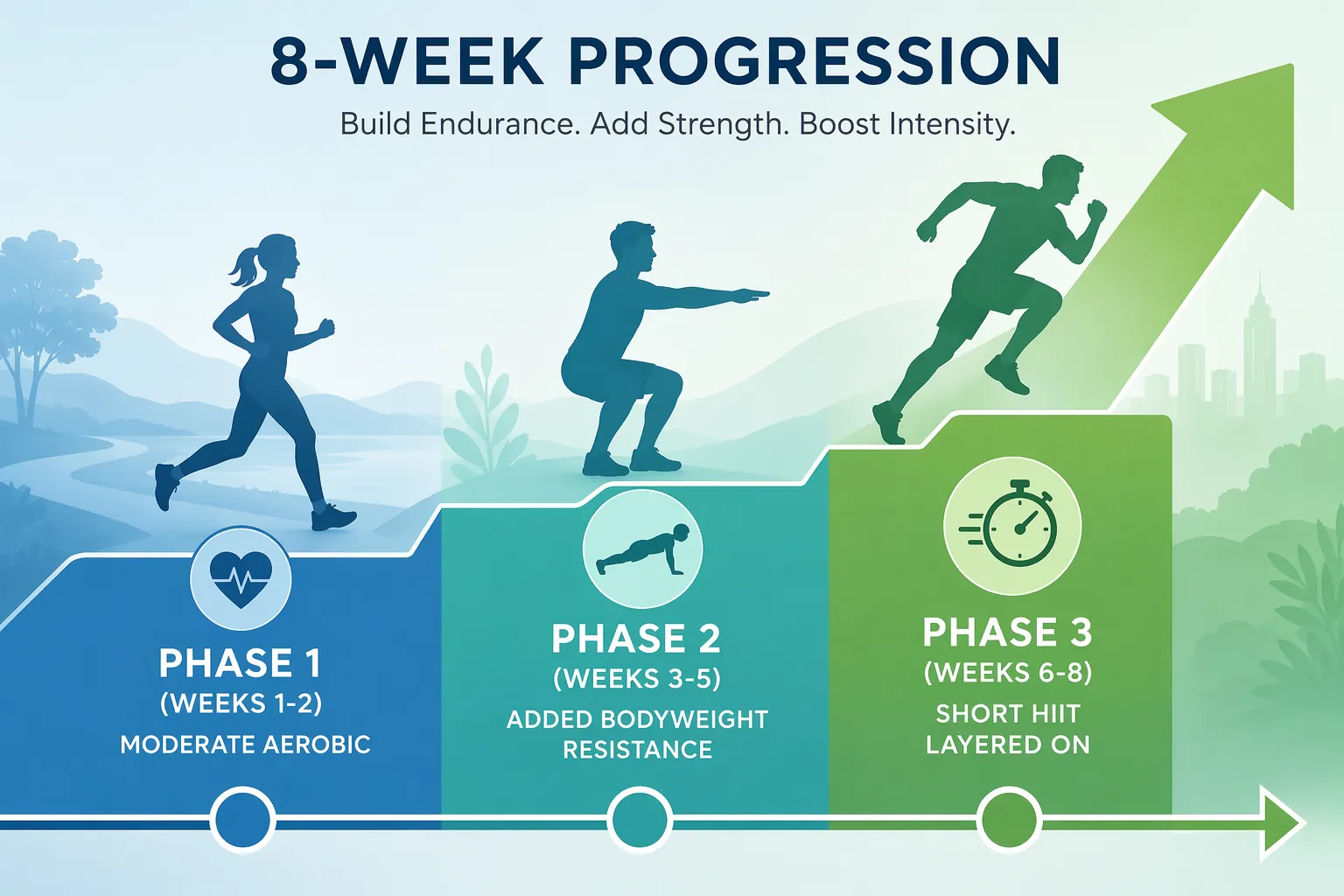
The 8-Week No-Equipment Plan
This schedule is built for a living room, hallway, porch, or small apartment. No treadmill, bike, dumbbells, or watch is required. If you have a heart condition, unusual shortness of breath, dizziness, or joint pain that changes your movement, get medical clearance before starting.
| Weeks | Weekly dose | Main work | Intensity cue | Home options |
|---|---|---|---|---|
| 1–2 | 5 days/week, 25–35 minutes/session | Moderate aerobic base | You can speak in short sentences, but singing would be hard | Marching in place, step-ups on a bottom stair, low-impact shadow boxing, brisk indoor walking, side steps |
| 3–5 | 5 days/week: 3 aerobic days, 2 resistance days | Keep aerobic work and add full-body bodyweight strength | Aerobic days stay moderate; resistance sets stop with 2–3 good reps left | Squats to chair, wall or incline push-ups, hip hinges, reverse lunges, glute bridges, plank variations |
| 6–8 | 5 days/week: 2 moderate aerobic days, 2 resistance days, 1 short HIIT day | Layer brief intervals on top of the base | HIIT intervals feel hard but controlled; recovery lets breathing settle | Fast marching, step-up bursts, squat-to-reach, low-impact skaters, mountain climbers on a counter |
The plan deliberately starts with work you can repeat. Cholesterol does not care that you crushed one heroic Saturday workout and then avoided the mat for nine days. The useful dose is the one that survives your week.
Weeks 1–2: Build the Aerobic Base
Start with five moderate aerobic sessions per week. Each session lasts 25–35 minutes, including a few easy minutes at the beginning and end. Pick one movement or rotate several so your calves, knees, and lower back do not take the same load every day.
- 5 minutes easy marching or walking around the room
- 18–25 minutes steady work: marching, step-ups, low-impact jacks, side steps, or shadow boxing
- 2–5 minutes easy movement until breathing feels normal again
Use the talk test instead of chasing a device number. Moderate means you are working, warm, and breathing faster, but you can still answer someone without gasping. If you finish feeling as if you could have done another 10 minutes, that is fine in week 1. The first two weeks are about making the appointment with yourself believable.
The triglyceride reason for this phase is stronger than most generic “cardio is good” advice. A review comparing statins and exercise found that one aerobic session reduced post-meal triglycerides by about 18%, while statins reduced them by about 27%; for post-meal clearance, the difference was not statistically significant. The same paper found statins lowered fasting triglycerides more than exercise, so the win is narrow and specific, not a blank check.[2]
That matters because many adults spend most of the day in the hours after eating. A home aerobic session cannot erase a poor diet or replace a prescription, but it can make the body handle the next wave of circulating fat more efficiently.
A Simple Aerobic Menu
| If this bothers you | Use this instead | Keep the cholesterol dose by |
|---|---|---|
| Knees dislike jumping | Marching, side steps, step-touch, low step-ups | Extending the steady portion rather than adding impact |
| Feet or calves get sore | Shadow boxing, seated fast punches, low-impact dance steps | Keeping breathing in the moderate zone |
| Small space | Marching intervals, wall taps, squat-to-chair without speed | Using time, not distance, as the target |
| Boredom | 5-minute blocks of different movements | Avoiding long rests between blocks |
If 30 minutes is unrealistic on workdays, split the session into shorter bouts. Readers who need that format can use exercise snacks for cardio at home and keep the same weekly minutes as the goal.
Weeks 3–5: Add Bodyweight Resistance Without Turning It Into a Gym Program
In week 3, keep three aerobic days and add two resistance days. The resistance work is not there for bodybuilding decoration. Reviews of exercise and lipids generally favor combining aerobic and resistance training over relying on either mode alone.[3]
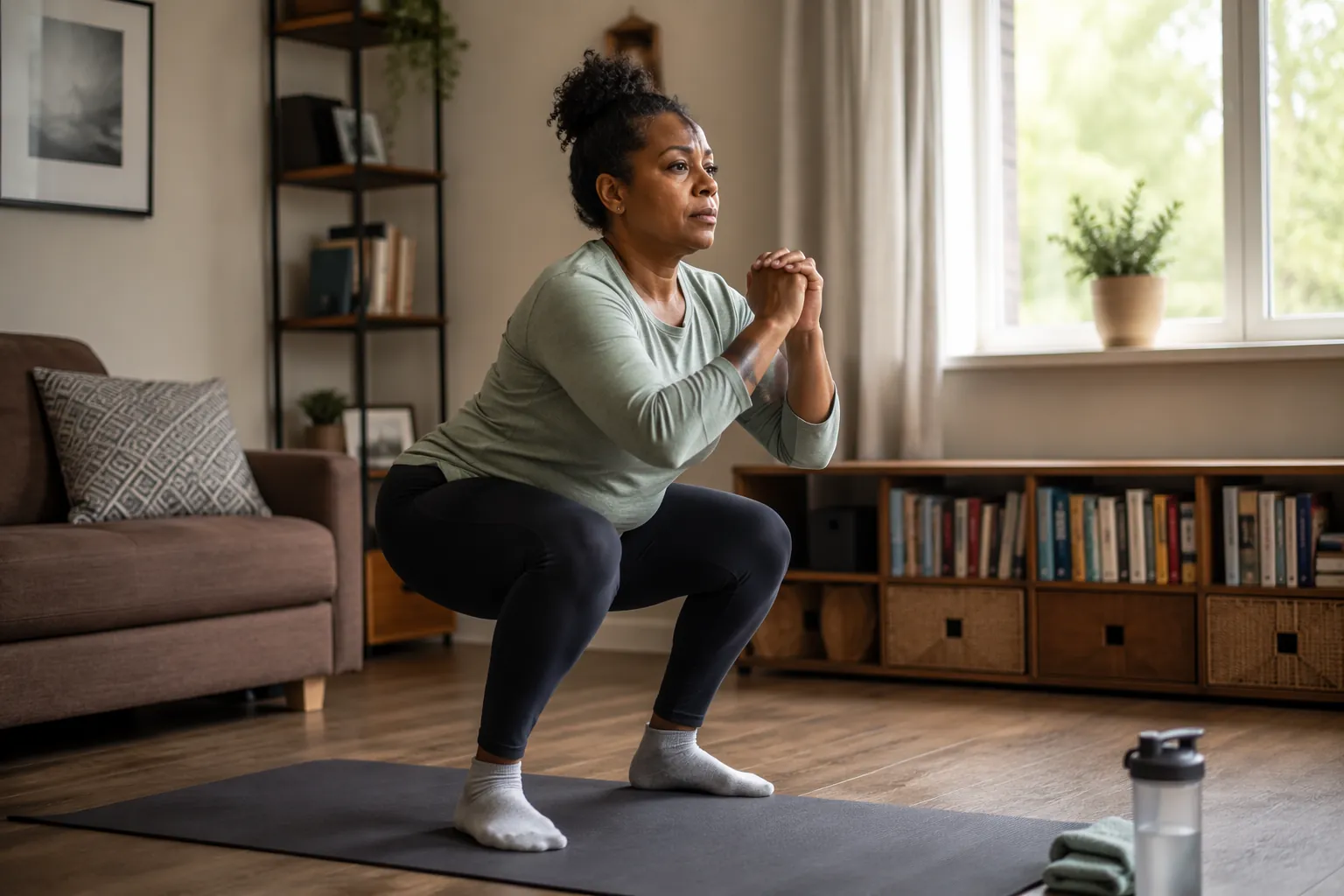
Do this circuit twice in week 3. If your form is still clean, move to three rounds in weeks 4 and 5.
| Exercise | Week 3 | Weeks 4–5 | Form note |
|---|---|---|---|
| Chair squat | 8–12 reps | 10–15 reps | Sit back to the chair, stand tall, avoid bouncing |
| Incline push-up on counter or wall | 6–10 reps | 8–12 reps | Keep ribs and hips moving together |
| Hip hinge | 8–12 reps | 10–15 reps | Push hips back; feel hamstrings, not low-back strain |
| Reverse lunge or supported split squat | 6–8 each side | 8–10 each side | Hold a wall or chair if balance is the limiter |
| Glute bridge | 10–15 reps | 12–20 reps | Pause briefly at the top |
| Forearm plank or elevated plank | 15–25 seconds | 20–40 seconds | Stop before your back sags |
Rest 45–90 seconds between exercises as needed. The effort should feel like a 6 or 7 out of 10, not a grinding max. In a small randomized trial, 14 weeks of moderate resistance training reduced total cholesterol by about 16 mg/dL and LDL by about 10–14 mg/dL, but the study was small and longer than this plan, so it should guide expectations rather than promise your exact result.[4]
Lower-to-moderate resistance intensity also fits the home setting. In a study comparing resistance intensities, lower and moderate intensity strength exercise produced more favorable triglyceride clearance than high-intensity strength exercise, which is one reason this plan avoids turning week 3 into a max-effort challenge.[5]
If upper-body choices feel limited without equipment, use this no-equipment upper-body workout for push-up progressions and pulling substitutes. For legs, this science-based home leg workout can help you choose squat, hinge, and lunge variations that suit your joints.
Weeks 6–8: Add One Short HIIT Day, Not Five
By week 6, the schedule changes because your base has changed. Keep two moderate aerobic days and two resistance days. Add one short interval day. More is not automatically better here; it is usually just harder to recover from.
| Day | Session | Time |
|---|---|---|
| Monday | Moderate aerobic work | 30–40 minutes |
| Tuesday | Bodyweight resistance circuit | 25–35 minutes |
| Wednesday | Easy walk or rest | Optional |
| Thursday | HIIT session | 18–24 minutes |
| Friday | Bodyweight resistance circuit | 25–35 minutes |
| Saturday | Moderate aerobic work | 30–45 minutes |
| Sunday | Rest | Full rest or gentle mobility |
The HIIT session is short: 5 minutes easy warm-up, then 6–8 rounds of 30 seconds hard and 90 seconds easy, followed by 3–5 minutes easy. Hard means you would rather not talk during the interval, but you are still in control of your landing, posture, and breathing. Good choices include fast marching, quick step-ups, counter mountain climbers, low-impact skaters, or squat-to-reach.
If your joints dislike speed, make the interval harder by raising your arms, increasing range of motion, or using a quicker but still low-impact march. Do not use pain as an intensity tool. A cholesterol plan that inflames your knee in week 6 is not a cholesterol plan; it is a reason to quit.
Why This Dose Is Smaller Than Some Studies and Still Worth Doing
Some of the strongest exercise-lipid trials used volumes many adults will not reproduce at home. In STRRIDE, the greatest improvements across lipid variables came from aerobic exercise at the caloric equivalent of jogging about 20 miles per week at 65–80% of VO2peak.[6] That is useful science, but it is not a Tuesday-night plan for a 58-year-old with dinner dishes, a sore Achilles, and no treadmill.
So this plan translates the evidence into a realistic weekly range: usually 150–200 minutes of moderate-plus home exercise by the later weeks. That is enough structure to plausibly move lipid markers for some adults, without pretending to match high-volume lab protocols.
The other reason not to judge the plan only by LDL-C is HDL function. In a 12-week exercise study, moderate-intensity training improved ABCA1-mediated cholesterol efflux capacity by 13.5% and increased HDL-C by 6.6%.[7] Cholesterol efflux is one way HDL helps move cholesterol out of cells. That is more interesting than the old shorthand that exercise simply “raises good cholesterol,” because the function of HDL may improve even when the headline HDL-C number changes only a little.
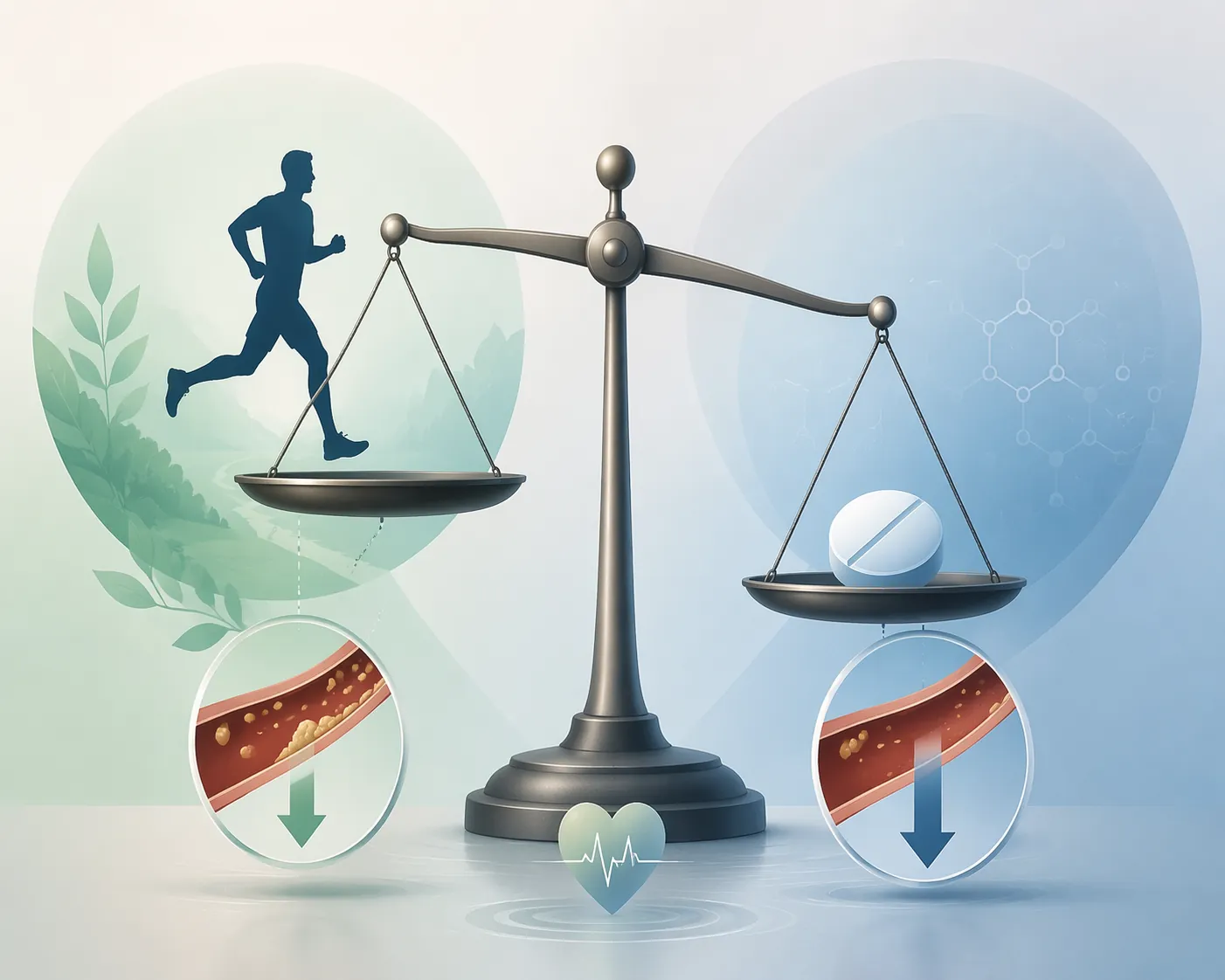
This is also where trial results can look frustrating. Some summaries have noted that diet can lower LDL more clearly than exercise alone in certain controlled trials.[8] That does not make exercise useless. It means the effect may show up more reliably in triglyceride handling, HDL function, fitness, body composition, insulin sensitivity, and particle profile than in one LDL-C line on the lab sheet.
Diet and exercise can be additive, and many people will need both. If you want the broader food-and-training approach rather than this exercise-only plan, use the FitAtHome guide to lower-cholesterol home workouts and diet.
How to Run the Plan Without Fooling Yourself
Before week 1, write down your latest LDL-C, HDL-C, triglycerides, total cholesterol, blood pressure if you have it, medications, and the date of the test. Do not compare a lab drawn after vacation eating with a lab drawn after a careful month and call the difference exercise. Try to keep the rest of your life steady enough that the repeat test means something.
- Track completed sessions, not intentions.
- Use the talk test for moderate days and controlled breathlessness for the interval day.
- Stop a set when form changes, especially on lunges, push-ups, and planks.
- Keep at least one full rest day each week.
- If you miss two sessions, resume the current week instead of “making up” workouts in one day.
The plan can be made easier without losing its purpose. Drop the HIIT day if recovery is poor and replace it with 30 minutes of moderate work. Use wall push-ups instead of floor push-ups. Use a chair for every squat. If you need a shorter on-ramp before committing to eight weeks, start with this home workout plan for busy parents and then return to the cholesterol schedule.
Minimal equipment is optional, not required. A resistance band or adjustable dumbbell can make pulling exercises and progressive overload easier, but do not wait to buy things before starting. If you are deciding whether equipment is worth it, this home gym workout plan by equipment tier shows what each tier actually adds.
What Result Should You Expect?
After eight weeks, a fair expectation is not a dramatic cholesterol rescue. A better expectation is a repeatable routine, improved aerobic capacity, better strength tolerance, and possibly a modest LDL shift in the range of a few mg/dL for some people. The research base supports LDL reductions around 3–6 mg/dL or roughly 5–7% as a reasonable exercise-based target in this kind of plan, while recognizing that individual responses vary and the supporting studies differ in population, duration, and training dose.[3][4][6]
HDL-C may rise modestly, but HDL function may be the more meaningful change. Triglycerides, especially post-meal handling, may respond session by session. These are not consolation prizes; they are part of cardiovascular risk. They just do not give you permission to ignore an LDL number that is high enough to need medical treatment.
Recheck labs after the eight weeks if your clinician agrees with that timing, or at the interval they recommend. Bring the workout log with the lab result. A clinician can then judge whether lifestyle alone is enough, whether diet needs tightening, whether medication still belongs in the picture, or whether exercise has helped enough to affect the dose discussion. That is the decision point this plan is meant to create.
References
- Doctors should 'prescribe' exercise for adults with slightly high blood pressure, cholesterol, American Heart Association, June 2, 2021.
- Effectiveness of statins vs. exercise on reducing postprandial hypertriglyceridemia, Journal of Sport and Health Science, 2022.
- Differential Effects of Aerobic Exercise, Resistance Training and Combined Exercise Modalities on Cholesterol and the Lipid Profile, Sports Medicine, 2014.
- Effect of 14 weeks of resistance training on lipid profile and body fat percentage in premenopausal women, British Journal of Sports Medicine, 1999.
- Low and moderate, rather than high intensity strength exercise induces benefit regarding plasma lipid profile, Lipids in Health and Disease, 2010.
- Effects of the amount and intensity of exercise on plasma lipoproteins, New England Journal of Medicine, 2002.
- Moderate‐ and High‐Intensity Exercise Improves Lipoprotein Profile and Cholesterol Efflux Capacity, Journal of the American Heart Association, 2022.
- How to lower your cholesterol without drugs, Harvard Health.
What a small equipment investment adds
We don't have a build tagged to this exact tier yet. Browse all builds.
How often should you repeat this?
See our recovery and rest reference for citation-anchored rest-interval guidance.
Spot something off?
Tell us if a movement, tier assumption, or duration didn't match your experience.