
Can You Improve Pickleball Accuracy at Home? 5 Drills Tested
Pickleball players living in apartments can improve shot accuracy with five specific drills that use only a foam ball, tape, and a wall. These drills were tested for noise and space constraints and produce measurable gains in 15-minute sessions.
- Equipment tier required
- $0-100
- Duration
- 15 min
- Difficulty
- beginner
- Target area
- full body
- Space footprint needed
- small room (e.g., living room)
- Noise level
- low
The apartment version of pickleball accuracy training starts with one unglamorous swap: use a foam ball instead of a regulation plastic ball. After that, the setup is simple enough to leave no excuse and cautious enough for a rental: a paddle, painter’s tape, one clear wall, roughly living-room or bedroom scale, and a 10- to 15-minute timer.
That matters because most “home pickleball” advice quietly assumes something many renters do not have: a garage, a basement, a driveway, or a neighbor who does not hear every dropped spoon. Foam training balls such as the Ninja-Ball and Gamma Librarian are described in gear guides as silent or apartment-friendly, with one review noting that soft balls will not dent walls or leave marks.[1][2] They are not magic. They bounce differently and do not feel exactly like a hard outdoor pickleball off the paddle. But they change the input enough that wall practice becomes realistic indoors.
If you want the broader noise comparison before setting up, FitAtHome has a separate guide to quiet pickleball home workout drills for small spaces and a closer look at foam balls versus quiet paddles. For an apartment accuracy setup, the practical answer is already clear: buy or borrow the quiet ball first. A quiet paddle still leaves you hitting a hard ball into a wall.
What “Tested” Means Here
Tested does not mean a controlled sports-science trial. It means the drills are drawn from coach and player practice guides, then filtered through apartment constraints: low noise, low wall risk, small footprint, repeatable scoring, and a setup a beginner-intermediate player can run without a coach watching.
The strongest at-home accuracy method is the taped-target wall rally. TopspinPro’s at-home guide quotes coach Connor Hance, creator of Dink Master, calling wall drills “the #1 best way to train on your own,” and PB5star and PowerPBC also place wall drills near the center of solo accuracy work.[3][4][5] That does not prove every player will improve at the same rate. It does mean this is the drill worth building the session around, because it gives feedback on every swing: hit the target, miss the target, or lose control before the next shot.
| Drill | Apartment Check | What You Track |
|---|---|---|
| Shadow swing with mirror or window reflection | No ball, no wall impact, almost silent | Same paddle path and finish for 10 clean reps |
| Taped-target wall rally | Foam ball only; painter's tape target on a clear wall | Consecutive controlled hits into or near the target |
| Dink-line wall touch | Short distance; low-speed contact | Soft contacts above a taped net line without popping up |
| Three-Five-Seven pattern | Same wall target, changing distance if space allows | Completion of 3, 5, and 7 controlled shots in sequence |
| Footwork ladder into target hit | No jumping required; tape ladder or floor markers | Balanced contact after moving your feet |
Set Up the Wall Before You Start Swinging
Pick the plainest wall you have, not the prettiest one. Move the coffee table, roll up the rug if it slips, and stand where your paddle can swing without clipping a lamp. If you need to practice near furniture, that is a sign to slow the drill down, not to test your reflexes next to a bookshelf.
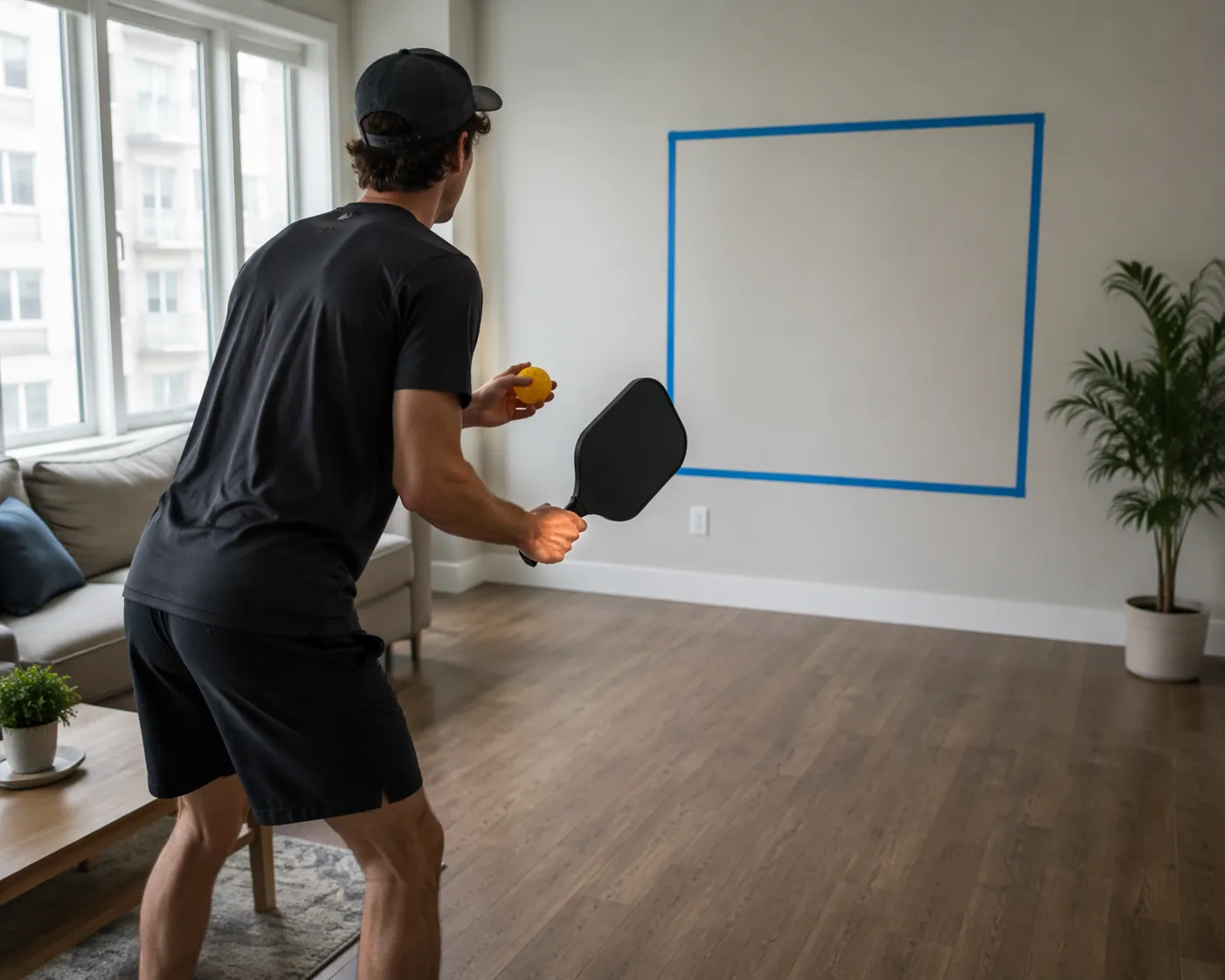
Use painter’s tape to make a rectangle at about chest height. A target around two feet wide and one and a half feet tall is large enough for real rallies and small enough to expose lazy contact. If your wall paint is delicate, test a small strip of tape in a low corner first and remove it slowly. Accuracy work is not worth a paint repair.
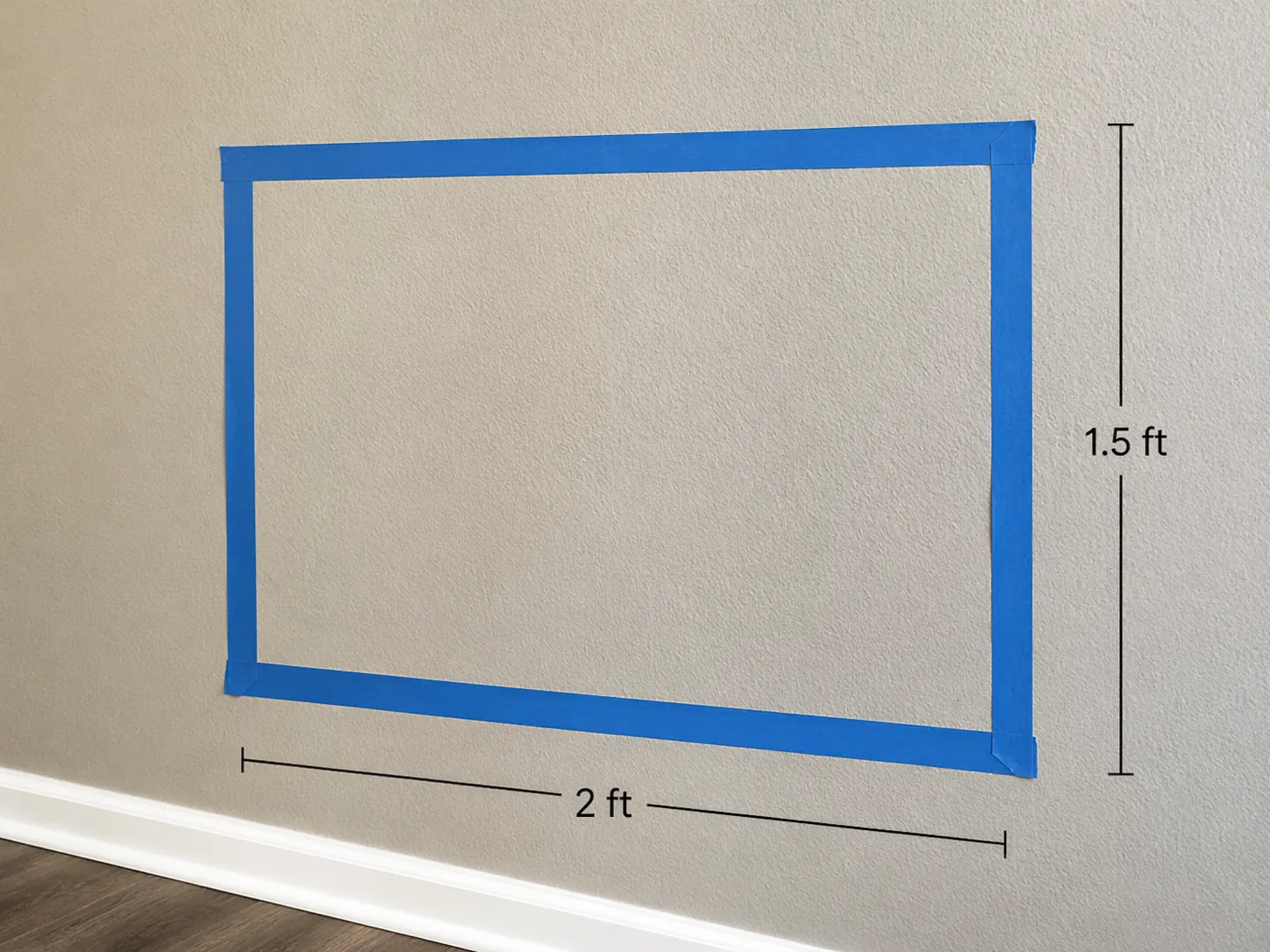
Add one horizontal tape line lower on the wall if you want a net reference for dink work. It does not need to be regulation-perfect. Indoors, the point is repeatability: same wall, same target, same distance, same ball, same count.
Drill 1: Shadow Swing Before the Ball Comes Out
Start with one minute of shadow swings. Stand sideways enough that your paddle path has room, use a mirror or dark window reflection if you have one, and make slow forehand and backhand motions without a ball. TopspinPro describes mirror-based shadow swinging as an underrated way to build muscle memory at home.[3]
This is not filler. It is the quietest way to clean up the swing you are about to repeat against the wall. Do 10 forehands and 10 backhands where the paddle face finishes toward the target area. If the paddle finishes across your body one rep and up by your ear the next, the wall drill will mostly measure inconsistency you installed before the ball arrived.
Drill 2: Taped-Target Wall Rally
This is the anchor drill. Stand a comfortable short distance from the wall, feed the foam ball gently, and rally against the taped rectangle. The first goal is not power. The first goal is to send a ball you can hit again.
Score it in a way that survives a normal apartment session. Count one point when the ball hits inside the taped rectangle and returns softly enough for another controlled swing. Do not count a target hit that ricochets wildly into the couch. That shot found the wall, not the drill.
- Round 1: forehands only, stop at 20 attempts, record clean target hits.
- Round 2: backhands only, stop at 20 attempts, record clean target hits.
- Round 3: alternating forehand and backhand, count your longest controlled streak.
- Progression: move back slightly only when you can keep the ball controlled at the current distance.
The tracking is deliberately plain. Write down “12 of 20 forehands,” “8 of 20 backhands,” or “longest streak: 6.” After a few sessions, improvement looks like more hits into the same target from the same distance, cleaner contact, and fewer emergency reaches. That is a more useful apartment metric than pretending the foam ball perfectly predicts a cross-court winner.
If your target is too easy, shrink the rectangle or add a smaller square inside it. If it is too hard, do not compensate by swinging harder. Stand closer, slow the feed, and rebuild the rally. The taped target should make the miss visible without turning the session into a wall-slapping contest.
Drill 3: Dink-Line Wall Touch
For dink practice, step closer and use the lower tape line as your net reference. The ball should leave the paddle softly, clear the line, and come back without forcing a rushed second touch. This is one of the safest apartment drills because the swing is compact and the foam ball is moving slowly.
Run it for two minutes. Count how many soft contacts clear the line without popping high above your target zone. If you keep sending the ball too high, check the paddle face before blaming the wall. A dink that floats indoors usually floats outdoors too; the foam ball just lets you see the habit without annoying everyone nearby.
Drill 4: The Three-Five-Seven Pattern
The Three-Five-Seven drill gives the session a progression instead of leaving you to rally until bored. PB5star and Inside the Den describe the pattern as three shots from the baseline area, five from the transition area, and seven from the kitchen area.[4][6] In an apartment, you adapt the distances to the room rather than pretending your bedroom is a court.
Mark three standing spots if space allows: farthest safe distance, middle distance, and close dink distance. From the far spot, hit three controlled balls into the target. Move to the middle spot and hit five. Move close and hit seven soft contacts over the net line or into the lower part of the rectangle. If your room only allows two distances, use two. The useful part is the change in touch, not the court cosplay.
| Stage | Apartment Version | Pass Standard |
|---|---|---|
| Three | Farthest safe wall distance | 3 controlled target attempts without lunging |
| Five | Middle distance | 5 repeatable contacts with the same swing speed |
| Seven | Close dink distance | 7 soft touches that stay above the net line and under control |
This drill exposes a common home-practice problem: some players can groove one distance but lose the paddle face as soon as they step in or back. Keep the target the same and let distance be the variable. When you can complete the pattern twice in a session without spraying the ball, make the target slightly smaller before adding speed.
Drill 5: Footwork Ladder Into a Target Hit
Accuracy falls apart when the feet arrive late. You do not need a real ladder for this; strips of painter’s tape, socks laid flat, or two floor markers are enough. Step through a simple in-in-out-out pattern, settle, then hit one foam ball into the wall target.
Keep it quiet: no jumping, no stomping, no speed ladder heroics. The pass standard is balance at contact. If the ball hits the target but your weight is falling sideways, count it as a warning rep, not a clean rep. On court, that same rushed contact is the shot that drifts wide while you swear you aimed correctly.
A 15-Minute Session That Actually Fits a Weeknight
FORWRD and PB5star both point to short, repeated practice blocks, with 15 to 20 minutes three times per week presented as a practical minimum dose for noticeable gains over weeks.[1][4] For an apartment, I would rather see three boring sessions completed than one elaborate setup abandoned because moving furniture took longer than the drill.
| Time | Work |
|---|---|
| 1 minute | Shadow swings: 10 forehands, 10 backhands |
| 5 minutes | Taped-target wall rally: forehand, backhand, alternating |
| 2 minutes | Dink-line wall touch |
| 4 minutes | Three-Five-Seven pattern |
| 2 minutes | Footwork ladder into target hit |
| 1 minute | Write down one score and remove the tape if needed |
Track only a few numbers, or you will stop tracking. The best ones are clean target hits out of 20, longest controlled rally, and whether you completed the Three-Five-Seven pattern. Use the same foam ball and the same wall distance when comparing sessions. If you change three variables at once, the notebook becomes decoration.
Players who want a broader home-practice menu can use FitAtHome’s guide to pickleball drills for home practice in small spaces. If conditioning is the next layer, add it after the accuracy work is stable, not during the first week. The 20-minute pickleball home workout and the combined skills and conditioning drills make more sense once your wall target numbers are not bouncing around wildly.
What Should Transfer Back to the Court
Do not expect a foam ball in a bedroom to reproduce the exact bounce, pace, or paddle response of a regulation pickleball rally. That is the trade. Foam balls make apartment practice possible; they do not make apartment practice identical to court play.
The transfer you are looking for is narrower and still useful: cleaner contact, a calmer paddle face, better control from a familiar distance, and more confidence aiming at a visible zone. If your wall score moves from scattered hits to repeatable target contact, you have improved something real. The next court session is where you confirm how much of that control survives a regulation ball, movement, spin, and another person trying to make you uncomfortable.
References
- Pickleball Training Aids: The Ultimate 2025 Guide, FORWRD
- Best Pickleball Training Aids, The Kitchen Pickleball
- At-Home Pickleball Practice Guide, TopspinPro
- The Best Drills for Improving Your Pickleball Accuracy, PB5star
- The Best Pickleball Drills for Solo Practice, PowerPBC
- Pickleball Drills Improve Accuracy, Inside the Den
What a small equipment investment adds
Cable Machine Alternatives That Save Space and Money
Compare the best cable machine alternatives for home gyms – from resistance bands and pulley systems to suspension trainers and compact digital units – and find the right option for your space and budget.
Small Treadmill Buying Guide: 7 Critical Specs to Check Before You Buy
A cross-category spec primer for apartment and small-space dwellers comparing walking pads, ultra-compact folding treadmills, and full-size folding treadmills. Learn the concrete thresholds for motor HP, deck length, noise, warranty, and subscription lock-in so you can compare apples to apples.
How to Practice Basketball at Home Without Noise Complaints
Learn how to run a full basketball workout in a small apartment without noise complaints. This guide covers no-dribble handling drills, wall form shooting, and silent ball options that let you train without disturbing neighbors.
How often should you repeat this?
See our recovery and rest reference for citation-anchored rest-interval guidance.
Spot something off?
Tell us if a movement, tier assumption, or duration didn't match your experience.