
Calling a single-stack cable machine, a dual-stack functional trainer, a smith+cable combo, a wall-mounted smart gym, and a power-rack hybrid by the same name — "all-in-one home gym" — is like calling a scooter and a pickup truck the same vehicle. They both get you from point A to B, but the similarity ends when you look at what they actually carry, where they fit, and how they handle the road.
I have watched too many friends drop three grand on a machine that looked good on paper only to find it could not do the exercises they actually wanted, or took up more floor space than they had, or required a monthly subscription they never budgeted for. The problem is not that the machines are bad. It is that the category "all-in-one" has become a marketing umbrella for five fundamentally different architectures, and most comparisons lump them together by brand or price tag instead of by how they train.
Here are the five architectures hiding under the "all-in-one" label. Read them once, then we will talk about the numbers that actually matter.
- Single-stack guided gyms — One weight stack (150–210 lbs), fixed pulley paths, guided exercises. Cheap, compact, beginner-friendly. But the 2:1 cable ratio makes the stack feel half as heavy, and you outgrow it fast.
- Smith + cable combos — A Smith machine married to cable stations. Most versatility per square foot: squat, bench, cable isolation. But the Smith path limits free movement, the cable ratio is almost always 2:1, and build quality varies wildly.
- Dual-stack functional trainers — Two independent weight stacks, adjustable pulleys. Smoothest cable experience, great for unilateral work. But no barbell, big footprint, and often less than 250 lbs per side.
- Smart digital gyms — Wall-mounted or floor-standing units with electromagnetic resistance. Tiny footprint, screen-based coaching. But max resistance is per arm (125 lbs for Tonal), subscriptions add $600+/year, and the feel is not the same as free weights.
- Power-rack + functional trainer hybrids — A rack with cable columns on each side. You get a barbell station plus cables. The closest to a full gym in one machine, but takes 35+ sq ft, costs $3,000+, and the cable ratio is usually 2:1.
The hidden spec that changes how every exercise feels: cable ratio
Most articles never mention cable ratio. Let me explain why it matters. A 2:1 ratio means the cable travels twice the distance the weight stack moves. Practically, a 50-lb stack feels like 25 lbs at the handle. That matters a lot if you are a stronger lifter buying a single-stack with a 160-lb stack — your lat pulldown might top out at 80 lbs felt. Dual-stack machines sometimes have 1:1 ratio, giving you the full stack weight at the handle. Check the manual. Many manufacturers do not list this on the product page.
Similarly, the "max resistance" on digital gyms like Tonal 2 and Speediance is total, not per arm. Tonal 2 offers 250 lbs total digital resistance, which is 125 lbs per arm. If you plan to do heavy one-arm cable rows, that might be short. On a dual-stack like REP Ares 2.0, you can get 260 lbs per side. That is a very different training ceiling.
The following table uses data from Garage Gym Reviews, manufacturer specs, and retailer listings from June 2026. I have included a column for cable ratio because that hidden spec changes how every cable exercise feels. Also note: "max resistance" on digital gyms is total, not per arm — a crucial distinction.
| Architecture | Price range | Footprint (D x W x H) | Max resistance (total / per arm) | Cable ratio | Subscription | Warranty |
|---|---|---|---|---|---|---|
| Single-stack (e.g., Powerline BSG10X) | $500–$1,800 | ~39" x 40" x 64" | 160–210 lbs / 160–210 lbs (single) | 2:1 (typically) | No | 1–5 years |
| Smith + cable (e.g., RitFit PSR05 2.0, Force USA G3) | $1,100–$4,500 | ~50" x 60–78" x 80–88" | Smith bar ~300 lbs, cables 160–260 lbs | 2:1 on cables | No | 1–10 years |
| Dual-stack functional trainer (e.g., Bells of Steel, REP Ares 2.0) | $1,300–$3,000 | ~54" x 59" x 81" | 260–300 lbs per side (dual stacks) | 2:1 or 1:1 | No | Limited lifetime–5 years |
| Smart digital gym (e.g., Speediance, Tonal 2) | $3,000–$4,800 (incl. install) | Ton: 5" x 21.5" x 51"Wall space; Speediance: 49" x 28" x 73" | 220–250 lbs total / 110–125 lbs per arm | Digital – no ratio | $0–$50/month | 2 years (Ton) varies |
| Power-rack + functional trainer hybrid (e.g., Major Fitness B17, REP Ares 2.0 in rack) | $2,500–$4,200 | ~68" x 78" x 88" | 260–310 lbs per side (dual stacks) | 2:1 | No | 1 year–limited lifetime |
The number that really bothers me: digital gyms quote total resistance, not per arm. Tonal's 250 lbs total sounds like a lot until you realize you only get 125 per arm. On a dual-stack like REP Ares 2.0, you get 260 lbs per side. That is not a minor difference — it is the difference between maxing out your rows and still having room to progress.
Match the architecture to your training style — the decision matrix
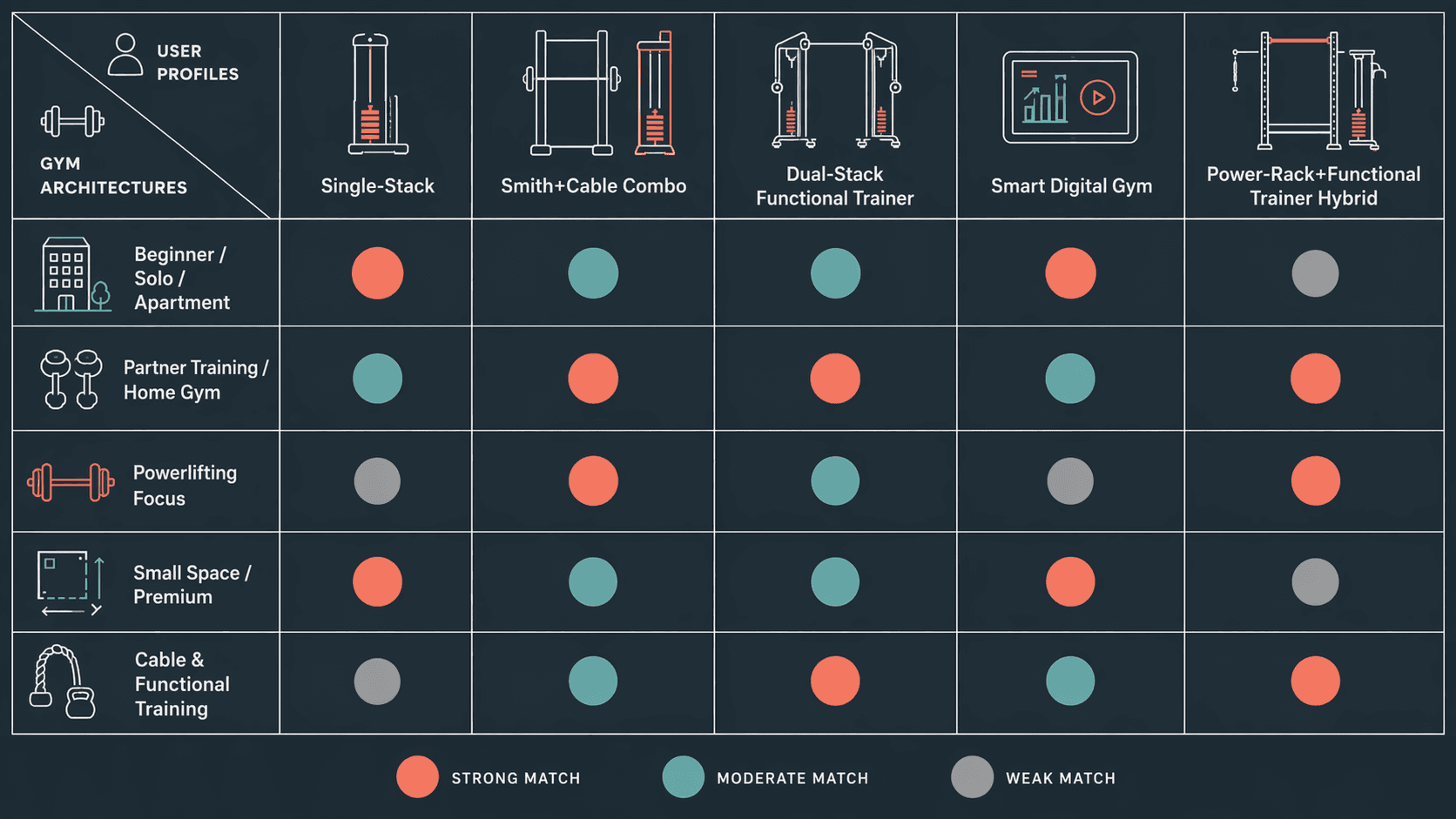
Read the row that describes you best. For example, the "Solo beginner, limited space" profile might lean toward a single-stack or smart digital gym, but the strong fit for the smith+cable combo depends on whether the user plans to do barbell work. The power-rack hybrid is a strong fit if the user also wants to progress to heavy barbell lifts. Notice that no profile gets a strong fit for all five architectures — that is the point. You pick the one that best serves your primary training style, not the one with the flashiest screen or most YouTube hype.
If space is your tightest constraint, you will want to see the compact home gym space tiers guide for a footprint deep dive. It shows exactly what fits in 10, 30, 50, or 100 square feet.
What each architecture actually delivers – and hides
Single-stack: a great start, but you will outgrow it
The classic: a single weight stack, a handful of pulleys, and a seat that adjusts for a dozen machines in one footprint. The Powerline BSG10X ($550–$700) is the most common entry-level example, with a 160-lb stack and 90% pre-assembly. The Body-Solid EXM2500 ($1,200) bumps the stack to 210 lbs and uses heavier steel. These machines are ideal for a single beginner who wants guided resistance without any setup decisions.
The hidden trade-off: most single-stack machines use a 2:1 cable ratio, so the 160-lb stack feels like 80 lbs at the handle. And the exercise selection, while broad (often 30+ exercises), is almost entirely guided — no free barbell, no unilateral cable work. If you outgrow the stack weight, you cannot easily upgrade. A few models like the Body-Solid EXM2500 have add-on stacks, but the path is still fixed.
This architecture is a great start, but most buyers I have talked to want to move on within 12–18 months. If you are confident you will stay at moderate resistance levels, it is a steal. If you see yourself progressing beyond a 210-lb stack, look elsewhere.
Smith + cable: the workhorse, but understand the guided path
This is the workhorse of the category. A Smith machine (guided barbell path) is welded to cable pulley stations, often with a lat pulldown seat and leg hold-down. The RitFit PSR05 2.0 at $1,099.99 is the entry point — it has a Smith bar, dual cables, and a lat pulldown. The Force USA G3 at $1,999 (possibly transitioning to the C-series — verify current stock) adds a heavier frame and more cable positions. The Force USA C10 at $4,499 is a cabled center-design that allows you to use the Smith and cables simultaneously without adjusting pulleys.
What makes this architecture versatile is that you can do barbell-style squats and bench presses (guided) and then switch to cable rows, lat pulldowns, and tricep pushdowns without moving to another station. In a footprint of roughly 6 x 4 feet, you get a full upper and lower workout.
The catches: the Smith bar is guided, which means you lose the stabilizer activation of a free barbell. The cable path on most models is fixed or limited to a few positions. And the cables on these combos are almost universally 2:1 — so that 200-lb cable stack feels like 100 lbs at the handle. The steel tube thickness on the RitFit (likely 14-gauge) is thinner than a standalone power rack (11- or 12-gauge), and the warranty is shorter. The Force USA G3 has better build quality but check availability; the C-series may have replaced some G3 models.
I recommend this architecture for someone who wants to squat and bench (guided) and do cable accessories, and who understands the guided path limitation. If you are a powerlifter who needs free barbell work, this is not your machine.
Dual-stack functional trainer: the cable purist's choice
This is the cable purist's choice: two independent weight stacks (often 200–300 lbs per side), adjustable pulley arms that move up and down, and a central column. The Bells of Steel All-in-One ($1,299 plate-loaded, $1,900 weight-stack) and the REP Ares 2.0 ($2,999) are standout examples. The Body-Solid G9B ($2,000) has dual 210-lb stacks and can accommodate two users at once.
The big advantage: independent left/right cables let you do unilateral work (single-arm press, flyes, chops) that no Smith-based machine can replicate well. The pulley movement is smooth — you can mimic nearly any cable station at a commercial gym. Many dual-stack units have a 1:1 cable ratio, meaning the stack weight is the felt weight. That is a huge difference for stronger lifters.
The trade-offs: footprint. These machines are wide (59–79 inches) and deep (54+ inches). They rarely include a squat or bench station — you are buying cables only. If you want barbell work, you will need a separate rack or a Smith machine. That is why the REP Ares 2.0 is popular as a drop-in cable attachment for their power rack: you get the rack and the cables in one system (which I cover in the next architecture).
This is the architecture for the cable-lover who trains alone or with a partner and has a dedicated floor space of at least 6 x 6 feet. It is not for the apartment dweller with a tight corner.
Smart digital gym: tiny footprint, huge subscription cost
These are the newest entrants: wall-mounted (Tonal) or floor-based (Speediance) boxes that use electromagnetic or motorized resistance. The Speediance Gym Monster ($3,199, no subscription) and Tonal 2 ($4,295 + $495 smart accessories + $250–$500 installation + $50/month membership) are the main players. Their defining feature is footprint: Tonal 2 projects only 5.25 inches from the wall and requires 21.5 inches of width; Speediance is a freestanding unit at 49 x 28 inches.
Digital resistance has some genuine benefits: automatic progressive overload, real-time form correction, and a tiny footprint for the exercise range (bench press, cable rows, squats, etc.). But the max resistance ceiling is real — 250 lbs total (125 per arm) for Tonal, 220 lbs total (110 per arm) for Speediance. If you are a 200-lb male who can barbell bench press 250 lbs, you will max out Tonal's bench press quickly. Also, digital resistance cannot replicate the eccentric overload of free weights — the electromagnet lags.
The subscription cost is the biggest hidden gotcha. Tonal's $50/month adds $600/year, and at $4,295 plus $745 in accessories and install, your first-year cost is $5,690. Speediance avoids the subscription, but third-party accessories may be limited. If you budgeted $3,000 for a machine, the first-year total for a Tonal is closer to $5,700. That is a very different purchase.
I would recommend smart gyms to someone who has a small apartment or wall space, values coaching and programming, and does not need to lift more than ~120 lbs per arm. If you are a heavier lifter or unwilling to pay subscription, look elsewhere.
Power-rack + functional trainer hybrid: the most complete system, but it needs space
This is the newest category: a half-rack or full power rack with a cable column on each side, often a lat pulldown/low row attachment in the back. The Major Fitness B17 ($4,199) and the REP Ares 2.0 ($2,999) are the prime examples. The B17 adds a Smith machine to the rack, making it an all-in-one: you get a free barbell station, a Smith, dual cable stacks (expandable to 260 lbs each), and a lat pulldown. The REP Ares 2.0 is a cable attachment that drops into a REP rack (or some other racks) — you supply the rack and bar.
The advantage of this architecture is that you do not compromise on the barbell. You can squat and bench heavy with a free barbell, then flip to cables for isolation work. The cable ratio is usually 2:1, so the 260-lb stack feels like 130 lbs per handle. That is acceptable for most cable work, but check if you need a 1:1 — some aftermarket cable systems offer optional pulleys.
The footprint is large — the B17 measures 68" D x 78" W x 88" H — more than 35 square feet. This is a garage gym or spare room machine, not an apartment unit. The weight stacks on the B17 come standard as 150 lbs each but are expandable; the REP Ares 2.0 ships with 260-lb stacks.
This is the architecture for the lifter who wants both heavy barbell and full cable capabilities in one frame, has the space, and is willing to pay a premium. It is the closest thing to a garage gym in one machine.
One-minute flowchart: your path to the right architecture
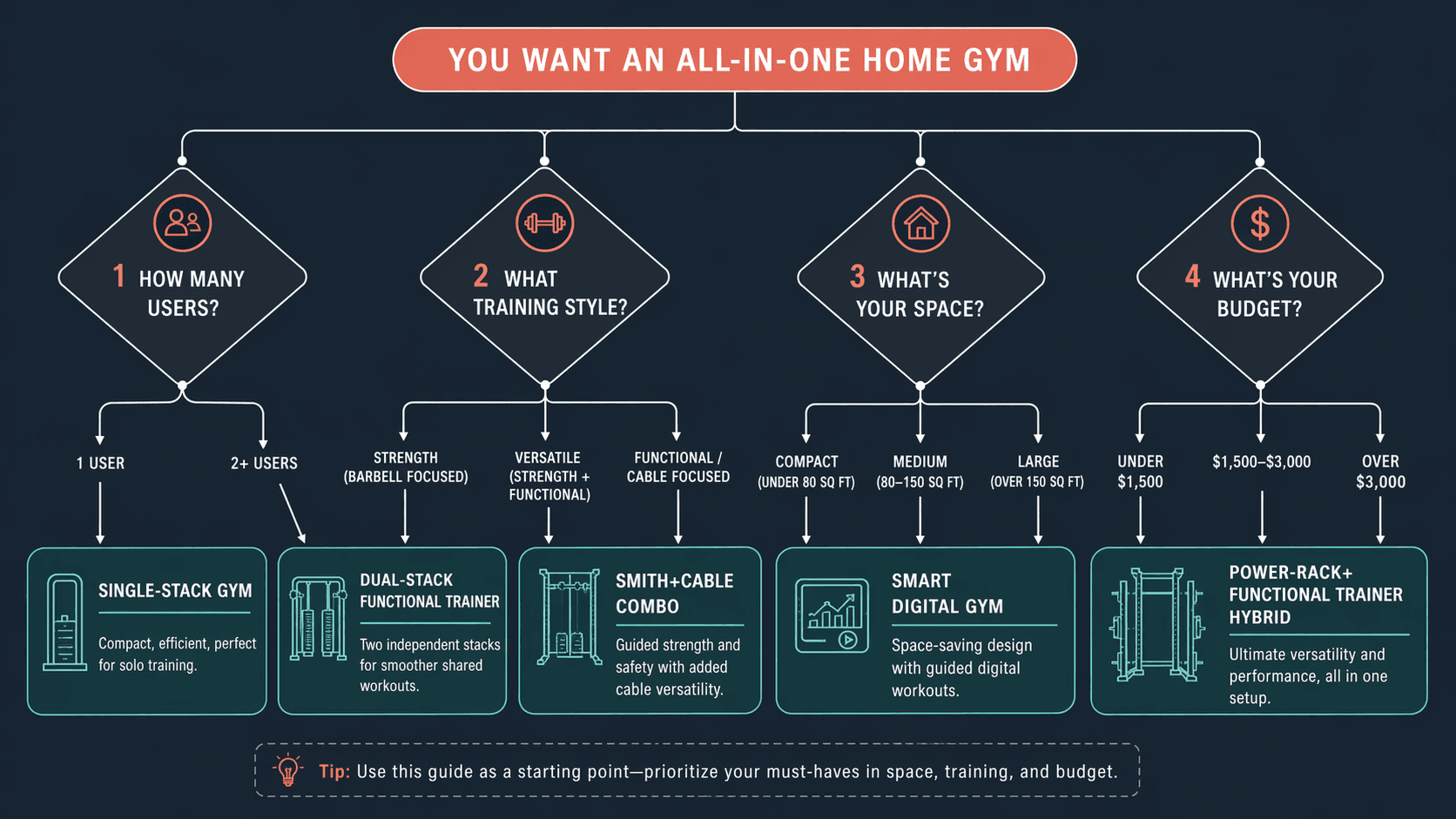
Start at the top. How many people are using the gym? Do you primarily train with barbells, cables, or bodyweight? How much floor space can you dedicate? What is your budget? Follow the branches — within a minute you will land on one or two architectures worth investigating further.
And once you have chosen, remember: the best machine is not the one with the most YouTube reviews or the biggest screen. It is the one that makes the exercises you care about feel right, fits your space, and stays under your total-cost-of-ownership limit. The architecture is the filter. Apply it first.
Comments
Join the discussion with an anonymous comment.