
The $1,855 average — what does it actually cover?
When you start comparing all-in-one machines, you will run into that number fast: $1,855 — the average price across home gyms tested by Garage Gym Reviews. I have to stop here for a second, because this number gets quoted as if it represents the market. It does not. It is the average of models those reviewers chose to test, not a weighted market median. Useful as a rough floor? Yes. A definitive cost line? No.
With that caveat out of the way, the cost picture is clearer than most buyers assume. A decent separate setup — power rack, barbell, plates, adjustable bench, and a separate cable tower — typically runs $2,500 and up. The all-in-one packages most of those functions into one purchase that starts at $1,299.99 (Bells of Steel) and goes to $2,999.99 (REP Fitness Ares 2.0) or $3,199 (Speediance Gym Monster). The all-in-one bundles the lat pulldown, low row, pec deck, leg extension — often without extra cost.
| Setup Type | Price Range | What's Included |
|---|---|---|
| All-in-one (tested avg) | $1,855 | Full frame, stack(s), numerous stations, often shipping |
| Bells of Steel all-in-one | $1,299.99 | Plate-loaded or 210 lb stack, lifetime warranty |
| REP Fitness Ares 2.0 | $2,999.99 | Dual 260 lb stacks (upgradable to 310 lb), lifetime warranty |
| Separate: rack + barbell + plates + bench + cable tower | $2,500–$3,500+ | Each piece sold individually — no bundled savings |
For the target budget of $1,000–$3,000, the all-in-one clearly delivers more stations per dollar. But the price does not include what happens when you want to lift more than the stack allows — which is the real cost to think about.
How much floor space do you actually have?
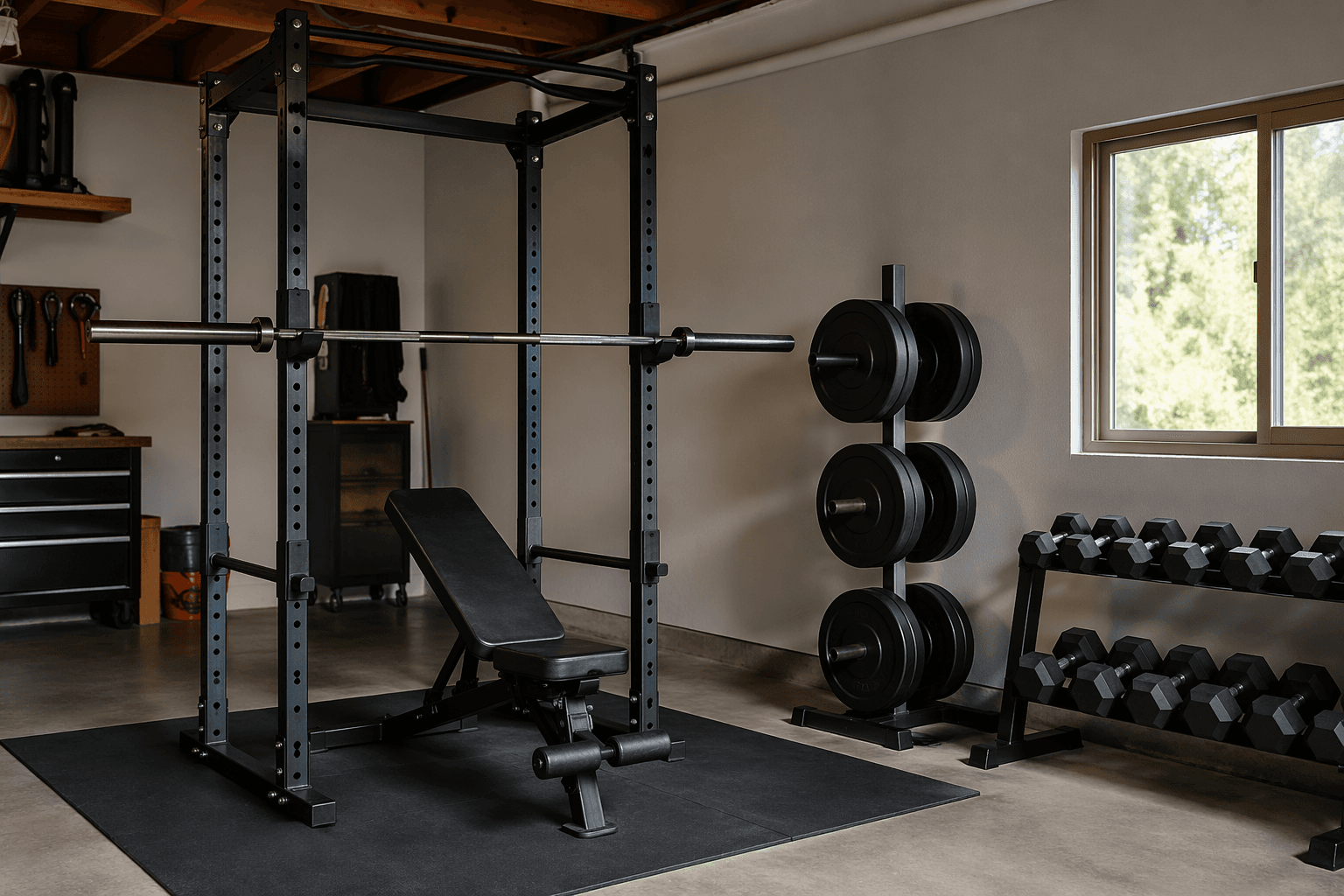
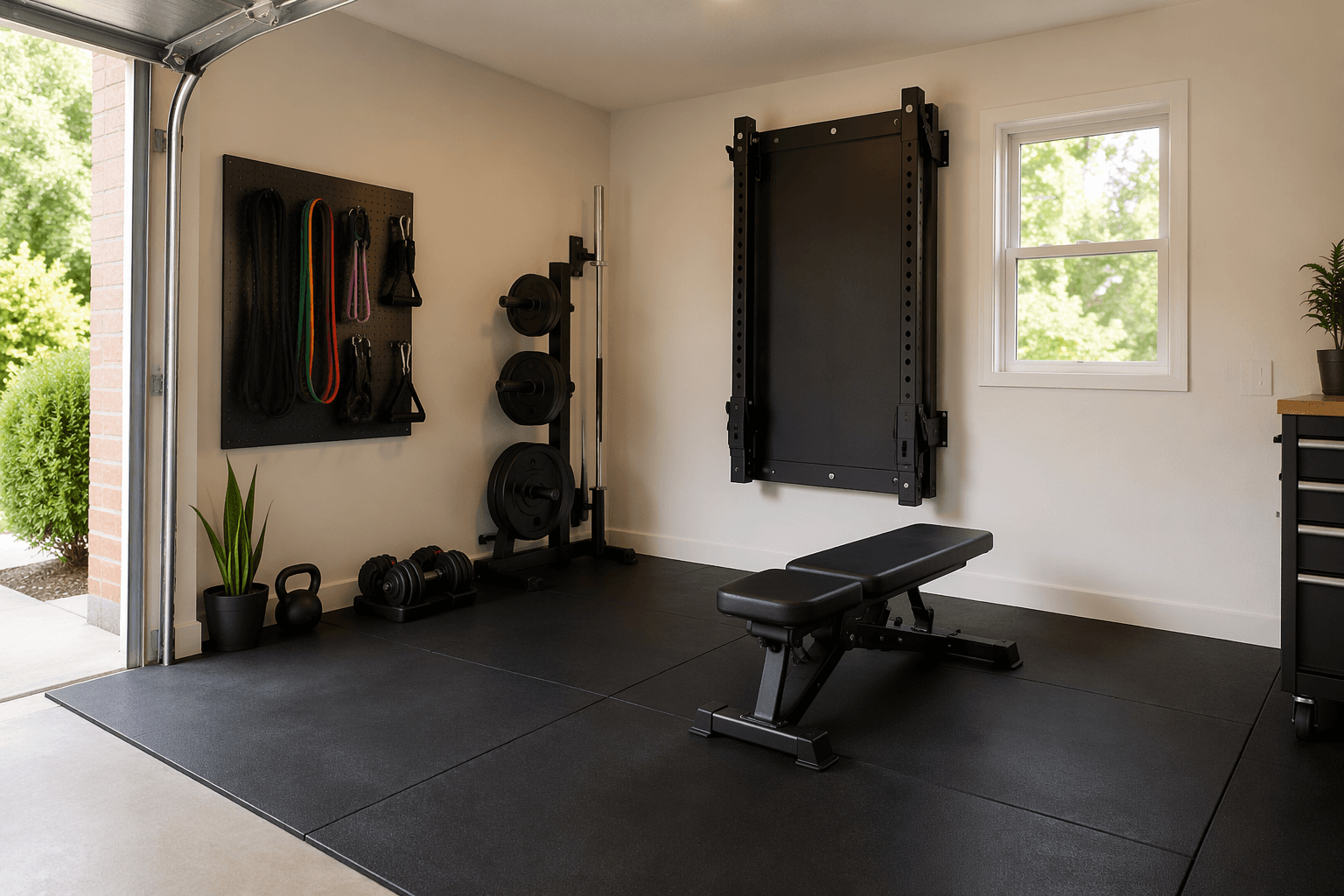
The all-in-one's space advantage is probably the easiest claim to verify without a calculator. FitnessFactory estimates multi-station gyms need about 7' x 10' — that includes movement space. The machine footprint itself often fits in under 20 square feet, especially if it includes built-in plate storage. Separate equipment, on the other hand, needs its own footprint for each piece: power rack (~4'x4'), bench (4'x2'), cable tower (~3'x3'), plate tree (2'x2'), plus walking clearance around each. That easily hits 40–80 square feet.
If you have a spare bedroom or a corner of a living room, the all-in-one wins this round without argument. Force USA points out that combining multiple stations into one unit is the whole point of the category. If you are in a dedicated garage gym with plenty of floor space, the space advantage is irrelevant — but then you are probably not reading this comparison.
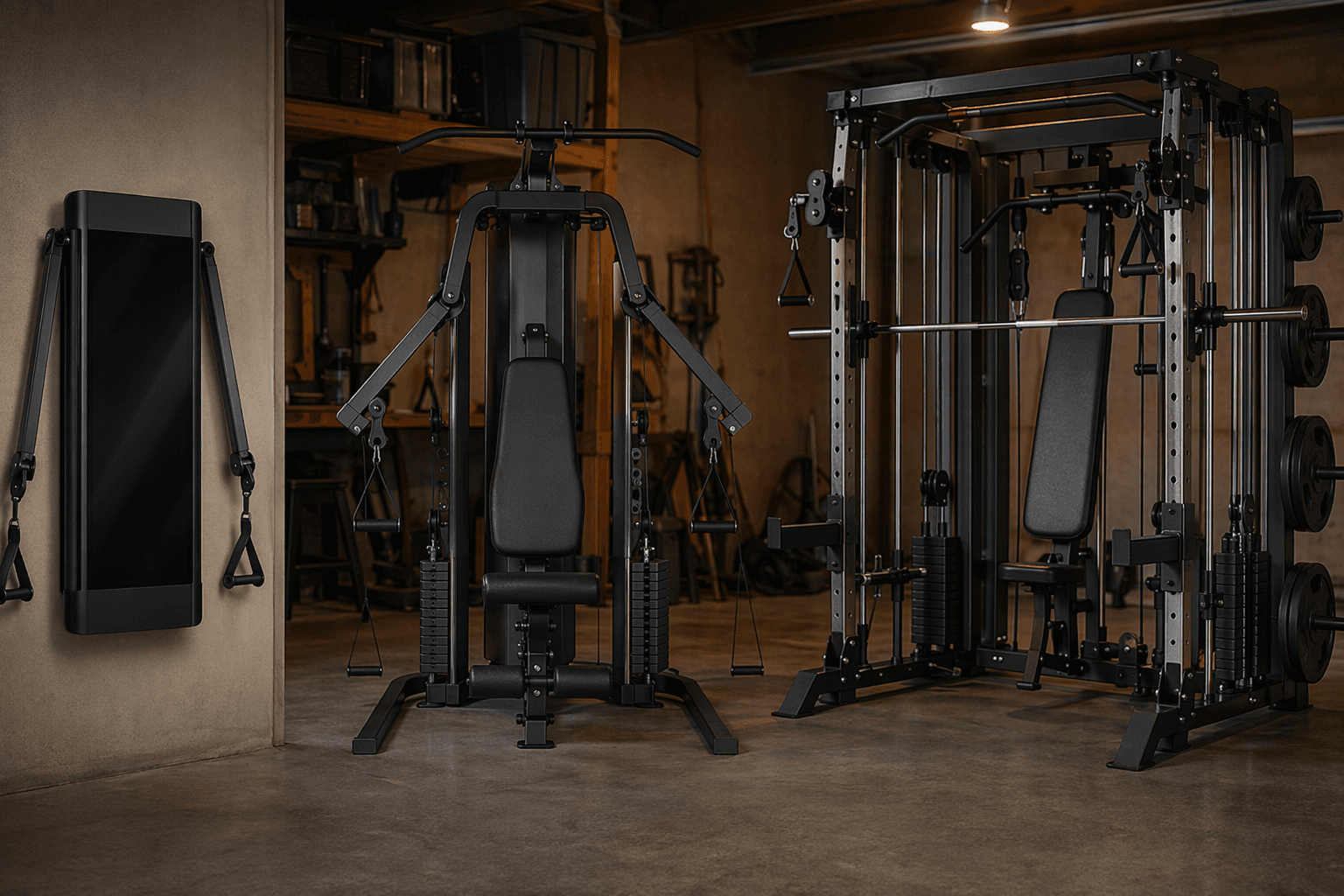
The safety that also holds you back
All-in-one machines with selectorized weight stacks have a genuine safety advantage for solo trainers. FitnessFactory notes that if you reach failure, you simply let go and the weight safely returns to the stack. No spotter needed, no risk of getting pinned. That is real.
It is also a ceiling. Most weight stacks top out between 210 lbs and 260 lbs. The REP Ares 2.0 is an outlier at 310 lbs upgradable. But the typical all-in-one — Body-Solid EXM2500 at 210 lbs, many others at 220–250 lbs — will not challenge a 180-lb male who benches 225 or squats 275. The guided path also removes eccentric overload, forced reps, and the ability to do partials or negatives. A barbell under a power rack with spotter arms offers comparable safety for solo training, but allows loads above 600 lbs and full free-weight movement.
The marketing around “25% more muscle interaction” (Body-Solid Fusion 600's Bi-Angular arm) sounds like a performance number. I do not buy that inference. It is a manufacturer claim cited by a reseller, not an independent test. The Bi-Angular arm is a real design feature — it lets you adjust the press path in ways a fixed-path machine cannot — but there is no validation that 25% more interaction translates to 25% more growth. Treat it as a design differentiator, not a proof of superiority.
What happens when you outgrow the machine
This is where the all-in-one value proposition crumbles for a subset of buyers. Separate equipment is modular: you can swap barbells, add more plates, upgrade the bench, replace the rack. The all-in-one binds you to its frame, its weight stack, and its attachment ecosystem. Bells of Steel offers about 15 attachments, which sounds flexible until you realize they all mount to the same frame with the same 210-lb stack limit.
The upgrade path for separate equipment is wide open. Want to deadlift 400 lbs? You need a barbell and plates — not a new machine. Want to switch from a flat bench to an adjustable one? Buy a bench. The all-in-one forces you to resell the whole unit if you hit its limits, and resale is harder because the buyer inherits the same constraints.
There is also a maintenance difference. A good power rack and barbell can last a lifetime. An all-in-one's cables need replacement every 5–7 years. That is a DIY-able job but a real cost and hassle. A $2,000 all-in-one may need cable service; a $2,000 rack + bar + plates setup will outlast you.
Three readers, two winners
The decision matrix below distills everything into three scenarios. The evidence points a clear direction for each.
| Profile | Budget | Space | Strength Level | Recommendation | Why |
|---|---|---|---|---|---|
| Solo trainer, small space, moderate goals | $1,000–$3,000 | Under 70 sq ft | Bench < 225, squat < 275 | All-in-one | Better value per station, compact, safe for solo — but accept the ceiling. |
| Multi-user household | $1,500–$3,500 | 40+ sq ft | Varies — some may exceed stack limits | Separate | Each user adjusts bench, bar, and plates separately; no single weight stack serves all. |
| Heavy lifter, >300 lb squat/deadlift | $1,500+ | Any | Bench 225+, squat 315+ | Separate | All-in-one stacks are a hard limit; barbell and rack allow progression to 600+ lbs. |
The solo trainer in a small space gets the most value from an all-in-one, as long as they honestly assess their strength trajectory. If you think you might want to pull 400 lbs in two years, do not buy an all-in-one. If you are content to train in the 150–200 lb range and value space, the all-in-one is the smarter purchase.
The bottom line: buy smart, not cheap
The conditional thesis holds: for a solo trainer with $1,000–$3,000 and a small-to-medium space, a quality all-in-one delivers better value than assembling separate equipment. But the calculus flips for multi-user households, heavy lifters needing more than 300 lbs, and anyone who prefers free-weight barbell work over guided resistance. The all-in-one is not a safe default; it is a specific-right tool for a specific situation.
Comments
Join the discussion with an anonymous comment.