
Two Ways to Buy a Treadmill — One Leaves You With a Brick
A $2,499 Echelon Stride-8S without an active membership is effectively a brick. OutdoorGearLab reports that the machine offers no useful functionality beyond manual mode — and that's if it lets you use manual mode at all. That is not a treadmill with an optional subscription. That is a treadmill that stops being a treadmill when you stop paying.
The market has split into two incompatible philosophies. On one side: closed ecosystems like Peloton, NordicTrack/iFit, and Echelon — a large touchscreen, a monthly fee, and a treadmill that depends on both. On the other: open platforms like Sole and Horizon — no mandatory subscription, you bring your own screen (or use none). The gap is not just price; it is what happens two years in.
Here are the upfront numbers so you can see the scale:
- Peloton Tread: $3,295 + $49/month All-Access membership (Consumer Reports)
- NordicTrack Commercial 1750: $2,499 + $39/month iFit (TreadmillReviews)
- Echelon Stride-8S: $2,499 + $40/month Echelon Fit (OutdoorGearLab)
- Sole F80: $1,899, free Sole+ app (same source)
- Horizon 7.0 AT: $1,099, no mandatory subscription (Wirecutter)
Consumer Reports notes that Peloton, NordicTrack, and ProForm subscriptions are “all but required” to use core features. I would not call the subscription an optional extra — it is the product. The hardware is the delivery vehicle for the content. Cancel the content, and the vehicle sits idle.
What the Subscription Actually Buys — and What You Lose When It Stops
The subscription buys three things that open platforms struggle to match: seamless auto-adjust, a large high-resolution display, and a library of thousands of classes. On NordicTrack's iFit, Automatic Trainer Control and ActivePulse adjust speed and incline in real time to match trainer cues and your heart rate. It works well — genuinely better than fiddling with buttons mid-stride. The screen on a Peloton Tread is 32 inches and bright. That is noticeably nicer than propping a tablet on a ledge.
| Feature | Closed Ecosystem (e.g., NordicTrack 1750) | Open Platform (e.g., Horizon 7.4 AT) |
|---|---|---|
| Auto-adjust | iFit's Automatic Trainer Control and ActivePulse adjust speed/incline in real time to match trainer cues and target heart rate zones (TreadmillReviews) | Bluetooth FTMS enables two-way control with some third-party apps, but the connection is less seamless and not all apps support full auto-adjust |
| Screen | 14-inch HD touchscreen (NordicTrack 1750) or 32-inch (Peloton Tread); integrated, bright, responsive | You provide your own tablet (e.g., $500 iPad); screen quality is comparable, but integration is looser |
| Content library | Thousands of live and on-demand classes, trainer-led, automatically adapted to your pace | Third-party app subscriptions (Peloton Digital $12.99/mo, Zwift $14.99/mo) offer similar breadth but lack hardware integration |
But the moment you stop paying, the value collapses. On a Peloton Tread, cancelling All-Access leaves you with basic manual mode — no classes, no auto-adjust. On an Echelon, you get effectively nothing. The sunk-cost asymmetry is brutal. A buyer who cancels after one year on a Peloton Tread has paid $588 in subscription fees and is left with a $3,295 machine that offers almost nothing beyond manual mode. That $588 did not improve the hardware; it bought access to a library that vanished the moment the payment stopped.
The Open-Platform Alternative — and the Overlooked FTMS Hybrid
Open-platform treadmills like the Sole F80 ($1,899) and Horizon 7.4 AT ($1,999) do not force you into a subscription. You lose the seamless auto-adjust and the large integrated screen, but you keep full control over your content and your long-term costs. The Sole F80 includes a 3.0 CHP motor, a 60-inch deck, and a free Sole+ app with 10 preset programs. Sole claims its Cushion Flex Whisper Deck reduces joint impact by up to 40% compared to asphalt — I treat that as directional, not a hard fact, but the machine itself is solid.
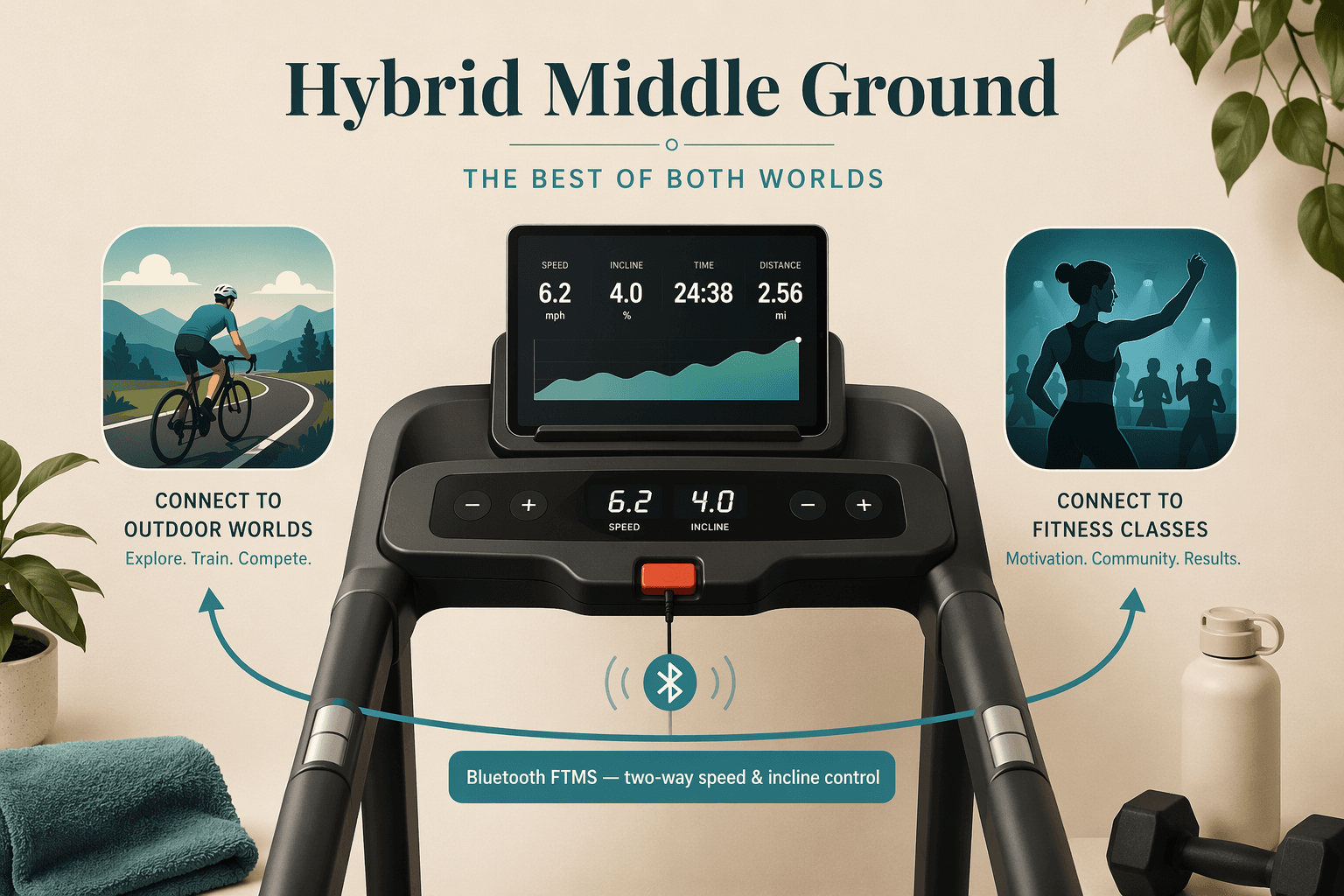
The most interesting — and most overlooked — option is the FTMS hybrid. The Horizon 7.4 AT uses Bluetooth FTMS to communicate with third-party apps. You can use Zwift ($14.99/month) or Peloton Digital ($12.99/month) to control speed and incline from the app. The auto-adjust is not as smooth as iFit's native integration, but it works well enough for most users. And if one app raises its price, you switch to another without buying a new machine. That flexibility is the real prize. The hybrid approach gives you most of the guided-training experience at a fraction of the long-term cost.
The 5-Year Cost Reality
OutdoorGearLab calculated the 5-year total cost of ownership assuming continuous subscription at the recommended tier. The gap is not subtle:
| Model | 5-Year Cost | Monthly Equivalent |
|---|---|---|
| Peloton Tread | $5,639 | $94 |
| NordicTrack Commercial 1750 | $4,479 | $75 |
| Horizon 7.4 AT | $2,399 | $40 |
| Sole F80 | $1,900 | $32 |
The difference between a closed ecosystem and an open platform over five years is $2,700 or more. That is the price of a second treadmill. For a detailed breakdown, see Do You Need a Treadmill Subscription? — but the key insight is that the subscription cost dominates the total, and if you cancel early, you lose the value of the subscription fees without retaining the functionality.
How Often Will You Actually Use the Screen?
All the cost and feature comparisons come down to one question: how often will you train with the built-in content? If you run 4–5 times a week, follow guided classes, and value seamless auto-adjust, a closed ecosystem like Peloton or NordicTrack makes sense — the monthly fee is a training subscription, not just a treadmill fee. If you use the treadmill 2–3 times a week, or prefer your own music and outdoor runs, an open platform or FTMS hybrid delivers better long-term value. You can still use Peloton Digital or Zwift for $12–$15/month without hardware lock-in. And if you only use the treadmill for bad-weather days — maybe once a week — a subscription is wasted money. Buy an open platform and use free apps.
My Verdict: Conditional, but Clear Enough
For the majority of home buyers, an open-platform or FTMS hybrid treadmill offers better long-term value and flexibility. The sunk-cost risk of a closed ecosystem is real, and the 5-year cost difference is hard to ignore. I concede that daily guided trainers who value large integrated screens and seamless auto-adjust may find the subscription worthwhile. But that is a specific use case, not the default. The right answer depends on your behavior, not on product spec sheets.
For more on the cost side of this decision, see Subscription-Free vs. Connected Treadmills and Treadmill Total Cost of Ownership: 3-Year Comparison.
Comments
Join the discussion with an anonymous comment.