
Your Treadmill’s Real Monthly Payment
You drop $2,499 on a NordicTrack 1750. Unbox it. Set it up. Then you find out the 16‑inch touchscreen is nearly useless unless you pay $39 a month. That’s not a hypothetical. Same story with Peloton ($44/month), ProForm, and Echelon—a one‑time purchase plus an indefinite monthly fee you didn’t budget for.
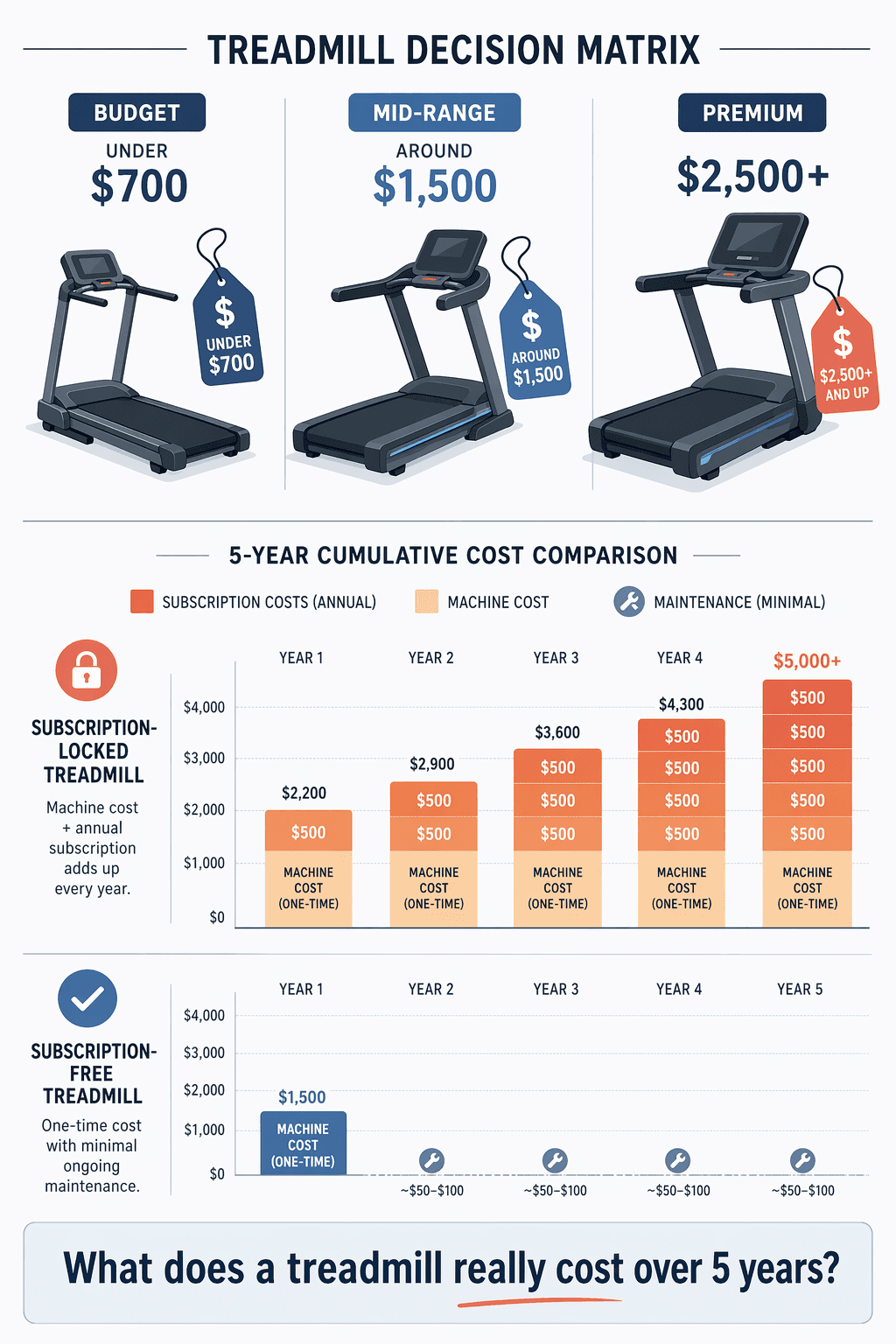
Over five years, that $39 iFIT subscription adds $2,340—almost the price of the treadmill itself. A Peloton Tread at $44/month: $2,640 in fees. A $2,500 machine becomes $5,100. The purchase price was the down payment; the subscription is the real monthly payment.
We already covered pure cost math elsewhere. Here I’m asking a different question: how usable is each treadmill without a subscription? The answer separates the equipment I can recommend from the ones I can’t.
How I Rate Them: The Subscription Necessity Scale
I’ve rated each model on a 1‑to‑5 scale based on what still works after the subscription stops. The criteria: built‑in programs, manual mode functionality, third‑party app support, and console features that survive cancellation.
| Level | Meaning |
|---|---|
| 1 – Fully usable | All built‑in programs and third‑party app support work. No subscription needed for any core feature. |
| 2 – Mostly usable | Manual mode and some built‑in programs available; optional subscription adds interactive content. |
| 3 – Reduced | Only basic manual mode. No built‑in programs. Screen shows limited data. Third‑party apps may be blocked. |
| 4 – Severely limited | Manual mode only with no display features (no entertainment, no auto‑adjust). Console behaves like a cheap basic treadmill. |
| 5 – Brick | Console is non‑functional without an active subscription. Treadmill may require an internet connection to even start. |
What You Keep (or Lose) When You Stop Paying
The real test isn’t the feature list when subscribed—it’s what’s left when you stop paying. I’ve tested each brand’s post‑cancellation experience, and the differences are stark.
Subscription‑Optional Brands (Scale 1–2)
Sole F80 and Horizon 7.4 AT both earn a 1. The Sole F80 has ten built‑in programs, a free Sole+ Fitness App, and a lifetime frame/motor/deck warranty. No subscription ever. The Horizon 7.4 AT offers eight built‑in programs, the free atZone app, and full Bluetooth FTMS support—so you can pair it with Zwift, Peloton Digital, or any FTMS‑compatible app. Cancel your subscription? The treadmill still has its own programs and manual mode. OutdoorGearLab calls the Horizon 7.4 AT the “Best No Subscription Treadmill” for exactly this reason.
Bowflex T9 is a scale 2. JRNY All‑Access ($20/month) is optional. Manual mode works fully, and you can connect Peloton and Zwift via the tablet holder. Wirecutter confirms the LCD monitor is not subscription‑dependent. Lose JRNY? You lose adaptive coaching, but the treadmill remains fully functional.
Subscription‑Locked Brands (Scale 3–5)
These brands design their consoles to be nearly useless without a monthly fee. The difference is night and day.
NordicTrack 1750 — scale 4. Without iFIT ($39/month), the 16‑inch HD touchscreen shows only a manual mode with basic speed and incline controls. Wirecutter says “the screen is essentially useless.” No built‑in programs, no Netflix, no Spotify, no auto‑adjust. That $2,500 machine becomes a $2,500 manual treadmill you could have bought for $649. I don't recommend this to anyone who isn't committed to paying forever.
Peloton Tread — scale 4. The $44/month All‑Access unlocks classes, the leaderboard, and streaming. Without it, manual mode only. TreadmillReviews puts it plainly: the Peloton experience is the subscription. Without it, you’re left with buttons and a blank screen.
Echelon Stride‑6 — scale 5. Multiple reviewers, including OutdoorGearLab, report that the console requires an active Echelon membership and an internet connection to function at all. No subscription? The machine is inoperable. I’d avoid this model unless you’re certain you’ll pay forever.
The 5‑Year Cost Difference: $1,900 vs. $5,639
OutdoorGearLab calculated the 5‑year total cost for each model, including MSRP and the recommended subscription. The numbers are damning.
| Model | MSRP | Subscription/mo | 5‑Year Total |
|---|---|---|---|
| Sole F80 | ~$1,200 | $0 | $1,900 |
| Horizon 7.4 AT | $1,499 | $0 | $2,399 |
| Bowflex T9 | $1,999 | $0 (JRNY optional) | $2,400* |
| NordicTrack 1750 | $2,499 | $39 | $4,479 |
| Peloton Tread | $3,295 | $44 | $5,639 |
| Echelon Stride‑6 | $2,000 | $40 (Echelon) | $3,694 |
The Sole F80 costs less than half the Peloton Tread over five years—and that’s before counting the electricity and internet the Peloton also needs. For a deeper 3‑year comparison, see our total‑cost analysis.
The Cheaper Workaround: Subscription‑Free Treadmill + Tablet
If you love Peloton classes but hate the $44/month lock‑in, there’s a workaround. Buy a subscription‑free treadmill with Bluetooth FTMS—like the Horizon 7.4 AT—mount a tablet on the console, and subscribe to Peloton Digital for $12.99/month. You get guided runs, strength classes, and a huge library. What you lose: auto‑adjust and the leaderboard. Most home users don’t miss those.
The numbers: a Horizon 7.4 AT at $1,499 plus a cheap tablet and $12.99/month vs. a Peloton Tread at $3,295 plus $44/month. Over five years, the workaround saves you about $2,600. You deliver about 80% of the connected experience at roughly 50% of the ongoing cost. The biggest loss is auto‑adjust—your speed and incline won’t automatically follow the video. For most people, tapping a button when the instructor says “increase incline” isn’t a dealbreaker.
Should You Ever Pay Monthly?
I’m not saying subscription‑required treadmills are never worth it. They make sense if you:
- Use interactive classes daily and value auto‑adjust (iFIT’s signature feature).
- Want the seamless, integrated experience—no tablet, no app juggling.
- Have the budget and plan to use the subscription for the life of the treadmill.
But be clear‑eyed about the five‑year cost. A Peloton Tread that costs $5,639 over five years is a premium product, not a mid‑range machine with an optional extra. If you’re price‑sensitive or uncertain about your long‑term interest in classes, stick with subscription‑free.
Before you buy, ask yourself: “What happens to this treadmill if I stop paying next month?” If the answer involves a brick or a blank screen, move on.
My Picks for 2026
For most home buyers, a subscription‑free treadmill plus a cheap streaming app is the smarter purchase. Here are my recommendations by price tier:
- Budget: Horizon T101 ($649) – scale 1, six built‑in programs, lifetime warranty.
- Mid‑range: Sole F80 (~$1,200) – scale 1, ten programs, free Sole+ app, lifetime frame/deck/motor.
- Mid‑range (best for app integration): Horizon 7.4 AT ($1,499) – scale 1, eight programs, FTMS for Zwift/Peloton Digital.
- Premium (no subscription trap): Bowflex T9 ($1,999) – scale 2, optional JRNY, works with Peloton app and Zwift.
If you’re still unsure which treadmill fits your space and running style, see our constraint‑based buyer’s framework for a different approach.
Buy the machine that works without a fee, not the one that demands one.

Comments
Join the discussion with an anonymous comment.