
The Oura Ring can replace a fitness tracker only if the part of fitness you care about most happens while you are recovering. If you need real-time workout stats, dependable strength-session logging, interval controls, or GPS-based run and ride records, it should not be your only tracker. If you mainly want better sleep, resting heart-rate, HRV, and readiness signals to decide how hard to train at home, Oura is one of the few wearables that can make a serious case for itself.
That is the useful split: Oura as a primary tracker versus Oura as a companion device. As a primary tracker, it has to own the whole job: capture workouts cleanly, show useful feedback during training, and produce records you trust afterward. As a companion device, it can do a narrower job extremely well: watch your body overnight, turn sleep and recovery signals into daily guidance, and leave workout logging to a watch, band, bike computer, or phone.
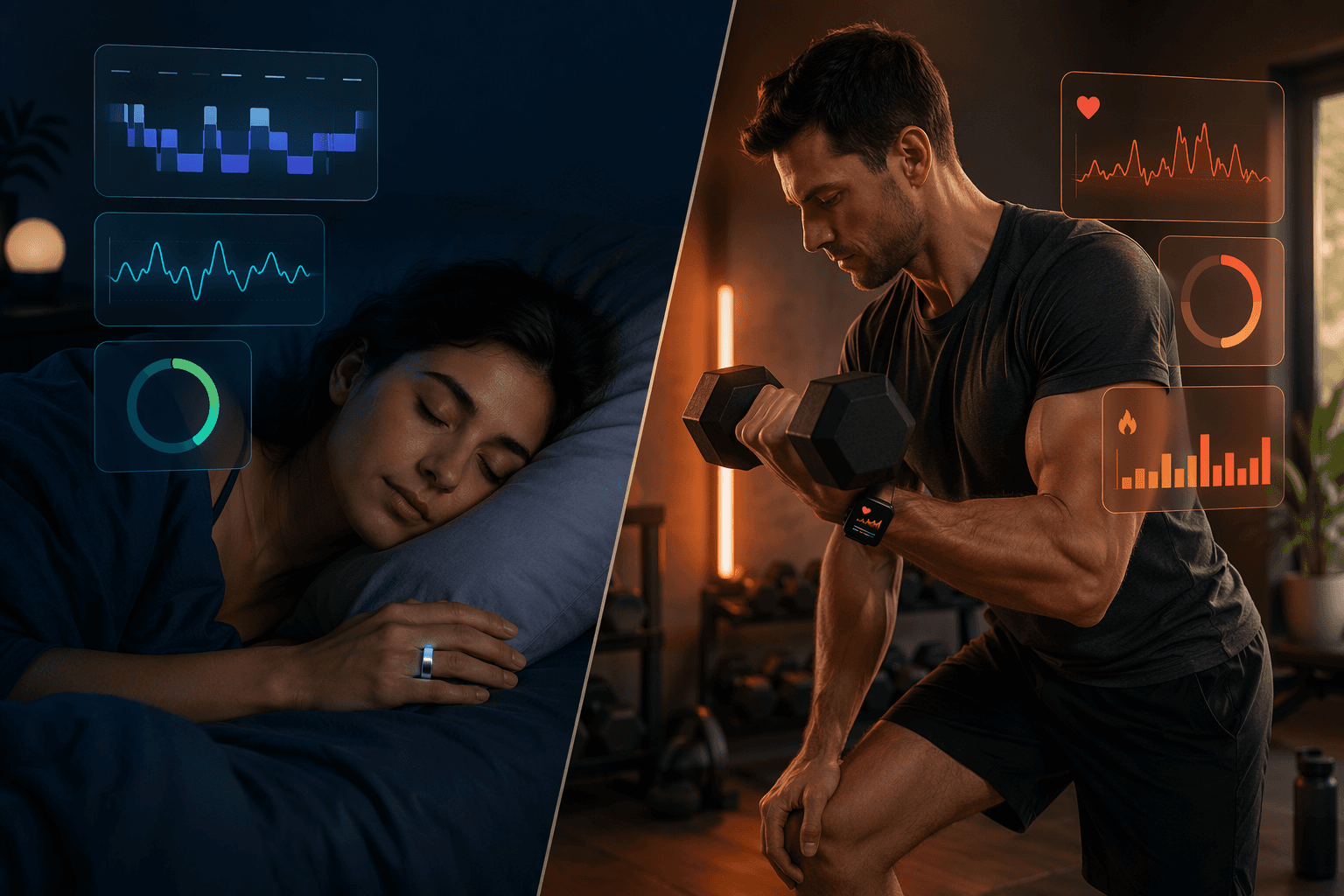
The short version: Oura tracks recovery better than it tracks workouts
The reason this question gets messy is that Oura is not inaccurate in some broad, dismissive sense. It is accurate at the things a ring is naturally positioned to measure: quiet, overnight physiology. A 2025 peer-reviewed study comparing consumer wearables against a Polar H10 chest strap over more than 500 nights found the Oura Ring to be the most accurate device tested for overnight HRV and resting heart rate among the consumer wearables in that comparison.[1]
That matters for home training because HRV and resting heart rate are not decoration. They are not a magic readiness oracle either, but they are useful context when yesterday’s poor sleep, a stressful week, or a lingering hard session should change today’s dumbbell plan. If your tracker’s main job is to help you decide whether to push, maintain, or back off, Oura is playing on its strongest ground.
The trouble starts when you expect the same ring to behave like a watch during exercise. A fitness tracker used during training has a different job: show heart rate zones while you are moving, log a run route, mark intervals, recognize the session correctly, and survive the practical mess of gripping dumbbells, kettlebells, pull-up bars, and barbells. Oura can record activity, but that is not the same as being a full workout instrument.
Why the ring is genuinely strong overnight
Oura’s best argument starts with placement. The ring uses optical sensing from the finger, and the finger can be a cleaner place to capture pulse signals than the wrist. In research comparing photoplethysmography signal quality, 95% of finger PPG readings were usable, compared with 67% to 86% for wrist readings.[2] That does not automatically make every ring better than every watch, but it explains why a well-designed ring can produce cleaner overnight heart-rate and HRV data than many wrist devices.
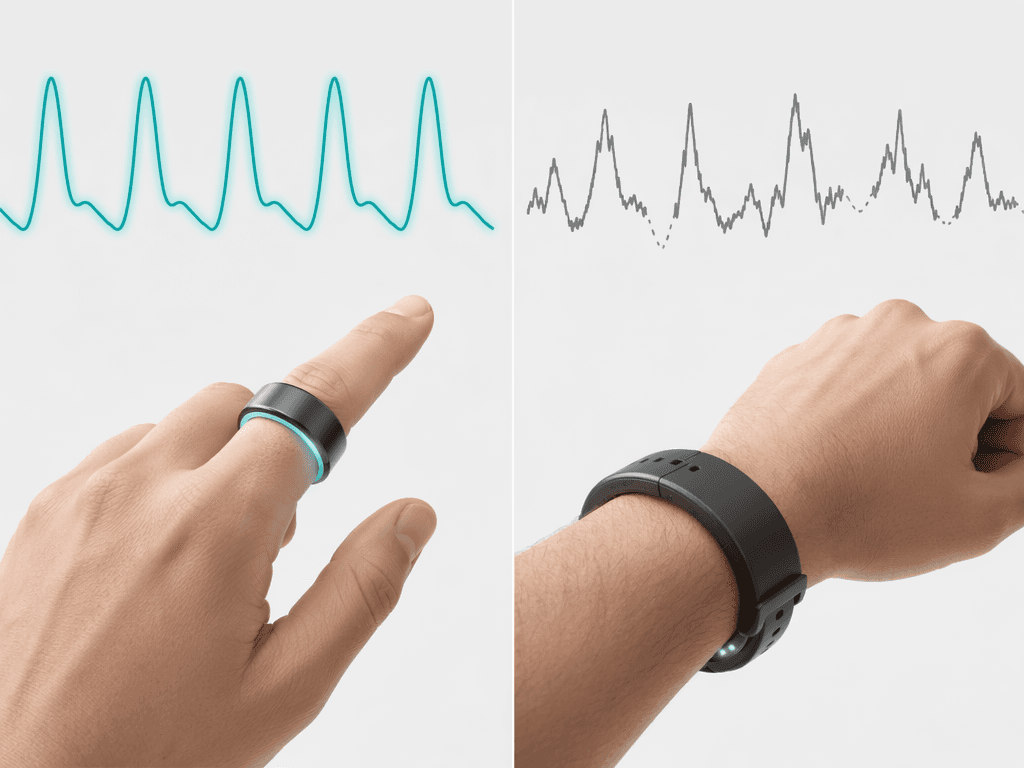
Sleep is the other part where Oura deserves more respect than the average wellness gadget. A 2024 study in Sensors found Oura to be the most accurate consumer sleep tracker tested for four-stage sleep classification.[3] A 2025 Scientific Reports study also evaluated finger-ring trackers for sleep assessment in a diagnostic context, adding to the independent evidence base around ring-based sleep measurement.[4]
Four-stage sleep classification means the device is trying to separate wake, light sleep, deep sleep, and REM sleep. No consumer wearable should be treated like a lab sleep study on your finger, but the distinction matters. A device that is merely good at detecting “I was in bed” is not doing the same job as one that performs comparatively well at classifying sleep stages and tying that to overnight heart-rate patterns.
This is why Oura feels more useful the morning after a bad night than during the last set of a workout. Its readiness-style guidance is built from signals collected while you are still: sleep duration and timing, resting heart rate, HRV, temperature trends, and recent activity load. If you are trying to avoid turning every tired day into another high-effort session, that can be more valuable than another calorie estimate.
For a deeper look at the recovery side, readers comparing the ring’s core measurements can use our guide to Oura Ring accuracy across sleep, HRV, heart rate, and recovery tracking. If your main decision is how to act on the morning score, the more practical companion is our guide to using Oura’s Readiness Score for home fitness recovery decisions.
Where it breaks down as a fitness tracker
Workout tracking is not just a checkbox in an app. For a home exerciser, it is the dull operational layer that keeps training honest: what you did, how hard it was, how long it took, and whether it matched the plan. This is the part where Oura still feels more like a recovery wearable that logs some activity than a dedicated fitness tracker.
Independent long-term and hands-on reviews show the same practical problem from different angles. In a six-week Forbes Vetted test, strength training was often misidentified as “housework.”[5] An NBC Select reviewer who used the ring for a year reported that yoga and strength training were not detected at all.[6] A Business Insider reviewer who used Oura for four years said they removed the ring for deadlifts and pull-ups.[7]
Those are not tiny misses if your routine is built around progressive strength work. A mislabeled or missed session means the app may misunderstand your training load. Removing the ring for grip-heavy work means the session may become less complete or require manual cleanup. A device can still be excellent overnight and annoying under a barbell; those are separate jobs.
The ring form factor also has a basic physical limitation. A ring sits exactly where many lifts create pressure and friction. Dumbbells, kettlebells, pull-up bars, rowing handles, and barbells all involve gripping metal or textured surfaces. Some users may tolerate that with lighter work. Others will remove the ring to protect the device, protect their finger, or simply avoid distraction. Once a tracker has to come off for important parts of training, it no longer owns workout logging by itself.
The missing screen matters more than it sounds
A screenless tracker can be peaceful during the day and genuinely better for sleep. During a workout, though, the missing glanceable display is a real trade-off. If you are doing intervals, trying to stay in a heart-rate zone, watching rest periods, or checking pace, a wrist device is simply easier. You do not have to pull out a phone, wake an app, or check later and hope the record makes sense.
That does not make Oura badly designed. It means it is designed around a different moment. It is better at telling you how your body handled yesterday than guiding every minute of today’s session.
Home-fitness scenarios: when Oura works, and when it does not
The cleanest way to decide is to stop asking whether the Oura Ring is “a fitness tracker” and ask which fitness job you are hiring it to do.
| Your main use case | Can Oura replace your tracker? | Why |
|---|---|---|
| Recovery-guided home training | Often, yes | Its strongest evidence is for sleep, HRV, and resting heart-rate tracking. |
| Dumbbell, kettlebell, bodyweight, or barbell training | Usually no | Strength sessions may be missed or mislabeled, and the ring can get in the way of gripping equipment. |
| Running or cycling with route, pace, and live stats | No for most users | A GPS watch, phone, or bike computer is better for real-time and route-based records. |
| Sleep tracking without wearing a watch | Yes, for many users | The ring is unobtrusive overnight and has strong sleep and recovery evidence. |
| Data-heavy training | Best as a companion | Use Oura for overnight physiology and a dedicated tracker for workouts. |
If your workouts are mostly dumbbells or bodyweight
Oura is useful before and after these sessions, not necessarily during them. The morning data can help you adjust the day: keep the planned lower-body workout, reduce volume, swap heavy sets for mobility, or take a low-intensity day after a rough night. That is a meaningful role.
But for logging the session itself, it is weak. Strength training is already hard for wearables because the valuable details are not only heart rate. Sets, reps, load, rest periods, range of motion, and progression all matter. Oura is not the device I would rely on to maintain that record. If you train with progressive overload, keep a separate workout log or use a watch/app setup that is built for strength tracking.
If you run or cycle
Oura is not the clean replacement for a GPS fitness watch. A runner or cyclist usually wants distance, route, pace, splits, elevation, intervals, and heart-rate behavior during the activity. A ring can contribute to the recovery picture afterward, but it is not as convenient as a watch for managing the session in real time.
If your outdoor training is casual and you already carry your phone, you may be fine with a phone-based record plus Oura’s recovery data. If you care about routes, pace trends, structured intervals, or race preparation, keep the watch.
If you mostly want to avoid overtraining
This is Oura’s best fitness case. The ring does not need to know every rep to be helpful if your biggest problem is stacking hard days on top of bad sleep. A lower readiness signal, elevated resting heart rate, or suppressed HRV can be enough to nudge a sensible change: reduce intensity, shorten the session, extend warm-up time, or choose a recovery workout.
That advice still needs judgment. Readiness scores should not boss your training around. They are context, not permission slips. But for home exercisers who tend to chase streaks, calories, or “more activity” scores, Oura’s bias toward recovery can be a useful counterweight.
If you hate sleeping in a watch
This is the simplest reason to choose Oura. Many people will not wear a watch to bed consistently, and inconsistent sleep data is not very helpful. A ring is less intrusive for many sleepers, and Oura’s strongest evidence sits exactly in that overnight window. If comfort is what makes the difference between having months of sleep and recovery data or having scattered gaps, the ring can win even if your watch has more workout features.
If you are a data-heavy user
Pairing devices sounds excessive until you separate their jobs. Oura can own the overnight layer. A watch, band, or bike computer can own the workout layer. That combination is less elegant than one device, but it is often more honest: the ring measures recovery well, and the dedicated tracker handles the boring live-workout tasks a ring is not built to perform.
If you want a broader form-factor comparison, our fitness tracker ring vs. smartwatch vs. fitness band guide is the better buying framework.
Ring 4, Ring 5, pricing, and the subscription question
As of June 2026, Oura Ring 4 pricing sits in the premium wearable range, with models commonly listed from $349 to $499, while Oura Ring 5 starts at $399.[8] PCMag’s June 18, 2026 update rated the Oura Ring 4 as its Best Overall smart ring with a 4.0 out of 5 score, praising accurate activity and sleep data plus personalized guidance, while also listing the subscription cost as a drawback.[8]
The subscription matters because Oura is not just a piece of jewelry with passive stats. Its value comes from the app interpretation: readiness, sleep analysis, trends, and guidance. If you dislike paying ongoing fees for your own health data, that should weigh heavily in the decision.
Ring 5 should be treated carefully. It is newer, and long-term independent testing is still limited. Early impressions may improve comfort or hardware details, but the core purchase question is unlikely to disappear: Oura’s sensor placement and app model remain oriented toward overnight recovery and wellness interpretation more than live workout control.
So, can the Oura Ring replace your fitness tracker?
For performance-oriented workout tracking, no. If you want one device to guide runs, show zones, log intervals, capture GPS routes, and handle strength sessions with minimal cleanup, a dedicated fitness tracker is still the better primary device.
For recovery-aware home fitness, yes, sometimes. If your main question is whether your body is ready for today’s training, Oura has unusually strong evidence where it matters most: overnight HRV, resting heart rate, and sleep. It can be a reasonable primary wearable for someone who does not need live workout metrics and is willing to log strength work separately.
For the most complete setup, use it as a companion: Oura for sleep and recovery, a watch or band for workouts. That is not the cheapest answer, but it is the cleanest one. The Oura Ring is a poor one-device replacement for serious workout tracking, a strong companion to a dedicated tracker, and a good primary wearable only when recovery guidance matters more than live exercise data.
References
- Oura Ring Accuracy: What 8 Peer-Reviewed Studies Actually Say About Sleep, HRV, Heart Rate, and Recovery Tracking, Home Fitness Recovery
- Photoplethysmography signal quality comparison of finger and wrist measurements, National Center for Biotechnology Information
- Four-Stage Sleep Classification Performance of Consumer Sleep Trackers, Sensors, 2024
- Performance of finger ring trackers for diagnostic sleep assessment, Scientific Reports, 2025
- Oura Ring Review, Forbes Vetted
- Oura Ring review, NBC Select
- Oura Ring review: I wore the smart ring for 4 years, Business Insider
- The Best Smart Rings for 2026, PCMag, June 18, 2026
Comments
Join the discussion with an anonymous comment.