
The useful question is not whether the bike has classes, scenic rides, leaderboards, or a glossy screen on day one. The useful question is what happens the month you cancel. Can you still pedal? Can you still change resistance? Can you see cadence, watts, distance, or time? Can the bike still talk to Zwift, Peloton Digital, Kinomap, or another app over Bluetooth? Or did you buy a frame, flywheel, and console that now waits for a server to approve a workout?
That cancellation moment is where a lot of “best home exercise bike” recommendations get too soft. They compare instructor energy, screen size, resistance smoothness, and app libraries, then treat the subscription as a monthly add-on. For connected bikes, the subscription is sometimes closer to a permission layer. The difference matters because several bikes that look similar on a sales page behave very differently after the account stops paying.
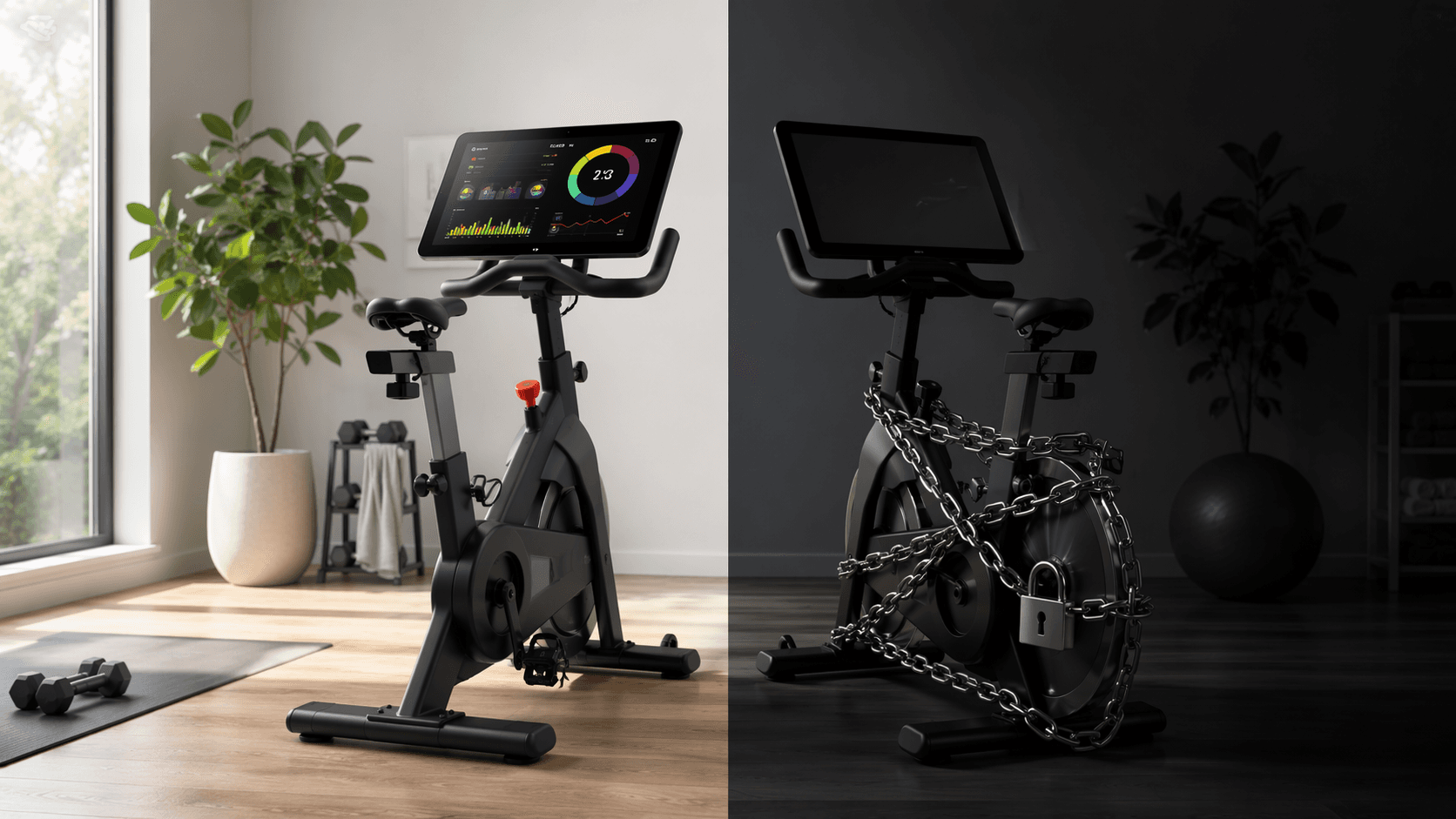
The Lock-In Severity Index
The cleanest way to judge subscription risk is to separate bikes by what remains when the paid service disappears. Not by how nice the app is. Not by how much the classes cost. By what the owner can still do without a live membership.
| Tier | What cancellation does | Typical examples | Buyer meaning |
|---|---|---|---|
| Tier 1: Completely Bricked | No usable workout, no meaningful metrics, no offline or manual operation on affected firmware | Echelon devices updated to post-July 2025 firmware, based on available reports | Avoid if long-term ownership control matters |
| Tier 2: Limited Manual Mode | Bike still works manually, but coaching, saved history, auto-adjustment, leaderboards, and richer screen features are locked | Peloton Bike/Bike+ without All-Access; NordicTrack and ProForm without iFit | Acceptable only if basic riding is enough after cancellation |
| Tier 3: Full Freedom | Core console, resistance, metrics, and often third-party app connectivity remain available without a required subscription | Schwinn IC4, Concept2 BikeErg, Schwinn Airdyne AD6, Sole SB1200, many budget mechanical bikes | Best fit for owners who want the machine to keep acting like a machine |
This index is a simplification, and some models sit near the borders. A bike can keep basic console metrics while losing coached programming. Another can work mechanically but lose app convenience. The important distinction is whether the subscription controls content, controls automation, or controls operation itself.
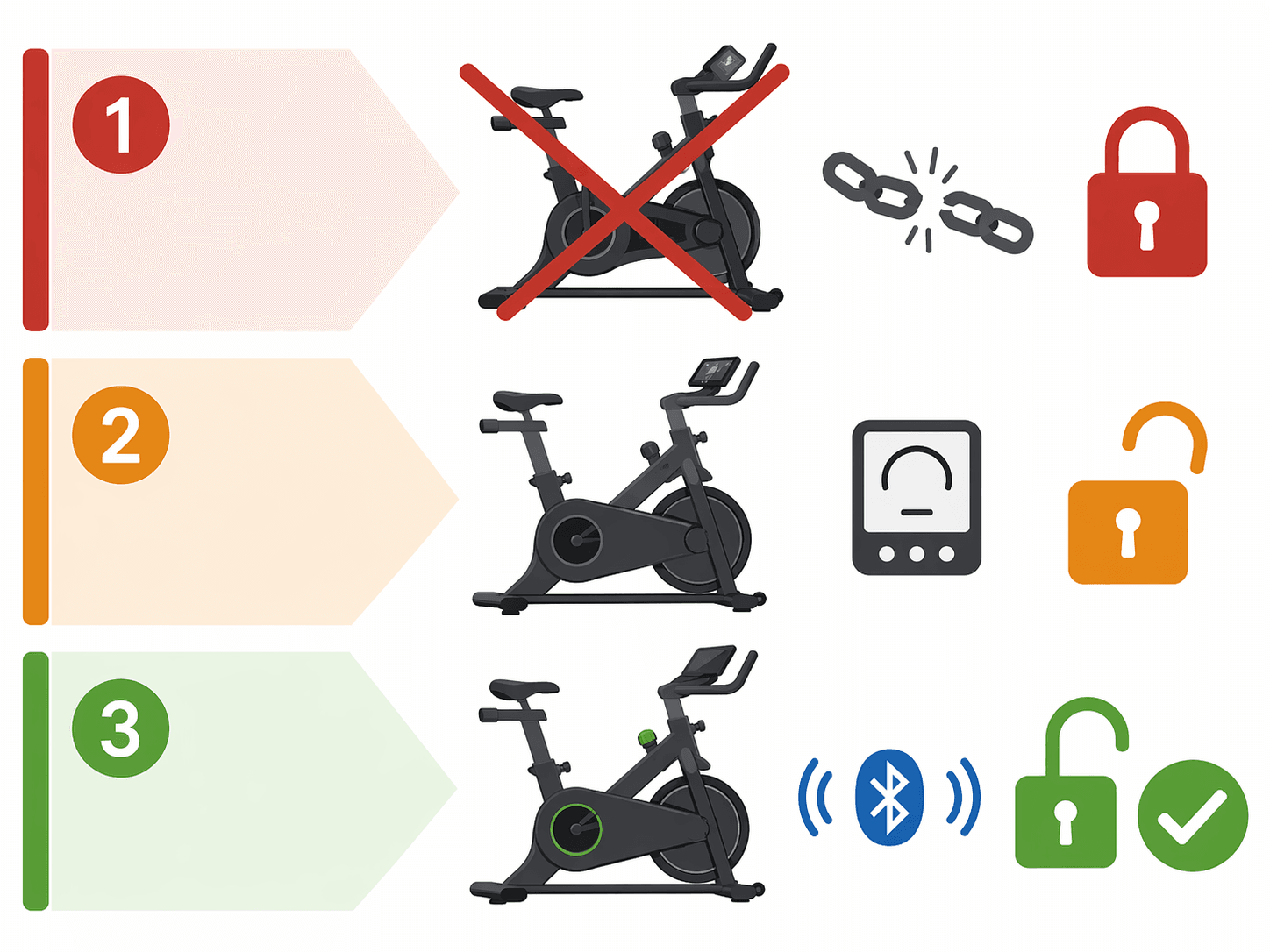
Tier 1: When cancellation can turn the bike into a brick
The Echelon firmware case is the reason this topic cannot be reduced to “subscriptions are annoying.” Ars Technica reported in July 2025 that an Echelon firmware update hindered offline functionality by requiring server authentication for devices to function, leaving affected owners without manual workouts, Bluetooth access, or useful metrics when the membership was not active.[1] Lifehacker described the practical result more bluntly: affected Echelon gym equipment became useless without a subscription.[2]
That is a different category from losing instructor-led classes. It means the hardware can still be physically present in the room, the pedals can still be attached, and the screen can still exist, but the ordinary baseline expectation — get on, start a manual ride, see what you are doing — is gone on affected devices.
The scope deserves care. The documented lockout applies to devices that received the post-July 2025 firmware behavior described in those reports. Older units, never-connected units, or bikes left on earlier firmware may not behave the same way. That caveat does not make the issue trivial; it makes it harder for buyers. A second-hand shopper may not know which firmware is installed, whether the bike was connected after July 2025, or whether an update can be avoided safely.
The repair angle makes the ownership problem sharper. 404 Media reported on a developer who had reverse-engineered a way to unlock newly restricted Echelon bikes but said he could not legally release the software because of DMCA-related risk.[3] Roberto Viola, developer of the QZ fitness app, wrote that Echelon’s changes broke the way his app interacted with the equipment and described the update path as irreversible once installed.[4] Zwift forum users also reported disruption for Echelon bike setups, which matters because many owners bought these bikes partly to avoid being trapped in a single app ecosystem.[5]
This is the highest lock-in tier because the loss is operational, not decorative. It is not just “no leaderboard.” It is no normal manual use on affected firmware. It is no simple fallback to a third-party app. It is the kind of failure that makes a used listing hard to evaluate and makes a firmware update feel less like maintenance than a transfer of control.
What to check before buying a used Echelon
- Ask the seller to show the bike starting a manual workout without an active paid membership.
- Ask whether the bike was connected to the internet after the July 2025 firmware change.
- Do not assume “it powers on” means “it works.” The relevant test is whether it records a ride, displays metrics, and allows resistance use without subscription authentication.
- Treat firmware uncertainty as a real purchase risk, not a minor missing accessory.
Tier 2: Bikes that still ride, but only in a narrowed form
The middle tier is where most confusion lives. These bikes are not bricked after cancellation. They still provide a usable workout. But the gap between “usable” and “works like it did when I bought it” can be wide.
Peloton Bike and Bike+: Just Ride survives, the Peloton experience does not
Peloton sits firmly in Tier 2 based on the available analysis. Without the All-Access subscription, the Bike and Bike+ retain Just Ride access and basic workout metrics such as speed, cadence, resistance, and wattage, along with a small number of sample classes, while losing saved workout history, leaderboard participation, auto-resistance follow, and the full class-and-screen programming experience.[6] The All-Access subscription price is $44 per month in the U.S. as of mid-2026.
That is a substantial downgrade, but it is not the same as bricking. A canceled Peloton can still serve as a manually ridden indoor bike. The owner who mainly wants coached classes and the social layer will feel the loss immediately. The owner who wants a quiet manual ride while watching something else may tolerate it.
There is some uncertainty around metric display in Just Ride because user reports have not always matched support-facing claims after software changes. The safest way to treat Peloton is not as “fully free after cancellation,” but as “manual riding survives, premium behavior does not.” If metrics are non-negotiable, verify the current Just Ride behavior on the exact software version before buying used.
NordicTrack and ProForm: manual mode remains, SmartAdjust does not
NordicTrack and ProForm connected bikes follow a similar middle-tier pattern. Available reviews and buying guides indicate that the bikes can still operate manually without iFit, but automated features such as SmartAdjust and auto-follow resistance or incline are subscription-controlled.[7][9] The iFit Family price is $39 per month in the U.S. as of mid-2026.
That distinction is important for riders who buy these machines because they want the bike to change resistance for them during classes or terrain-based workouts. If those automated changes are the reason the bike costs more than a simpler model, cancellation removes part of the value proposition. If manual riding is acceptable, the hardware still has a fallback.
This is also where sales language can get slippery. “Premium features require membership” is fair when it means coached workouts, saved history, leaderboard placement, or automatic resistance. It becomes much less fair when the phrase hides the fact that basic operation depends on a paid account. Peloton and NordicTrack-style limitations belong in a different risk bucket from the Echelon firmware case because the bike is still a bike after cancellation.
Tier 3: Bikes that keep working because the subscription was never the key
The full-freedom tier is less dramatic because the design is less dependent on permission. These bikes may still work with paid apps, but the app is optional. The console, resistance, and workout basics are not held behind a membership gate.
Schwinn IC4 is the clean benchmark
The Schwinn IC4 is the easiest Tier 3 benchmark because the supported facts line up with what ownership should look like. Garage Gym Reviews and Steady Athlete describe it as a subscription-free indoor bike with a manual console, 100-level magnetic resistance, visible workout metrics, and Bluetooth FTMS compatibility for third-party apps such as Zwift, Peloton Digital, and JRNY.[7][8]
Bluetooth FTMS matters because it is not just a convenience label. It gives the bike a better chance of communicating with multiple fitness apps instead of behaving like a captive terminal for one platform. An owner can ride manually, pair with an app, leave the app later, and still have a functional console.
The IC4 will not replicate the full Peloton Bike experience. It does not need to. Its strength is that the core machine is not waiting for a subscription to decide whether cadence and resistance are allowed to exist.
Air bikes, BikeErg-style machines, and mechanical budget bikes
The same independence logic applies to simpler machines such as the Concept2 BikeErg, Schwinn Airdyne AD6, Rogue Echo Bike, Sole SB1200, Yosuda, Sunny, and other budget mechanical or mostly mechanical bikes identified in subscription-free roundups.[8] They may not offer the same polished class interface, but their basic function is not entangled with a paid content account.
A fan bike is loud and blunt. A budget magnetic bike may have a plain console and fewer connected features. Those trade-offs are real. But there is dignity in a bike that becomes less fancy, not less usable, when an app changes terms or a company stops supporting a feature.
How to use the index before you buy
Start with the minimum function you insist on keeping without a subscription. For one rider, that may be only resistance and time. For another, it may include cadence, watts, heart-rate pairing, and Bluetooth app compatibility. The right bike changes depending on that floor.
- If you require the bike to work fully offline, avoid Tier 1 risk entirely.
- If you are comfortable losing classes, history, leaderboards, and automation, Tier 2 may be acceptable.
- If you want long-term independence, prioritize Tier 3 bikes with manual consoles, mechanical resistance systems, or Bluetooth FTMS.
- If buying used, ask the seller to demonstrate the exact no-subscription mode on video, not just power-on status.
Then separate financial cost from functional control. A $44 monthly class subscription and a $39 monthly training platform can be worth it to the right rider. The problem is not paying for instruction, software, music licensing, servers, and production. The problem is discovering that the machine’s baseline operation was bundled into the same payment. For the cost side, use a true five-year exercise bike cost guide or a subscription cost breakdown. For the ownership side, keep using the lock-in tier.
If you are still choosing between spin bikes, upright bikes, recumbents, and air bikes, step back before comparing apps. A home exercise bike buying guide or a bike-type selection guide will help you decide what kind of ride you actually want. Once that is clear, a broader best home exercise bike decision matrix can make more sense because subscription appetite becomes one factor instead of a hidden trap.
The buyer rule
Choose the bike by the amount of function you insist on keeping without permission from a subscription account or firmware server. Avoid fully bricked risk if ownership control matters. Accept limited manual mode only if you are genuinely comfortable losing coached, saved, social, and automated features. Prioritize subscription-free or Bluetooth FTMS-compatible bikes if you want the machine to remain useful years after the app relationship changes.
References
- Echelon kills smart home gym equipment offline capabilities with update — Ars Technica
- Your Echelon Gym Equipment Is Now Useless Without a Subscription — Lifehacker
- Developer Unlocks Newly Enshittified Echelon Exercise Bikes But Can't Legally Release His Software — 404 Media
- How I Built QZ—and How Echelon Is Now Breaking It — Roberto Viola
- Echelon bike users - warning! — Zwift Forums
- Can You Use Peloton Bike Without Subscription? — Road Hybrid Bike
- Best Exercise Bikes (2026) — Garage Gym Reviews
- Best Exercise Bikes Without a Subscription (2026) — Steady Athlete
- The Best Exercise Bikes of 2026 — Outdoor Gear Lab

Comments
Join the discussion with an anonymous comment.