
I have watched too many people buy a walking pad thinking it will serve as their primary home fitness machine, only to discover six months later that they cannot increase speed or add incline. The walking pad sits under the desk unused, and they end up spending another thousand dollars on a real treadmill. The opposite happens too: someone drops $1,200 on a full treadmill for a corner that only fits a folding pad. The failure is not about which product is better. It is about skipping three constraint checks before you compare any model.
Most articles treat walking pads and treadmills as two interchangeable choices differentiated only by price and footprint. They are not. A walking pad typically caps at 4 mph with no incline. A full treadmill can go 10–12 mph and incline up to 15%. That is not a minor spec gap. It is the difference between a walking pad that will never match outdoor walking intensity and a treadmill that can grow with you. The warranty gap is even starker. Walking pads carry 90-day to 1-year warranties (the Goplus 2-in-1 has 90 days; the GoYouth has 1 year), while budget treadmills under $1,000 like the Horizon T101 come with a lifetime frame and motor warranty. A 90-day warranty on a $300 purchase means you are effectively self-insuring after three months. That changes the total cost picture entirely.
The remedy is a decision framework that forces you to answer three questions before you look at any product. These are the constraints that actually determine whether you should buy a walking pad, a full treadmill, or—only in narrow cases—a hybrid 2-in-1.
Where will you walk?
This is the simplest question, and it eliminates half the options immediately. If the primary walking spot is under a standing desk in your home office, a walking pad fits. Its compact deck (the WalkingPad P1 is 16.5 by 47.24 inches) slides right under, and you can fold it away when you stand. If you plan to walk in a dedicated corner of your living room, spare bedroom, or garage, a full treadmill works. Even a folding treadmill needs about 6 feet of clearance behind it. The decision comes down to geometry and use-case. The split scene below captures the two realities.
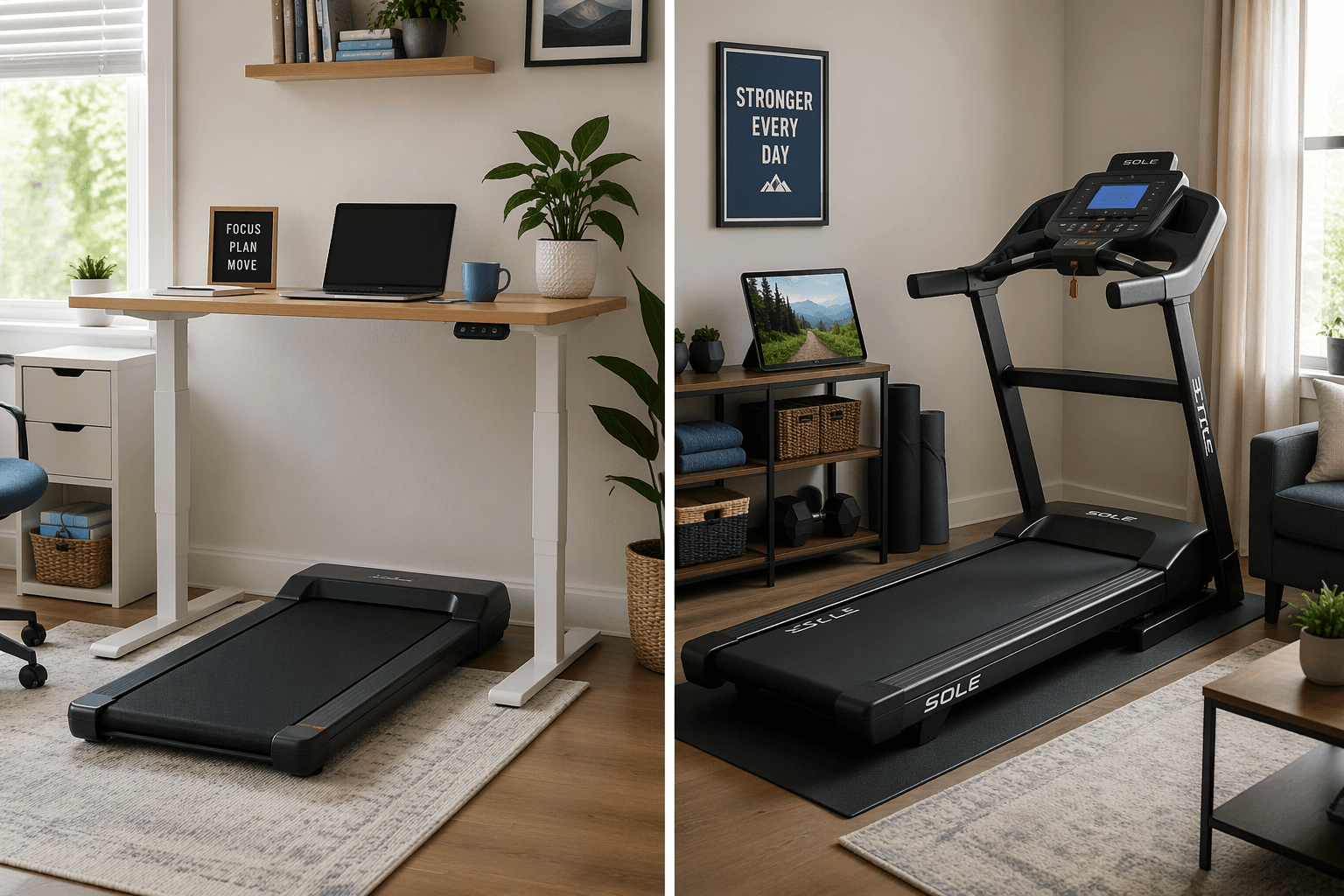
How hard do you want to walk?
If you only want slow, flat walking while you answer emails, a walking pad handles that. Its typical max speed is 3–4 mph, and almost no walking pad offers an incline. The Merach W50 is a rare exception: it has 12% incline but still caps at 4 mph. But if you ever want to increase intensity, add incline to match outdoor walking (a 1% incline on a treadmill closely mimics outdoor walking energy expenditure, per Health.com), or eventually jog, a walking pad is a dead end. A full treadmill with 10–15% incline and speeds up to 12 mph gives you room to progress. The table below shows how the two categories stack up on the dimensions that matter for a walking workout.
| Dimension | Walking Pad | Full Treadmill |
|---|---|---|
| Max speed | 3–4 mph | 10–12 mph |
| Incline | None (rare exception: 12% at 4 mph) | 10–15% |
| Outdoor walking match | No — flat surface under-delivers | Yes — 1% incline matches outdoor |
| Progression potential | None beyond speed within cap | Speed + incline + eventually jogging |
| Typical price | $200–$600 | $600–$2,500+ |
What's the total cost picture?
Upfront price is the trap. A walking pad looks cheap at $249 (GoYouth). A budget treadmill like the Horizon T101 costs $649. But compare the warranties: the GoYouth has a 1-year warranty; the Horizon has a lifetime frame and motor warranty. If you walk daily and the motor fails in year three, the walking pad is a total loss, while the treadmill is covered. Over five years, the walking pad has effectively cost you $50 per year of coverage, then $0 coverage for years two through five. The treadmill's lifetime warranty means you pay $649 once and are covered for the life of the machine. I have looked at this carefully in our deep dive on treadmill total cost of ownership, and the pattern is consistent: walking pads have 90-day to 1-year warranties; budget treadmills under $1,000 often have lifetime motor/frame coverage.
| Product | Upfront Price | Warranty | 3-Year Total Cost at Risk |
|---|---|---|---|
| GoYouth 2-in-1 (walking pad) | $249 | 1 year | $249 if fails year 2, plus full replacement |
| Goplus 2-in-1 | $299 (est.) | 90 days | $299 if fails after 3 months |
| Horizon T101 | $649 | Lifetime frame/motor | $649 — no additional risk |
| Sole F63 | $1,199 | Lifetime frame/motor | $1,199 — no additional risk |
The 2-in-1: a narrow solution for specific users
A small group of 2-in-1 folding treadmills try to bridge the gap. They can be used under a desk (walking mode) and also inclined for walking or jogging. The Goplus 2-in-1 is the best-known example. After testing with more than 30 panelists, Wirecutter noted that the belt started fraying after a few weeks. Its 90-day warranty and 265-lb weight limit make it a risky buy for anyone who plans to use it daily. The UREVO Strol 2E also lists 265 lbs, but Garage Gym Reviews found it felt unstable near that limit. These machines are heavier (45+ lbs) and harder to move, and they still lack the deck length and incline range of a full treadmill. They work only for lighter, shorter users (under 5'10", under 265 lbs, willing to accept a 40-inch deck) who want occasional incline walking at a desk. For anyone else, they are a compromise that solves neither use case well.
So which one fits?
Now that you have answered the three questions, the mapping is straightforward. The table below will help you land on the right category before you compare specific models.
| If your answers are... | Then your category is |
|---|---|
| Desk use, flat slow walking, budget under $600 | Walking pad — e.g., WalkingPad P1 or GoYouth |
| Dedicated space, want incline and progression, willing to spend $600+ | Full treadmill — e.g., Horizon T101 or Sole F63 |
| Desk use, occasional incline, under 5'10" and 265 lbs, short-term solution | Hybrid 2-in-1 — but know the limits |
| Not sure yet about space or ambition | Start with apartment-friendly full treadmill options — see our guide below |
If you have decided on a full treadmill and want specific picks for walking, we have curated eight expert-tested options in our Best Home Treadmill for Walking (2026) guide. If you need help fitting the machine into a small apartment, our guide on what home gym equipment actually fits in a small space covers footprint, ceiling height, and noise considerations. And for a deeper look at how warranty and subscription costs affect long-term value, see The True Cost of a Folding Treadmill for Home.
The framework works because it forces you to look at the real constraints: where you'll put it, how hard you want to walk, and what you'll pay over time. Skip these questions and you risk buying a machine that does not match your living space, your fitness ambitions, or your budget. Map your constraints first, then compare products.
Comments
Join the discussion with an anonymous comment.