
The $1,695 Bike That Really Costs $3,494
A Peloton Bike costs $1,695. That is the number on the product page, the number in the checkout cart, the number most people remember. But the bike requires Peloton All-Access at $49.99 per month to work with its built-in screen. Over three years that adds $1,799.64. The bike you thought cost $1,695 actually costs $3,494.64. The subscription alone is more than the bike.
This is not a Peloton-specific problem. Every major connected exercise bike has a subscription that, over two to three years, can exceed the purchase price. Most buyer guides focus on hardware specs, screen size, resistance type, and footprint. They treat the monthly fee as a footnote. I start with the subscription and work backward to the bike.
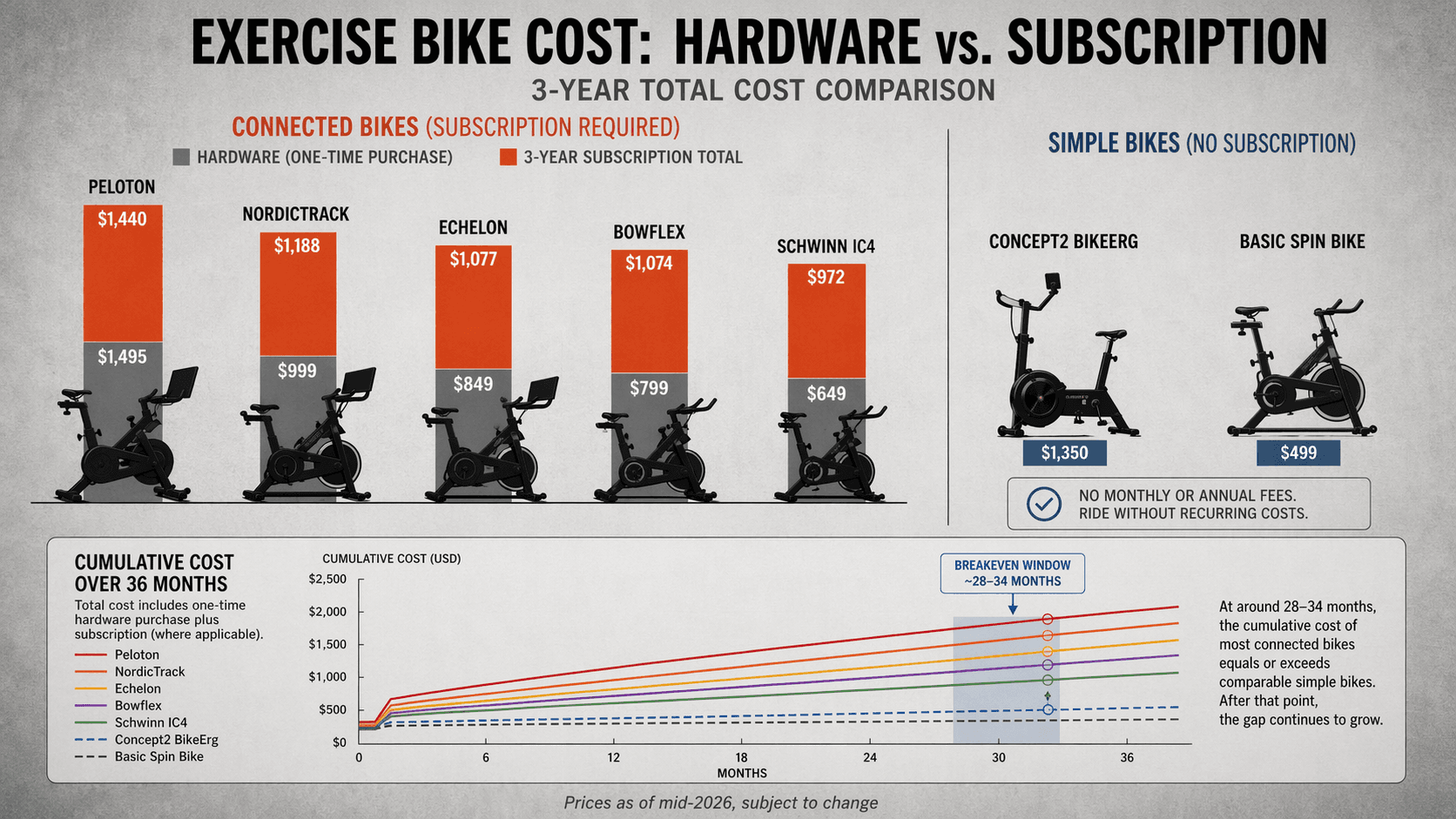
3-Year Totals: The Real Price Tag
Here is the 3-year total cost for the most popular connected exercise bikes, plus the subscription-free benchmark. I use the subscription tier required to make the bike’s built-in screen fully functional — not the cheaper mobile-only tier that marketers often mention first.
| Bike | Hardware Price | Required Subscription | Monthly Cost | 3-Year Sub Total | Total 3-Year Cost |
|---|---|---|---|---|---|
| Peloton Bike | $1,695 | All-Access | $49.99 | $1,799.64 | $3,494.64 |
| NordicTrack X24 | $1,999.99 | iFIT Pro | $39.00 | $1,404.00 | $3,403.99 |
| Echelon EX-5 | $1,499.99 | Premier (monthly) | $39.99 | $1,439.64 | $2,939.63 |
| Bowflex VeloCore | $2,199.00 | JRNY All-Access | $19.99 | $719.64 | $2,918.64 |
| Concept2 BikeErg | $1,100.00 | None | $0.00 | $0.00 | $1,100.00 |
The Concept2 BikeErg sits at the bottom not because it has better hardware — it has none of the connected features — but because it costs less than half of any connected bike over three years. More on that later.
Why You Can’t Really Skip the Subscription on Most Bikes
A common thought: “I’ll just buy the bike and follow free YouTube workouts.” On a connected bike, that rarely works as expected.
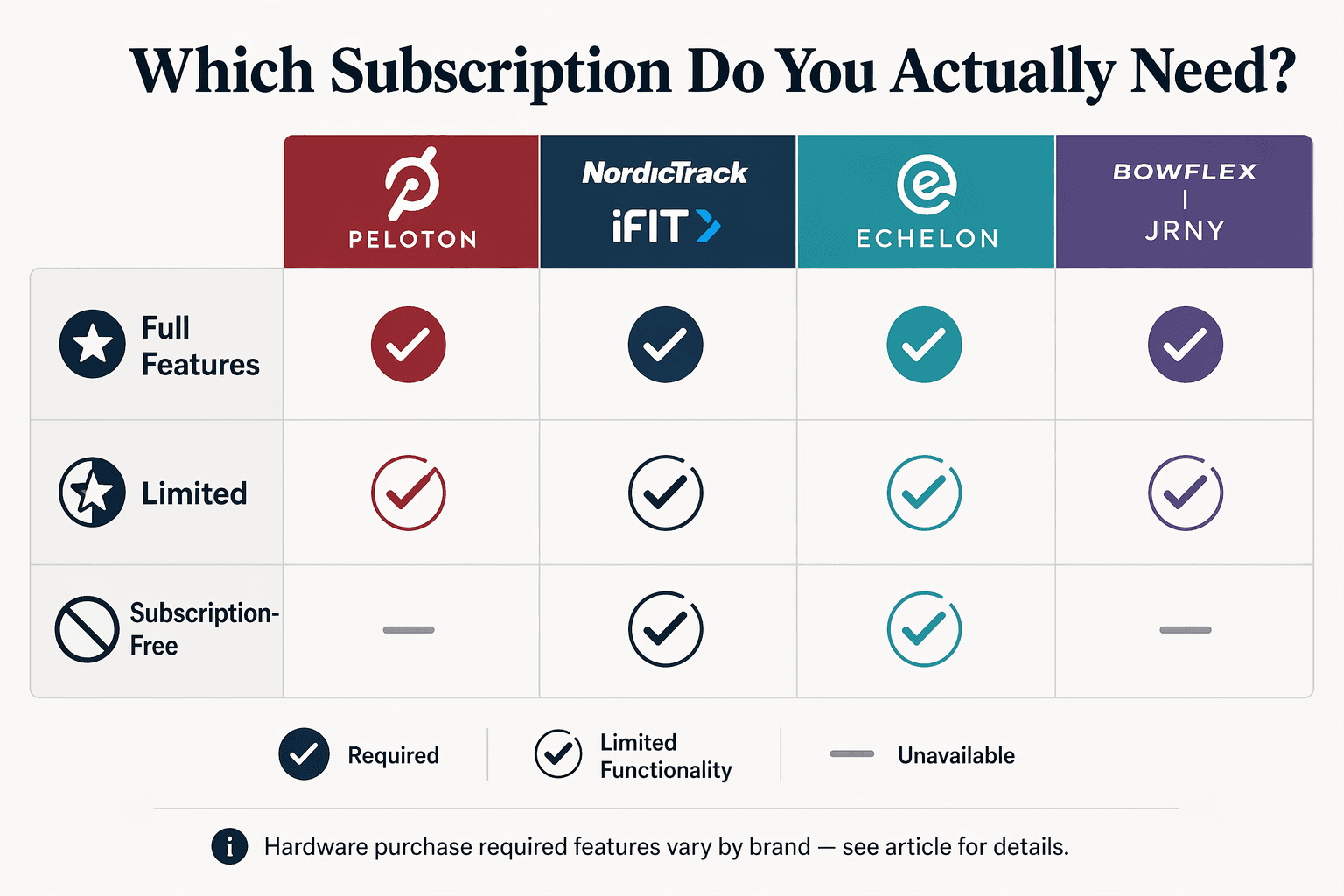
Peloton’s All-Access membership is required to operate the bike’s touchscreen. You cannot pair the screen with the cheaper App One ($15.99/mo) or App+ ($28.99/mo) tiers — those only work on your own phone or tablet. The screen you paid for is a paperweight without the $49.99 tier.
NordicTrack’s iFIT Pro ($39/mo) is the only tier that works with the built-in display on the X24 and other NordicTrack/ProForm machines. The cheaper iFIT Train ($15/mo) is limited to a phone or tablet; it cannot talk to the bike’s hardware. Most buyers do not know this until after they unbox the machine.
Bowflex’s JRNY has a free-forever tier with a limited library of workouts, but it does not include trainer-led classes or entertainment streaming on the touchscreen. To use the screen as intended, you need JRNY All-Access at $19.99/mo (or $149/year).
Peloton and NordicTrack: The $50 and $39 Traps
These two brands have the highest subscriptions and also the highest hardware prices. Their 3-year totals are within $90 of each other: $3,494 for the Peloton Bike, $3,404 for the NordicTrack X24. The subscription accounts for 41% of the total in both cases.
A casual rider using Peloton All-Access three times per week pays about $3.84 per workout in subscription fees alone. ( $49.99 × 36 months = $1,799.64 ÷ 468 workouts = $3.84. ) That is more than many gym memberships on a per-visit basis.
NordicTrack owners have an option: if they are willing to use their own tablet instead of the bike’s built-in screen, they could subscribe to iFIT Train at $15/mo instead of iFIT Pro at $39/mo. That brings the 3-year subscription cost down from $1,404 to $540, saving $864. But most people who pay for a premium touchscreen want to use it.
Echelon and Bowflex: Cheaper Upfront, but Watch the Fine Print
Both brands market lower hardware prices than Peloton, but their subscription structures can mislead.
Echelon’s Premier tier is $39.99/month billed monthly, or $33.33/month billed annually ($399.99/year). The annual plan saves about $80 per year — worth taking if you plan to keep the bike. But do not confuse the $11.99 FitPass with a bargain. FitPass is for off-equipment workouts only. The moment you bought an Echelon bike, you locked yourself into Premier for the bike classes.
Bowflex’s JRNY All-Access at $19.99/month ($149/year) is cheaper than Peloton or Echelon. If you use the annual plan, the monthly equivalent drops to $12.42. That is the lowest monthly cost among the connected bikes for a full-feature plan. But the free tier is so limited that most buyers will upgrade within the first week. The decision is not whether to subscribe, but whether to pay $11.99/mo for the mobile-only plan (which means ignoring the touchscreen) or $19.99/mo for the full experience.
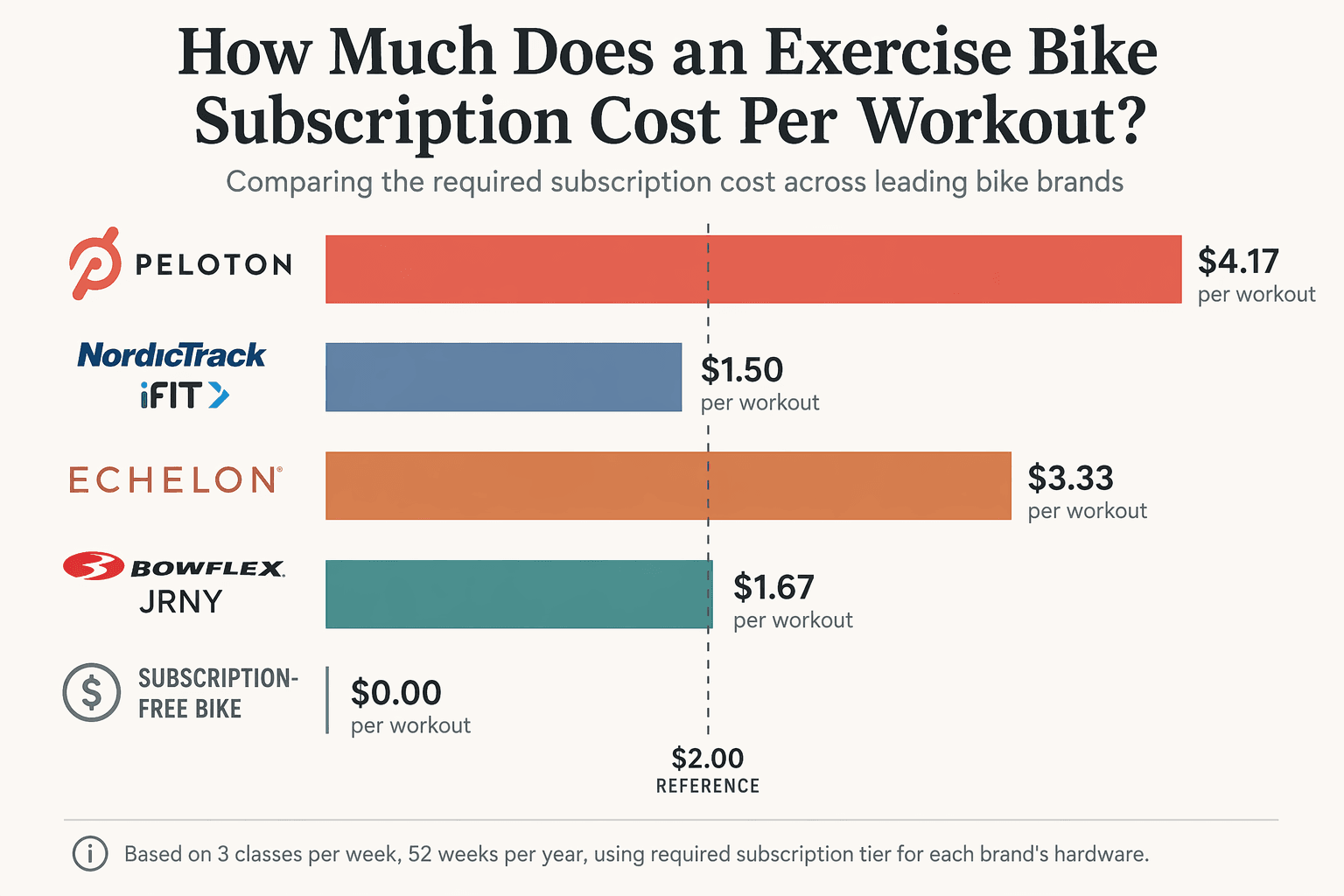
Your Cost Per Ride: $0.00 to $3.84
The table below translates monthly subscription fees into a per-workout cost at three rides per week. This is the most honest number: what you pay every time you clip in.
| Bike | Monthly Subscription (Required Tier) | 3-Year Sub Total | Per-Workout Cost (3x/week) |
|---|---|---|---|
| Peloton Bike | $49.99 (All-Access) | $1,799.64 | $3.84 |
| NordicTrack X24 | $39.00 (iFIT Pro) | $1,404.00 | $3.00 |
| Echelon EX-5 | $39.99 (Premier monthly) | $1,439.64 | $3.08 |
| Bowflex VeloCore | $12.42 (JRNY All-Access annual) | $447.12 | $0.96 |
| Concept2 BikeErg | $0.00 (none) | $0.00 | $0.00 |
Riding more often lowers the per-workout cost but raises the absolute spend. A daily rider (7x/week) paying Peloton All-Access would see per-workout cost drop to $1.64 — $1,799.64 ÷ 1,092 workouts — but still pays the same $1,799.64 total. The subscription does not care how often you pedal.
The Subscription-Free Anchor: Concept2 BikeErg and Your Options
The Concept2 BikeErg costs $1,100. No subscription. No screen. No classes. It is a fan-resistance air bike with a simple performance monitor that shows distance, pace, and calories. It is the same brand that builds the rowing machines found in CrossFit boxes and rowing clubs worldwide.
Over three years, the BikeErg saves $2,394.64 compared to the Peloton Bike ($3,494.64 – $1,100). That is enough to buy a second BikeErg and have money left over.
The trade-off is real: no instructor-led rides, no leaderboard, no entertainment streaming on a 24-inch screen. But if you already own a tablet or phone, you can subscribe to a standalone app like Peloton App One ($15.99/mo) or iFIT Train ($15/mo) for a fraction of the hardware-locked subscription. Suddenly the BikeErg plus a $15 app subscription costs $1,100 + $540 over three years = $1,640 — still $1,855 less than the Peloton bike alone.
Verdict: When the Subscription Is Worth It, and When It's Not
The data says one thing clearly: for most budget-conscious buyers, a subscription-free bike like the Concept2 BikeErg saves thousands over three years. The connected features are fun, but they cost more than the bike itself.
That said, subscriptions have real value for certain riders. If you ride five or more times per week, if you rely on the coaching and community, and if the per-workout cost of $2–$4 feels reasonable for a session you would otherwise pay $20–$30 for at a studio, then a connected bike makes sense. The Bowflex VeloCore with JRNY All-Access on the annual plan offers the lowest per-workout cost ($0.96) among connected options, and the Peloton ecosystem still has the largest library of live and on-demand classes.
But before you buy any connected bike, calculate your own 3-year total: hardware price + (monthly subscription × 36). If that number shocks you, consider a subscription-free bike plus a cheap app. The math is simple, but most buyer guides skip it.
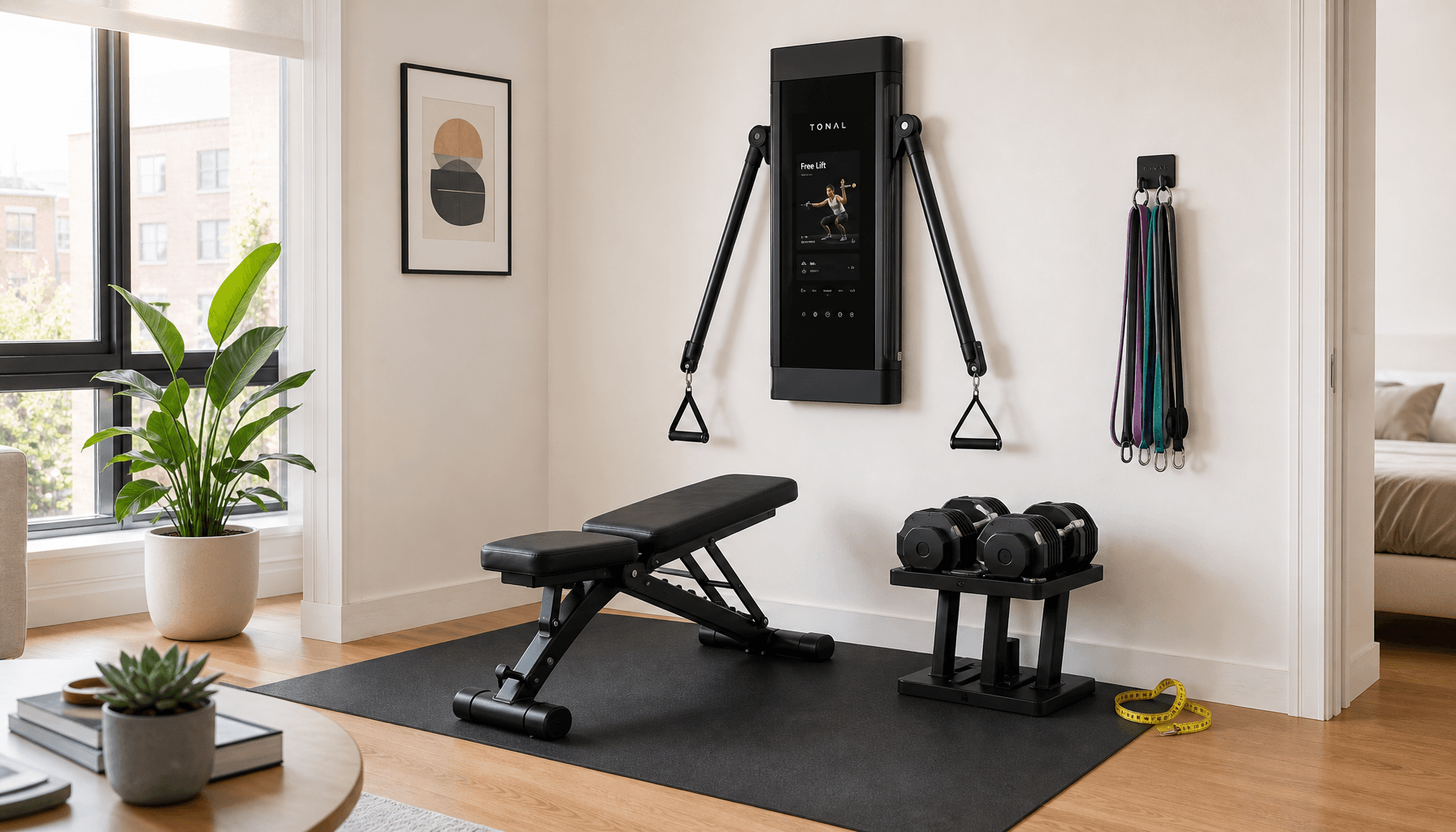
This TCO framework applies beyond bikes. We used the same approach for the Tonal home gym, and the conclusion is the same: the subscription is the cost driver, not the hardware. Evaluate the recurring expense before comparing resistance types.

Comments
Join the discussion with an anonymous comment.