
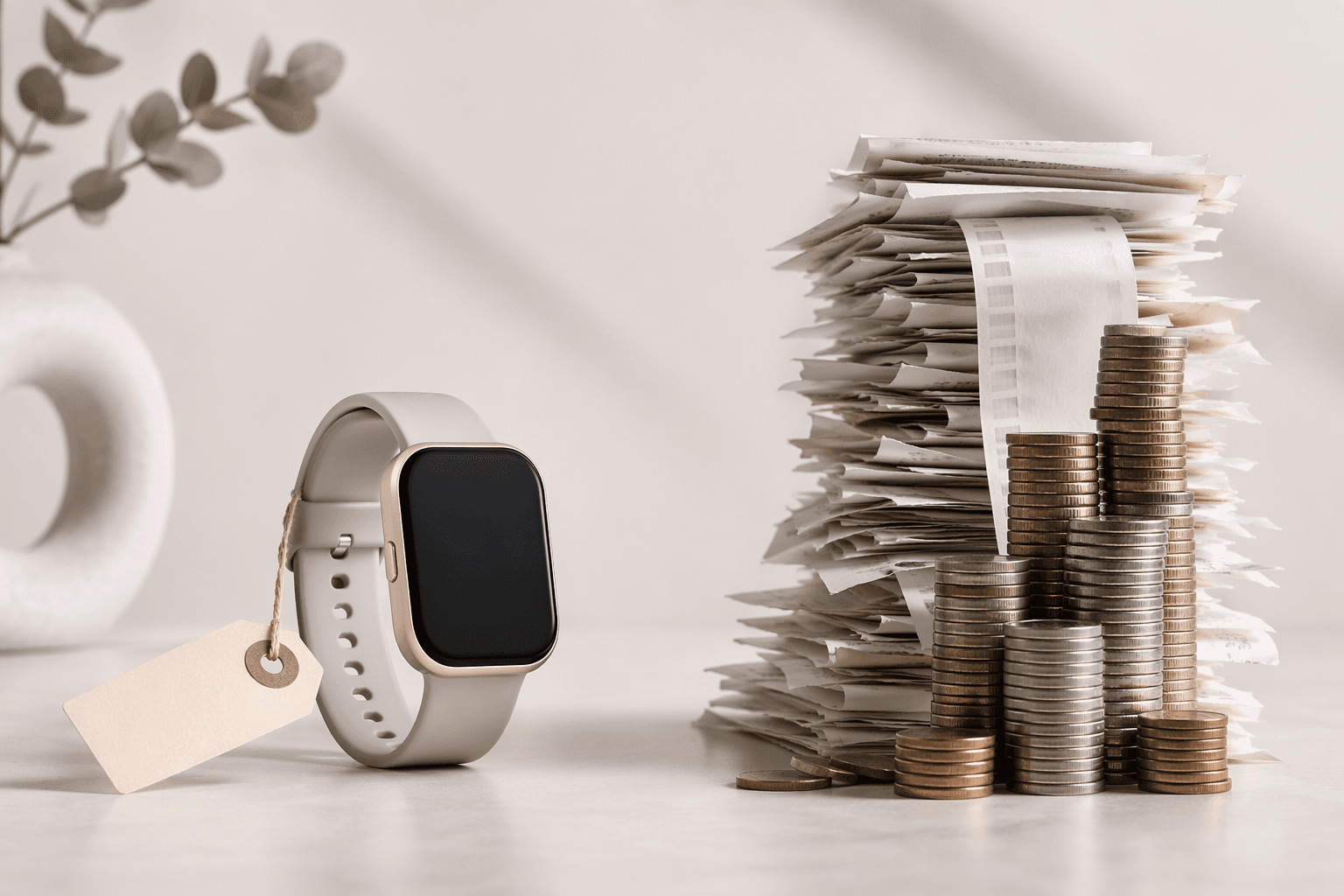
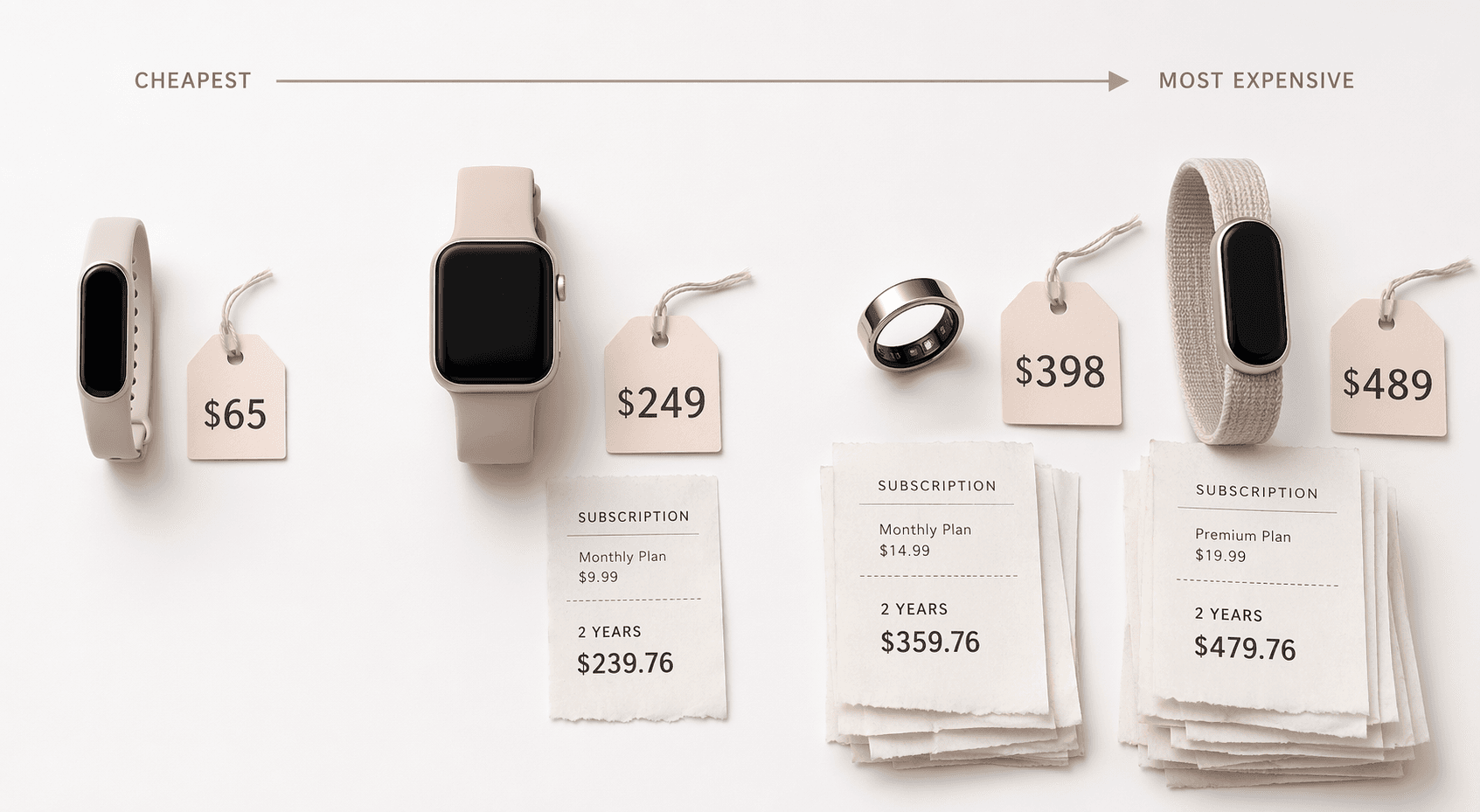
As of June 2026, the best fitness tracker for women is not necessarily the one with the lowest checkout price. The real comparison starts after you add the subscription that unlocks sleep detail, stress scores, recovery coaching, fertility-adjacent tools, or the app experience that made the device look useful in the first place. A $0 tracker can become a $398 two-year purchase; a $349 ring can become $489; a $64.99 watch can stay $64.99.
This comparison uses a two-year ownership window because that is long enough for subscription models to stop looking like small add-ons and start acting like part of the purchase price. Prices and subscription terms are current to the available June 2026 information and can change.
The two-year cost table
| Device | Type | Upfront price (June 2026) | Subscription | Two-year cost used here | Women’s health and sleep/recovery features included without a required paid plan | What is paywalled or uncertain |
|---|---|---|---|---|---|---|
| Amazfit Active 2 | Watch | $64.99 | No required subscription | $64.99 | Sleep tracking, health metrics, AMOLED screen, GPS, 160+ sport modes, and cycle-related app features are included in the no-subscription value case. | Long-term independent validation is thinner than for the bigger platforms. |
| Amazfit Bip 6 | Watch | $79.99 | No required subscription | $79.99 | Sleep tracking, health metrics, AMOLED screen, GPS, 160+ sport modes, and cycle-related app features without a required paid plan. | The value is strong on paper; buyers should still be conservative about medical-style interpretations. |
| Fitbit Inspire 3 | Slim band | $79.95 | Optional Fitbit Premium at $80/year | $79.95 without Premium; $239.95 with two years of Premium | Core step, sleep, and heart-rate tracking do not require Premium. | Advanced insights such as stress score, deeper sleep breakdown, and wellness reports require Premium. |
| Apple Watch SE 3 | Smartwatch | $249 | No required subscription for core Apple Health/Fitness tracking | $249 | Core health, activity, sleep, and cycle logging through Apple’s ecosystem without a required tracker subscription. | Best value depends heavily on already using an iPhone. |
| Garmin Lily 2 | Small watch | $249 | No required subscription for Garmin Connect health metrics | $249 | Body Battery, sleep, stress, and cycle tracking through Garmin Connect without a required paid plan. | No built-in GPS and a grayscale display; phone-connected GPS may matter for runners. |
| Whoop 5.0 | Screenless band | $0 hardware | Required membership at $199/year | $398 | The coaching-style experience is included only while membership is active. | The band loses most of its usefulness when the subscription stops; there is no meaningful one-time-purchase version. |
| Garmin Venu 3S | Small smartwatch | $449 | No required subscription for Garmin Connect health metrics | $449 | Body Battery, sleep, stress, cycle tracking, recovery-adjacent insights, and broader smartwatch health metrics without a required paid plan. | Higher upfront cost, but the two-year price is clean. |
| Oura Ring 4 | Ring | $349 | Membership at $70/year for the full experience | $489 | Ring form factor, sleep and recovery platform, and access to the Oura ecosystem. | The recurring membership is central to the full experience; fertility-adjacent value depends partly on integrations such as Natural Cycles. |
| Fitbit Charge 6 | Band | Not specified in available June 2026 pricing | Optional Fitbit Premium at $80/year | Hardware price plus $0 to $160 over two years, depending on Premium | Core Fitbit tracking is available without Premium. | Advanced Fitbit insights follow the same Premium problem: decide before buying whether those insights are part of what you actually want. |
| Fitbit Air | Screenless or minimalist tracker | Not specified in available June 2026 pricing | Premium relationship should be checked at purchase | Not calculated from available June 2026 pricing | Too new for settled long-term performance claims. | Released in May 2026, so any durability, accuracy, and subscription-value claims should be treated as preliminary. |
| Circular Ring | Ring | Not specified in available June 2026 pricing | No required subscription identified in available June 2026 information | Hardware price only, based on available June 2026 information | Positioned as a sleep/recovery/cycle-tracking ring alternative without a required subscription. | Comparable feature claims need to be separated from independent validation. |
| Bond Ring | Ring | Not specified in available June 2026 pricing | No required subscription identified in available June 2026 information | Hardware price only, based on available June 2026 information | Positioned as a ring alternative for sleep, recovery, and cycle-related tracking without a required subscription. | Independent long-term evidence is more limited in the available June 2026 information. |
The most annoying row in that table is Whoop, because it proves why checkout price is a bad proxy for value. Whoop 5.0 can look free at the hardware level, but the required $199/year membership makes it a $398 two-year purchase, and the band is not a normal one-time fitness tracker if you stop paying.
Oura Ring 4 has a different problem. It is not pretending to be free: the hardware starts at $349 in the available June 2026 pricing. But once the $70/year membership is included, the two-year cost reaches $489. That may still be worth it for the right buyer, especially someone who wants a ring rather than a watch, cares about Oura’s app experience, and plans to use fertility-related integrations. It should not be mentally filed as a $349 purchase.
The subscription split matters more than the brand name
There are three practical buckets here. The first is the cleanest: no required subscription for the health features most buyers expect. Garmin Lily 2, Garmin Venu 3S, Amazfit Active 2, Amazfit Bip 6, and Apple Watch SE 3 fall into that general camp based on the available June 2026 information. You may still have ecosystem costs elsewhere — an iPhone for Apple Watch, for example — but the tracker itself is not asking you to re-buy its main health dashboard every year.
The second bucket is optional subscription devices, where the hardware works without the paid plan but some of the most interesting interpretation is held back. Fitbit is the obvious example. Fitbit Inspire 3 is a very good low-cost tracker on the basics: Wirecutter reported a 0.32% step-count error rate in its testing, the best result in that comparison. Fitbit Premium is also the gatekeeper for advanced insights such as stress score, deeper sleep breakdown, and wellness reports at $80/year.[1]
The third bucket is subscription-as-product. Whoop belongs here. It is better understood as a coaching membership with a wearable attached, not as a cheap band. Oura sits somewhere between hardware and service: the ring is a real device with a clear form-factor advantage, but the membership is part of the full experience. If you would resent the app becoming less useful when you stop paying, that resentment should be priced in before purchase.
“Has cycle tracking” is too vague to be useful
Cycle tracking can mean several very different things. At the lightest end, it means period logging: you enter dates, symptoms, and maybe flow, and the app estimates future periods from your history. That can be convenient, but it is still mostly a logging and prediction tool. Garmin and Fitbit cycle tools sit closer to this user-logged category than to a clinically validated fertility product.
The next level is cycle context layered into broader wellness metrics. This is where a tracker may show sleep, stress, readiness, or recovery changes across a cycle. That can be genuinely useful if it helps you notice patterns: worse sleep before a period, lower training tolerance during certain weeks, or stress readings that line up with symptoms. It is still not the same as a diagnostic tool, and it should not be sold to yourself as one.
Fertility-adjacent use is the category that deserves the most caution. Oura’s Natural Cycles integration has the strongest published clinical-validation context among the options discussed here, while Garmin and Fitbit rely more on user-logged cycle data with less clinical backing. That does not make Oura the automatic best buy for every woman. It means the extra cost has a more specific justification if fertility-related tracking is the reason you are buying a wearable.
This distinction is where cheap trackers can either be a bargain or a disappointment. If you want reminders, logged symptoms, sleep trends, and a general sense of how your body responds across the month, a no-subscription Garmin or Amazfit may be enough. If you are choosing a device specifically around fertility integrations, the comparison changes, and the Oura membership becomes part of the feature, not just an annoying add-on.
Garmin and Amazfit are the pressure test for every paid plan
Garmin’s strongest argument is not that Lily 2 or Venu 3S is cheap in every case. Venu 3S is $449 upfront, which is not impulse-buy territory. The argument is that the price is legible. Garmin Connect includes health metrics such as Body Battery, sleep, stress, and cycle tracking without requiring a paid plan. Lily 2 is especially relevant for women who want a smaller watch, though DC Rainmaker’s review notes the tradeoffs: no built-in GPS and a grayscale display.[2]
Amazfit is the bargain that makes the entire category uncomfortable. Active 2 at $64.99 and Bip 6 at $79.99, with AMOLED screens, GPS, 160+ sport modes, sleep tracking, and no required subscription, make it hard to defend vague premium-device mystique. The caveat is not nothing: buyers should be more cautious about validation, app polish, and long-term support than they would be with Apple, Garmin, Fitbit, or Oura. But if the question is two-year cost for a general wellness tracker, Amazfit forces every recurring fee to justify itself.
Garmin and Amazfit also help separate “I need coaching” from “I need my data presented clearly.” If what you want is sleep duration, stress trends, cycle logging, workouts, and a watch that does not ask for another $70 to $199 next year, they are the first place I would look.
Fitbit is still tempting, but Premium has to be a conscious choice
Fitbit Inspire 3 is exactly why this comparison should not turn into a subscription rant. At $79.95, it can be a smart buy for someone who wants a slim band, strong basic tracking, and a familiar app. The Wirecutter step-count testing result gives it credibility beyond brand familiarity.[1]
The problem is the line between tracking and interpretation. If you are satisfied with core step, sleep, and heart-rate tracking, Fitbit can stay inexpensive. If the features that sold you are stress scores, richer sleep analysis, and wellness reports, add $160 to your two-year mental price. That moves Inspire 3 from $79.95 to $239.95 over two years with Premium.
Fitbit Charge 6 should be judged the same way, even though available pricing did not provide a hardware price to calculate a clean two-year total here. Do not compare its shelf price against Garmin or Amazfit until you decide whether Premium is part of your real use case. Fitbit Air needs an even larger asterisk because it was released in May 2026; long-term performance and ownership value are not settled.
Oura is expensive, but at least the reason can be specific
Oura Ring 4 is not the value pick. At $489 over two years, it costs more than Garmin Venu 3S in this comparison and far more than Amazfit Active 2. But rings solve a real problem that watch comparisons often treat as cosmetic: some people do not want a screen on their wrist all day and night, and some wrists are simply not comfortable with larger watches.
Oura’s other advantage is ecosystem fit. Women make up nearly 60% of Oura’s user base, making it the most female-dominated wearable ecosystem discussed here. That does not prove better accuracy by itself. It does suggest that the product direction and app experience may be unusually aligned with sleep, recovery, cycle, and fertility-adjacent use cases.
The ring alternatives, Circular Ring and Bond Ring, are worth watching because they are positioned as offering similar sleep, recovery, and cycle-tracking categories without a required subscription. The missing piece is confidence. Without the same depth of long-term independent evidence, I would treat them as promising ways to avoid recurring fees, not as proven Oura replacements for every buyer.
Wrist size is part of the cost equation
A tracker that is technically affordable but too bulky to wear to bed is not affordable. A common fit problem is that many women with wrists under 14 cm find 44–46 mm watch faces too large. That matters for sleep tracking in particular, because the most beautiful recovery dashboard in the world is useless if the watch comes off before midnight.
This is where smaller devices are financially relevant, not just prettier. Garmin Lily 2, Garmin Venu 3S, Fitbit Inspire 3, rings, and screenless bands exist because standard smartwatch sizing does not work for everyone. If a large watch makes you skip nights, the two-year value drops immediately. A smaller tracker with fewer headline features can deliver better real-world value simply because it stays on your body.
For more sizing-specific tradeoffs, the small-wrist problem deserves its own pass; a good starting point is this internal guide to small-wrist fitness trackers. The short version for this comparison: do not pay extra for a device shape you already know you will avoid wearing.
The shortlist by buyer type
- Best two-year value if you want the lowest cost: Amazfit Active 2. At $64.99 with no required subscription, it is the clearest bargain, with the caveat that validation and long-term support should be weighed more carefully than with older ecosystems.
- Best no-subscription small watch: Garmin Lily 2. It is $249, includes Garmin Connect health metrics without a required paid plan, and is designed around a smaller, more jewelry-like watch format. The no built-in GPS tradeoff matters if you run without your phone.
- Best no-subscription fuller smartwatch for women who want more features: Garmin Venu 3S. The $449 upfront price is high, but sleep, stress, Body Battery, cycle tracking, and recovery-adjacent health metrics are not locked behind a required annual fee.
- Best low-cost Fitbit if you do not need Premium: Fitbit Inspire 3. It is inexpensive, slim, and strong on basic tracking. Just decide before buying whether the Premium-only insights are part of the reason you want it.
- Best ring to consider if fertility-adjacent integrations matter: Oura Ring 4. The two-year $489 cost is not casual, but the form factor and ecosystem may justify it for someone who specifically wants a ring and plans to use the membership-supported features.
- Best if you actually want a coaching membership: Whoop 5.0. Buy it only if the $199/year service is the product you want. Do not buy it because the hardware says $0.
If long-term value is the priority, start with Garmin or Amazfit. If you like Fitbit, price Premium honestly before you fall for the hardware price. If Oura’s ring format and fertility-related ecosystem are the point, budget for the membership from day one. If Whoop appeals to you, treat it as an annual coaching bill with a band attached.
All prices here are current to the available June 2026 information. Wearable health metrics are useful for general wellness patterns, but cycle, fertility, recovery, sleep, and stress data should not replace medical advice or decision-making with a healthcare provider.
References
- The Best Fitness Trackers, The New York Times Wirecutter, https://www.nytimes.com/wirecutter/reviews/the-best-fitness-trackers/
- Garmin Lily 2 In-Depth Review, DC Rainmaker, January 2024, https://www.dcrainmaker.com/2024/01/garmin-lily-depth-review.html
Comments
Join the discussion with an anonymous comment.