
Full-Body Dumbbell Workouts for Your Exact Equipment Setup
Not sure what full-body dumbbell workout to do with the equipment you own? This guide provides four research-backed routines matched to your exact gear — from a single dumbbell to a full bench and pull-up bar setup — so you can start training immediately without guesswork.
A lot of “dumbbell-only” plans stop being dumbbell-only the moment you scroll past the warm-up. Suddenly you need a flat bench, a full rack of weight jumps, enough floor space for long walking lunges, and maybe a pull-up bar the title forgot to mention. That does not make your setup bad. It means the workout was written for a different room.
Use this selector first. Pick the row that matches the equipment you can train with today, then run that workout for two to three non-consecutive days per week. If you train Monday, Wednesday, and Friday, that works. If your life only allows Tuesday and Saturday, that works too.
| Your setup | Use this workout | What the plan has to solve |
|---|---|---|
| One dumbbell | Tier 1 | One load, no bench, limited exercise symmetry |
| Two dumbbells, no bench | Tier 2 | No chest support, no bench pressing angle, apartment-friendly space |
| Two dumbbells plus bench | Tier 3 | More pressing and support options, but still no true vertical pull |
| Two dumbbells, bench, and pull-up bar | Tier 4 | Most complete home setup, with vertical pulling finally covered |
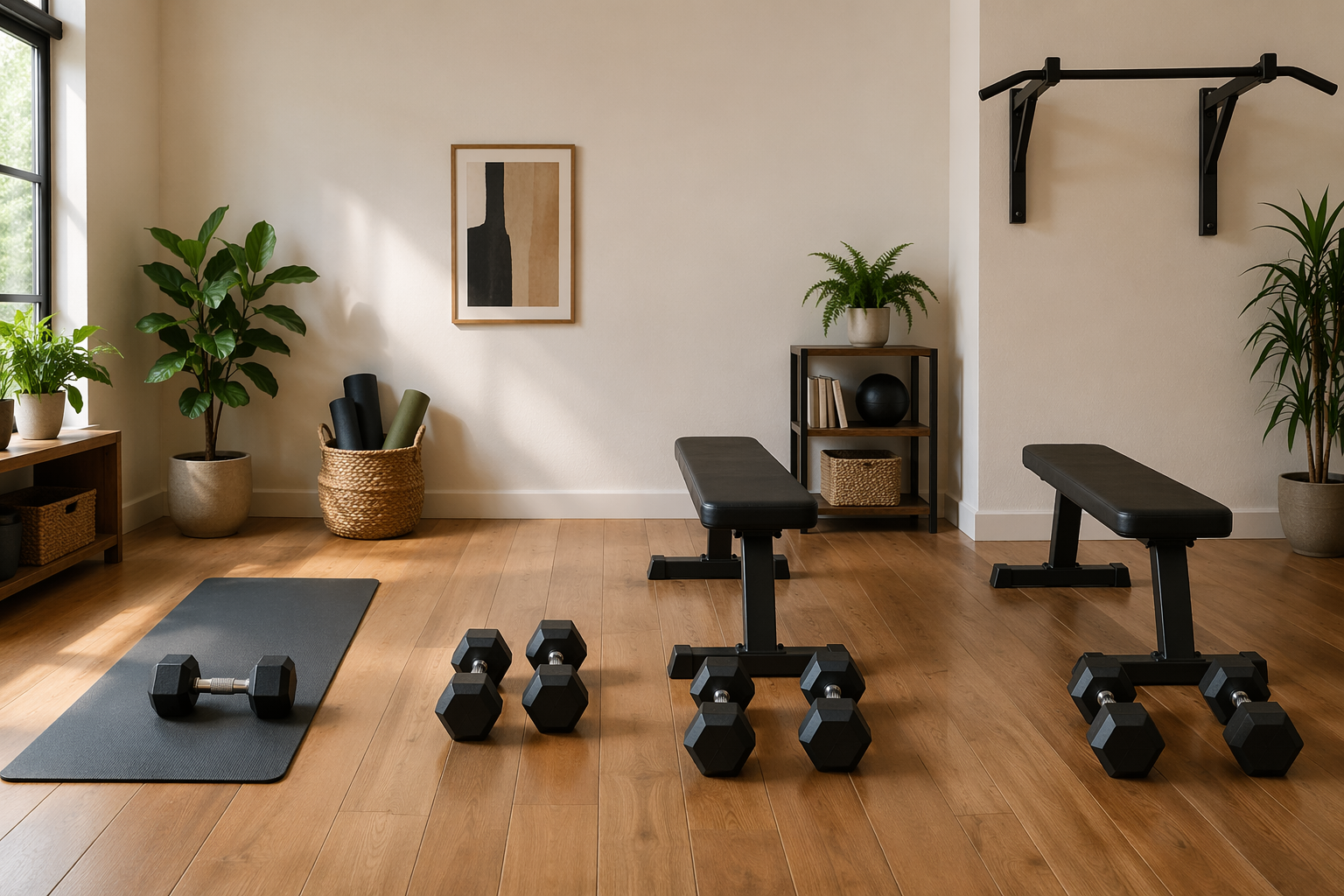
Tier 1: Full-body dumbbell workout with one dumbbell
One dumbbell is not a cute “better than nothing” setup. It just demands different exercise choices. The plan has to use one side at a time, make light weights feel heavier when needed, and avoid movements that only work if you own a matching pair. A New York Times beginner workout preview in 2024 also framed a single dumbbell as enough for a full-body challenge, especially when the movements are simple and compound rather than fussy isolation work [1].
| Exercise | Sets | Reps or time | Notes |
|---|---|---|---|
| Goblet squat | 3 | 8–12 | Hold the dumbbell tight to your chest. If it is light, slow the lowering phase. |
| Single-arm dumbbell row | 3 each side | 8–12 | Brace one hand on a couch, chair, or your own thigh. |
| Single-arm floor press | 3 each side | 8–12 | Press from the floor. Keep the non-working arm out for balance. |
| Single-leg Romanian deadlift | 3 each side | 8–10 | Hold the dumbbell in the opposite hand from the working leg. |
| Half-kneeling dumbbell press | 2–3 each side | 8–10 | Use this instead of standing press if your back wants to arch. |
| Dumbbell halo | 2 each direction | 8–10 | Move slowly around the head; do not crank the neck. |
| Suitcase carry | 3 each side | 30–45 seconds | Walk if you have room. If not, march in place. |
Run the exercises in order. Rest about 60–90 seconds between sets, longer if your breathing is still the limiting factor. The goblet squat and single-leg RDL cover the squat and hinge patterns. The row gives you a real pull. The floor press gives you a horizontal press without pretending a bench is hiding somewhere in the closet. The carry is not filler; with one dumbbell, it is one of the cleanest ways to train your trunk, grip, and posture without inventing complicated core work.
If your dumbbell is too light for squats, make the movement harder before shopping: slow down the descent, pause at the bottom, or switch to split squats. If it is too heavy for pressing, use two hands to help it into position, reduce the rep target, or press from a half-kneeling position where you can control your ribs and pelvis.
Tier 2: Two dumbbells, no bench
This is the setup a lot of apartment lifters actually own: a pair of fixed dumbbells or adjustables, a mat, and no place to put a bench. That is enough for a serious full body dumbbell workout, as long as the plan stops asking for bench presses and chest-supported rows.
| Exercise | Sets | Reps | Notes |
|---|---|---|---|
| Double-dumbbell front squat | 3 | 8–12 | Hold both dumbbells at the shoulders. Use goblet squat if the rack position is uncomfortable. |
| Dumbbell Romanian deadlift | 3 | 8–12 | Keep the weights close to your legs and stop when your hips stop moving back. |
| Dumbbell floor press | 3 | 8–12 | The floor limits shoulder extension, which makes it useful when there is no bench. |
| Bent-over dumbbell row | 3 | 8–12 | Hinge, brace, and row both weights toward your ribs. |
| Standing overhead press | 3 | 6–10 | Squeeze your glutes and avoid turning it into a standing incline press. |
| Reverse lunge | 2–3 each side | 8–10 | Reverse lunges usually need less space than walking lunges. |
| Farmer carry or march | 3 | 30–45 seconds | Walk a short hallway, turn carefully, or march in place. |
The floor press is the key no-bench substitution. SELF describes the dumbbell floor press as a bench-press alternative that still targets the chest, shoulders, and triceps, while the floor changes the bottom range of motion [2]. That difference matters. You are not getting the same stretch as a bench press, but you are getting a stable press you can repeat safely in a small room.
The Romanian deadlift is another home-friendly compromise that is better than it looks on paper. Bony to Beastly uses the dumbbell RDL in its three-day dumbbell program and notes it as a practical substitute for deadlift variations when training at home [3]. For upstairs neighbors, sleeping kids, or thin floors, a controlled hinge beats a workout that quietly assumes you can drop weight.
If you are tight on space, keep every movement inside roughly the footprint of your mat. LoadMuscle describes a dumbbell-only setup as workable in about a 4-by-6-foot area, which is a useful reality check for home training [4]. For more room-by-room setup ideas, see this guide to building a compact home gym by room size.
Tier 3: Dumbbells plus bench
A bench does not make the workout magic. It does remove several annoying workarounds. You can press through a longer range of motion, support your torso for rows, sit for overhead pressing, and use incline angles instead of forcing every upper-body movement to happen from the floor.
| Exercise | Sets | Reps | Notes |
|---|---|---|---|
| Goblet squat or double-dumbbell front squat | 3 | 8–12 | Choose the version that lets you keep a clean torso position. |
| Dumbbell Romanian deadlift | 3 | 8–12 | Use straps only if grip fails before your hamstrings and glutes. |
| Flat dumbbell bench press | 3 | 8–12 | Use a controlled bottom position; do not chase depth your shoulders dislike. |
| One-arm bench-supported row | 3 each side | 8–12 | Brace one hand and one knee on the bench, or use a staggered stance. |
| Seated dumbbell shoulder press | 3 | 6–10 | Set the bench upright if adjustable. Keep the ribs down. |
| Bulgarian split squat | 2–3 each side | 8–10 | Use bodyweight first if balance is the limiting factor. |
| Dumbbell pullover | 2–3 | 10–12 | Keep the rib cage controlled and use a range you can own. |
The bench earns its floor space most on pressing and rowing. A supported row lets your back do the work instead of turning every set into a lower-back endurance test. A flat or incline press gives you more options than the floor press, especially once your dumbbells are heavy enough that setup and range of motion matter.
If your bench is mostly used as storage, clear it before the workout starts. That sounds too obvious to mention until the third set of squats becomes a laundry negotiation. Home training lives or dies on tiny friction points: whether the dumbbells are reachable, whether the bench angle is already set, and whether you need five minutes of cleaning before the first warm-up set.
Tier 4: Dumbbells, bench, and pull-up bar
This is where the program becomes much more balanced for the upper body. Dumbbells can row, pullover, and reverse-fly all day, but they do not perfectly replace a true vertical pull. A pull-up bar fills that gap. LoadMuscle specifically points to the pull-up bar as the missing vertical-pulling piece in dumbbell-only training and notes that basic doorway options can be inexpensive, though exact prices change over time [4].
| Exercise | Sets | Reps | Notes |
|---|---|---|---|
| Double-dumbbell front squat | 3 | 8–12 | Use goblet squat if your dumbbells are awkward to rack. |
| Dumbbell Romanian deadlift | 3 | 8–12 | Keep this controlled; it is still your main hinge. |
| Pull-up or chin-up | 3 | 3–8 | Use assistance if needed. Stop before form falls apart. |
| Flat or incline dumbbell bench press | 3 | 8–12 | Pick one angle and progress it for several weeks. |
| One-arm bench-supported row | 2–3 each side | 8–12 | Rows stay in the plan even after pull-ups arrive. |
| Seated or standing dumbbell shoulder press | 2–3 | 6–10 | Use the version that feels strongest and most repeatable. |
| Bulgarian split squat | 2 each side | 8–10 | Keep these honest; they do not need much load to work. |
| Farmer carry | 2–3 | 30–45 seconds | Finish with trunk and grip work. |
If you cannot do pull-ups yet, do not replace them with nothing. Use slow negatives, band-assisted reps, foot-assisted reps from a chair, or dead hangs plus top-position holds. If your bar setup allows inverted rows safely, they can bridge the gap, but do not improvise under furniture that is not built to hold you.
Weighted pull-ups belong here only after bodyweight reps are clean. A dumbbell held between the feet or attached with a belt is an advanced progression, not the entry fee. For many home lifters, getting from zero controlled chin-ups to sets of several good reps is already a long, productive training block.
How to progress without rewriting the workout
Keep the routine stable long enough to know whether it is working. Most people change home workouts too early because the equipment feels limited, not because the program has stopped producing. Use the same tier for at least several weeks unless pain, schedule, or a real equipment change forces an adjustment.
- Add reps first. If the target is 8–12 reps, stay with the same weight until you can hit the top of the range on all sets with clean form.
- Then add load when you can. With adjustable dumbbells, move up the smallest available jump and let the reps drop back toward the lower end.
- If you cannot add load, add control. Slower lowering phases, pauses, longer carries, and single-leg versions can extend a light setup.
- Stop sets with one or two good reps left most of the time. Grinding every home set makes recovery harder and form sloppier.
- Write down the exercise, weight, reps, and any setup note that affected the set. “Couch brace slipped” is useful training data.
For the main lifts, rest about 90–150 seconds when the set is hard. For carries, halos, and lighter accessory work, 45–90 seconds is usually enough. If your form changes because you are rushing, the rest period is too short.
Moving between tiers without starting over
Upgrades should solve a specific training problem. They should not make you feel as if the work you already did was fake. A single dumbbell can train the whole body. A pair gives you more loading options. A bench expands pressing and supported pulling. A pull-up bar adds the vertical pull that dumbbells struggle to duplicate.
| If you add... | Keep from your current plan | Replace or add | What the upgrade solves |
|---|---|---|---|
| A second dumbbell | Goblet squats, rows, floor presses, carries | Add double-dumbbell RDLs, front squats, and farmer carries | More even loading and heavier lower-body options |
| A bench | RDLs, squats, lunges, carries | Replace floor press with bench press; add bench-supported rows | Better pressing range and more stable row setup |
| A pull-up bar | Bench presses, dumbbell rows, squats, hinges | Add pull-ups, chin-ups, assisted reps, or controlled negatives | Vertical pulling |
| Heavier adjustable dumbbells | The whole structure | Progress load before adding more exercises | Longer strength progression without cluttering the workout |
The best purchase is the one that removes the bottleneck you actually feel. If squats and hinges are too easy, more load matters. If pressing from the floor feels cramped and you have space, a bench helps. If your upper back work is all rows and no overhead pulling, a pull-up bar changes the program more than another small accessory.
Weekly schedule and recovery
Use any tier two or three times per week on non-consecutive days. The three-day structure is common in dumbbell programming, including Bony to Beastly’s three-day full-body dumbbell plan [3]. The extra day is useful if you recover well and your sessions are not turning into hour-long battles. Two days is still a real plan, especially if those two days actually happen.
| Training days | Example schedule | Best for |
|---|---|---|
| 2 days per week | Tuesday and Saturday | Beginners, busy weeks, harder sessions, limited recovery |
| 3 days per week | Monday, Wednesday, Friday | Most steady beginner-to-intermediate home lifters |
| Alternating days | Every other day | People with flexible schedules who do not need a fixed weekly pattern |
Do not make up missed workouts by stacking two full-body sessions back to back. Just take the next available training day and continue. A missed Wednesday does not require a punishment workout on Thursday; it requires a plan that is still there on Friday.
A few substitutions that keep the plan honest
- No room for walking lunges: use reverse lunges or split squats.
- No bench for pressing: use dumbbell floor presses.
- No bench for rows: brace on a chair, couch arm, wall, or your own thigh.
- Dumbbells too light for lower body: use single-leg RDLs, Bulgarian split squats, pauses, and slower tempos.
- Dumbbells too heavy for overhead press: use half-kneeling presses, fewer reps, or two-hand assistance to set the dumbbell.
- No pull-up bar: keep rowing hard and consider pullovers, but recognize that these are approximations rather than identical replacements.
A full body dumbbell workout should not make you decode someone else’s home gym before you can train. Match the routine to the gear in front of you, keep the main squat, hinge, press, row, carry, and pull patterns covered as well as your setup allows, and repeat it next week.
References
- A Beginner’s Dumbbell Workout, The New York Times, 2024.
- A Full-Body Dumbbell Workout to Hit Every Muscle in Your Body, SELF.
- 3-Day Full-Body Dumbbell Workout, Bony to Beastly.
- Dumbbell Only Workout Plan, LoadMuscle.
This result comes from one real apartment under the stated conditions — it is a strong signal, not a guarantee your space will measure identically.
Builds this evidence supports
Cable Machine Alternatives That Save Space and Money
Compare the best cable machine alternatives for home gyms – from resistance bands and pulley systems to suspension trainers and compact digital units – and find the right option for your space and budget.
How to Choose a Compact Home Gym That Works for Your Space, Budget, and Noise Tolerance
This article provides a structured decision framework for apartment dwellers and small-space residents to match their specific floor footprint, noise sensitivity, and budget to the most suitable compact home gym strategy — whether that's an all-in-one machine, modular build, smart digital system, or band/bodyweight setup.
The Garage Gym Reality Check: What Equipment Actually Fits in a Single-Car Garage
Most garage gym guides assume a two-car space. This article uses real dimensions, real equipment footprints, and three layout templates to show what fits—and what doesn't—in a single-car garage (10x20 to 12x20 ft).
Spot something off?
If this result didn't match your own space, let us know — floor-damage and noise claims carry real deposit-risk consequences if we get them wrong.