
“Low impact” is useful only if you know what kind of impact you are avoiding. It usually means the machine reduces pounding or ground-reaction force compared with running or jumping. It does not mean the workout is easy, medically safe for every knee or hip, or automatically worth the space it takes up.
For home buyers comparing low impact exercise equipment, the practical question is less “Which machine is gentlest?” and more “Which compromise can I live with?” A recumbent bike is the safest serious-cardio starting point for many people with knee or hip concerns. A rowing machine can produce the strongest calorie-burn and whole-body training case if the movement is tolerable. A walking pad is often the best space-to-consistency compromise, because the machine that stays reachable tends to get used.
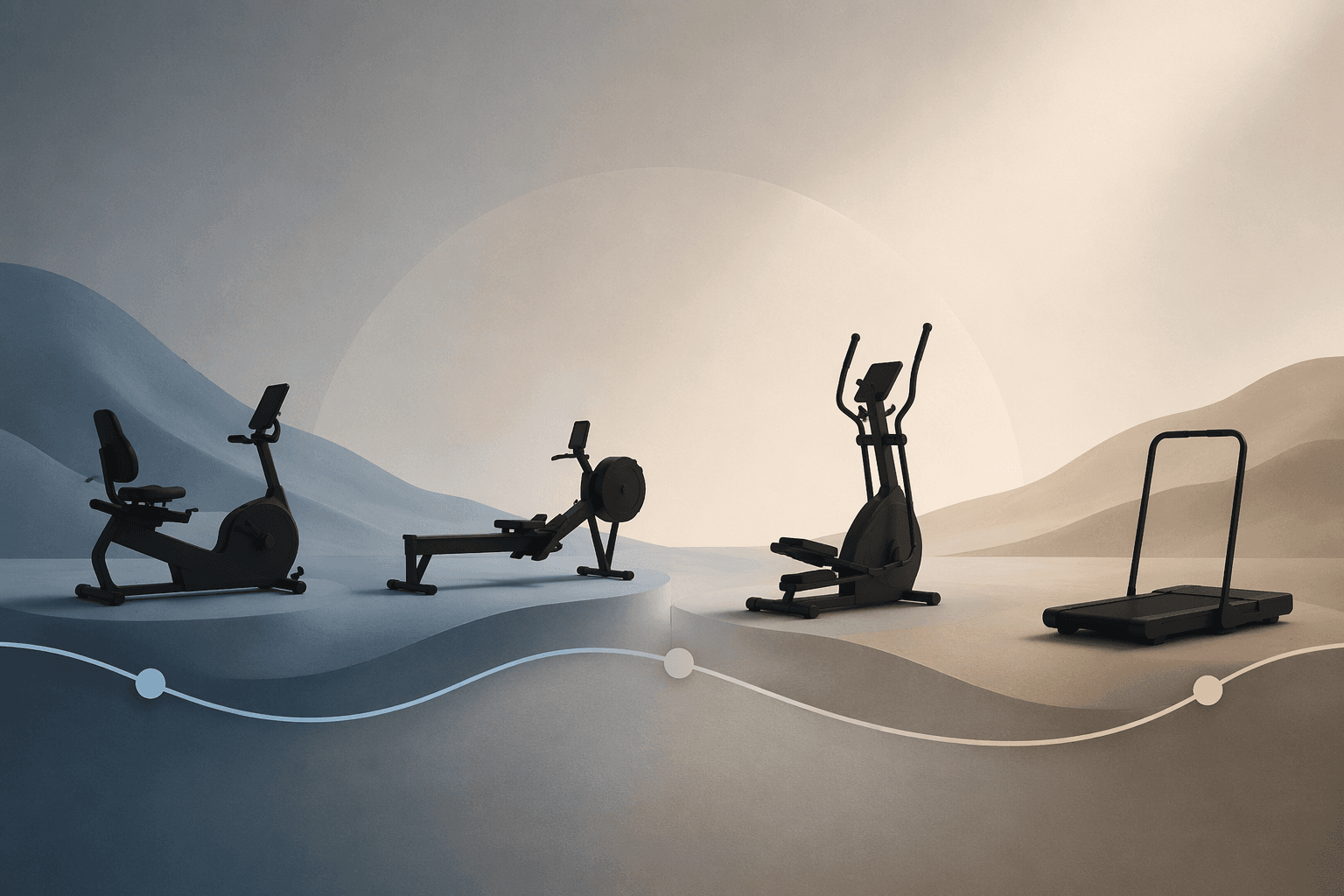
How this comparison scores joint load, calorie burn, and footprint
The rankings below use three axes because those are the places home fitness purchases usually disappoint: the machine aggravates the joint problem it was supposed to work around, it does not create enough training stimulus to justify owning it, or it becomes too awkward to keep accessible.
Joint load is treated as a directional comparison, not a clinical safety rating. The clearest machine-by-machine scale in the source material is Hypervibe’s proprietary 0–5 joint-load scale, which places under-desk pedallers around 0/5, recumbent bikes around 1/5, and ellipticals around 2/5. Hypervibe does not disclose a peer-reviewed methodology for that scale, so it is best used as a shared comparison language rather than medical proof.[1]
Ellipticals also get a separate caution label in this comparison. Harison repeats the common industry claim that ellipticals have about one-sixth the impact of running, but the source does not provide a primary research citation. That claim is directionally plausible for a non-running machine, but it should not be read as settled clinical science or as a guarantee for a specific knee, hip, or back issue.[2]
Calorie ranges are deliberately shown as ranges, not promises. The figures used here are moderate-effort estimates for a 70 kg person, aggregated from Hypervibe, Technogym, and Mayo Clinic-style exercise estimates: rowing roughly 400–700 kcal/hr, elliptical training roughly 400–600 kcal/hr, recumbent biking roughly 300–500 kcal/hr, and under-desk pedalling roughly 100–250 kcal/hr.[1][3][4] Body weight, resistance, stroke rate, cadence, machine algorithm, workout duration, and whether the user is actually working at moderate effort can all move the result.
Footprint is estimated from typical home-equipment dimensions in the source material rather than from one brand’s exact model. Walking pads are treated as roughly 2.5 ft by 5 ft. Recumbent bikes are roughly 4 ft by 2.5 ft. Rowers commonly run about 7–8 ft long, though some stand vertically in about 4 sq ft when stored. Under-desk machines can be around 1.5 ft by 1.5 ft, while vertical climbers may occupy around 2.5 ft by 3 ft of floor space but need roughly 7 ft of height clearance.[1][2]
Those measurements make this less tidy than a single “best low impact machine” list. A machine can be low-load and still too passive for your goal. It can be compact on the floor and still fail in a low-ceiling room. It can burn calories efficiently and still be the wrong movement for a cranky back.
Head-to-head ranking of seven low impact machine types
| Equipment type | Joint-load profile | Calorie-burn profile | Footprint and storage profile | Best fit | Main caution |
|---|---|---|---|---|---|
| Recumbent bike | Very low; Hypervibe places recumbent bikes around 1/5 | Moderate: about 300–500 kcal/hr at 70 kg, moderate effort | About 4 ft × 2.5 ft; usually not flat-folding | People prioritizing knee or hip comfort while still wanting real cardio | Seated position lowers balance demands but may not feel intense enough without resistance |
| Walking pad | Low for many users because it removes running impact, but still weight-bearing | Variable; depends heavily on walking speed, incline if available, and session length | About 2.5 ft × 5 ft; often stores under furniture or upright | Small-space buyers who need the easiest machine to keep accessible | Not ideal if the goal is high-intensity conditioning from short workouts |
| Rowing ergometer | Low impact in the no-pounding sense, but flexion-heavy at knees, hips, and back | High: about 400–700 kcal/hr at 70 kg, moderate effort | Often 7–8 ft long in use; some store upright in about 4 sq ft | People who want calorie burn and broad muscle involvement from one machine | Technique and joint tolerance matter more than the “low impact” label suggests |
| Elliptical trainer | Low-to-moderate; Hypervibe places ellipticals around 2/5, and industry claims often compare them favorably with running | High-moderate: about 400–600 kcal/hr at 70 kg, moderate effort | Usually larger and taller than it looks in product photos | Users who want upright cardio without running impact | Stride path and machine fit can bother some knees or hips |
| Under-desk pedaller or under-desk elliptical | Extremely low; Hypervibe places under-desk pedallers around 0/5 | Low: about 100–250 kcal/hr at 70 kg, moderate effort | Around 1.5 ft × 1.5 ft for some units | Movement breaks, very small spaces, and people who need the lowest-friction option | Easy to overestimate as a replacement for structured cardio |
| Vibration platform | Low impact in the sense that it avoids stepping or pounding | Not well supported as a calorie-burn substitute in the provided materials | Usually compact compared with full cardio machines | Supplemental movement, balance-style sessions, or very space-limited use | Not comparable to a bike, rower, or walking pad for conventional cardio training |
| Vertical climber | Low impact by design, but not necessarily low joint demand | Potentially intense, but the provided sources do not support a precise calorie range here | About 2.5 ft × 3 ft floor footprint but roughly 7 ft tall | Users who want compact, demanding upright training and tolerate the movement | A poor blind buy for people shopping primarily because of knee or hip concerns |
The table makes one thing obvious: the best machine changes as soon as the constraint changes. The under-desk pedaller wins on joint-load minimalism and footprint, then loses badly if the buyer expects it to replace a harder cardio session. The rower looks demanding on storage length, then becomes more attractive if it stands upright and the buyer wants one machine to involve more of the body. The vertical climber looks compact on the floor, then becomes less appealing for the person whose first requirement is joint gentleness.
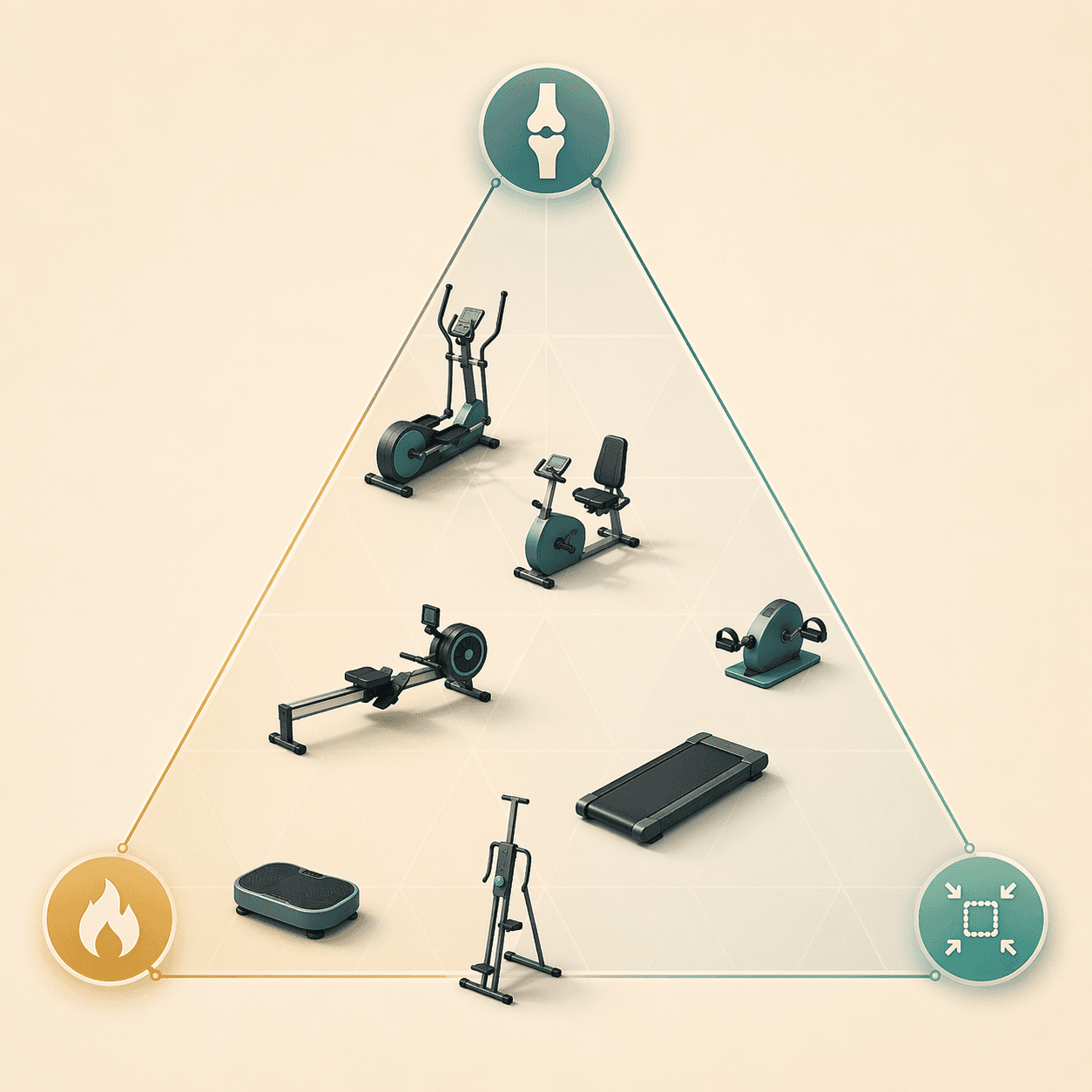
If joint comfort is the first priority
Start with the recumbent bike if knee or hip concern is the reason you are shopping in this category. The seated, supported position removes balance demands and keeps the movement predictable. On Hypervibe’s directional joint-load scale, the recumbent bike sits around 1/5, lower than the elliptical’s 2/5 rating and far below running as a practical reference point.[1]
That does not make the recumbent bike a medical device. Seat position, knee bend, resistance, and session length can still matter. But among the equipment types here that can support a sustained cardio session, it is the least fussy starting point for many cautious buyers.
Under-desk pedallers are even lower on the joint-load scale, around 0/5 in Hypervibe’s ranking, but that rating comes with a training trade-off.[1] They are better understood as movement-access tools: something to use while reading email, watching TV, or adding circulation-friendly activity to a sedentary day. They are not the strongest answer for someone trying to build a primary cardio habit.
Ellipticals deserve a middle position. They remove the repeated foot strike of running, and the commonly repeated industry comparison says they produce about one-sixth the impact of running.[2] Still, the fixed stride path can be a problem if the machine’s geometry does not suit the user. A shopper with existing knee or hip pain should be more careful with an elliptical than the marketing phrase “low impact” usually implies.
Vertical climbers need the most caution in this joint-first group. They may be marketed as low impact because the feet are not striking the ground, but the motion can be steep, loaded, and intense. If the whole reason for buying low impact exercise equipment is to avoid irritating knees or hips, a vertical climber should be tested before purchase or moved down the shortlist.
For condition-specific buying guidance, especially if pain has already changed how you move, see the site’s joint-pain equipment guide.
If calorie burn and training stimulus matter most
The rowing machine has the strongest case when calorie burn, effort, and whole-body involvement are the main goals. The calorie range used here puts rowing at roughly 400–700 kcal/hr for a 70 kg person at moderate effort, above recumbent biking’s roughly 300–500 kcal/hr range and similar to or higher than typical elliptical estimates.[1][3][4]
Rowing also has a broad muscle-engagement claim attached to it: British Rowing and Men’s Health UK have circulated figures around 84–85% of muscles used during rowing.[5] That number should be treated carefully because it comes from industry-facing sources and depends on how muscle activation is counted. Even so, the practical point holds: rowing asks the legs, trunk, and upper body to contribute in one repeated movement, which is not true of a simple under-desk pedaller and is less complete than many people assume from an elliptical.
The catch is that rowing’s low-impact status can mislead people with back, hip, or knee sensitivity. There is no pounding, but there is repeated bending and extending. A buyer who cannot comfortably hinge at the hips, compress the knees, or maintain position through the stroke may find a rower less forgiving than a recumbent bike.
Ellipticals sit close behind rowers for calorie burn in the available estimates, at roughly 400–600 kcal/hr for a 70 kg user at moderate effort.[1][3][4] They are often easier to use casually than a rower because the movement pattern is guided, but that same guided path can become a fit issue. For calorie-focused buyers, the elliptical is a good candidate when upright movement feels better than rowing and there is enough room for a full-size machine.
Recumbent bikes are less aggressive on the calorie axis but not weak. The 300–500 kcal/hr estimate is still meaningful if the user sets enough resistance and rides long enough.[1][3][4] For many home users, especially those returning from a layoff or protecting a joint, that lower ceiling is an acceptable trade for comfort and repeatability.
If space and day-to-day access decide whether you exercise
A walking pad is rarely the most intense machine in the room. It is also the one I would take most seriously for a small home where friction kills routines. At about 2.5 ft by 5 ft, it asks for more floor length than an under-desk pedaller but less commitment than many full cardio machines, and many models are designed to store under furniture or upright.[1][2]
The reason that matters is plain: low impact exercise equipment only helps if it is accessible enough to use. A rower that must be dragged out from behind a sofa and laid across a narrow room has to overcome a setup barrier every time. A walking pad that can stay near a desk or slide out quickly lowers that barrier.
Rowers are the awkward-but-worth-considering exception. Their in-use length, often 7–8 ft, surprises renters and apartment buyers.[1] But if a model stores vertically in about 4 sq ft and the ceiling height allows it, the storage footprint can be better than the workout footprint suggests. That makes rowers unusually compelling for people who can tolerate the movement and want high training value per stored square foot.
Under-desk pedallers are the footprint winners, with some units around 1.5 ft by 1.5 ft.[1] The trade-off is not storage; it is expectation. They are good for adding movement where no real machine would fit. They are a poor choice if the buyer secretly wants the outcome of a harder bike, rower, or elliptical workout.
Vertical climbers are compact in a different way. The floor footprint can be around 2.5 ft by 3 ft, but the machine may need about 7 ft of height clearance.[1] In a basement, low-ceiling apartment, or room with a fan overhead, that vertical requirement is not a detail.
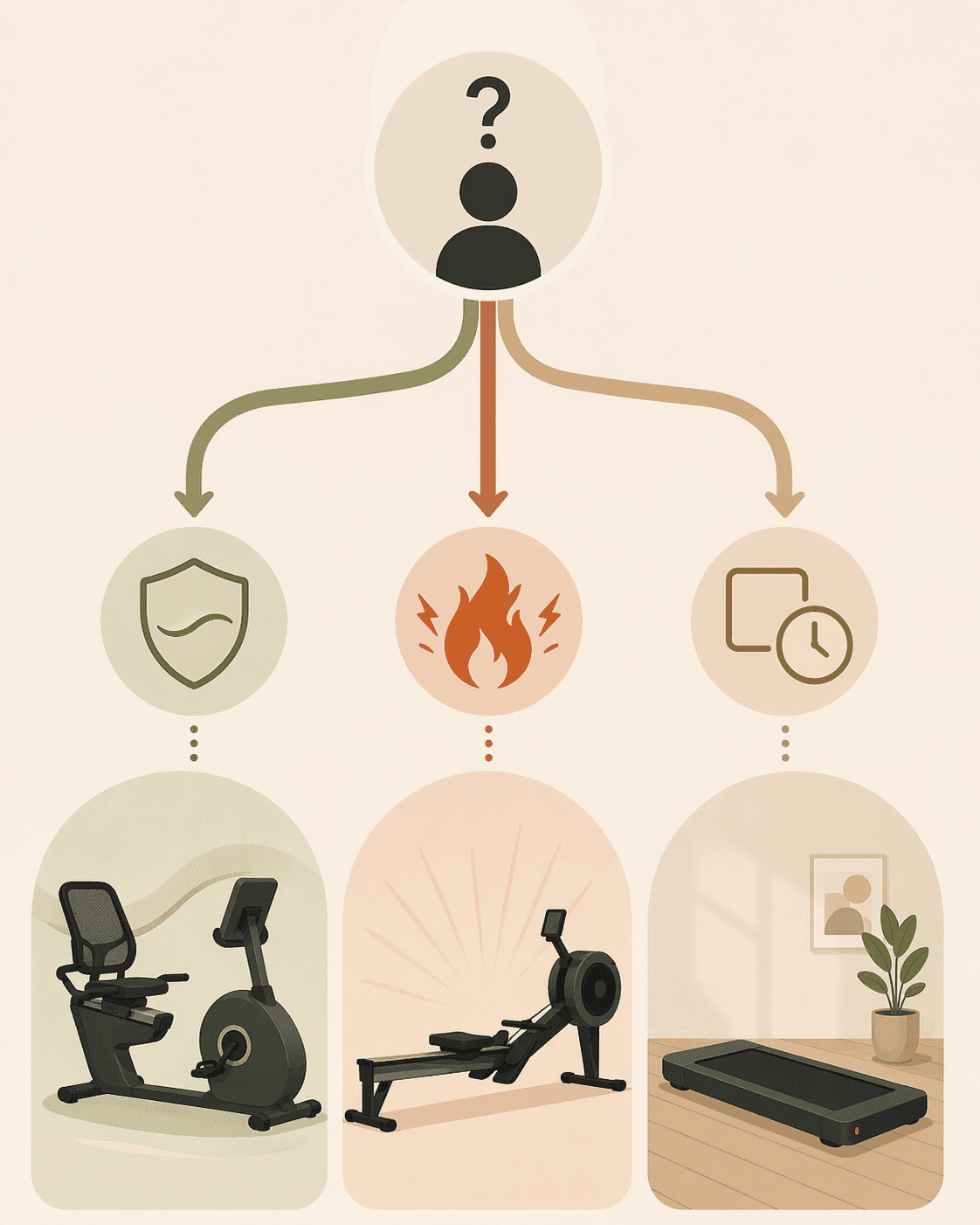
A decision framework by constraint
Consumer Reports’ expert framing of cardio-machine selection is useful here because it starts with the user’s goal rather than the machine’s marketing category: weight loss, endurance, strength support, joint comfort, and available space can point to different equipment.[6] The CDC’s general adult activity guideline of 150 minutes per week of moderate-intensity aerobic activity is also helpful context, but it is not a low-impact-equipment endorsement or a proof that any one machine is best.[7]
| Your dominant constraint | Start with | Also consider | Be careful with |
|---|---|---|---|
| Existing knee or hip concern | Recumbent bike | Under-desk pedaller for very gentle movement; walking pad if walking is comfortable | Vertical climber; elliptical without testing the stride |
| Highest calorie burn from one home machine | Rowing machine | Elliptical trainer | Under-desk pedaller as a primary cardio substitute |
| Small apartment and low setup tolerance | Walking pad | Under-desk pedaller; foldable or vertical-storing rower | Full elliptical if it will block the room |
| Need upright movement without running | Elliptical trainer | Walking pad | Machine with a fixed stride that feels wrong after a short test |
| Movement during work or TV time | Under-desk pedaller | Walking pad if the space and noise level work | Expecting high calorie burn from passive pedalling |
| Compact but intense training | Vertical climber only if joints tolerate it | Rower if storage length works | Buying a climber solely because it is labeled low impact |
| Supplemental movement in very limited space | Vibration platform | Under-desk pedaller | Treating vibration as equivalent to sustained cardio |
This is also where trend data can be useful without letting it take over the buying decision. Les Mills reported in its 2025 trend material that 30% of gym-goers were prioritizing low-impact training and 50% were incorporating low-impact strength training.[8] That helps explain why the category is getting more attention, but it does not tell you whether your apartment can handle a rower or whether your knee will like a climber.
Where each machine lands
Choose a recumbent bike when joint protection is the dominant concern and you still want a machine capable of sustained cardio. It is not the smallest option and not the highest-calorie option, but it is the most defensible first stop for cautious buyers with knee or hip worries.
Choose a rower when calorie burn and whole-body effort matter, you can tolerate the stroke, and you have a real plan for the machine’s length. A rower is not automatically gentle just because it is low impact, but it has the best training-density argument in this comparison.
Choose a walking pad when consistency and storage are the actual bottlenecks. It is the machine most likely to solve the “I do not want to set anything up” problem, which is often the hidden reason home equipment fails.
Choose an elliptical when you want upright cardio without running impact and can test or confidently judge the stride fit. It can be a strong calorie-burn option, but it deserves more space and fit scrutiny than many buyers give it.
Choose an under-desk pedaller when the goal is frequent light movement in almost no space. It is not a failed cardio machine; it is a small movement tool. The mistake is asking it to do the job of a bike, rower, or elliptical.
Treat vibration platforms and vertical climbers as more specialized choices. A vibration platform may fit a tiny space, but the source material here does not support treating it like a conventional calorie-burning cardio machine. A vertical climber may be compact and intense, but it is not the first machine I would hand to someone shopping because their joints already complain.
For a more detailed look at the core comparison, see our earlier guide to low impact exercise equipment by joint load, calorie burn, and footprint. If pain is the deciding factor rather than general comfort, use the condition-specific joint-pain guide before buying.
References
- Best Low-Impact Exercise Equipment for Seniors — Hypervibe
- Top 10 Most Useful Fitness Equipment 2026 — Harison
- Exercise and calorie expenditure estimates — Technogym
- Exercise for weight loss: Calories burned in 1 hour — Mayo Clinic
- Rowing muscle engagement figures — British Rowing / Men’s Health UK
- Best Cardio Machines to Meet Your Fitness Goals — Consumer Reports
- Physical Activity Guidelines for Adults — Centers for Disease Control and Prevention
- 2025 fitness trends and low-impact training data — Les Mills
Comments
Join the discussion with an anonymous comment.