
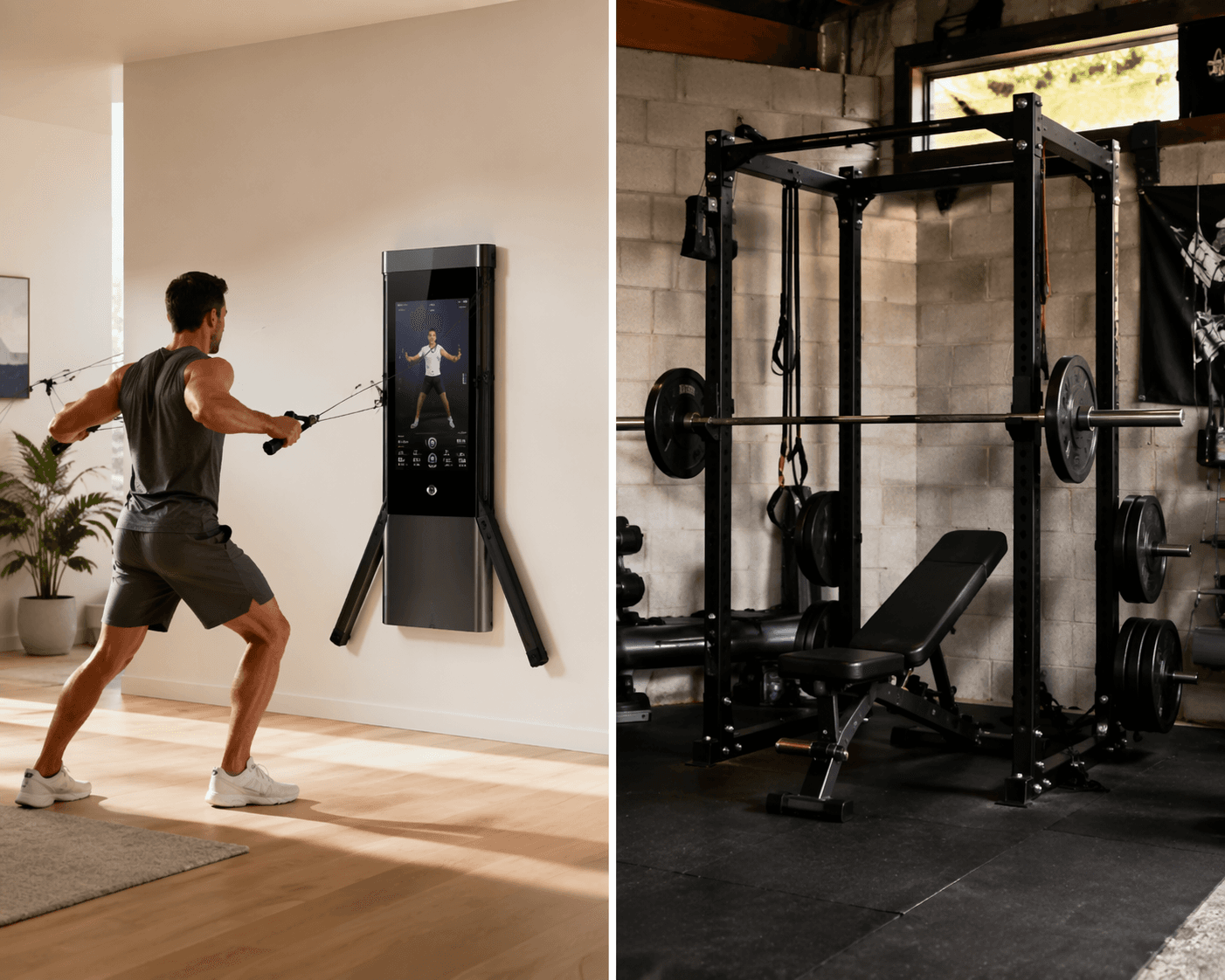
The best home gym is not the one with the slickest demo or the longest exercise list. It is the one whose ownership model still makes sense after the first year, when the equipment is no longer new and your training habits are obvious. Smart home gyms usually win when you want coaching, guided programming, a cleaner room, and very little equipment maintenance. Traditional rack-and-free-weight setups usually win when you care more about load capacity, no monthly bill, resale value, and the ability to keep adding pieces over time.
That is the real comparison: not screen versus steel, but what you are buying over the next five to ten years. A smart gym can sell you resistance, instruction, tracking, and convenience in one package. A traditional setup sells you ownership control: a rack, bar, plates, bench, and whatever you decide to bolt on later.
The five-year cost gap is where the decision gets real
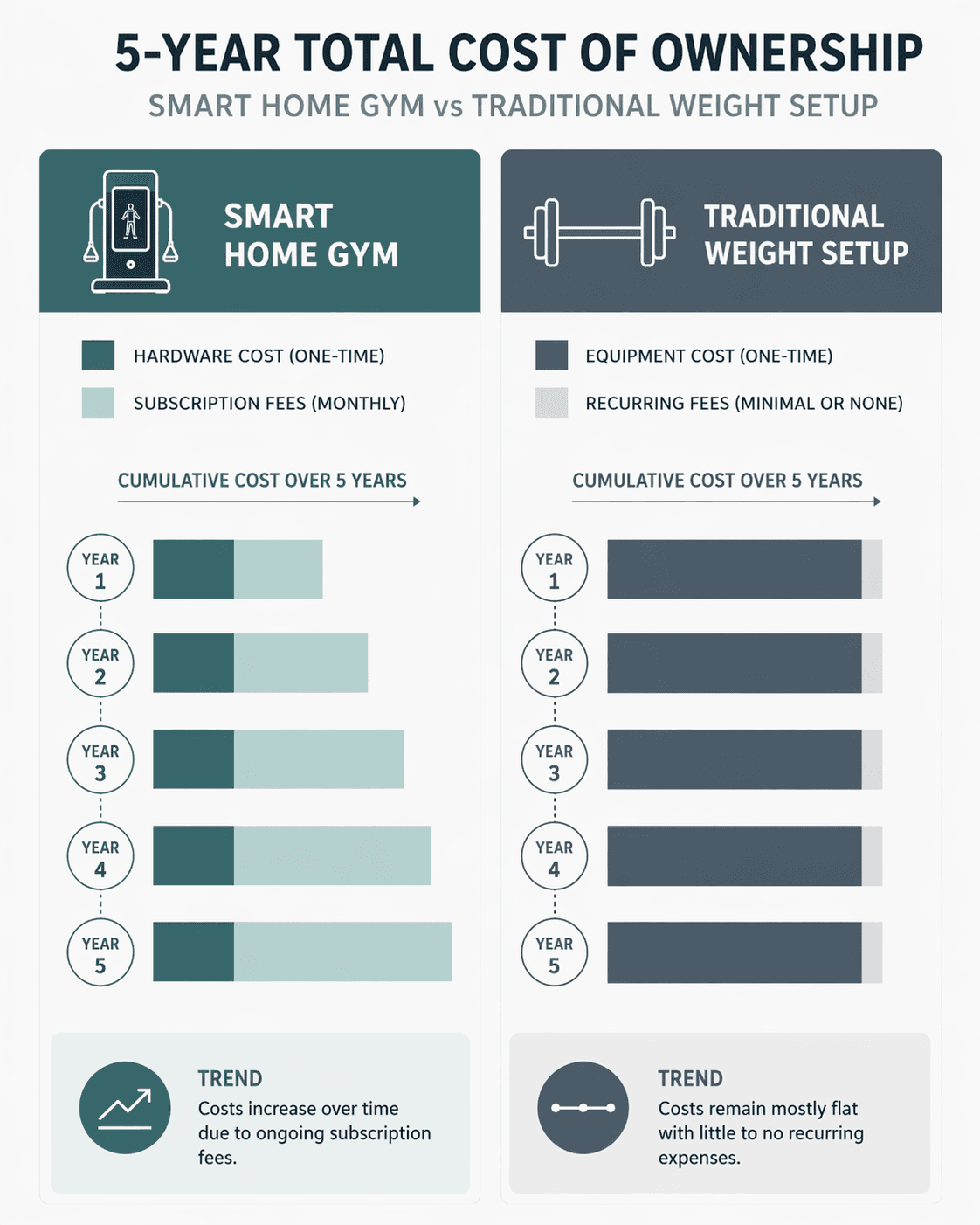
Sticker price hides too much. Tonal 2, for example, is not just a $4,295 machine. A published 2026 cost scenario includes the $4,295 MSRP, $495 Essential Accessories, $295 installation, and a $59.95 monthly membership, putting the first-year total at roughly $5,085 to $5,805 and the five-year total around $7,892, depending on how the costs are counted and rounded.[1]
A traditional strength setup built around something like a REP PR-4000 rack, barbell, plates, and bench is estimated at about $1,500 to $2,500 with no required ongoing fee.[1] That range should not be treated as a statistically precise market average. It is a practical expert estimate, and your number can move quickly if you choose calibrated plates, specialty bars, flooring, cable attachments, or commercial-grade components. Still, the ownership shape is very different: most of the traditional cost happens on day one.
| Ownership window | Smart gym example: Tonal 2 | Traditional rack/bar/plate setup | What the number means |
|---|---|---|---|
| Year 1 | About $5,085–$5,805 | About $1,500–$2,500 | Smart gym includes hardware, accessories, installation, and first-year membership; traditional setup is mostly upfront equipment cost. |
| Year 3 | Year 1 cost plus two more years of $59.95/month membership if the fee stays unchanged | About $1,500–$2,500 before optional upgrades | The subscription starts doing the work in the math; traditional cost only rises if you add equipment. |
| Year 5 | About $7,892 in the cited scenario | About $1,500–$2,500 before optional upgrades | This is where subscription tolerance matters more than the original sticker price. |
| Year 10 | Five-year cost plus five more years of membership if the service and fee remain in place | About $1,500–$2,500 before optional upgrades, repairs, or expansion | The smart-gym estimate is a straight-line subscription scenario, not a guarantee that fees, hardware, or service terms stay fixed. |
The ten-year row is not a forecast. It simply extends the known monthly fee across a longer ownership window. Subscription prices can change, hardware can age, and companies can alter what is included. But that is exactly why the monthly line item cannot be waved away. A $59.95 membership is not background noise if you are comparing it with a rack that keeps working without asking for a login.
The smart-gym buyer should ask a blunt question: will the membership change your behavior enough to justify the cost? If guided workouts, automatic weight adjustments, tracking, and coaching cues keep you training three or four days a week, the subscription is buying something real. If you will eventually ignore the classes and use the machine like a cable station, the math gets worse fast.
Subscriptions buy coaching, but they also create dependency
The strongest argument for a smart gym is not that it is cheaper. It usually is not, at least not compared with a basic rack and barbell. The stronger argument is that it reduces friction. You turn it on, follow the program, get prompted through sets, and avoid the decision fatigue that makes a lot of home gym equipment quietly become storage.
That matters most for people who need structure. Beginners often do not need maximum loading on day one; they need to know what to do, how hard to push, when to progress, and how to stay consistent. A smart gym can be worth more than a pile of iron if the alternative is buying a rack and then avoiding it because every workout feels like homework.
The trade-off is that the platform remains part of the purchase. You are not only buying equipment; you are buying into a system that may require ongoing payment to feel complete. That is acceptable when the service is what keeps you training. It is irritating when the subscription is treated like a footnote in a buying guide.
Traditional equipment is cheaper to own because it is easier to separate from the original purchase
A rack, barbell, plates, and bench do not care whether a company updates an app. They do not need content libraries. They do not lose core function because you canceled a membership. That is the traditional setup’s biggest financial advantage: once you own the basic tools, you can train with them indefinitely, upgrade them selectively, and sell individual pieces if your needs change.
Resale is a real part of the ownership math. Garage Gym Reviews estimates that a traditional power rack setup can hold roughly 60% to 70% of its value.[1] That does not mean every used rack sells instantly or that scratched plates magically keep retail value. It means modular equipment has a secondhand market that is easy for buyers to understand: steel, weight capacity, hole spacing, attachments, bars, plates, benches.
This also changes how upgrades feel. With a traditional setup, you can buy a rack now, add more plates later, pick up a cable attachment when the budget allows, and replace a bench without replacing the whole gym. With many smart systems, the upgrade path is more tied to the platform. That can be elegant if the ecosystem fits you. It can be limiting if your training evolves away from what the machine does best.
Resistance ceilings are not a fine-print issue
Digital resistance feels clean, controlled, and surprisingly challenging. It can also make lighter loads feel harder through eccentric modes, tempo control, and cable angles. But the ceiling still matters. Tonal 2 maxes out at 250 pounds of digital resistance, while Speediance is listed at 220 pounds.[1] A traditional free-weight setup has no practical upper limit beyond the rack, bar, plates, floor, and user’s ability to handle the load safely.[1]
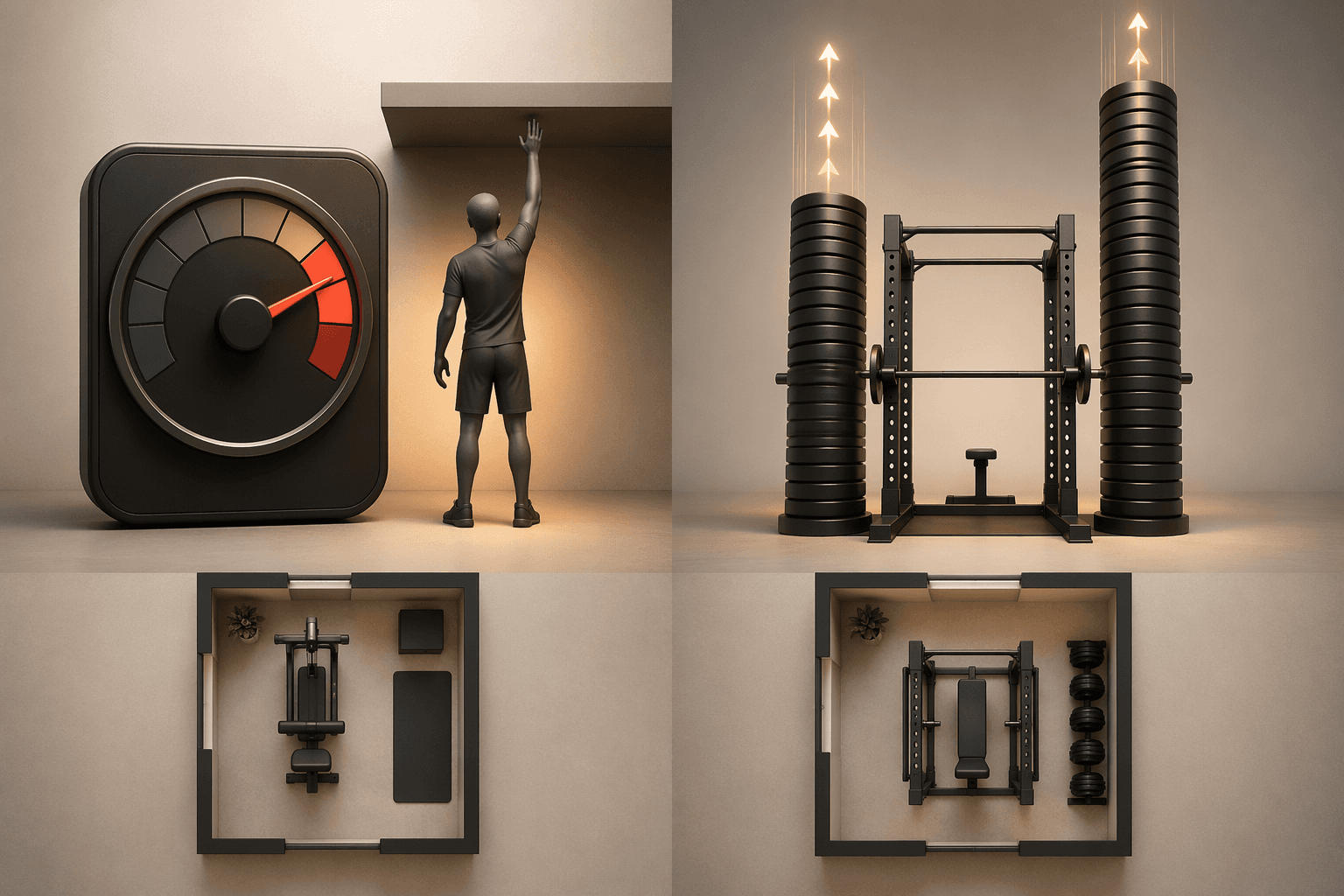
For general fitness, 220 to 250 pounds of digital resistance may be plenty for a long time. For an intermediate lifter, it depends on the lift, the cable setup, and how the system applies load. For a strength-focused lifter who wants heavy squats, deadlifts, presses, and long-term progressive overload, that ceiling is not theoretical. It is the point where a beautiful guided system may stop being the main strength tool.
This is where a lot of “best home gym” advice gets sloppy. A smart gym can be excellent and still not be a forever answer for every strength goal. A traditional setup can be brutally effective and still be a poor match for someone who needs coaching, hates plate changes, or lives in a small apartment. The resistance type has to match the way you plan to progress.
Exercise variety is different from exercise freedom
Smart gyms often feel more complete on day one because the exercise library is built in. You can move from a guided upper-body workout to a lower-body session to a mobility block without shopping for attachments or writing your own plan. For many users, that is the difference between training and just owning equipment.
The variety is strongest when the movements fit cable-based resistance: rows, pulldowns, presses, curls, lateral raises, chops, hinges, split squats, and controlled accessory work. A bodybuilding-oriented user who likes cable-style tension may get a lot out of that format, especially if they are not chasing heavy barbell numbers.
Traditional equipment starts narrower if you buy only the basics, but it expands in a different way. A rack can become a squat station, bench station, pull-up station, landmine station, dip station, cable station, storage hub, and specialty-bar platform. The catch is that you have to buy, store, and organize those additions. Freedom has a footprint.
Space claims need a tape measure, not a product photo
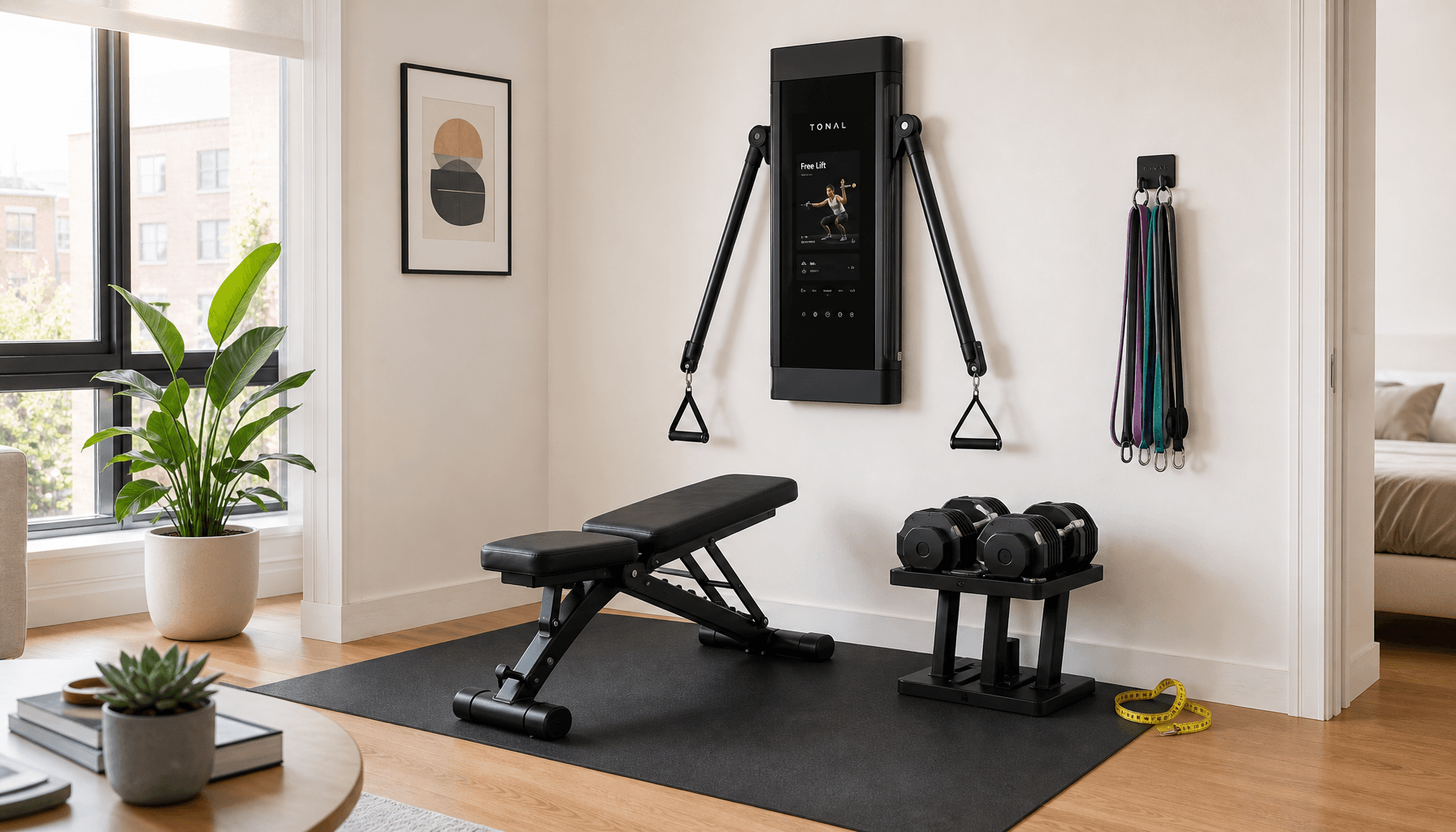
A wall-mounted smart gym looks compact because the hardware sits flat against the wall. That is useful, especially in a spare room or apartment. But the working area still matters: Tonal-style smart gyms need roughly 7 feet by 7 feet of clear floor space for training.[1] The machine may be thin; your body, cable angles, lunges, hinges, and arm paths are not.
A traditional power rack can have a smaller minimum footprint on paper, around 4 feet by 6 feet.[1] That number should also be handled carefully. It does not include every safety buffer, plate storage choice, bench movement, bar loading space, or the room you need to walk around the setup. A garage lifter can often make that work. A living-room lifter may not want a rack visually owning the room all year.
Noise and mess belong in the same conversation. Smart gyms usually keep the room cleaner and quieter because there are no iron plates to drag around. Traditional setups are more tolerant of abuse, but they ask for flooring, storage, and enough household patience to live with steel, rubber, chalk, and the occasional deadlift thud.
The gym-membership breakeven is useful only if you would actually keep paying for a gym
One common benchmark says the average U.S. gym membership costs $65 per month, based on a 2024 Health & Fitness Association figure cited by Garage Gym Reviews.[2] Against that number, a $1,500 home gym reaches breakeven in about two years.[2]
That comparison is helpful, but only for the right person. If you are truly replacing a commercial membership you would have kept paying, the home setup can be financially easy to justify. If you are the kind of person who cancels every gym membership after two months, the breakeven is less meaningful. You are not avoiding two years of fees you were never going to pay.
It also cuts differently for smart gyms. A Tonal-style setup can replace a gym membership for some users, but it also brings its own monthly fee. The better comparison is not simply home versus commercial. It is commercial membership versus smart-gym subscription versus owned equipment with no required monthly payment.
Installation, maintenance, and failure points
Smart gyms are attractive because they reduce daily maintenance. There are no plates to unload, no barbell knurling to brush, no rack attachments to rearrange. The trade-off is installation and electronics. Tonal’s cited cost scenario includes $295 installation, which should be treated as part of the real purchase price rather than an optional annoyance.[1]
Traditional equipment is mechanically simple. Bolts may need checking, upholstery can wear, cables on an attachment can eventually need attention, and cheap benches can reveal their limits. But the core tools are durable in a very boring way. A barbell does not become unsupported software. Plates do not need a firmware update.
Which setup fits your training style?
The right answer depends less on whether smart gyms are “worth it” in general and more on what job the equipment has to do in your house.
General fitness user who wants consistency
A smart gym is often the better investment if your main problem is consistency. The guided sessions, clean setup, tracking, and low-friction start can be worth the subscription if they keep you training. The resistance ceiling is less likely to matter if your goals are strength maintenance, muscle tone, conditioning, and general health rather than maximal barbell progress.
Beginner who needs structure
A beginner can go either way, but the deciding factor is coaching. If you already know how to squat, hinge, press, row, program progression, and manage fatigue, a traditional setup gives more long-term runway for the money. If those words feel like a second job, a smart gym’s guided programming may be the thing that turns the purchase into actual training.
Powerlifter or strength-focused lifter
Buy traditional. The reason is not nostalgia; it is loading. A lifter whose progress depends on heavy squats, deadlifts, bench presses, overhead presses, and small plate jumps should not build the main gym around a fixed digital resistance ceiling. A smart gym can still be useful for accessories, warmups, or supplemental work, but it should not be mistaken for the core strength platform.
Bodybuilding-oriented user
This is the most interesting middle ground. Smart gyms can be very good for controlled cable-style movements, unilateral work, tempo, and guided volume. A traditional setup can be better if you want heavy presses, rows, squats, Romanian deadlifts, plus the ability to add cables, specialty bars, dumbbells, and machines over time. If you like programming your own training and slowly building a room, traditional wins. If you want a coached cable station that stays tidy, smart can make sense.
Apartment or small-room buyer
A smart gym has the visual advantage. It looks intentional instead of like half a garage moved indoors. But do not buy from the wall profile alone. You still need clear training space, and roughly 7 by 7 feet is not nothing in an apartment.[1] A compact traditional setup can fit in a smaller footprint on paper, but it brings plates, a bench, bar storage, flooring, and more visual clutter.
Budget-conscious buyer
Traditional is usually the safer investment if you cannot treat a monthly fee as invisible. The upfront setup can be phased in, used gear is often available, and resale value gives you an exit if your needs change. A smart gym can still be the right call if it replaces other spending and genuinely keeps you training, but the subscription needs to be part of the budget from the start.
The ownership model matters more than the category label
Smart is the better investment when the platform changes your behavior: you use the coaching, follow the programming, value the cleaner room, and do not resent the subscription. Traditional is the better investment when progressive loading, ownership control, modular upgrades, and resale matter more than guided convenience.
If you are buying for the next decade, do not ask only what looks better on day one. Ask what you will still want to use in year three, what you may outgrow by year five, and whether you want your home gym to be a platform you keep paying for or equipment you own outright.
References
- Best Home Gyms, Garage Gym Reviews, 2026.
- How Much Does a Home Gym Cost?, Garage Gym Reviews.
Comments
Join the discussion with an anonymous comment.