
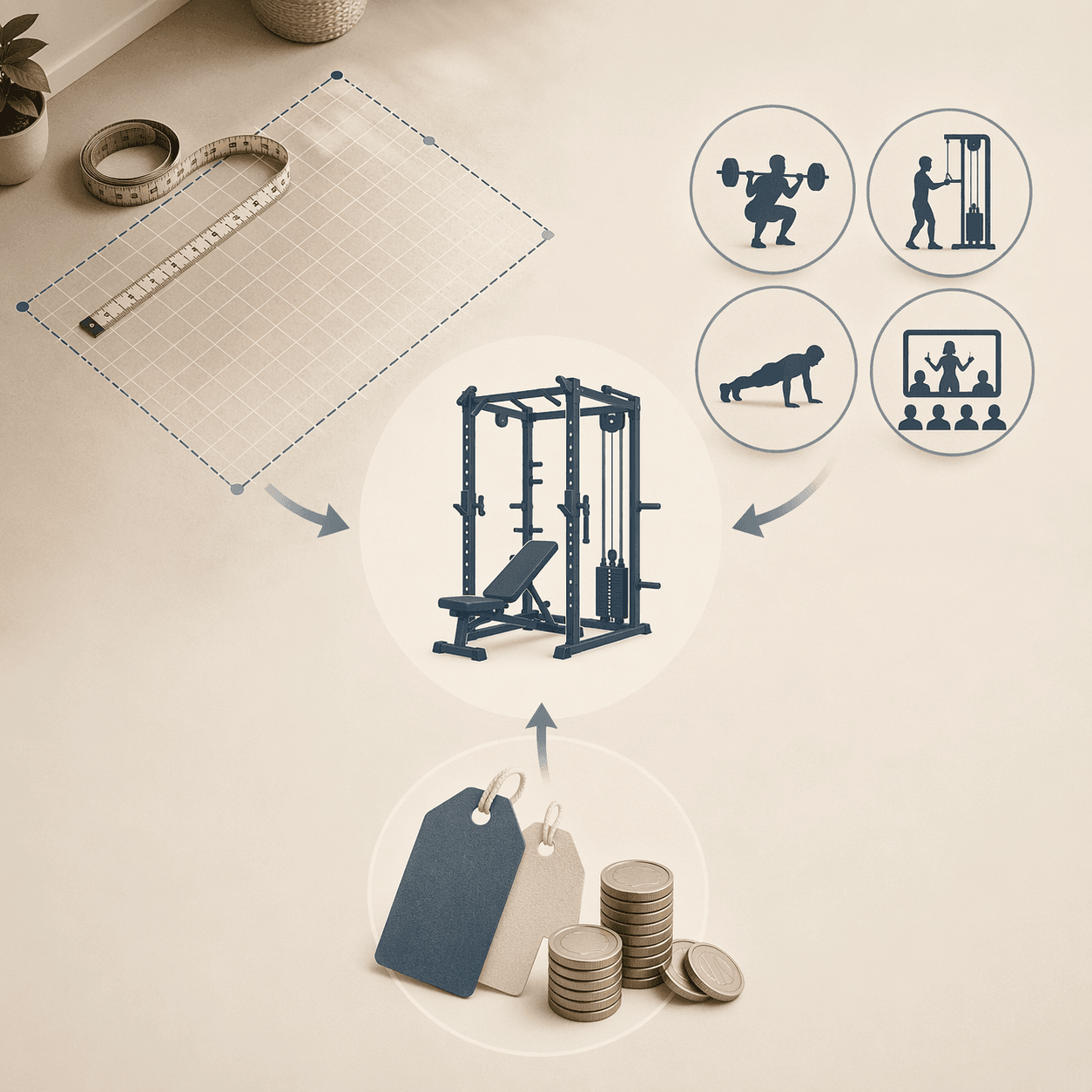
Before comparing specific workout machines for home, measure the room and decide what kind of training you will actually repeat. The machine that looks like a bargain online can become the expensive one if the cable arms hit a wall, the rack feels cramped, or the subscription turns a one-time purchase into a bill you resent every month.
A useful first pass is not “best overall.” It is: available floor space, preferred training style, budget horizon, and subscription tolerance. Those four filters usually eliminate the wrong categories faster than another product ranking.
Start With The Filters That Delivery Day Cannot Fix
Use this as a decision tree before looking at brands:
- Measure usable space, not just empty floor. Add 1–2 ft around the machine where you need to step, load plates, pull cables, unrack a bar, or move a bench.
- If you have under 20 sq ft, eliminate most power racks and many all-in-one machines. Look first at resistance band systems, compact cable towers, or wall-mounted smart gyms.
- If you mainly want squats, bench press, deadlifts, presses, and long-term strength progression, start with a power rack plus barbell setup.
- If you mainly want rows, pulldowns, flyes, lateral raises, curls, triceps work, and adjustable angles, start with a functional trainer or compact cable tower.
- If you want coaching, form prompts, classes, and a cleaner room, consider a smart gym after pricing the subscription over several years.
- If the lowest upfront cost and closet storage matter most, start with bands or suspension training, then accept that loading and progression will be less tidy than plates or weight stacks.
That order matters. A power rack is excellent in the right garage and annoying in the wrong bedroom. A smart wall trainer can be genuinely convenient, but its small footprint does not make its five-year cost small. A band system can be the only setup that fits a shared apartment, but it will not feel like a commercial cable stack.
Footprint Comes First Because You Cannot Negotiate With A Wall
Manufacturer footprints are a starting point, not the whole room plan. You still need clearance for the bar path, the bench, cable travel, seat adjustments, and the awkward human motion of getting into position. Real-world setup often needs another 1–2 ft around the listed machine footprint for safe movement.[1][2]
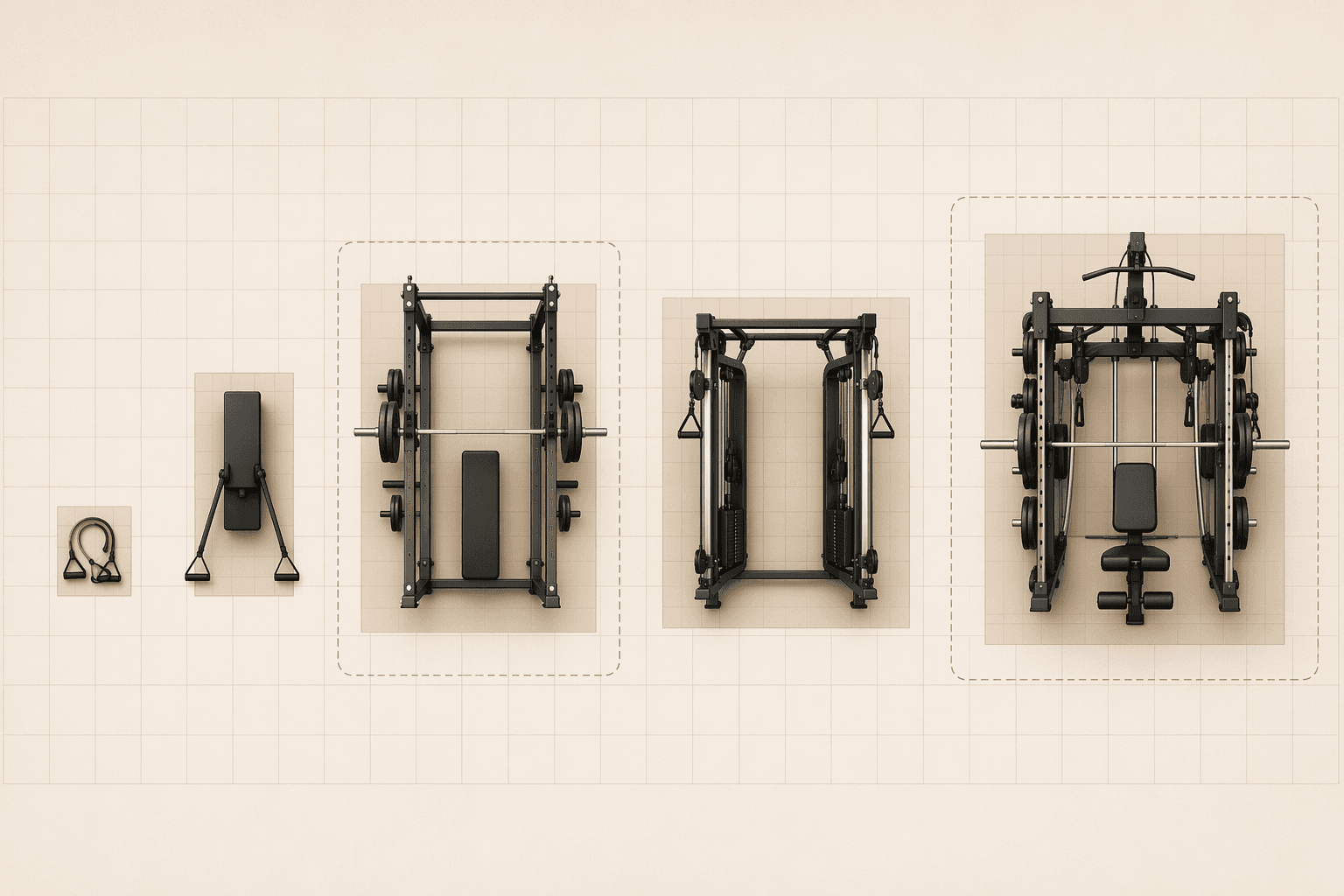
| Machine type | Typical space reality | Best fit | Main space problem |
|---|---|---|---|
| Resistance band system | Stores in roughly 2–4 sq ft | Apartments, travel, lowest upfront cost | Training area still needs enough room to anchor, step, and control band tension |
| Wall-mounted smart gym | Small mounted footprint, larger workout zone | Guided strength training in a clean space | The wall footprint hides the need for movement clearance and subscription cost |
| Functional trainer or cable tower | Often roughly 20–30 sq ft once you include cable movement | Cable-based full-body training | Side clearance matters more than buyers expect |
| Power rack plus barbell | About 24+ sq ft before added clearance | Compound barbell lifting and long-term loading | Bar length, plate loading, and bench position demand room |
| All-in-one machine | Roughly 20–50 sq ft depending on design | One station for Smith work, cables, pull-ups, and accessories | Complex frames can crowd small rooms quickly |
Under 20 sq ft, the rack dream usually needs to wait unless you are building around a very compact setup and can still move safely. The same goes for many all-in-ones. They may appear efficient because they combine stations, but combining a Smith machine, cables, pull-up bar, and bench does not erase the space each movement needs.
The functional trainer sits in the middle. It can deliver a lot of exercise variety for the floor it uses, especially when the arms adjust well and the pulleys move smoothly. The trade-off is not variety; it is loading. Cable stacks and plate-loaded towers usually top out earlier than a barbell setup, especially for lower-body strength work.
Then Price The Setup Over Years, Not Checkout
Garage Gym Reviews has estimated the average home gym cost at roughly $1,500–$2,500 based on reader-submitted setups, which is useful as a sanity check but not the same thing as a controlled survey.[3] A rack, barbell, plates, bench, and flooring can land near that range. A compact cable tower may come in lower. A smart gym can blow past it before the first subscription renewal.
The fair comparison is total cost of ownership. A gym membership averaged about $65 per month in the 2024 U.S. Health & Fitness Consumer Report, so a home setup can make financial sense over time, but only if you include all required parts, delivery, flooring, accessories, and subscriptions.[4]
| Category | Price anchors from current market examples | Ongoing cost issue |
|---|---|---|
| Resistance band system | X3 Bar at $549; many suspension or band setups under $600 | Usually no required subscription, but progression is harder to measure |
| Compact cable tower or functional trainer | Bells of Steel Cable Tower listed at $434.99 plate-loaded | May require plates, attachments, bench, and wall or floor space |
| Power rack plus barbell | REP or Titan-style rack setups often around $1,500–$2,000 | Low ongoing cost, but plates, flooring, safeties, and delivery add up |
| Traditional all-in-one | Bowflex Xtreme 2 SE at $1,499; more complex all-in-ones often around $3,500+ | More moving parts and shorter warranties can matter over time |
| Smart gym | Tonal 2 at $4,295 plus $59.95/month; Peloton Bike+ at $2,695 plus $49.99/month; Speediance Gym Monster at $3,199 with basic mode at $0 subscription | Subscription terms define the real long-term cost |
The Tonal 2 example is the cleanest warning label. At $4,295 for the machine and $59.95 per month, the subscription alone comes to about $3,597 over five years, before accessories, installation, taxes, or any future price change.[5][6] That does not make it a bad purchase. It makes it a compact purchase with a long tail.
Subscription pricing for Tonal, Peloton, and similar systems is current as of June 2026 in the sources used here and should be checked again before buying.[5][6] Smart gyms are often sold on convenience, coaching, and a tidy room. Those are real benefits for the right person. They just belong in the same calculation as the monthly fee.
If You Have Under 20 Sq Ft
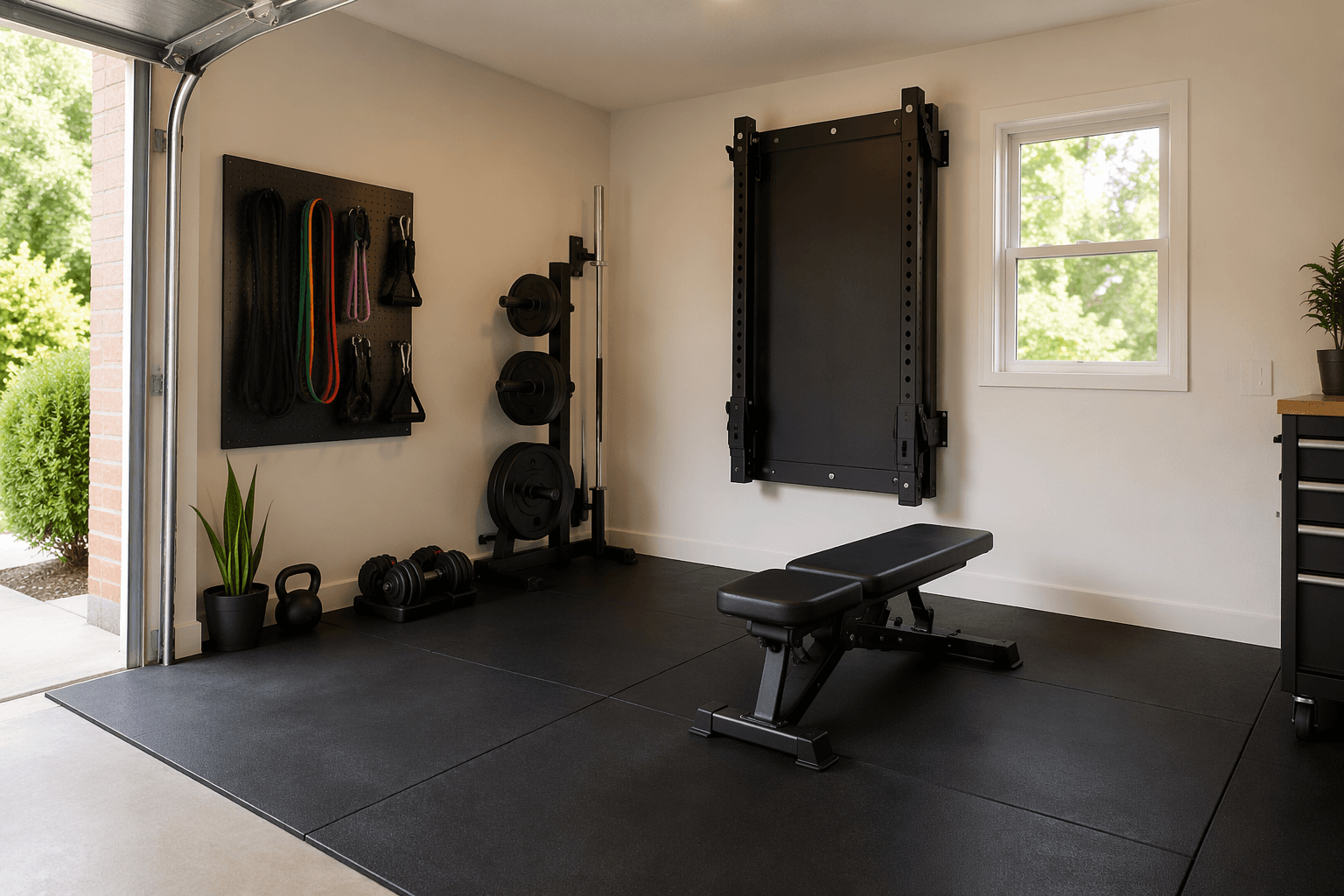
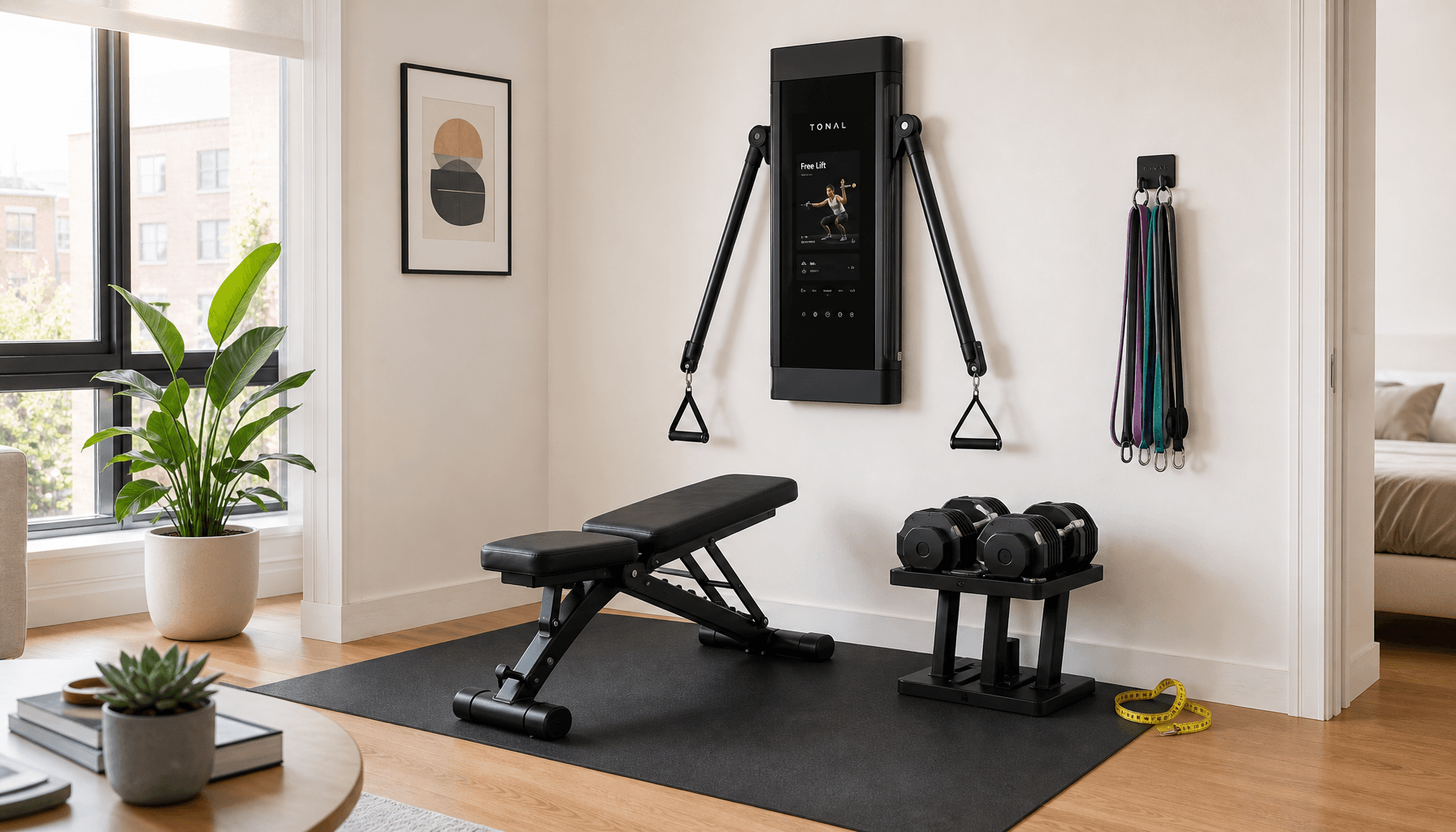
Start with storage-first equipment: resistance bands, suspension trainers, a compact cable tower if you have a suitable wall or corner, or a wall-mounted smart gym if the subscription fits. This is the zone where buying too much machine creates the most regret.
Band systems are the cheapest and easiest to store. The X3 Bar, for example, is listed at $549, and band-based setups can fit in a closet rather than taking over a room.[1] The compromise is progression. With plates or a weight stack, you can add load in obvious increments. With bands, resistance changes through the range of motion, and comparing one week to the next takes more attention.
A compact cable tower can be a better choice if you want repeatable rows, pulldowns, curls, pressdowns, and single-arm work. A plate-loaded tower may keep the price down, but it still needs plates and space for cable travel. Measure the pulling direction, not just the tower width.
If You Prefer Cable Training
Look at functional trainers first. They are usually the most balanced choice for someone who wants full-body training without committing to barbell lifting. Adjustable pulleys make it easier to train at different angles, switch between upper- and lower-body accessories, and share the machine with another person who uses different heights and movements.
The limitation is the ceiling on resistance. A functional trainer can be excellent for controlled cable work, but it is not the same as a rack, barbell, and plates for heavy squats, bench press, deadlifts, or loaded carries. If your favorite commercial-gym exercises are pulldowns, seated rows, cable flyes, face pulls, lateral raises, and triceps pressdowns, the trade-off is probably worth it. If your training identity is built around adding weight to the bar, it probably is not.
If Barbell Strength Is The Point
Start with a power rack, barbell, plates, bench, and flooring. This is the least glamorous answer and often the most durable one. A rack setup needs about 24+ sq ft before you add practical clearance, but it gives you the clearest path for compound lifts, heavier loading, and long-term progression.[1]
The buyer’s remorse version is predictable: someone buys a rack because serious lifters use racks, then realizes they do not enjoy programming their own training, changing plates, or resting between heavy sets. A power rack is not a motivation machine. It is a platform for people who want to practice the same lifts and make the numbers move.
If that sounds appealing, the long-term economics are strong. Once the main setup is paid for, there is usually no required monthly fee. More plates, specialty bars, and attachments can be added later, but the core does not depend on a software subscription staying active.
If You Want Guidance More Than Equipment
Smart gyms deserve a real place in the decision tree. For some buyers, the problem is not owning enough iron; it is deciding what to do, keeping sessions moving, and fitting training into a room that still has to look like a room. Systems such as Tonal 2, Peloton Bike+, and Speediance Gym Monster compete on guided workouts, compact hardware, and software-led training rather than raw steel per dollar.[5][6]
That convenience has different strings depending on the brand. Tonal 2’s $4,295 machine price plus $59.95 monthly subscription creates a very different five-year cost than Speediance Gym Monster at $3,199 with basic mode listed at $0 subscription.[5][6][7] Peloton Bike+ is a different training category than a strength wall, but its $2,695 hardware price plus $49.99 monthly membership shows the same ownership pattern: the screen is only part of the cost.[6]
Choose this route if coaching, classes, and friction reduction are worth paying for. Avoid it if you mostly want independent lifting, dislike locked ecosystems, or know you will cancel the subscription and then resent what the hardware can no longer do.
If An All-In-One Machine Still Looks Right
All-in-one machines make sense when you want several stations in one footprint and have enough room to use each station properly. The appeal is obvious: Smith work, cables, pull-ups, benches, leg attachments, and storage can live in one frame. The catch is that complexity concentrates risk. More pulleys, rails, guide rods, cables, and attachments mean more parts that need to feel good and keep working.
This category also stretches widely on price and footprint. Some simpler home gyms sit around the $1,500 mark, while more complex all-in-ones often run around $3,500+ and can require roughly 20–50 sq ft depending on the layout.[1][8] Warranty terms matter more here than they do on a simple rack because the machine is doing more jobs.
If this is the category that survives your space and training filters, compare the major designs before comparing individual models. A deeper breakdown of single-stack, dual-stack, multi-stack, and smart trainer designs will help you avoid treating very different machines as if they solve the same problem.
If You Refuse Subscriptions
This filter cuts through the smart-gym aisle quickly. If you do not want a required monthly fee, prioritize power racks, cable towers, functional trainers, traditional all-in-ones, and band systems. Some smart machines offer limited no-subscription modes, but that should be verified model by model before purchase.
A no-subscription setup is not automatically cheap. Flooring, plates, benches, attachments, and delivery can push the first bill higher than expected. But after that, the equipment does not need permission from an app to keep working.
The Category You Should Compare Next
| Your constraint | Compare this category first | Trade-off you are accepting |
|---|---|---|
| Less than 20 sq ft and lowest upfront cost | Resistance band system | Less precise progressive overload |
| Less than 20 sq ft and desire for coaching | Wall-mounted smart gym | Higher five-year cost and possible subscription dependence |
| Cable exercises are the main goal | Functional trainer or compact cable tower | Lower resistance ceiling than barbell training |
| Heavy compound lifts are the main goal | Power rack plus barbell | More floor space, more setup work, less built-in guidance |
| Many stations in one frame | All-in-one machine | Higher complexity, larger footprint range, warranty scrutiny |
| No monthly fees under any circumstances | Rack, cables, bands, or traditional all-in-one | More responsibility for programming and progression |
Once one category survives those filters, product comparisons become useful. Before buying, verify the exact footprint with clearance, ceiling height, delivered weight, assembly requirements, warranty, accessory costs, and any subscription terms that affect core features. That is the difference between owning a home gym and storing one.
References
- The Best Home Gym Machines in 2026: Tested for Versatility, Durability, and Performance, Garage Gym Reviews.
- Best Compact Workout Machines & Gear for Small Spaces, Motion Fitness.
- How Much Does a Home Gym Actually Cost in 2026, Garage Gym Reviews.
- 2024 U.S. Health & Fitness Consumer Report, Health & Fitness Association.
- The Best Home Gym Equipment We've Tested for 2026, PCMag.
- Best Smart Home Gyms for 2026, CNET.
- 2026 Multi-Function Home Gym Comparison, Speediance.
- Best Home Gyms of 2026 (Personally Tested), BarBend.
Comments
Join the discussion with an anonymous comment.