
Nearly 39 million Americans live in apartments. That number should frame every compact home gym comparison, not the wattage of digital resistance or the height of a folded rack. Because if your workout makes your downstairs neighbor file a noise complaint, the specs on the box don't matter.
Most roundups skip this. They compare max resistance numbers across categories as if 250 lbs of digital resistance is the same as 250 lbs on a barbell, and they treat a machine's folded depth as the only space metric worth mentioning. The result is that people buy a compact smart gym, install it, and discover it needs seven feet of wall space they don't have, or that the subscription fee bumps the three-year cost past what they'd pay at a gym.
This comparison organizes the decision around four constraint axes: how much floor and wall space you actually have (including the movement zone), how much noise you can make without antagonizing neighbors, what kind of resistance is strong enough for your goals, and whether you are willing to pay a monthly subscription on top of the upfront price. These are the filters that determine which category of compact gym makes sense for you, not which product has the most features.
Space is not just the folded footprint
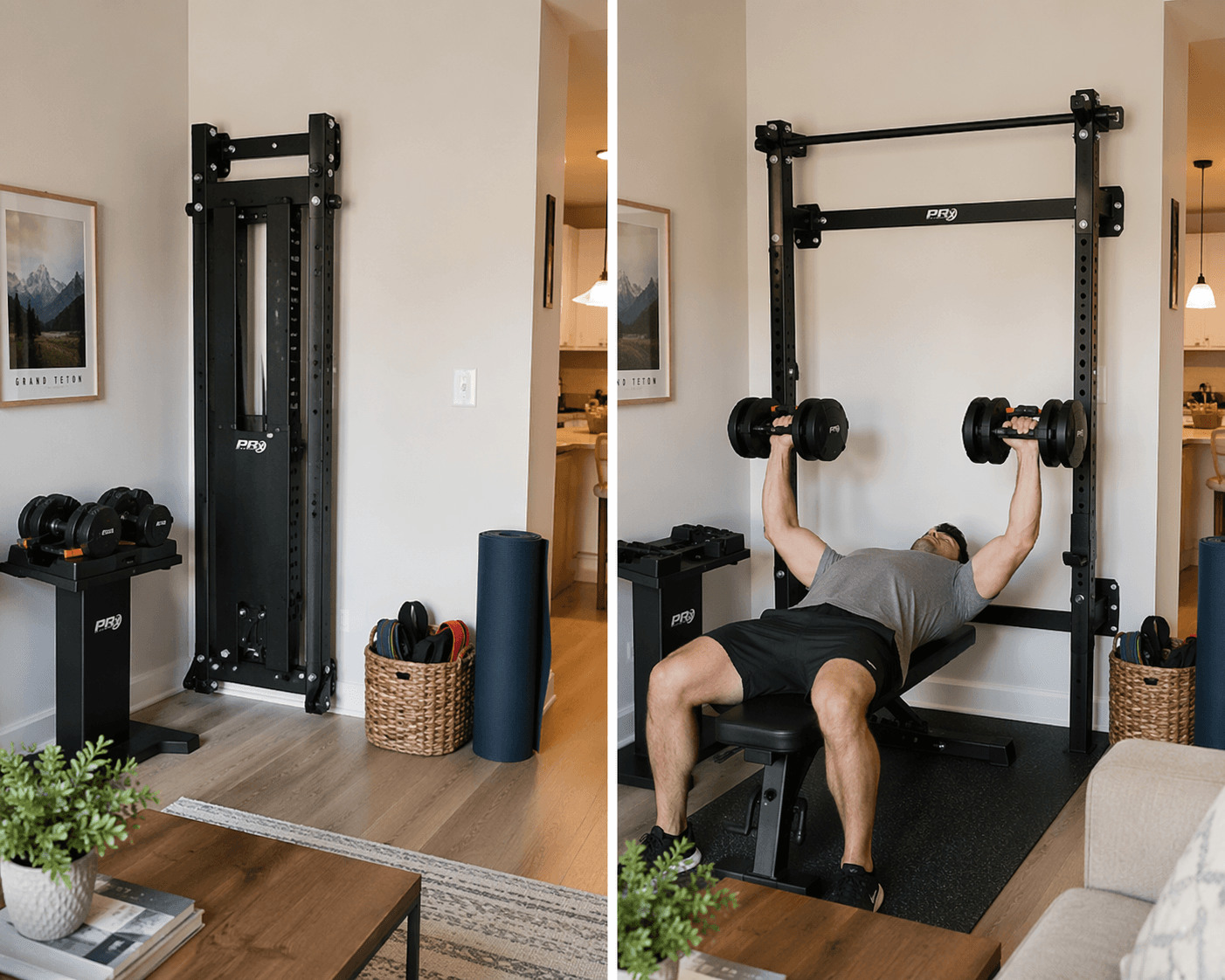
A machine's folded dimensions are a marketing number. The real measure is the usable footprint: the area you need clear to perform exercises safely. A foldable rack like the PRx Profile PRO has a folded depth of 12 inches, which sounds nearly invisible. But when you fold it down for a squat, you need room behind the bar for a bailout, room in front for the movement, and often a spotter or at least clearance to dump the weight. That easily turns a 12-inch wall-mounted footprint into a 6-foot usable zone.
Here is how the four categories compare on actual space required — including the movement zone:
| Category | Folded/Stored Footprint | Usable Floor Space |
|---|---|---|
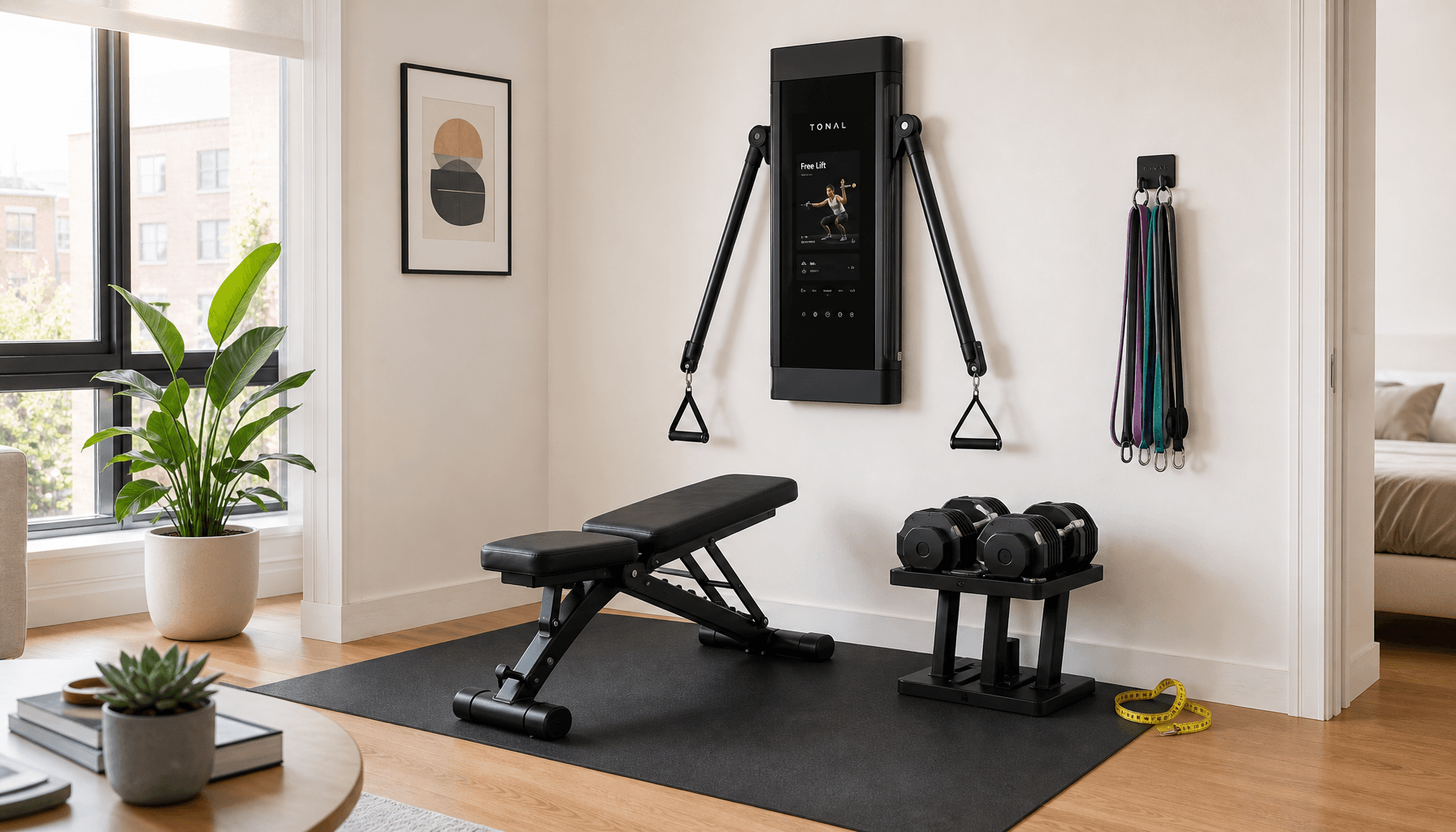
| Smart gym (Tonal 2) | 5.25" D x 21.5" W x 50.9" H | Requires 7 ft wall width + ~30 sq ft floor |
| Smart gym (Speediance) | 14.96" D x 28.34" W x 72.83" H | ~25 sq ft when unfolded; less when stored |
| Cable/weight-stack (Bowflex Xtreme 2 SE) | ~84" L x 30" W | ~20 sq ft permanent |
| Cable tower (Bells of Steel) | 31" D x 28.5" W x 80.75" H | ~15 sq ft permanent |
| Band system (X3 Bar) | 10" L x 19" W x 1" H | ~10 sq ft (foldable mat, no permanent space) |
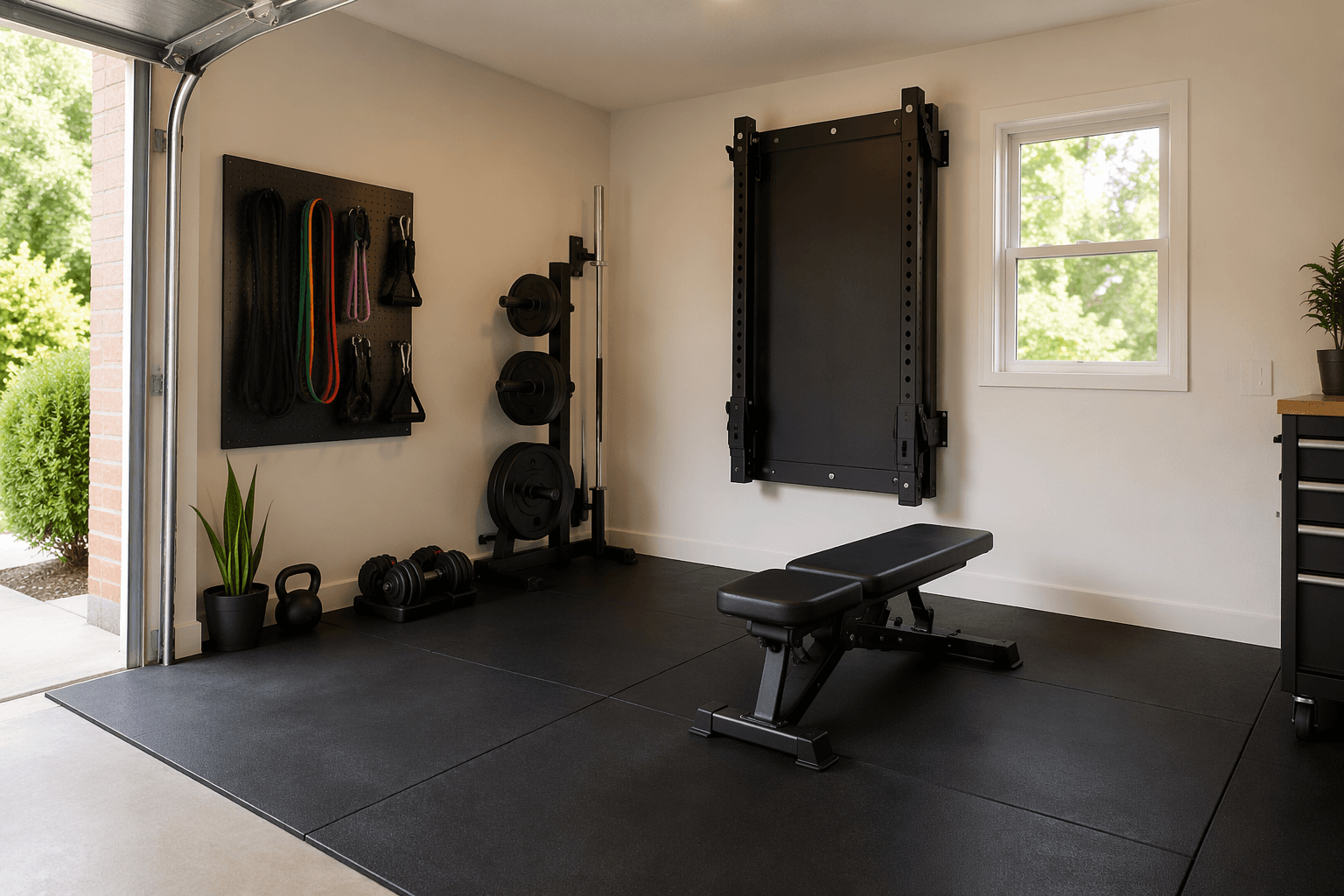
| Modular free weights (rack + dumbbells + bench) | Rack 12" D folded; dumbbells ~2 sq ft | ~20 sq ft when rack is down; ~6 sq ft stored |
The band system and adjustable dumbbells take almost no permanent space. The X3 Bar footprint is 10 x 19 inches and you can store it under a couch. Adjustable dumbbells like the REP QuickDraw sit on a small stand and replace up to 12 pairs of fixed dumbbells. For anyone whose gym is also their living room, that reclaimed floor area matters every day.
For a visual breakdown of what fits in each room size, our space-tier guide shows exactly what you can build in 10, 30, 50, or 100 square feet.
Noise: the neighbor tax
When I tested a foldable rack in a second-floor apartment, the racking sound — metal on metal when the barbell hits the j-cups — carried through the floor. The person below knocked on the ceiling twice. That was with a crash pad. Now imagine a cable machine with a clanking weight stack, or a band system where a snap could sound like a whip crack. Some categories are fundamentally noisier than others, and this is almost never discussed in product specs.
| Category | Operational Noise | Impact Noise |
|---|---|---|
| Smart gym (digital resistance) | Low (motor/pulley whir) | Negligible (no dropping) |
| Cable/weight-stack | Moderate (stack clanking) | Low (controlled descent) |
| Band system | Low (no mechanical parts) | Medium (snap risk, but avoidable) |
| Foldable rack + free weights | Low (lifting only) | High (racking and dropping) |
| Adjustable dumbbells | Silent | Low (set down gently) |
If you live on a ground floor with concrete subfloor, noise is less of a constraint. If you are on the fifth floor of a wood-frame building, consider band systems, adjustable dumbbells, or digital-resistance smart gyms. Tonal uses electromagnetic resistance — no plates to clang — and its wall mount is a one-time drilling event. The Speediance Gym Monster has similar quiet operation. For renters who want heavy compound lifts without noise complaints, a folding rack can work with a thick platform and bumper plates, but that adds cost and still does not eliminate sound.
A cheap interlocking foam mat ($25 for 24 sq ft) can dampen impact noise, but it will not silence a dropped barbell. Our apartment renter's guide covers floor protection and deposit safety in more detail.
The resistance spec that lies to you
A spec comparison without a feel comparison is misleading. The Bowflex Xtreme 2 SE claims 210 lbs of resistance, upgradable to 410 lbs. But its power rods become stiffer as you stretch them, meaning the resistance curve is ascending — the weight feels heavier at the end range and lighter at the start. Tonal 2 offers 250 lbs of electromagnetic resistance, but you need the $59.95/month membership to unlock eccentric overload (the phase where the weight lowers under tension). Without it, you lose a core stimulus for muscle growth.
The X3 Bar claims up to 300 lbs of force from its bands. But the bar is only 10 inches wide — you cannot use it for conventional deadlifts or rows without modifying the movement. The bands also produce progressive tension: the hardest part of the exercise is at the top, not the bottom. That can be effective but it is not interchangeable with a cable stack or free weights.
Free weights — whether fixed iron or adjustable dumbbells like the REP QuickDraw (5–60 lbs each) — provide constant resistance. The weight on the handle is the weight you move through the entire range. That simplicity is why many intermediate lifters prefer them. The tradeoff is that free weights require a spotter or a safe bailout strategy for heavy dumbbell presses or squats, which eats into your usable space.
For a decision framework that also considers form factor and user experience level, the decision matrix article takes a broader view before diving into compact gym specifics.
The subscription trap: three-year total cost
The upfront price is only half the story. A smart gym with a monthly subscription can end up costing more over three years than a comparable free-weight setup plus a gym membership.
| Category | Upfront Price | Monthly Subscription | 3-Year Total Cost |
|---|---|---|---|
| Tonal 2 | $4,295 | $59.95 | $6,453 |
| Speediance Gym Monster | $3,199 | None | $3,199 |
| Bowflex Xtreme 2 SE | $1,499 | None | $1,499 |
| Bells of Steel Cable Tower | $435 | None | $635 (with ~$200 weights) |
| X3 Bar + bands | $549 + $129 | None | $678 |
| Modular free weights (PRx rack + QuickDraw + Ironmaster bench) | $1,100 + $336 + $499 | None | $1,935 |
| Gold's Gym membership (comparison) | $0 equipment | $25 | $900 |
The Tonal 2 crosses the $900 gym-membership threshold in about 13 months — after that you are paying more than a gym every single month unless you cancel the subscription, which removes key features. The Speediance Gym Monster avoids this entirely, but its $3,199 upfront still buys a lot of adjustable dumbbells and a rack. The breakeven for a free-weight setup against a gym membership is around 4 years (using the $1,098 average home gym cost from CNET), but that changes if you buy more equipment or add subscriptions.
For a deeper breakdown of what each dollar buys across budget ranges, see our home gym cost guide.
Which category fits your life?
If you have under $500, need near-silent operation, and only have a corner of a room: go with a band system and a pair of adjustable dumbbells. The X3 Bar ($549) plus Living.Fit bands ($129) covers pulling and pressing; the REP QuickDraw ($336) handles everything else. Total under $680, zero permanent footprint, and you can store it all in a basket. You will outgrow the dumbbells eventually, but for a beginner or someone maintaining strength, this is the most space- and neighbor-friendly option.
If you have $500 to $1,500, some noise tolerance, and a dedicated closet or spare room: a cable tower like the Bells of Steel Cable Tower ($435) plus a bench and a set of adjustable dumbbells gives you a complete gym for under $1,000. The cable tower provides isolation movements and lat pulldowns; the dumbbells cover compound lifts. The footprint is about 15 sq ft permanent. Add a folding rack like the PRx Profile PRO ($1,099) if you want barbell work — but that pushes the total to around $1,935 and requires more space.
If you have over $1,500, are on a ground floor or have understanding neighbors, and want the smallest possible footprint with guided workouts: a smart gym like the Speediance Gym Monster ($3,199, no subscription) or Tonal 2 ($4,295 + subscription) fits in a 25–35 sq ft movement zone and requires only a wall mount. The Speediance avoids the subscription trap entirely. The Tonal provides more advanced tracking and coaching, but you should calculate the three-year cost honestly: $6,453 is more than seven years of a Gold's Gym membership.
For more on the form-factor decisions behind these categories, our archetypes guide compares all-in-one, wall-mounted, and component-based layouts.
The bottom line
No single compact gym category is the best. The right choice depends on how much space you can vacate, how thin your floors are, how heavy you lift, and whether you are okay with a monthly bill. The marketing will tell you smart gyms are the future; the numbers show that bands and dumbbells will outlast most subscriptions.
| Setup | 3-Year Cost | Breakeven vs. $25/mo Gym |
|---|---|---|
| Tonal 2 | $6,453 | Never (always costs more) |
| Speediance Gym Monster | $3,199 | ~9 years |
| Bowflex Xtreme 2 SE | $1,499 | ~4 years |
| Bells of Steel Cable Tower + dumbbells | $935 | ~3 years |
| X3 Bar + bands | $678 | ~2 years |
| Modular free weights (rack + dumbbells + bench) | $1,935 | ~5 years |
A dedicated home gym can be cheaper in the long run, but only if you buy equipment that holds its value and does not require monthly payments. The average home gym costs $1,098 upfront and breaks even against a $300/year gym membership after about 4 years. That is a reasonable timeline — but it assumes you do not resubscribe every month to a company that charges $60 for the privilege of using the machine you already bought.
Measure your actual space before you buy anything. Think about noise with a concrete plan: who lives below you, what time you train, and whether you can drop weight without drama. Decide on the subscription question first, not last. Then compare products, not the other way around.
Comments
Join the discussion with an anonymous comment.