
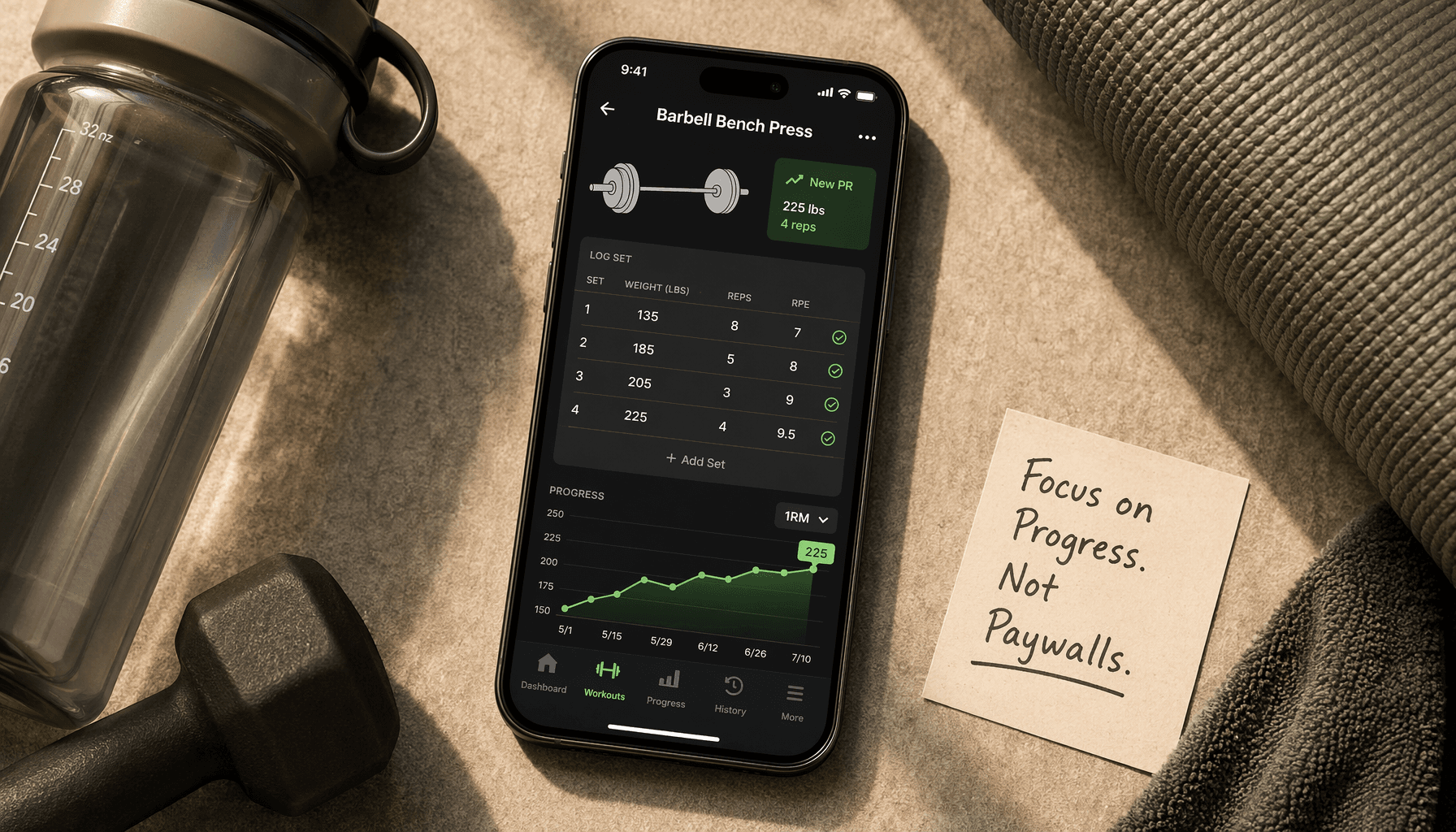
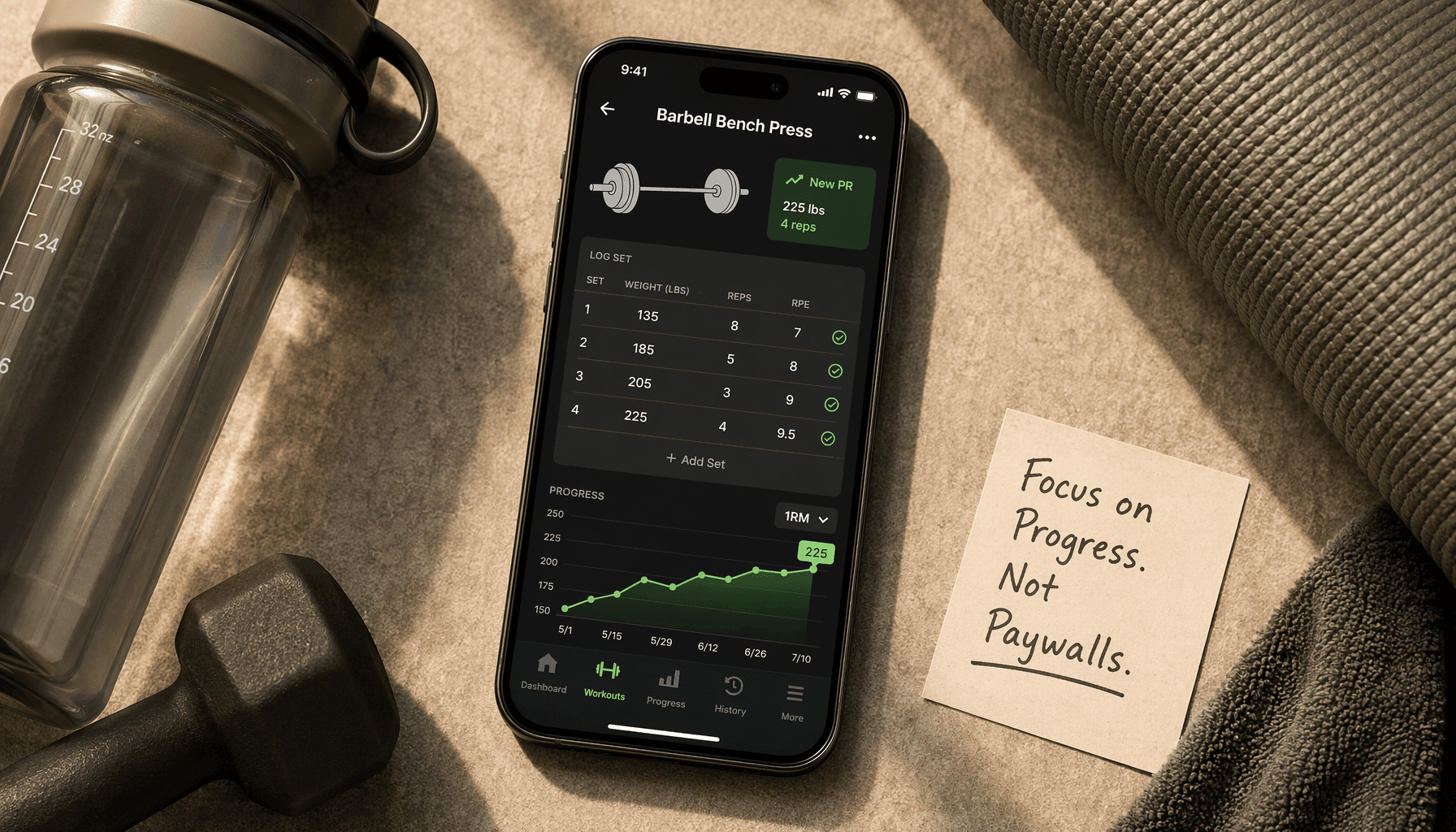
You download an app that says "free." The first workout goes fine. The second asks you to create an account. By the third session, you hit a screen that says "Unlock with Premium." The set you just logged? It might vanish from your history in thirty days. The rest timer? Locked. The progress chart? A blurry preview with a "Subscribe to see more" label.
This is not a failure of motivation. It is a deliberate design pattern.
A 2024 study found that 69% of fitness app users abandon within 90 days. A separate survey found that nearly one in five smartphone users have downloaded a fitness app. Those numbers do not mean people cannot stick with a routine. They mean the apps themselves get in the way—most often by confusing what "free" actually allows.
What "Free" Actually Means
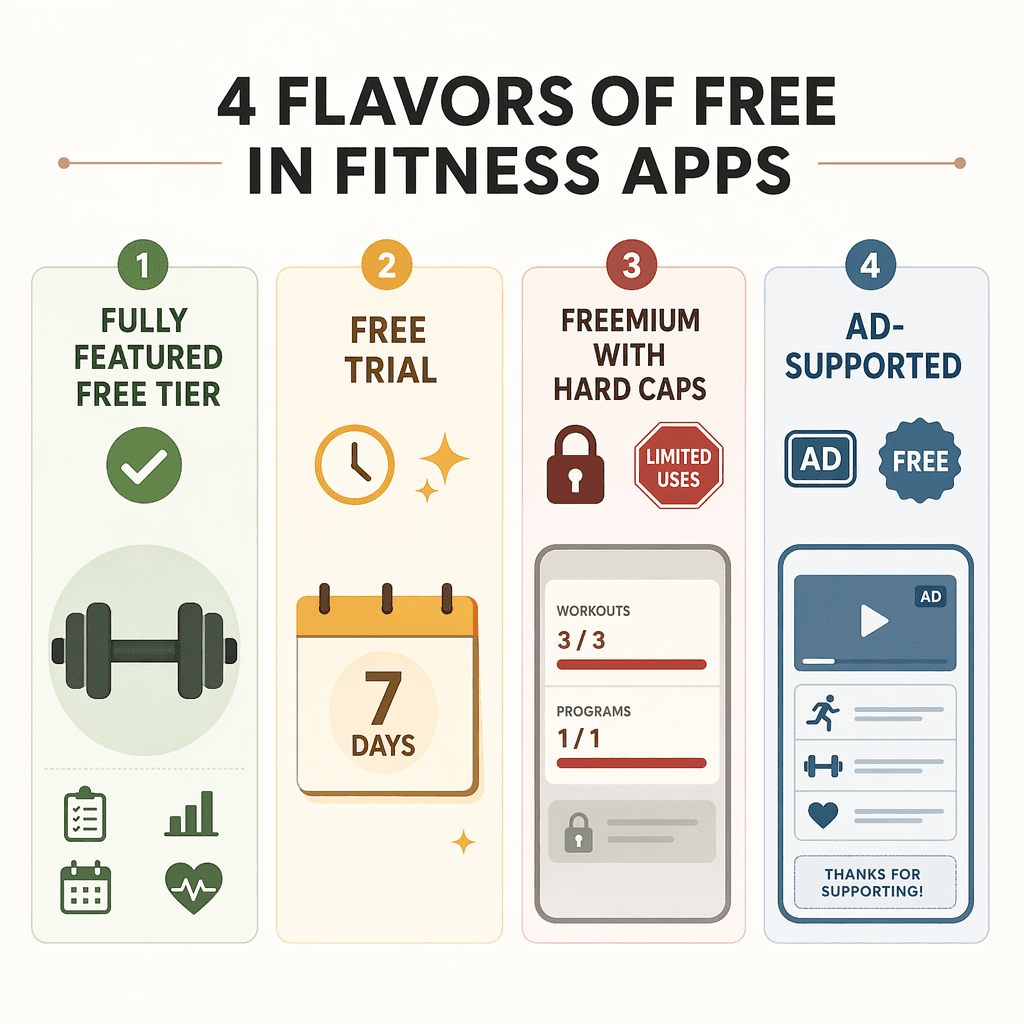
When an app labels itself "free," it means exactly one of four things. Knowing which flavor you are dealing with is the first step to not being tricked.
- Fully featured free tier: Everything you need to track workouts and see progress is included. No time limit, no cap on sets or routines. Example: Nike Training Club — completely free since 2020, with over 300 workouts and no premium tier at all.
- Free trial: Full access for a limited period, then a subscription required. Sometimes they ask for a credit card upfront; sometimes not. The trial itself is not a trap, but the automatic charge if you forget to cancel is. Example: Most subscription apps with a 7- or 14-day trial period.
- Freemium with hard caps: The app is free to download and use in a limited way, but core features—like logging more than three custom routines, accessing workout history beyond 30 days, or using a rest timer—are locked behind a paywall. Example: Strong free tier limits you to three custom routines (Setgraph). That might be enough for a beginner, but it will pinch as soon as you want to rotate workouts.
- Ad-supported: The app is free and functional, but every few sets you get a video ad. The ads can kill your workout rhythm and eat into your rest time. Still, if the logging is solid and the data is yours, some people tolerate it. Example: Several generic workout tracker apps fall here.
The first and third flavors are where most confusion happens. Fully featured means exactly what it says. Freemium with hard caps uses the word "free" to get you in, then frustrates you into upgrading.
But even within a fully featured tier, you need to check that the app actually gives you the tools to make progress. I've tested dozens of apps over the years. After the first few weeks, I've found a clear pattern: an app that does not give you these four things for free cannot support real training progress.
- Unlimited set logging. You need to log as many sets as your workout has, every session, without hitting a cap. Three routines? Not enough. Five sets on bench plus three accessories? That should be one session, not a negotiation.
- Full workout history. You need to see what you lifted last week, last month, last year. If history disappears after 30 days, you are training blind.
- A rest timer. It keeps your rest intervals consistent. Without it, you are guessing—and guessing usually means resting too long.
- Basic progress charts. A simple line chart showing weight or volume over time. That is the core feedback loop of progressive overload.
Mechanical tension, not a subscription, is what builds muscle (PMID: 32826845). An app that paywalls any of these four tools is charging you to apply a basic training principle. That is not a premium feature; it is a ransom.
A 5-Minute Vetting Ritual
You do not need to read the privacy policy or squint at comparison charts. In five minutes you can decide whether an app is worth your time.
- Log three sets of anything. Does the interface let you complete a set, rest, and log another? Does it lock that third set behind a "Premium" prompt?
- Check the history. Go back to the workout you just entered and view it. Then check if there is a date in the past—say, two weeks ago—that is still accessible. If history disappears after 30 days, that is a red flag.
- Test the rest timer. Start a set, tap "done," and watch for a timer to automatically count down. If none appears, or if the timer is grayed out with a lock icon, the app is deliberately crippled.
- Check export options. Can you export your data to CSV or another format? If not, your log is trapped inside their paywall system.
- Count the ads. Do you get a video ad between sets? A banner at the bottom is one thing. A forced 30-second ad mid-workout is a dealbreaker for most people.
Applications that require a credit card for a free trial, lock history after 30 days, or show video ads between sets are the most aggressive traps (Ascend). Walk away.
Four Apps That Actually Deliver
A small number of apps genuinely deliver a full workout tracking experience without asking for a dime. Each has trade-offs you need to know before downloading.
Nike Training Club
This app was $14.99/month until 2020, then Nike made it completely free during the pandemic and never reverted. It has over 300 guided workouts across 10 categories: yoga, HIIT, strength, mobility, and more. Ratings are stellar—4.8 on iOS, 4.4 on Android (Garage Gym Reviews).
The catch: NTC has no set tracking. You cannot log your own weight, reps, or sets. It is a guided workout library, not a logging tool. For someone who wants to follow a coach-led session, it is fantastic. For anyone running their own progressive overload program, it falls short.
Caliber
Caliber's free tier is one of the most generous in the industry: over 600 exercises, unlimited set logging, full workout history, algorithm-generated custom programs, and group features. No ads. No hidden caps. The only paid tier is the 1-on-1 coaching at $200/month (Men's Journal). If you train on your own, everything you need is free.
Caliber also claims that members make 34% faster progress with coaching versus training alone (Forbes, citing Caliber's own data). That is a self-reported figure, but the free version itself does not lose anything by being free.
FitNotes (Android Only)
FitNotes is the closest thing to a pure workout log. It is 100% free, zero ads, no premium tier. It works offline, exports full data to CSV, and lets you track sets, reps, and weight exactly as you like. It is the gold standard for minimal, distraction-free logging (Ascend, Setgraph).
The hard limitation: Android only. iOS users will need an alternative. Ascend's Foundation Mode is one option—free with no ads, built by the same team that wrote the Ascend article on free apps. The Strong free tier is another, though it caps you at three routines.
Boostcamp
Boostcamp offers over 1,000 free strength training programs from elite coaches and athletes, with unlimited tracking and a Pro subscription ($14.99/month or $79.99/year) that adds analytics only (Garage Gym Reviews). The free tier is genuinely useful: you can pick a program, log your workouts, and see basic progress. The Pro layer is for people who want deeper data, not for those who just need to train.
Comparison
| App | Set Logging | Full History | Rest Timer | Progress Charts | Platform | Key Limitation |
|---|---|---|---|---|---|---|
| Nike Training Club | No (guided only) | N/A (no logging) | Built-in for guided sessions | No (no logging) | iOS & Android | Not a logging tool |
| Caliber (free) | Unlimited | Yes | Yes | Yes | iOS & Android | 1-on-1 coaching is paid ($200/mo) |
| FitNotes | Unlimited | Yes | Yes | Basic (simple volume chart) | Android only | No iOS version |
| Boostcamp (free) | Unlimited | Yes | Yes | Basic | iOS & Android | Advanced analytics are Pro only ($14.99/mo) |
The table makes the trade-offs visible at a glance. NTC is excellent for guided workouts but cannot track your own lifts. FitNotes is the most complete logging experience, but only on Android. Caliber and Boostcamp cover all four basics on both platforms.
The four-flavors taxonomy and the must-be-free features are a repeatable method. The next time you see an app labeled "free," run the red-flag test. If it passes, use it. If it fails, delete it.
For beginners who are not sure which app style suits them, start with our 5-step decision framework for complete newcomers. If injury prevention is your priority, check our ranking of best free apps for beginners with injury prevention features. And for a deeper dive into how the top logging apps compare head-to-head, see the workout tracker app showdown.
Comments
Join the discussion with an anonymous comment.