
Your Tracker’s Calorie Number Is a Guess — and Not a Good One
If you’ve been trusting that calorie-burn number to create a deficit, you’ve been misled. Not slightly — structurally. In 2017, Stanford researchers tested seven wearables on 60 volunteers. The most accurate device was off by an average of 27 percent. The least accurate? 93 percent. That’s not a rounding error — it’s a guess wrapped in a display. I’ve read that study a few times, and the takeaway is simple: the number on your wrist is not a measurement; it’s an estimate with a wide margin. (For a fuller look, see our general smartwatch accuracy guide.)
The devices tested are now 7–9 years old, but the problem hasn’t been fixed. Newer wearables fall into similar error ranges, as the 2025 meta-analysis below shows. I’ll get to that in a moment.
Which Devices Are Least Unreliable?
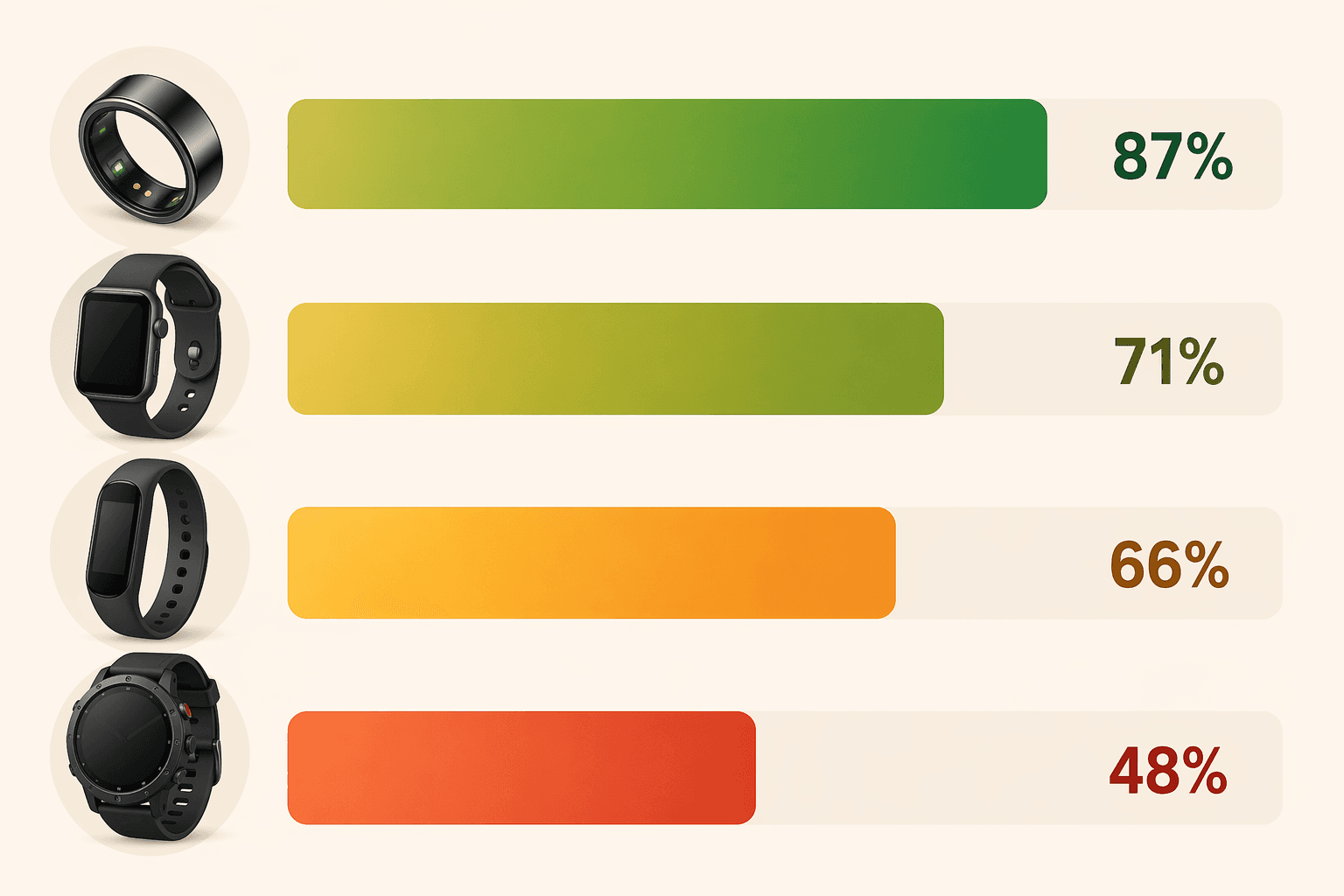
The 2025 WellnessPulse meta-analysis (compiled by Kygo Health) ranked current-generation devices by calorie accuracy. The numbers are not comforting.
| Device | Calorie Accuracy | Notes |
|---|---|---|
| Oura Ring (Gen 3) | ~87% | Limited testing; small sample. Strength is sleep/HRV, not calories. |
| Apple Watch | ~71% | Best among wrist wearables, but still 1 in 3 calories wrong. |
| Fitbit | ~65.6% | Popular, but accuracy lags behind Apple Watch. |
| Garmin | ~48% | Worst of the group; more than half of calories may be over- or underestimated. |
Apple Watch’s 71 percent sounds like a passing grade — until you flip it. Nearly one out of every three calories it reports is wrong. Oura’s 87 percent comes from a much smaller test sample, so I wouldn’t treat it as a head-to-head win. Garmin’s 48 percent means you have a coin-flip chance of being close to reality. That is not a tool for precision deficit management.
Why Calorie Estimation Fails
It’s not that sensors need a tweak. The problem is structural. Every wearable uses a proprietary algorithm to convert heart rate, motion, and personal data into an energy number. Those algorithms are trained on averages, and you are not an average. Your metabolic efficiency, muscle mass, even room temperature affect real calorie burn in ways a wrist sensor cannot see. Then there’s NEAT — non-exercise activity thermogenesis — the thousands of micro-movements you make in a day. A tracker lying on your nightstand while you pace the kitchen is measuring nothing. The number on your wrist looks precise because it ends in a decimal. It is not.
Three Metrics That Actually Move the Scale
Steps: The One Number You Can Trust
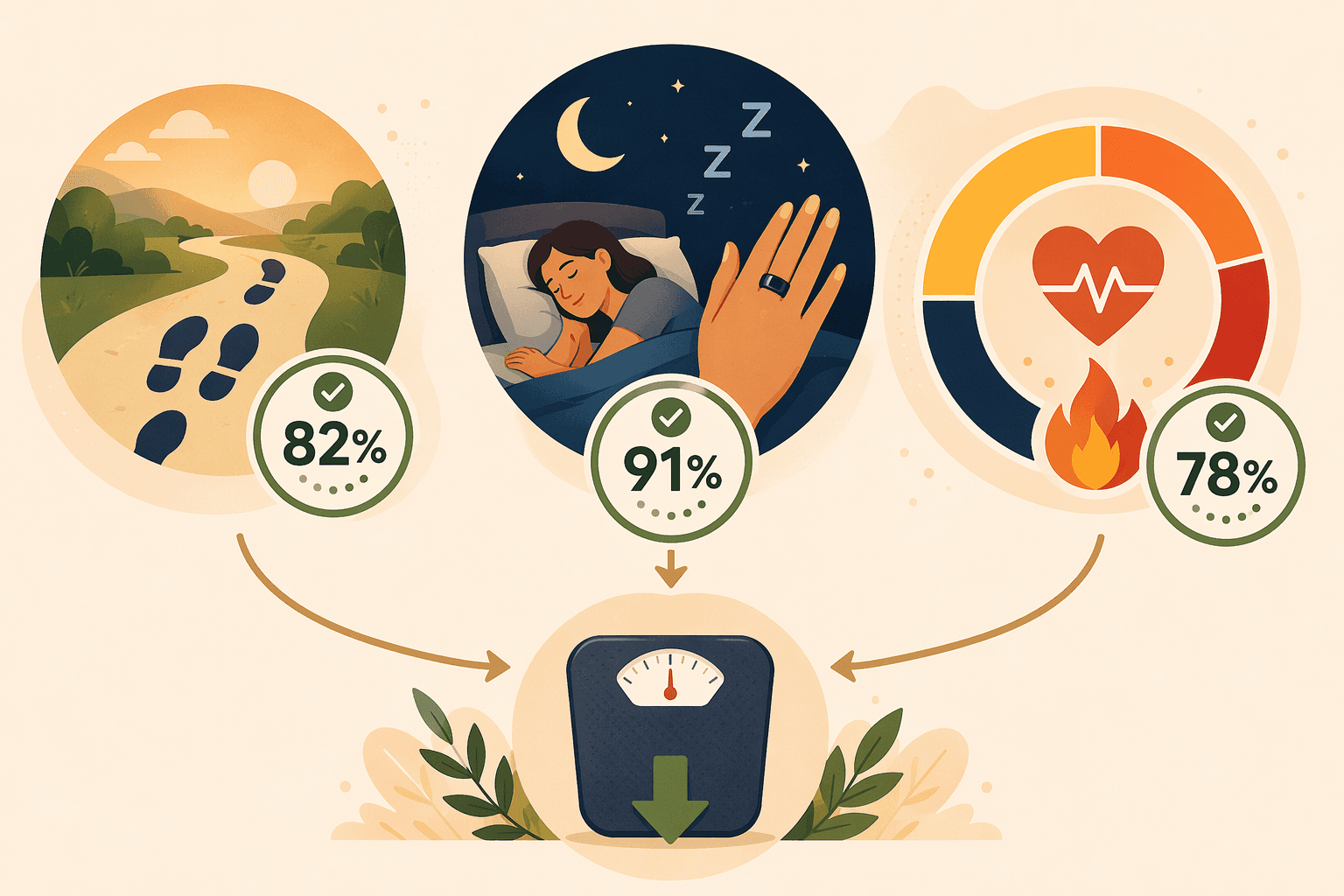
Step count accuracy is the one category where all major devices perform decently. The WellnessPulse meta-analysis puts Garmin at 82.58 percent, Apple Watch at 81.07 percent, and Fitbit at 77.29 percent. That’s usable. A consistent step target — say, 8,000 to 10,000 per day — builds an activity baseline that directly increases total daily energy expenditure. You don’t need to know how many calories you burned to know that walking more moves you toward a deficit.
Sleep: The Hormone Regulator
Poor sleep disrupts hunger hormones — ghrelin rises, leptin drops — and that drives cravings and overconsumption. Here, wearables can genuinely help. Oura Ring leads with a 91.8 percent sleep/wake accuracy validated against polysomnography (96 participants, 421,000 epochs). Its HRV tracking (concordance correlation coefficient 0.99 vs. ECG) gives a window into recovery and readiness. If you suspect your weight loss is held back by poor sleep, Oura is your best bet. Our Oura recovery guide explains how those metrics support weight management.
A note: the HRV accuracy data comes from a study with only 13 participants (though 536 nights were collected). The sample is small, but the agreement among devices is consistent enough that I trust the direction. None of these studies prove causation — but the convergence is hard to ignore.
Active Zone Minutes: The Effort Proxy
Fitbit’s Active Zone Minutes rewards time spent in moderate-to-vigorous heart rate zones. The direct correlation with weight loss hasn’t been proven in controlled trials — at least not in the material I’ve seen. But the logic is sound: consistent moderate-to-vigorous activity drives energy expenditure. Rather than chasing a speculative calorie number, aim for a target of active minutes per day. For a full guide on using heart rate data effectively, see our HR zone guide for home workouts.
So Which Tracker Should You Buy?
Stop shopping by calorie accuracy. Match the device to how you build habits.
- Habit-builder: You want clear daily targets and simplicity. Fitbit’s step counting and Active Zone Minutes make it a strong choice. Its calorie number is no better than others, but the feature set leans into the metrics that matter.
- Data-driven: You want the least unreliable calorie number and strong heart rate tracking. Apple Watch leads here. Its 71 percent calorie accuracy is the best among wrist devices, and its step count (81 percent) is solid. If you must look at the calorie number, this is the least risky way to do it.
- Sleep-first: You suspect your weight loss is held back by poor sleep. Oura Ring’s sleep/wake accuracy and HRV tracking are unmatched. Don’t buy Oura for calories — buy it for sleep and recovery, then watch how that affects your appetite and energy.
Most people have overlapping goals. A hybrid approach — wearing a ring for sleep and a watch for daytime activity — can work, but consistency matters more than pairing. The best tracker is the one you will actually wear every day.
How to Use Your Tracker Without Falling for the Calorie Trap
You now know the numbers cannot be trusted for precision. Here’s how to pivot your behavior:
The evidence is clear: step count, sleep quality, and active minutes correlate with weight loss. Calorie numbers from wearables do not. Stop optimizing for a fiction. Start tracking what moves the scale.
Comments
Join the discussion with an anonymous comment.