
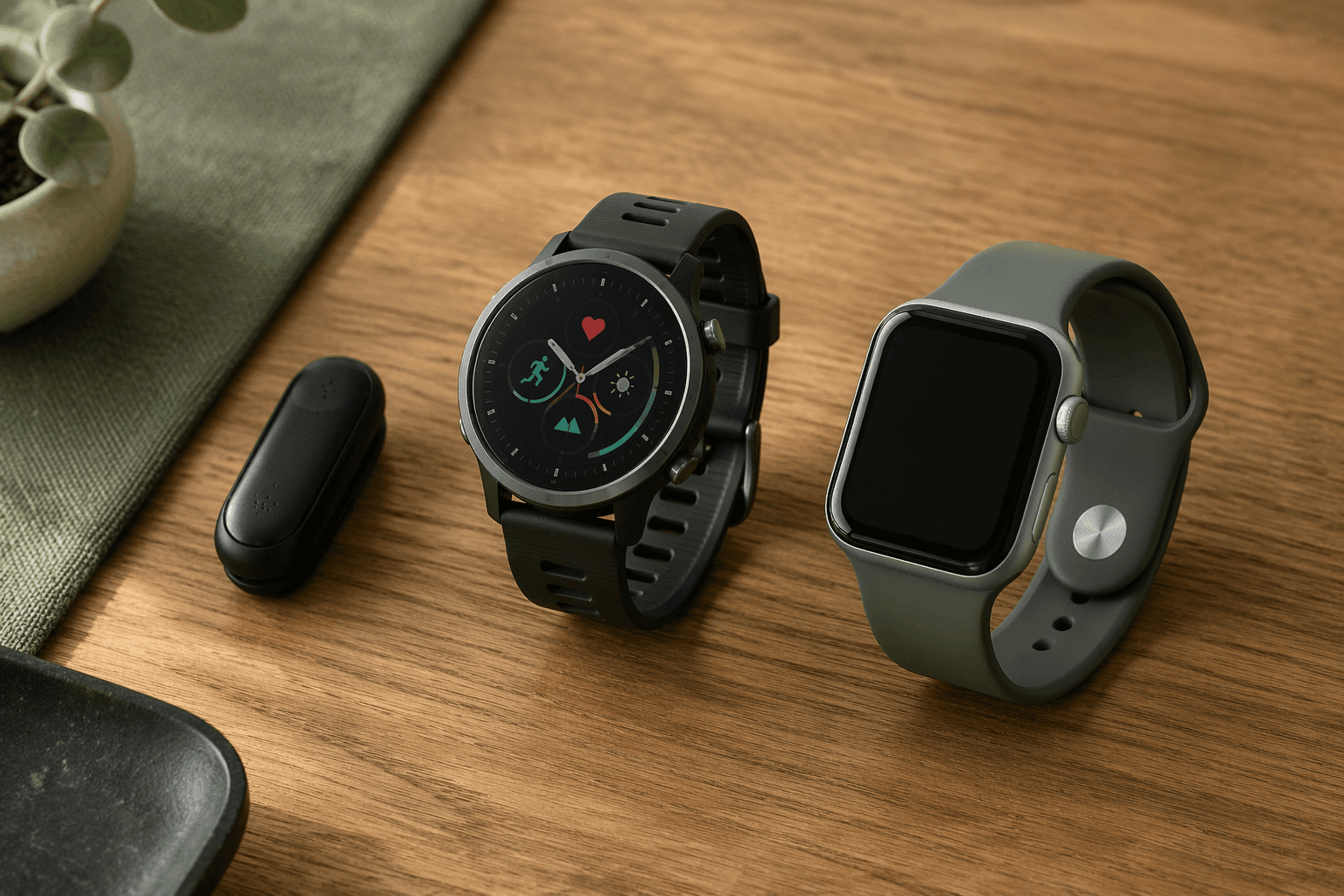
The decision between a Fitbit, Garmin, and Apple Watch isn’t about chipsets or step-count algorithms. It’s about your phone, your workout habits, and how often you’re willing to charge a device. The numbers that matter are the ones that affect what you actually do every day.
Battery: the real constraint
The Apple Watch Series 11 lasts 24–43 hours depending on use (PCMag, WIRED). That means daily charging. If you want sleep tracking—and if you’re serious about recovery, you should—you have to find a window each day when the watch is off your wrist. Miss a day and you lose a full night of data. That’s a real friction point, not a minor inconvenience.
Garmin watches sit at the other extreme. The Vivoactive 6 lasts 11 days (5 days with always‑on display) and the Forerunner 970 pushes to 15 days. You can track sleep, heart rate, and workouts for two full weeks without touching a cable. That changes how you use the device—you wear it and forget it.
Fitbit sits in the middle. The Fitbit Air manages 7 days (Men’s Health), the Charge 6 about a week, the Inspire 3 up to 10 days (PCMag, Wareable). No daily charging, but a weekly top‑up is a habit you’ll form quickly.
The hidden subscription cost
The entry price is the least important number. What you keep paying matters more.
Fitbit’s $99 Air is the cheapest device in the entire comparison. But Fitbit Premium costs $79.99 per year (Android Central). New devices include a 6‑month trial; after that, advanced analytics, the AI Health Coach, and deeper sleep insights run $9.99 a month. Over two years, the Air becomes $99 + $80 = $179. Not terrible, but suddenly not a bargain over a Garmin that gives you similar analytics for free.
Garmin’s Connect platform gives you Body Battery, Training Readiness, sleep insights, and detailed running dynamics without a subscription (WIRED). An optional Connect+ tier ($70/year) adds AI coaching and deeper trends, but the core analytics are free. For a data‑obsessed user, that’s a $70‑per‑year advantage over Fitbit’s Premium wall.
Apple Watch has no required subscription. The built‑in Health app, sleep tracking, and workout stats are all free. The trade‑off is the daily charging we already covered.
Accuracy: what the studies actually say
Every manufacturer publishes accuracy claims. I want to be careful here. Some of the most-cited numbers come from company-sponsored studies or use older models. Here’s the data that survived independent review—and the caveats that matter.
| Metric | Fitbit | Garmin | Apple Watch |
|---|---|---|---|
| Heart Rate | MAPE <25% (step count), HR accuracy <5% error on older models (Stanford 2017) | Good HR accuracy; no large‑scale peer‑reviewed figure for latest models | MAPE <10% for HR (JMIR 2021) |
| GPS | Charge 6 has well‑documented GPS/HR problems during outdoor runs (Wareable) | Industry‑leading GPS accuracy | Good GPS; not tested head‑to‑head with Garmin in the same controlled conditions |
| Sleep | Sensitivity 95‑96%, specificity 58‑69% (Forbes); underestimates deep sleep by ~41 min | Sensitivity ≥93% for sleep/wake, but stage classification inconsistent (Forbes) | No published large‑scale sleep staging accuracy equivalent to Fitbit/Garmin studies |
| Afib Detection | PPV 98% from Fitbit‑sponsored study (n=455,699); independent replication limited (Forbes) | PPV 92% (Forbes) | PPV 84% (NEJM study, Forbes) |
Three things to note about this table.
- Fitbit’s 98% PPV for Afib comes from the company‑sponsored Fitbit Heart Study. That’s a massive sample size (455,699), and the number is impressive. But it is not independently replicated at that scale. I’d treat it as strong evidence the algorithm works, not as a guarantee it outperforms Apple’s or Garmin’s by 14 points in every scenario. Forbes covers the data fairly.
- The Stanford 2017 study and JMIR 2021 review use older Fitbit models (Charge 2, HR). Newer sensors—especially on the Air and Charge 6—may perform differently. I would treat these figures as lower bounds, not current benchmarks.
- Calorie estimates across all three ecosystems are unreliable. Stanford found the best device was off by 27% and the worst by 93%. JMIR found MAPE >30% for all brands. Do not base nutrition decisions on a wrist tracker’s calorie burn number.
Your phone decides first
Apple Watch works only with iPhone 11 or later and iOS 26 (PCMag). Android users cannot pair it. That alone eliminates the Apple Watch for roughly half the market. Fitbit and Garmin work with both iOS and Android. If you use an Android phone, your choice is between Fitbit and Garmin. Full stop.
If you use an iPhone, the Apple Watch offers unmatched integration—messages, calls, music control, and Health app tightness. But it forces daily charging and the battery is a real friction point for sleep tracking. You have to decide what you value more: seamless phone integration or uninterrupted sleep data.
Where each one fits
The decision comes down to your workout habits, your phone, and your willingness to charge. Here is how I break it down for the most common user profiles.
For a beginner who wants a simple, affordable entry: Fitbit. The Air at $99, with no required subscription for basic steps, sleep, and heart rate, is the easiest start. The app is cleaner than Garmin’s for non‑athletes, and the optional Premium gives you AI coaching later if you want it.
For a runner or outdoor athlete: Garmin. The best GPS accuracy in the class, battery life measured in weeks, and free advanced metrics (Training Readiness, Body Battery) that rival paid subscriptions. The Forerunner series is purpose‑built for running. If you train for a half‑marathon or race, Garmin’s ecosystem is the right choice. See also our Garmin vs. Whoop vs. Oura comparison for a broader landscape.
For an iPhone user who wants a smartwatch first, fitness second: Apple Watch. No ecosystem comes close to the integration with Messages, calls, notifications, and Apple Health. Accept that you will charge every day, and you will lose sleep data on the nights you forget. If you want detailed fitness analytics, you may still prefer Garmin. Read our Apple Watch fitness tracking accuracy analysis for deeper data.
For an Android user: Fitbit or Garmin. The choice depends on your workout intensity. Casual gym goers and walkers: Fitbit. Serious runners or cyclists: Garmin.
For a budget‑seeker: Fitbit Air at $99. But look at total cost of ownership. If you plan to use Premium, the two‑year cost approaches $260, at which point a Garmin Vivoactive 6 at $250 with no subscription is actually cheaper.
For a data‑obsessed user who wants the deepest metrics without a monthly fee: Garmin. Free Body Battery, Training Readiness, sleep insights, and running dynamics cover 90% of what Premium offers. The optional Connect+ ($70/year) adds AI coaching, but the base platform is already rich.
The hybrid option (not as simple)
Some users ask: why not wear a Fitbit Air for casual daily tracking and a Garmin for workouts? You can. The Air is light (12 grams) and unobtrusive. The Garmin gives better GPS and workout metrics. But the friction is real: two devices to charge, two apps to sync, two data streams that don’t talk to each other. I would only recommend this if you truly need the Air’s form factor for sleep and the Garmin’s accuracy for training. Most people will find the complexity outweighs the gain.
Ignore the press releases. Look at your phone, your workout habits, and your willingness to charge. The right Fitbit (or Garmin, or Apple Watch) is the one that fits the life you actually live.
Comments
Join the discussion with an anonymous comment.